双碳战略

Search documents
全国首台套转炉煤气CO_2捕集工程连云港投产
Xin Hua Ri Bao· 2025-12-30 23:27
Core Viewpoint - The launch of China's first demonstration project for CO_2 capture and resource utilization from converter gas marks a significant breakthrough in the steel industry regarding carbon capture and resource utilization [1] Group 1: Project Overview - The project is a collaboration between Beijing University of Science and Technology and Binxin Steel Group, achieving a full-chain closed loop of CO_2 "capture - conversion - reuse" [1] - The project embodies the national "dual carbon" strategy, focusing on the innovative concept of "turning waste into treasure and treating carbon with carbon" [1] Group 2: Technological Innovation - The project utilizes a unique technological pathway to capture high-concentration CO_2 emissions from converter gas, purifying it for direct reuse in steelmaking processes [1] - The project represents a transformation from "useless waste gas" to "resource recycling," from "environmental burden" to "benefit driver," and from "unit technology" to "system integration" [1] Group 3: Environmental and Economic Impact - The project is expected to capture 30,000 tons of CO_2 annually, reducing CO_2 emissions by 60,000 tons per year and saving 10,000 tons of standard coal [1] - The initiative will also lead to a reduction of over 4,000 tons of dust and smoke at the source, promoting the simultaneous governance of gas, smoke, and CO_2 [1] - The project aims to increase the proportion of high-end steel products by 18% and reduce CO_2 emissions per ton of steel by over 20 kilograms [1] - The chairman of Binxin Steel Group stated that the project will convert the annual reduction of over 60,000 tons of CO_2 into downstream products with a "zero-carbon label," achieving a win-win situation for environmental and economic benefits [1]

中国金融机构绿色贷款43.5万亿 上市银行创新服务助力“双碳”征程
Chang Jiang Shang Bao· 2025-12-30 23:21
Core Viewpoint - Under the national "dual carbon" strategy, China's listed banks are integrating Environmental, Social, and Governance (ESG) principles into their development strategies, focusing on building a green financial system to promote a low-carbon economic transformation [1][3]. Green Credit - Green credit serves as the main channel for directing financial resources towards green industries, with banks shifting funds from high-energy and high-emission sectors to clean energy and environmentally friendly industries [1]. - As of the end of Q3 2025, the balance of green loans in China reached 43.51 trillion yuan, a 17.5% increase from the beginning of the year, with an increase of 6.47 trillion yuan in the first three quarters [1]. - The breakdown of green loans by purpose includes 19.29 trillion yuan for infrastructure upgrades, 8.32 trillion yuan for energy transition, and 5.01 trillion yuan for ecological protection, with respective increases of 2.65 trillion yuan, 662 billion yuan, and 620.4 billion yuan in the first three quarters [1]. Green Bonds - By the end of 2024, the cumulative issuance of labeled green bonds in China exceeded 4 trillion yuan, with a stock of nearly 2 trillion yuan [3]. - Among the 42 listed banks, 29 disclosed green bond issuance data, holding a total of approximately 1.2 trillion yuan in green bonds, with major banks like ICBC and CCB leading in holdings [3]. ESG Investment and Wealth Management - The rise of green wealth management and asset management indicates banks are expanding their ESG influence, actively issuing ESG-themed financial products and establishing green industry funds [3]. - This shift encourages both individual and institutional investors to direct their wealth towards sustainable development, transforming the concept from "savers" to "green investors" [3]. ICBC's Role - ICBC has taken significant steps in green finance, with a green loan balance exceeding 6 trillion yuan as of mid-2025, maintaining a leading position in the industry [5]. - The bank has also issued green bonds, including the first floating-rate green financial bond in the domestic market, and has a total green bond issuance of 980 billion yuan in the domestic interbank market [6]. - ICBC's green investment in wealth management exceeded 40 billion yuan in the first half of 2025, with a year-on-year growth of over 40% [6]. Green Leasing - ICBC's leasing subsidiary, ICBC Financial Leasing, focuses on providing financial support for key sectors such as manufacturing and green industries, with a green leasing balance of 602.24 billion yuan, accounting for 50.65% of its domestic financing leasing business [7][8].

安徽皖维高新材料股份有限公司关于协议受让安徽皖维可降解膜材料有限公司70%股权暨关联交易的公告
Shang Hai Zheng Quan Bao· 2025-12-30 22:51
Core Viewpoint - Anhui Wanwei High-tech Materials Co., Ltd. plans to acquire 70% equity of Anhui Wanwei Biodegradable Film Materials Co., Ltd. from its controlling shareholder, Wanwei Group, for a total consideration of RMB 25.2985 million, based on assessed market value and additional capital contributions made by Wanwei Group [2][7][14]. Summary by Sections Transaction Overview - The transaction involves the acquisition of 70% equity in the biodegradable film materials company, which has a registered capital of RMB 35 million, with Wanwei Group holding 70% [4]. - The acquisition price is based on an asset valuation report, with the assessed value of the target assets being RMB 9.9785 million, reflecting a 2.95% increase from the book value [7][14]. Strategic Importance - This acquisition is seen as a strategic move to accelerate the company's entry into the PVA water-soluble film market, addressing high technical barriers and enhancing product development capabilities [5][6]. - The biodegradable film materials company has established a market presence with products that are already being used by major clients, which will help the company quickly leverage existing customer resources post-acquisition [6][7]. Financial and Operational Impact - The transaction is expected to enhance the company's profitability and risk management capabilities, aligning with national environmental policies and market trends towards biodegradable materials [7][20]. - The acquisition will not lead to significant changes in the company's main business or adversely affect its financial status [20]. Approval and Compliance - The transaction has been approved by the company's board of directors, with related parties abstaining from voting, and does not require shareholder approval due to its size [3][9][21]. - The transaction complies with relevant regulations and does not involve any conflicts of interest or competitive issues [20][21].

无用废气从“环保负担”变为“效益引擎”
Xin Hua Ri Bao· 2025-12-30 21:37
Core Viewpoint - The first demonstration project for CO_2 capture and resource utilization from converter gas in China's steel industry has been launched, marking a significant breakthrough in carbon capture and resource utilization [1] Group 1: Project Overview - The project is a collaboration between Beijing University of Science and Technology and Binxin Steel Group, achieving a full-chain closed loop of CO_2 "capture - conversion - reuse" [1] - The project aligns with the national "dual carbon" strategy, focusing on innovative practices of "turning waste into treasure" and "using carbon to treat carbon" [1] Group 2: Technological Achievements - The project employs unique technological pathways to capture high-concentration CO_2 emissions from converter gas, purifying it for direct reuse in steelmaking processes [1] - It represents a transformation from "useless waste gas" to "resource recycling," from "environmental burden" to "benefit driver," and from "unit technology" to "system integration" [1] Group 3: Environmental and Economic Impact - The project is expected to capture 30,000 tons of CO_2 annually, reducing CO_2 emissions by 60,000 tons per year and saving 10,000 tons of standard coal [1] - It will also reduce dust emissions by over 4,000 tons, promoting the increase of high-end steel products by 18% and decreasing CO_2 emissions per ton of steel by over 20 kilograms [1] - The chairman of Binxin Steel Group stated that the project will convert the annual reduction of over 60,000 tons of CO_2 into downstream products with a "zero carbon label," achieving a win-win for environmental and economic benefits [1]
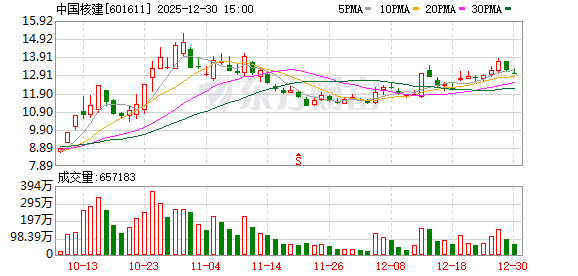
中国核建:公司将持续关注储能领域发展机遇
Zheng Quan Ri Bao· 2025-12-30 12:41
Core Viewpoint - The company is actively responding to the national "dual carbon" strategy and the requirements for the construction of a new power system by strategically investing in the energy storage sector [2] Group 1: Company Initiatives - The company has engaged in multiple engineering projects in the energy storage field, including the Xingan League Tuchuan Pingchuan Substation Energy Storage Project, Huadian Intelligent Energy Storage Project, and the Xingshan Energy Storage Power Station Demonstration Project [2] - The company has accumulated rich practical experience through its involvement in these projects, which positions it well for future opportunities in the energy storage sector [2] Group 2: Future Outlook - The company will continue to monitor development opportunities in the energy storage field and leverage its core engineering capabilities to expand its business scenarios [2] - The company aims to contribute to the transformation and upgrading of the energy structure through its ongoing efforts in the energy storage sector [2]


国内首个百万平米级油田多热源耦合供暖示范项目投用
Huan Qiu Wang· 2025-12-30 09:23
Core Viewpoint - The Hebei Renqiu Western New Town geothermal heating project is China's first million-square-meter oilfield characteristic multi-heat source coupling heating demonstration project, utilizing geothermal and oilfield waste heat resources for clean heating [1][2] Group 1: Project Overview - The total heating area of the Renqiu geothermal heating project is 2.69 million square meters, with an average indoor heating temperature above 22 degrees Celsius [1] - The project is expected to reduce carbon dioxide emissions by 70,000 tons annually, equivalent to the afforestation area of approximately 2,000 hectares [1] Group 2: Resource Utilization - The North China Oilfield is located in a region rich in geothermal resources, capable of meeting a heating area of 2 billion square meters [2] - The oilfield has developed a series of geothermal development technologies that do not consume water and ensure equal layer reinjection, enhancing the efficiency of energy conversion and utilization [2] Group 3: Strategic Alignment - The project aligns with China's "dual carbon" strategy, actively utilizing deep geothermal resources and exploring successful models for the development and utilization of oilfield waste heat resources [2] - The North China Oilfield has established multiple geothermal comprehensive utilization projects in the Beijing-Tianjin-Hebei region, contributing to regional green development [2]

新奥能源(02688.HK)成功发行首期6.08亿元碳中和绿色资产支持专项计划
Ge Long Hui· 2025-12-30 07:44
本次发行是新奥能源盘活绿色能源资产、拓宽融资渠道、优化融资结构的重要举措,亦将为公司泛能业 务的可持续发展提供有力支撑。底层资产涵盖七家子公司的分布式光伏发电项目及配套储能电站,通过 以项目公司股权为基础开展资产证券化,公司有效实现了资产盘活与融资结构优化。 本次类REITs以中信建投证券作为储架及首期产品的计划管理人及牵头主承,以华泰资管为储架的联席 管理人,首期产品获得了大型国有银行、头部股份制银行及基金公司等机构的积极认购。展望未来,新 奥能源将持续深化与金融机构的合作,充分利用储架发行机制,稳步推进后续各期发行,积极助力国 家"双碳"战略目标的实现,致力于成为"推动技术创新变革、引领绿色低碳实践、赋能行业智能化发 展、缔造安全品质服务典范"的先行企业。 (2025年12月30日,香港)新奥能源控股有限公司(以下简称"新奥能源")近日在深圳证券交易所成功 发行"新奥泛能1期碳中和绿色资产支持专项计划"。本期发行规模为6.08亿元,优先级资产支持证券票 面利率2.60%,获得最高"AAA"级信用评级,体现了市场对产品投资价值的高度认可。 本期专项计划属于"新奥泛能1-8期碳中和绿色资产支持专项计划"储架产 ...

中国SAF产业加速驶入全球航道
Zhong Guo Hua Gong Bao· 2025-12-30 07:38
Core Insights - The SAF production facility in Lianyungang, supported by Honeywell and Jiaao Environmental, has achieved large-scale production, processing 10,000 barrels daily, equating to an annual capacity of approximately 500,000 tons, marking a significant step towards commercial operation in China's SAF industry [1] - The project is seen as a pivotal element in the intersection of policy and market opportunities, reshaping China's green aviation energy landscape and positioning "Made in China" within the global green energy supply chain [1] Market Dynamics - The global aviation industry faces unprecedented carbon reduction pressures, with SAF being the most viable decarbonization pathway, potentially reducing lifecycle carbon emissions by up to 80% compared to traditional jet fuel [2] - In Europe, the demand for SAF is expected to surge due to regulatory drivers, with a projected consumption of 1.9 million tons by 2025, while domestic production capacity is only around 1 million tons, leading to a significant supply gap [2] - The International Air Transport Association forecasts that global SAF production could reach 2 million tons by 2025, representing only 0.7% of total fuel consumption, indicating substantial market potential [2] - The limited supply of SAF in the U.S. due to trade policies is shifting global buyers' focus towards Asia-Pacific production capabilities, presenting historic opportunities for Chinese SAF exports [2] Domestic Support and Infrastructure - China is establishing a comprehensive support system for the SAF industry, with top-level design and legal frameworks such as the Energy Law and Renewable Energy Law laying the groundwork for bio-liquid fuel development [3] - The People's Bank of China and other departments have included SAF in the 2025 Green Finance Support Project Directory, facilitating access to green loans and bonds to alleviate financing challenges [3] - Local governments are actively building industrial ecosystems, exemplified by Chengdu's establishment of a dedicated SAF industrial park and the introduction of supportive policies with over 100 million yuan investment planned over three years [3] Industry Growth Projections - The combination of policy and market forces is propelling the Chinese SAF industry into a rapid growth phase, with predictions of nearly tenfold market growth over the next five years, potentially reaching a market size in the trillions [4] Strategic Collaborations - The partnership between Honeywell and Jiaao Environmental aims to create a complete commercial loop from technology to product, utilizing Honeywell's Ecofining technology to efficiently convert waste oils into high-quality SAF [5] - Jiaao Environmental has established itself as a leader in SAF production with a designed capacity of 372,400 tons per year, leveraging its expertise in biomass energy [5] Market Expansion and Achievements - Jiaao Environmental has made significant strides in 2025, obtaining necessary approvals for domestic sales and becoming the first company on China's bio-jet fuel export list, exporting approximately 13,400 tons to Rotterdam [6] - Strategic investments from major players like BP and China National Aviation Fuel have solidified Jiaao's market position and distribution channels [6] Future Directions - The focus for the SAF industry will be on continuous cost reduction, with efforts to narrow the cost gap with traditional jet fuel through technological advancements and financial support [7] - Diversification of raw materials is essential to mitigate supply risks, with potential future developments in utilizing agricultural waste and synthetic fuels from green hydrogen and carbon dioxide [7] - Companies may explore advanced SAF production technologies and integrate carbon capture and utilization to develop "negative carbon" fuels as a future direction [7]


战略深耕与可持续引领 H&M荣膺年度行业领军企业
Cai Jing Wang· 2025-12-30 07:16
如果说战略深耕是H&M抢占市场的"矛",那么可持续发展就是其巩固行业地位的"盾"。作为将可持续 发展纳入核心战略的时尚企业,H&M的实践早已超越单一环保举措,形成覆盖供应链、技术创新、生 态共建的完整体系——这也是其斩获领军企业奖项的关键加分项。 在供应链脱碳领域,H&M的"绿色时尚倡议"已取得实质性成果:通过为中国10余家供应商提供低息贷 款与直接投资,每年可减少碳排放6.5万吨;参与绿色电力交易机制与绿电证书体系,加速供应链向可 再生能源转型。更具行业价值的是,其与上海电气(601727)合作的熔盐储能项目成功落地,为纺织行 业热能脱碳提供了突破性解决方案,并荣获上海市绿色低碳技术创新大赛大奖,实现了"商业价值+社 会价值"的双赢。技术创新与生态共建则彰显了其长期视野。H&M基金会通过"全球变革大奖",持续支 持中国纺织领域的早期创新,助力突破性技术实现规模化落地,这种"赋能产业链上游"的举措,不仅提 升了自身供应链的韧性,更推动了整个行业的技术升级。从2002年发布首份可持续发展报告,到如今形 成全链条可持续体系,H&M的实践为外资企业融入中国"双碳"战略提供了典范。 领军价值凸显:为行业提供"可复制的 ...
研判2025!中国中高压变频器行业结构、产业链、市场规模、竞争格局及未来前景分析:下游行业节能改造需求旺盛,带动中高压变频器规模达216亿元[图]
Chan Ye Xin Xi Wang· 2025-12-30 01:39
Core Insights - The core viewpoint of the article emphasizes the significant role of medium and high-voltage variable frequency drives (VFDs) in industrial production, driven by China's "dual carbon" strategy and policy support, leading to a stable growth in market demand [1][10]. Industry Overview - Medium and high-voltage VFDs are essential for adjusting motor speed and operational status to meet various process requirements, commonly used in fans, pumps, and compressors [1][6]. - The market size of China's medium and high-voltage VFD industry is projected to grow from 10.8 billion yuan in 2017 to 21.6 billion yuan in 2024, with a compound annual growth rate (CAGR) of 10.41% [1][11]. Industry Chain - The upstream of the medium and high-voltage VFD industry includes raw materials and components such as transformers, IGBTs, capacitors, and cooling systems [8]. - The downstream applications encompass sectors like electricity, petrochemicals, construction materials, coal, and metallurgy [8]. Market Demand and Growth - The demand for medium and high-voltage VFDs is significantly influenced by the need for energy conservation and emission reduction in high-energy-consuming industries, particularly under strict environmental regulations [1][10]. - The industrial power generation in China is expected to grow from 6,275.82 billion kWh in 2017 to 9,418.1 billion kWh in 2024, with a CAGR of 5.97% [9][10]. Competitive Landscape - The medium and high-voltage VFD industry in China features a diversified competitive landscape, with both international brands (like Schneider, ABB, Siemens) and domestic leaders (like Invt, Huichuan Technology, and HeKang New Energy) [11]. - Domestic companies are gaining market share by leveraging localized service responsiveness and competitive product pricing [11]. Key Companies - Invt Electric Co., Ltd. focuses on industrial automation and energy sectors, reporting a revenue of 1.153 billion yuan from VFDs in the first half of 2025, a year-on-year increase of 6.56% [12]. - Huichuan Technology Co., Ltd. provides automation solutions across various industries, with a revenue of 8.807 billion yuan from general automation in the first half of 2025, reflecting a year-on-year growth of 17.11% [13]. Development Trends - Future trends in the medium and high-voltage VFD industry include energy efficiency optimization and enhanced dynamic response capabilities through advanced semiconductor devices and control algorithms [14]. - The integration of VFDs into the industrial internet will enable full lifecycle digital management, enhancing operational efficiency and predictive maintenance [15]. - VFDs are expected to evolve into power conversion nodes with multi-energy interfaces, supporting renewable energy integration and smart grid functionalities [15].