
双碳目标

Search documents
天合光能ABS项目成功发行 光伏资产证券化实现突破
Zhong Guo Jin Rong Xin Xi Wang· 2026-02-03 07:32
当前光伏行业正经历转型期,天合光能等头部企业通过资产证券化实现资产盘活,为行业发展提供了新 范例。在行业层面,ABS产品还促进了光伏行业运营的规范化。由于ABS产品对基础资产的现金流稳定 性有较高要求,将推动光伏电站运营管理的标准化和精细化,从而提高全行业的运营水平。(吴琼) 转自:新华财经 当前,天合光能正积极推进"富家2.0"战略,加速构建与生态伙伴价值共创的新模式。此前,天合光能 在投资者关系平台表示,其2025年储能业务全年发货量预计超8GWh,且2026年预计发货量将达15- 16GWh,保持高速增长态势。在山东市场,天合光能已推出AI赋能的工商业微电网解决方案,并与山 东临邑达成虚拟电厂项目战略合作,协同打造"分布式能源+负荷调控"的政企合作范式。这些新业务场 景需要大量前期投入,ABS提供的资金将使天合光能更灵活地布局这些新兴领域。 中证鹏元结构融资部资深评级分析师孙晨表示,在"双碳"目标推动下,我国正持续优化绿色金融体系, 资产证券化市场也在向新能源领域扩展。这种扩展为行业提供了更多元化的融资渠道。 近日,"太保资产-天合富家新能源基础设施碳中和绿色持有型不动产资产支持专项计划(乡村振 兴)" ...

国网蒙东电力发布2025年社会责任报告
Xin Hua Cai Jing· 2026-02-03 07:18
Core Viewpoint - The report by State Grid Inner Mongolia East Power Co., Ltd. outlines key efforts and achievements in power supply assurance, grid construction, renewable energy consumption, optimization of the power business environment, and service to public welfare by 2025 [1] Group 1: Grid Quality Improvement - The company is advancing the construction of a new power grid platform to support the green transformation of the economy and society [2] - By 2025, the company plans to start 147 projects and put into operation 80 projects, significantly enhancing the resource optimization capacity of the grid [2] - The total external power delivery is expected to reach 2,277 billion kilowatt-hours by 2025, ranking among the top provincial grids in the country [2] Group 2: Support for Renewable Energy Development - The company is focused on achieving national carbon neutrality goals and supporting the construction of a clean energy region [3] - By the end of 2025, the installed capacity of renewable energy connected to the grid is projected to reach 35.86 million kilowatts, accounting for 60% of the total capacity [3] - New energy sources have become the primary power source for the grid, exceeding national targets for renewable energy consumption responsibility by 8.2 percentage points [3] Group 3: Integration into National Power Market - The company is implementing full market entry for renewable energy and has initiated trial operations for long-cycle continuous settlement in the spot market [4] - During the 14th Five-Year Plan period, the company completed green electricity transactions totaling 6.356 billion kilowatt-hours, promoting renewable energy consumption and carbon reduction [4] Group 4: Enhancement of Power Supply Service Quality - The company is committed to improving power supply reliability, particularly in rural areas, with an investment of 1.907 billion yuan in rural power networks by 2025 [5] - The company has implemented 20 measures to support the development of private enterprises and enhance customer service experiences [5] - The "Internet + Power Supply Service" model has registered 4.55 million users, improving the convenience of electricity access [5] Group 5: Addressing Public Welfare Issues - The company is investing 1.05 billion yuan in 2025 to complete various public welfare projects, benefiting 150,000 households [6] - The company is actively supporting the development of electric vehicles by ensuring power supply for 15,900 charging piles [6] - During peak summer periods, the company achieved historical highs in both internal and external power supply, reaching 8.62 million kilowatts and 4,174 million kilowatts, respectively [6]
填补空白,运达牵头两项国家标准正式发布
中国能源报· 2026-02-03 05:37
近日,由运达能源科技集团牵头修编的GB/T 3 15 19- 20 26《风能发电系统 台风型风 力发电机组》与牵头制定的GB/T 46784—202 5《海上风力发电机组环境监测系统技 术要求》两项国家标准正式发布,均由全国风力发电标准化技术委员会归口管理。两 项标准的发布将有力提升我国海上风电设备的抗台风设计水平与环境监测能力,破解 行业规范化发展瓶颈,为海上风电高质量发展奠定标准基础,对推动能源结构转型、 助力实现"双碳"目标具有重要意义。 升级抗台标准,筑牢安全防线 来源:运达能源科技集团 End 欢迎分享给你的朋友! 出品 | 中国能源报(c ne ne rgy) 广告 首发监测标准,装上"智慧之眼" 运达牵头制定的《海上风力发电机组环境监测系统技术要求》标准同步落地,填补了我 国海上风电环境监测领域的标准空白。该标准明确了环境监测系统的技术要求、配置准 则与性能评价体系,为系统研发、运营管理提供统一规范。 通过精准监测海洋盐雾、波浪载荷、极端风速等关键参数,这套"智慧之眼"可大幅提升 机组在恶劣海洋环境中的风险预警与抵御能力,为海上风电机组安全运行和全生命周期 稳定运营提供坚实的数据支撑与技术保障 ...


当前行情如何布局?紧握“政策+景气”双主线,规避这一外部风险
Sou Hu Cai Jing· 2026-02-03 04:42
Core Viewpoint - The A-share market shows a strong performance driven by high-end manufacturing and hard technology sectors, while the Hong Kong market exhibits a divergence with weak technology stocks, indicating a structural differentiation influenced by macroeconomic and policy factors [1][2][3]. Group 1: A-share Market Performance - Major A-share indices, except for the Sci-Tech 50, recorded gains, with the Shenzhen Component Index leading at +0.93% and a total trading volume of 1.604 trillion yuan [1]. - The top gainers in A-shares include sectors such as defense and military (+3.71%), machinery equipment (+2.58%), and power equipment (+2.15%), while traditional sectors like banking and oil & gas saw declines [1][2]. Group 2: Hong Kong Market Dynamics - The Hong Kong market displayed a mixed performance, with the Hang Seng Index nearly flat and the Hang Seng Tech Index dropping by 1.48%, highlighting a contrast with the A-share market [1]. - The weakness in Hong Kong's technology stocks is attributed to their offshore market nature, influenced by both domestic fundamentals and global liquidity expectations, particularly regarding the U.S. Federal Reserve's interest rate policies [3]. Group 3: Sector Insights - The rise of the defense and military sector is linked to increased geopolitical uncertainties and expectations for accelerated equipment procurement under the "14th Five-Year Plan," providing long-term visibility and certainty [2]. - The demand for new energy infrastructure under the "dual carbon" goals and recent government initiatives for large-scale equipment updates are expected to inject substantial growth into related industries [2]. Group 4: Market Outlook - The main investment themes in the A-share market remain intact, focusing on policy-driven and growth-oriented sectors like military, high-end manufacturing, and new energy [4]. - In the Hong Kong market, the valuation pressures on technology stocks are likely to persist until clearer overseas policy signals or stronger mainland economic data emerge to boost risk appetite [4].
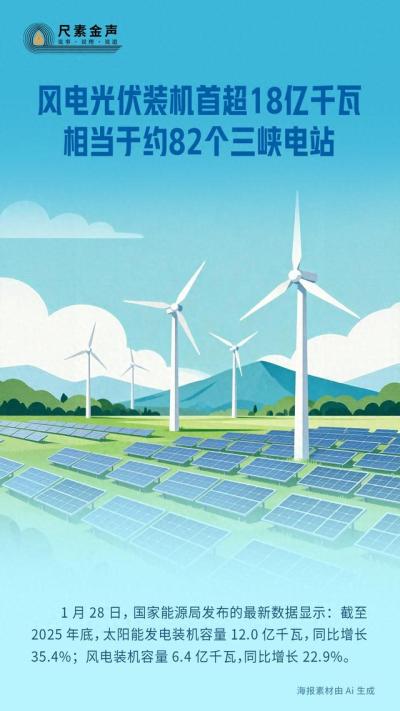
风电光伏装机首超18亿千瓦,相当于约82个三峡电站
Ren Min Ri Bao· 2026-02-03 03:47
1月28日,国家能源局发布的最新数据显示:截至2025年底,太阳能发电装机容量12.0亿千瓦,同比增 长35.4%;风电装机容量6.4亿千瓦,同比增长22.9%。 这是我国风电光伏累计装机首次超过18亿千瓦、达到18.4亿千瓦,相当于约82个三峡电站总装机,占比 达47.3%。 看技术进步,"十四五"时期,我国新能源等技术装备领跑全球,光伏转换效率、海上风电单机容量等不 断刷新世界纪录,技术创新和产品迭代推动成本快速下降。不仅如此,抽水蓄能、新型储能等调节存储 技术快速发展、特高压技术创新应用、智能微电网建设加快等,为破解新能源电力消纳瓶颈提供了支 撑。 看企业活力,我国新能源市场环境开放、经营主体多元、市场竞争充分,绝大多数的光伏设备制造企业 和60%以上的风电整机制造企业都是民营企业。 纵向比,我国风电光伏从2020年底的5.3亿千瓦增加到2025年底的18.4亿千瓦,风电光伏累计装机连续跨 越13个亿级台阶,2025年历史性超过火电装机。通过坚持集中式与分布式、陆上与海上并举,风电光伏 发展速度更快、电量占比更高,当前平均度电成本已比煤电低三成左右。 横向看,我国风电光伏装机规模均连续10余年稳居全球第 ...
临平为“中国绿港”装上“智慧大脑”
Hang Zhou Ri Bao· 2026-02-03 03:20
Core Insights - The "China Green Port" zero-carbon park construction and high-quality development conference was held in Linping, focusing on "zero carbon" and "industry" to create a new blueprint for green low-carbon development [1][2] - Linping's new energy equipment manufacturing industry cluster achieved an industrial output value of 36.658 billion yuan in the previous year, with a growth rate of 32.4%, accounting for over 40% of Hangzhou's total [1] Group 1 - The conference saw the establishment of several high-level empowerment platforms, including the "China Green Port" expert advisory committee and the Zhejiang Province "Three Meetings" specialized and innovative enterprise promotion center [1] - A smart energy and carbon management platform was launched, integrating IoT, big data, and AI algorithms for comprehensive visualization of energy consumption and carbon emissions across parks and key enterprises [1] Group 2 - Linping aims to push the green energy industry ecosystem's output value to 100 billion yuan by 2030, establishing itself as a new landmark in China's green energy industry [2] - The conference also introduced special support policies for the green energy sector, providing full lifecycle support for enterprises within the district [2] - The event serves as a mobilization for traditional industry transformation and upgrading, aligning with the national "dual carbon" goals [2]
化工行业2025年信用回顾与2026年展望
新世纪资信评估· 2026-02-03 02:35
Investment Rating - The chemical industry is rated as "Weak" and stable for 2025, with expectations of continued low economic prosperity and pressure on profitability [1]. Core Insights - The chemical industry is expected to remain in a low prosperity phase in 2025, with most raw material and product prices at historical lows. The decline in oil, coal, and gas prices has eased raw material cost pressures for chemical companies, but has weakened support for product prices [1][7]. - The overall profitability of the chemical industry is under pressure, with different segments experiencing varying levels of impact. The supply side shows a slowdown in fixed asset investment, while certain petrochemical raw materials like ethylene and propylene are expected to see significant new capacity released [1][4]. - Demand from downstream sectors is expected to remain weak, with notable differences across industries. Real estate demand continues to be sluggish, while automotive production is growing rapidly, and the demand for chemical raw materials in the new energy and new materials sectors remains high [1][27][32]. Summary by Sections Industry Overview - The chemical industry is categorized into basic chemicals and fine chemicals, with basic chemicals including acids, alkalis, and plastics, while fine chemicals encompass pesticides, fuels, and specialty chemicals [6]. Supply and Demand Dynamics - The supply of basic chemical raw materials is expected to grow moderately, while demand is anticipated to improve slightly. However, issues of overcapacity and homogenized competition are expected to persist in the short term [4][18]. - Fixed asset investment in the chemical industry has shown a general slowdown, with significant growth in the petrochemical and chemical fiber sectors, while investment in chemical raw materials and products has decreased [20][21]. Financial Performance - In the first three quarters of 2025, the overall operating income of sample companies in the chemical sector showed a slight decline, with profitability remaining at historical lows. However, cash flow from operations has improved [2][3]. - The credit quality of the chemical industry has weakened, with a concentration of credit ratings in the AAA and AA+ categories. The financing environment is stable, with a focus on leading companies [3][4]. Price Trends - The CCPI index for chemical products has shown a downward trend, with an average decline of 12.69% compared to 2023. Prices for many chemical products have reached historical lows due to weak demand and oversupply [9][17]. Sector-Specific Insights - In the agricultural chemicals sector, prices for key products like urea and glyphosate have fluctuated, influenced by global price trends and domestic demand [31]. - The new energy sector continues to drive demand for chemical raw materials, with significant growth in lithium battery production and renewable energy installations [32]. Future Outlook - The chemical industry is expected to face challenges in 2026, including continued overcapacity and competition issues. However, the fine chemicals sector is projected to develop towards high-end, green, and intelligent growth [4][5].
华电科工2025年新签合同额突破300亿元
Bei Jing Ri Bao Ke Hu Duan· 2026-02-03 02:31
Core Insights - China Huadian Engineering Co., Ltd. (华电科工) achieved record-high operational metrics in 2025, with new contract value exceeding 30 billion yuan and revenue growth of 11.78% year-on-year [1][3] - The company was recognized with dual A-level ratings in production and operational assessments by China Huadian Group and was named a national civilized unit, highlighting its commitment to innovation and quality [1][3] Group 1 - The company has established a modern industrial system characterized by distinctive scientific and technological features, optimizing its industrial structure [3] - The implementation of the "2345" development strategy has enhanced core functions and competitiveness, contributing to high-quality development in the energy transition era [3][8] - The company aims to become a century-old enterprise and accelerate the construction of a world-class technology innovation platform [4] Group 2 - Huadian Engineering has developed high-level research platforms, including a robot full-weight division and an efficient clean intelligent power generation research institute, undertaking over 20 key national and provincial R&D tasks [6] - Strategic emerging industries such as hydrogen energy, energy storage, and biomass energy have rapidly developed, with revenue from these sectors exceeding 50% [6] - The company has deepened "Belt and Road" capacity cooperation, achieving an overseas installed capacity of 2.076 million kilowatts, with international business revenue increasing annually [6] Group 3 - In 2026, the company plans to cultivate new productive forces, focusing on reform and innovation as fundamental drivers, while ensuring the safety and development of the energy sector [8] - The company aims to contribute significantly to national energy security, the achievement of carbon neutrality goals, and the service of China's modernization efforts [8]

在建最大钠离子电池储能站竣工验收
Zhong Guo Hua Gong Bao· 2026-02-03 02:29
Core Viewpoint - China Electric Power Construction (China Electric Power) has completed the acceptance of the first phase of the largest sodium-ion battery energy storage station under construction in China, located in Honghu City, Hubei Province, with a capacity of 100 megawatts and 200 megawatt-hours [1] Group 1: Project Details - The project is the largest sodium-ion battery energy storage station under construction in China, with a total capacity of 100 megawatts and 200 megawatt-hours [1] - The first phase of the project is configured with an energy storage capacity of 50 megawatts and 100 megawatt-hours, including the construction of a 50-megawatt 110 kV booster station and a 110 kV line to the 110 kV Maojiang Substation [1] Group 2: Industry Impact - Once fully operational, the project will become one of the largest sodium-ion energy storage stations in the country, significantly promoting the development of regional sodium-ion storage and new power systems [1] - The project is expected to contribute positively to the growth of the local new energy industry cluster and support the region in achieving its "dual carbon" goals and economic development [1]

筑牢电源规模化 发展根基
Zhong Guo Dian Li Bao· 2026-02-03 01:24
Core Viewpoint - The recent policy notification establishes a reliable capacity compensation mechanism, addressing the need for stable revenue channels for various power sources, which is crucial for energy security and achieving carbon neutrality goals in China [1][2]. Group 1: Policy Overview - The notification introduces a three-phase development plan for capacity pricing in China's power generation sector: government pricing, capacity compensation, and capacity market [2]. - The new policy aims to optimize existing capacity pricing for coal, gas, and pumped storage while establishing a unified capacity pricing standard for new energy storage [2][3]. Group 2: New Energy Storage - New energy storage is positioned as the biggest beneficiary of the capacity mechanism, with its capacity pricing linked to peak load support capabilities [3][4]. - The policy clarifies that independent new energy storage systems not participating in grid storage can receive capacity price support, marking a significant recognition of their value [3][4]. Group 3: Pumped Storage - The policy provides a transitional arrangement for pumped storage, allowing for differentiated treatment based on project timelines and investment characteristics [5][6]. - It ensures that existing projects under previous pricing mechanisms can continue to receive reasonable returns, while new projects will have their capacity prices set based on average costs over 3-5 years [5][6]. Group 4: Market Integration - The notification addresses the need for uniform standards in charging and discharging prices for energy storage, promoting a more coherent market structure [7][8]. - It emphasizes the importance of regional collaboration in shared pumped storage projects, establishing clear guidelines for capacity cost sharing among provinces [8]. Group 5: Economic Viability - The policy supports the economic viability of new energy storage by linking capacity pricing to actual contributions to peak load support, thus enhancing revenue predictability [4][5]. - The investment cost for new energy storage systems has significantly decreased, making them commercially viable under the new capacity pricing framework [4].