
碳达峰

Search documents
2025年中国LNG油改气行业政策、产业链全景、发展现状及未来发展趋势研判:重卡主导需求韧性凸显,细分市场潜力持续释放[图]
Chan Ye Xin Xi Wang· 2025-10-14 00:37
Core Viewpoint - LNG oil-to-gas conversion is a significant direction for clean energy transition, utilizing the low-temperature liquid characteristics of LNG for efficient storage and transportation, while significantly reducing pollutant emissions and fuel costs [1][2] Industry Overview - LNG oil-to-gas conversion refers to the process of retrofitting traditional fuel-driven vehicles to use liquefied natural gas (LNG) as the primary fuel, leveraging LNG's low-temperature liquid properties for efficient storage and combustion [2][3] - Compared to traditional fuels, LNG combustion results in a significant reduction in emissions, with nitrogen oxides reduced by 85% and particulate matter by 95%, while fuel costs can decrease by 30%-55% [2] Policy Analysis - China has implemented multiple top-level policies, such as the "2030 Carbon Peak Action Plan," to support the LNG oil-to-gas industry, focusing on energy structure optimization and infrastructure improvement [5][6] - Local policies, like the LNG refueling station layout plan in Hunan Province, aim to address refueling bottlenecks and enhance user confidence in LNG vehicles [5] Industry Chain - The LNG oil-to-gas industry chain consists of upstream gas source development, midstream storage and transportation infrastructure, and downstream application expansion [6] - Upstream includes natural gas extraction and importation, while midstream focuses on vehicle retrofitting and LNG refueling infrastructure [6] Current Development Status - China's energy structure shows a "rich coal, poor oil, and scarce gas" characteristic, leading to a growing supply-demand gap for natural gas [7] - LNG demand has rapidly increased due to policies promoting "coal-to-gas" and "oil-to-gas" transitions, with LNG's superior peak-shaving capabilities making it a key transitional energy source [7][8] Market Performance - The LNG oil-to-gas market is projected to grow significantly, with an estimated market size of approximately 760 billion yuan in 2024, expected to reach around 900 billion yuan by 2025 [9] - The number of LNG refueling stations is anticipated to exceed 7,000 by 2025, enhancing the refueling network across the country [8][9] Future Trends - The industry is expected to evolve towards three main trends: intelligent upgrades across the entire chain, low-carbon and hydrogen energy integration, and regional market differentiation alongside global resource integration [10][11][12] - Intelligent upgrades will enhance efficiency and safety through advanced technologies like IoT and AI, while low-carbon initiatives will focus on integrating LNG with renewable energy sources [10][11] - The market will see a differentiated layout domestically, with high-density LNG refueling networks in key regions, and internationally, Chinese companies will expand their global LNG resource footprint [12]




山东港口获超2.4万张“绿证”,预计可核减约12477吨碳排
Qi Lu Wan Bao Wang· 2025-10-13 07:33
Core Insights - Shandong Port has achieved a significant milestone in the green energy sector by obtaining 24,954 renewable energy green power certificates (green certificates) from the National Energy Administration, which is expected to reduce carbon emissions by approximately 12,477 tons [1][2] - Each green certificate corresponds to 1,000 kilowatt-hours of green electricity, enabling the consumption of 24.954 million kilowatt-hours of green electricity, equivalent to replacing the transport capacity of 5 million tons of trucks [1][2] Group 1 - The acquisition of green certificates marks the first such honor for Beijing Lugang Company, contributing to the construction of a green port and the implementation of the "carbon peak and carbon neutrality" strategy [1][3] - Green certificates serve as the official proof of renewable energy consumption, empowering enterprises to fulfill their environmental responsibilities and enhance their green brand image, thus creating a competitive advantage in the market [2] - The green certificates facilitate international trade by meeting the increasing green procurement demands of global supply chains, acting as a "hard pass" for enterprises to integrate into the global green industry chain [2] Group 2 - The successful certification reflects the internal collaboration and resource integration within Beijing Lugang Company and its partnership with Shandong Port Bohai Bay Port Group, demonstrating a unified effort towards green transformation [3] - Looking ahead, Beijing Lugang Company aims to further invest in renewable energy sectors such as wind and solar power, optimizing the energy consumption structure of the port and contributing to the national "dual carbon" goals [3] - The company intends to explore replicable and scalable green development pathways, striving to provide a "Shanport model" for the clean energy transition in the national port sector [3]

哈尔滨银行发布碳减排贷款信息披露(2025年第二季度)
Jin Tou Wang· 2025-10-13 02:38
Core Viewpoint - Harbin Bank has issued carbon reduction loans supported by the People's Bank of China, contributing to carbon neutrality goals through financing clean energy and environmental protection projects [1] Summary by Categories Carbon Reduction Loans - Harbin Bank has issued a total of 14.2 million yuan in carbon reduction loans to one project, with an interest rate of 3.95% [1] - The annual carbon reduction achieved through these loans is 5,149.24 tons of CO2 equivalent [1] Project Focus - The carbon reduction loans are specifically allocated to key areas such as clean energy, energy conservation, environmental protection, and carbon reduction technologies [1] Commitment to Green Development - Harbin Bank will continue to play an active role in supporting green and low-carbon development, in accordance with regulations from the People's Bank of China, and will regularly disclose information related to carbon reduction loans [1]
构建建材央企ESG评价体系:绿色建材、碳约束、产品质量是重中之重
Shenwan Hongyuan Securities· 2025-10-13 02:13
Investment Rating - The report gives an "Overweight" rating for the construction materials industry, indicating a positive outlook for the sector's performance relative to the overall market [30]. Core Insights - The construction materials industry is increasingly focused on ESG (Environmental, Social, and Governance) criteria, with a particular emphasis on green materials and carbon constraints. This report is part of a series aimed at developing an ESG evaluation system for state-owned enterprises in the construction materials sector [3][8]. - Recent policies have heightened the requirements for low-carbon, green, and environmentally responsible practices within the construction materials industry, leading to the establishment of industry standards and guidelines [3][9]. - The report outlines a comprehensive ESG evaluation framework that includes specific indicators tailored to the construction materials sector, emphasizing the importance of product quality and green materials [3][13]. Summary by Sections 1. ESG Policies for Construction Materials State-Owned Enterprises - The construction materials industry is a critical component of the national economy, with increasing policy demands for low-carbon and green practices. Recent initiatives include the establishment of a certification framework for green materials and the promotion of sustainable development practices [9][10]. - Key policies include the introduction of green material product certifications and the promotion of carbon peak strategies, with significant milestones set for 2025 [9][10]. 2. Construction Materials ESG Evaluation System - The ESG evaluation system for state-owned enterprises in the construction materials sector incorporates additional indicators such as "green materials" and "product quality," reflecting the industry's substantial carbon emissions [13][23]. - The evaluation framework consists of five categories of positive indicators and one category of negative indicators, with a total of 18 primary indicators and 51 secondary indicators [13][23]. - Specific areas of focus include importance assessment, environmental impact, climate change response, social responsibility, and corporate governance, each with defined scoring metrics [13][23][24]. 3. Detailed Indicator Breakdown - **Importance Assessment**: This is a core component of the evaluation, emphasizing the assessment process for significant issues, with a total score of 9 points available [14][25]. - **Environmental Indicators**: These are aligned with green development principles, including a new indicator for "green materials," with a total score of 17 points [15][17]. - **Climate Change Response**: This section includes 4 primary indicators and 18 secondary indicators, with a total score of 18 points, focusing on climate governance and management [18][19]. - **Social Responsibility**: This includes a new indicator for "quality responsibility," with a total score of 22 points, reflecting the industry's commitment to product safety and quality [20][21]. - **Governance Indicators**: These emphasize the importance of governance mechanisms, with a total score of 34 points available [23][24]. 4. Conclusion - The report highlights the growing importance of ESG practices in the construction materials industry, driven by regulatory requirements and market expectations. The establishment of a robust ESG evaluation framework is expected to enhance the industry's sustainability and competitiveness [3][12].
数据申报!2025中国企业碳中和贡献力研究报告
中国能源报· 2025-10-11 10:57
Core Viewpoint - The article emphasizes the importance of Chinese enterprises in achieving carbon neutrality and peak carbon emissions, highlighting their role as both the main contributors to carbon emissions and the key players in realizing carbon neutrality goals [3][4]. Group 1: Background and Report Overview - The "China Enterprise Carbon Neutral Contribution Research Report" is the first authoritative, impartial, and public interest report on the carbon neutrality contributions of enterprises in China, marking its fifth consecutive year of publication [3]. - The report evaluates the carbon neutrality contributions of Chinese enterprises in a systematic, objective, and multi-dimensional manner, providing guidance for more enterprises in their carbon peak and neutrality efforts [4]. Group 2: Call for Participation - The collection of materials for the "2025 China Enterprise Carbon Neutral Contribution Research Report" has officially begun, inviting Chinese enterprises to submit relevant materials [4][16]. - The submission criteria include indicators such as carbon peak/carbon neutrality timelines, carbon emissions across the economy, carbon intensity, carbon footprint of main products, and green investment amounts [4]. Group 3: Timeline and Previous Reports - The collection period for submissions is from now until November 21, 2025, with the report scheduled for release on December 4, 2025, during the "8th China Energy Industry Development Annual Conference" [4]. - Previous reports, such as the 2024 and 2023 editions, aimed to provide benchmarks and encourage enterprises to enhance their carbon neutrality efforts [7][8].

2026-2032年中国光伏智慧运维市场研究与前景趋势报告
Sou Hu Cai Jing· 2025-10-11 07:47
中国产业研究报告网发布的《2026-2032年中国光伏智慧运维市场研究与前景趋势报告》报告中的资料和数据来源于对行业公开信息的分析、对业内资深人 士和相关企业高管的深度访谈,以及共研分析师综合以上内容作出的专业性判断和评价。分析内容中运用共研自主建立的产业分析模型,并结合市场分析、 行业分析和厂商分析,能够反映当前市场现状,趋势和规律,是企业布局煤炭综采设备后市场服务行业的重要决策参考依据。 报告目录: 第1章:光伏智慧运维行业综述及数据来源说明 1.4本报告研究范围界定说明 1.5本报告数据来源及统计标准说明 3.7全球光伏智慧运维行业发展经验借鉴 第4章:中国光伏智慧运维行业产品进出口贸易状况及对外贸易依存度 4.1全球及中国光伏智慧运维行业产品发展差异分析 4.2中国光伏智慧运维行业产品进出口贸易整体状况 4.3中国光伏智慧运维行业产品进口贸易状况 4.3.1中国光伏智慧运维行业产品进口规模 4.3.2中国光伏智慧运维行业产品进口价格水平 4.3.3中国光伏智慧运维行业产品进口产品结构 4.3.4中国光伏智慧运维行业产品进口来源地 4.4中国光伏智慧运维行业产品出口贸易状况 4.4.1中国光伏智慧运维行 ...

数据申报!2025中国企业碳中和贡献力50强
中国能源报· 2025-10-10 05:07
征集启动 中国企业碳中和贡献力 时间安排 征集日期:即日起至2025年11月21日 报告发布:2025年12月4日,在人民日报社举行的"第八届中国能源产业发展年会"发布。 附件下载 扫码下载相关申报表 历届发布 中国企业碳中和贡献力 2024中国企业碳中和贡献力研究报告暨50强榜单发布 背景介绍 实现碳达峰碳中和 是一场广泛而深刻的经济社会系统性变革 在实现"双碳"目标的过程中 企业既是碳排放的主体 也是落实碳中和目标的主人公 积极稳妥推进碳达峰碳中和工作 加快培育新质生产力 以新优势引领企业低碳转型升级 将成为企业"双碳"管理核心 关于报告 《中国企业碳中和贡献力研究报告》 是国内首份具权威性、公正性、公益性的 企业碳中和贡献力旗舰报告 今年是连续第五年编写 报告系统、客观、多维度地 评价中国企业碳中和贡献力 并基于企业实践为更多企业 在碳达峰碳中和工作方向上提供指引 对引领绿色低碳可持续发展 具有重要参考价值 为继续主动服务国家"双碳"大局 积极引导企业低碳转型 现面向社会企业 正式启动 《2025中国企业碳中和贡献力研究报告》 征集工作 征集标准 征集范围:中国企业 参考指标:碳达峰/碳中和时间表、路线 ...

振奋人心的2035气候目标:开启中国新能源“新黄金十年”
Sou Hu Cai Jing· 2025-10-10 03:01
Core Points - China has set ambitious new climate goals, aiming for a 7%-10% reduction in greenhouse gas emissions from peak levels by 2035, alongside significant increases in renewable energy capacity [3][4][5] - The new targets reflect a shift from focusing solely on carbon dioxide to encompassing all greenhouse gases, indicating a broader commitment to climate responsibility [4][6] - The renewable energy sector is expected to experience a "new golden decade" of growth, driven by these ambitious targets, particularly in wind and solar energy [3][10] Group 1: Emission Reduction Goals - By 2035, China aims for a 7%-10% reduction in greenhouse gas emissions compared to peak levels, translating to a reduction of approximately 10.8 to 14.4 million tons of CO2 [5][6] - The peak CO2 emissions are estimated to be around 14.4 billion tons, based on industry predictions [5][6] Group 2: Renewable Energy Capacity - The target for wind and solar power capacity is set to exceed six times the 2020 levels, aiming for a total of 360 million kilowatts by 2035 [3][7] - As of now, China's renewable energy capacity has already surpassed 170 million kilowatts, indicating a strong growth trend that may lead to exceeding the 2035 target [7][8] Group 3: Non-Fossil Energy Consumption - By 2035, non-fossil energy consumption is expected to account for over 30% of total energy consumption, up from 15.9% in 2020 [11][13] - The new target represents a significant acceleration in the transition to non-fossil energy sources, requiring a yearly increase of 1 percentage point post-2030 [11][13] Group 4: Industry Implications - The ambitious targets are seen as a strong signal to the renewable energy sector, providing confidence and clarity for future investments and developments [10][11] - The government is expected to implement more robust policies and reforms to address the challenges faced by the renewable energy industry, ensuring sustainable growth [13]


天和磁材拟投资9亿建设高性能稀土永磁相关项目
Zheng Quan Shi Bao· 2025-10-09 18:10
Core Viewpoint - Tianhe Magnetic Materials (603072) announced plans to invest 850 million yuan in a high-performance rare earth permanent magnet and component manufacturing and R&D project, with a total investment of 900 million yuan, aimed at enhancing production capacity in response to growing market demand for rare earth materials [2][3]. Group 1: Investment Projects - Tianhe New Materials will invest 850 million yuan in a high-performance rare earth permanent magnet project, which will be completed in two phases, with the first phase requiring 210 million yuan and an 18-month construction period [2]. - Tianhe intends to invest up to 50 million yuan in the manufacturing and R&D of high-performance rare earth permanent magnet production equipment, which will help expand its business scale and improve profitability [3][4]. Group 2: Market Demand and Industry Growth - The demand for high-performance rare earth permanent magnets is increasing due to the growth of emerging industries such as new energy vehicles, wind power generation, and energy-efficient appliances, driven by China's carbon peak and carbon neutrality goals [2][4]. - China's rare earth permanent magnet industry has experienced rapid growth, with the country becoming the largest producer and exporter of neodymium-iron-boron permanent magnets globally [2][3]. Group 3: Production Capacity and Future Outlook - As of the end of 2024, the company has achieved an annual production capacity of 9,300 tons of high-performance rare earth permanent magnets, with plans to increase this to 12,300 tons by the end of 2025 [4]. - The construction of the new projects will enhance the company's production capacity and allow it to meet the growing orders in various sectors, including new energy vehicles and consumer electronics [4][5].
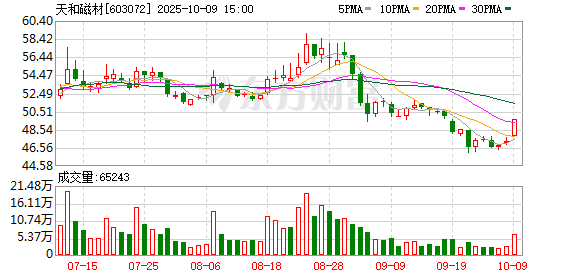
天和磁材拟投资9亿元 建设高性能稀土永磁相关项目
Zheng Quan Shi Bao Wang· 2025-10-09 13:08
Core Viewpoint - Tianhe Magnetic Materials plans to invest 850 million yuan in high-performance rare earth permanent magnet and component manufacturing and R&D projects, with a total investment of 900 million yuan expected [1] Group 1: Investment Projects - Tianhe New Materials will invest 850 million yuan in a high-performance rare earth permanent magnet project, which will be completed in two phases, with the first phase costing 210 million yuan and taking 18 months [1] - Tianhe plans to invest up to 50 million yuan in high-performance rare earth permanent magnet production equipment manufacturing and R&D [2] Group 2: Market Demand and Industry Growth - The demand for high-performance rare earth permanent magnet materials is increasing due to their applications in electric vehicles, home appliances, wind power, industrial robots, and consumer electronics [1][2] - China's rare earth permanent magnet industry has experienced rapid growth, with the country becoming the largest producer and exporter of neodymium-iron-boron permanent magnet materials [1][2] Group 3: Production Capacity and Future Outlook - As of the end of 2024, the company has an annual production capacity of 9,300 tons of high-performance rare earth permanent magnet materials, with plans to increase this to 12,300 tons by the end of 2025 [3] - The construction of the new projects will enhance the company's production capacity and expand its market presence, thereby improving profitability [3] Group 4: Regulatory Environment - The implementation of export controls on certain rare earth materials by the Ministry of Commerce and the General Administration of Customs may impact the company's sales and delivery timelines [4] - The company has established a compliance management system in response to the export control policies and is actively applying for necessary export licenses [4]