国产GPU

Search documents
摩尔线程完成上市辅导,国产 GPU 第一股呼之欲出
是说芯语· 2025-06-19 06:37
Core Viewpoint - The progress of Moer Thread's IPO counseling status to "counseling acceptance" indicates a significant step towards its potential listing, marking a milestone for the domestic GPU chip industry in China [1][3]. Company Overview - Moer Thread, founded in 2020 by former NVIDIA executive Zhang Jianzhong, focuses on developing domestic full-function GPU chips aimed at providing computing power for AI training, graphics rendering, and scientific computing [1][2]. - The company has completed six rounds of financing, raising over 4.5 billion yuan, with investments from over 40 notable institutions including Sequoia China, Tencent, and ByteDance [1]. Product Development - Moer Thread's self-developed GPU chip utilizes the MUSA architecture, integrating four major engines: AI computing acceleration, graphics rendering, video encoding/decoding, and physical simulation, showcasing strong competitiveness [2]. - In December 2023, the company launched the fully domestic thousand-card billion model training platform, Moer Thread KUAE, highlighting its capabilities in large model training [2]. - The MTT S4000 computing card successfully passed evaluation by the China Academy of Information and Communications Technology, enhancing its market recognition [2]. Market Reaction - Following the news of Moer Thread's IPO progress, shares of its affiliated company, Heertai, surged nearly 7%, positively impacting related concept stocks [2]. - Analysts believe that if Moer Thread successfully lists, it could leverage capital market resources to expand production capacity and increase R&D investment, thereby enhancing market share [2]. Competitive Landscape - The domestic GPU market is experiencing rapid growth due to explosive AI computing demand and supportive policies for domestic alternatives, but it also faces intense competition from companies like Cambricon and Birun Technology [3]. - Despite Moer Thread's technological advancements, it still lags behind international giants like NVIDIA in terms of technology maturity and market share, posing a significant challenge for profitability post-IPO [3]. Industry Significance - The completion of Moer Thread's IPO counseling is a crucial milestone for the domestic GPU industry, with implications for both the company and the broader domestic computing chip sector [3].


昇腾910系列全年出货量下调
是说芯语· 2025-06-12 00:38
Core Viewpoint - The article discusses the growing interest and procurement plans for domestic GPUs, particularly Huawei's Ascend series, in light of increasing restrictions on GPU imports from the U.S. [1] Domestic GPU Procurement Situation - ByteDance is the most proactive in adopting domestic GPUs, primarily using Cambrian and Ascend, with plans to increase procurement in 2025 [2] - Alibaba is more cautious, planning to purchase Haiguang and Cambrian cards in 2025 while continuing to stockpile NVIDIA products [3] - Tencent is the most conservative, preferring NVIDIA products, followed by H company's offerings, and only considering Cambrian and Haiguang as alternatives [3][4] Ascend 910 Series Latest Situation - As of early June, the Ascend 910B has shipped approximately 160,000 units, while the 910C has only shipped about 27,000 units due to production delays [5] - The 910C has received positive feedback for its cluster capabilities but still lags behind NVIDIA in performance [5][6] - The annual shipment target for the Ascend series has been adjusted from 850,000 to around 700,000 units due to demand fluctuations and market conditions [6] Application Scenarios and Challenges - Approximately 15% to 20% of Ascend cards are used for model training, with the majority for inference tasks [6] - High costs and technical challenges limit the widespread use of Ascend cards in high-end training applications [6][8] - The development of multi-modal models is driving higher hardware standards, with domestic manufacturers striving to catch up with international brands [7] Custom Development and Market Outlook - Collaborating with Ascend for customized development offers cost advantages but requires significant human resources for adaptation [8] - The domestic chip industry is expected to expand its market share as technology advances and market demands evolve [8]
昇腾910系列全年出货量下调
傅里叶的猫· 2025-06-11 11:31
Core Viewpoint - The article discusses the increasing interest in domestic GPUs, particularly Huawei's Ascend series, amid growing restrictions on GPUs from the U.S. and highlights the performance and shipment trends of these products [1]. Group 1: Domestic GPU Procurement Situation - Major Chinese tech companies are adjusting their capital expenditures for cloud and AI hardware, with ByteDance planning to invest 160 billion by 2025, Alibaba 380 billion over three years, and Tencent 90 billion by 2025 [2]. - ByteDance is actively adopting Cambricon and Ascend GPUs, planning to increase procurement of these brands by 2025 [2]. - Alibaba is cautious, using its self-developed chips alongside some Ascend cards, but plans to procure Haiguang and Cambricon cards by 2025 while continuing to stock NVIDIA products [2]. - Tencent remains conservative, preferring NVIDIA products, followed by H company's offerings, and is also considering Cambricon and Haiguang [2]. Group 2: Ascend 910 Series Latest Situation - As of early June, the Ascend 910B has shipped approximately 160,000 units, while the 910C, despite better performance, has only shipped around 27,000 units due to production delays [3][6]. - The 910C has received positive feedback for its cluster capabilities but still lags behind NVIDIA products [3]. - The demand for the 910C among major internet companies is fluctuating, influenced by a shortage of training cards and the gradual replacement by Alibaba's self-developed chips [6]. Group 3: Market Dynamics and Challenges - The annual shipment target for the Ascend series has been revised down from 850,000 to around 700,000 units due to demand adjustments [6]. - Approximately 15% to 20% of Ascend cards are used for model training, with the rest primarily for inference tasks, facing challenges in cost and technology for high-end training applications [6]. - The development of multi-modal models is driving higher hardware standards, with domestic chip manufacturers striving to close the gap with international brands [7][8]. - Collaborating with Ascend for customized development offers cost advantages but requires significant human resources for adaptation, increasing time and technical challenges [8].
中电信息以4.84亿挂牌转让GPU企业中微电32.5%股权
Ju Chao Zi Xun· 2025-05-17 03:46
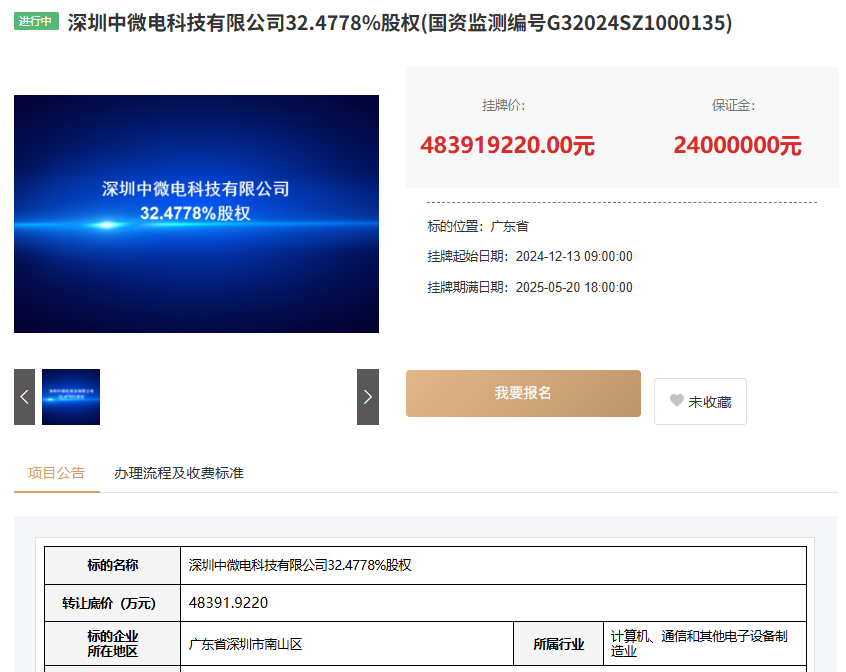
Group 1 - The core point of the news is the transfer of 32.4778% equity of Shenzhen Zhongwei Electric Technology Co., Ltd. by a state-owned shareholder at a base price of 484 million yuan, reflecting a company valuation of only 1.49 billion yuan, which is notably low in the current GPU market context [1][2] - Zhongwei Electric, as a key player in GPU research and development under the China Electronics Corporation, has achieved milestones such as the successful launch and mass production of its first high-performance desktop GPU "Nanfeng No. 1" in 2022 and the completion of core IP development for "Nanfeng No. 2" in 2024 [2] - Despite these achievements, the company has faced ongoing operational losses, reporting revenue of 55.21 million yuan in 2023 with a loss of 89.05 million yuan, and a loss of 38.54 million yuan in the first ten months of 2024 [2] Group 2 - The equity transfer by China Electronics International Information Service Co., Ltd. reflects the challenges faced in GPU research and development, including the need for substantial ongoing investment and intense market competition dominated by international giants [2] - The ownership structure of Zhongwei Electric includes investments from notable firms such as Sequoia Capital and Lihua Venture Capital, raising questions about how this equity change will impact the company's future and whether new strategic investors can be found [3] - The ongoing development of the information technology industry highlights the necessity for domestic chip companies to balance technological breakthroughs with commercial sustainability [3]
国产GPU的性能PK
傅里叶的猫· 2025-05-08 14:11
Core Viewpoint - The article discusses the performance of domestic GPUs, highlighting the competitive landscape and the impact of sanctions on production capabilities. It emphasizes that while the BR100 from Birun is the most powerful, it cannot be mass-produced due to sanctions, leaving Huawei's 910C as the strongest available option [1][2]. Performance Comparison - The performance ranking of GPUs indicates that the Huawei 910C leads, followed by the Haiguang BW100, with the latter achieving approximately 87% of its potential performance. The Cambrian 590's performance is uncertain, potentially reaching 80% [2]. - The Haiguang BW100 has a deep computing capability of over 400T, which is about 50% of the H800's performance, while the 910C reaches approximately 60% of the H800's performance [1][2]. Memory and Bandwidth - Most domestic GPUs utilize HBM2e memory due to sanctions preventing the use of HBM3e. Sufficient memory is crucial for initiating inference tasks, as insufficient memory can hinder model startup [3]. - Huawei leads significantly in memory bandwidth, which is a critical factor for performance [4]. Pricing Insights - Current market prices for GPUs are as follows: Haiguang BW100 at approximately 100,000 yuan, Huawei 910B at around 70,000 yuan, and 910C at about 180,000 yuan. The Cambrian 590 has seen a price drop from 80,000-85,000 yuan to between 60,000-70,000 yuan [2]. Technical Specifications - A table summarizes key specifications of various GPUs, including memory type, bandwidth, capacity, and arithmetic intensity. For instance, the Huawei 910C features HBM2e with a bandwidth of 3.2 TB/s and a memory capacity of 64 GB [5].