
再军事化

Search documents
日方提出交涉,中国大使驳回:将按既定步骤推进!高市早苗遭在野党批评
Mei Ri Jing Ji Xin Wen· 2026-01-08 22:46
Group 1 - The Chinese government has strengthened export controls on dual-use items to Japan, citing national security and international obligations as the primary reasons for this decision [1][3][5] - The announcement prohibits all dual-use items from being exported to Japanese military users and any entities that could enhance Japan's military capabilities [3][5] - The Chinese Ministry of Commerce emphasized that this measure is a legitimate response to Japan's recent military policy shifts and statements from Prime Minister Fumio Kishida, which are perceived as threats to China's sovereignty [5][6] Group 2 - Japan's opposition parties have criticized Kishida's administration, labeling it as the most dangerous since World War II due to its militaristic tendencies and increased defense spending [6][10] - The Japanese government is planning to revise its "Security Three Documents," which includes increasing defense budgets and modifying its "Three Non-Nuclear Principles" [10][12] - Discussions are underway to establish a framework for Japan to provide military equipment and technology to other countries, indicating a shift towards a more proactive military stance [12][14]

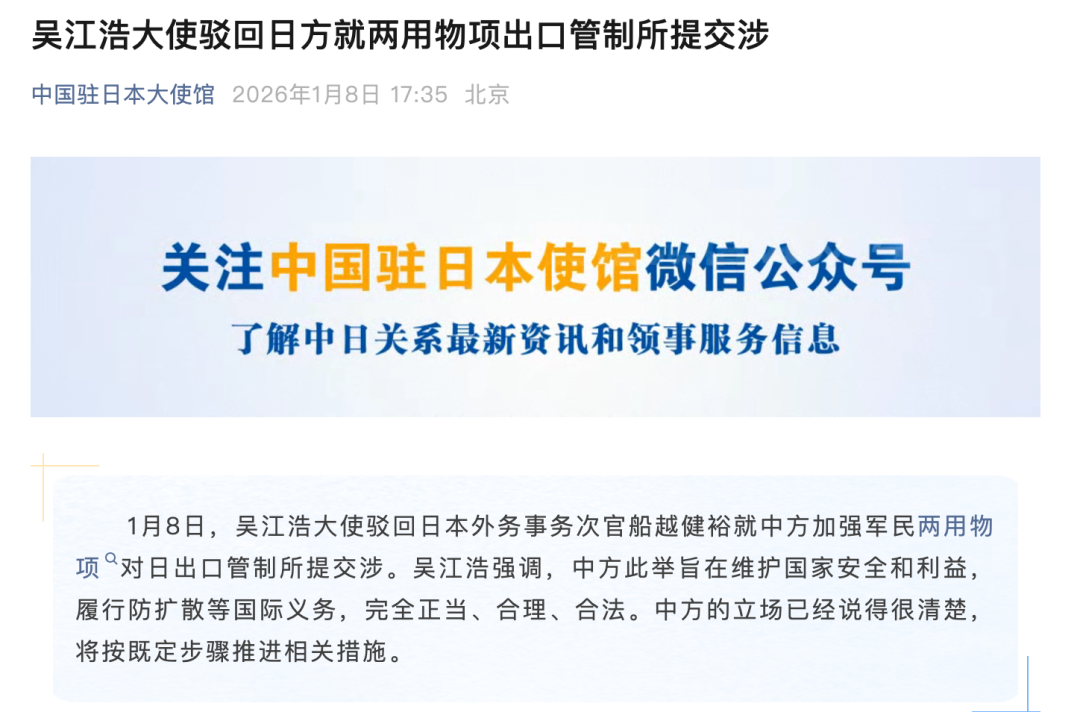
制止“再军事化”涉民事用途不受影响
Xin Lang Cai Jing· 2026-01-08 22:04
Core Viewpoint - China emphasizes its commitment to international non-proliferation obligations and has implemented export controls on dual-use items to Japan, aimed at preventing Japan's militarization and nuclear ambitions [1] Group 1: Export Controls - The Chinese Ministry of Commerce has announced a ban on exports of dual-use items to Japanese military users and any entities involved in enhancing Japan's military capabilities [1] - The measures are described as legitimate and reasonable, aimed at curbing Japan's militarization efforts [1] Group 2: Political Context - The spokesperson criticized Japanese Prime Minister Fumio Kishida's remarks regarding Taiwan, stating they infringe on China's sovereignty and interfere in its internal affairs [1] - Kishida's administration is accused of promoting militarization and challenging the post-war international order, which could threaten regional and global peace [1] Group 3: Trade Implications - China reassures that its commitment to maintaining global supply chain stability and security remains intact, and normal civil trade will not be affected by these export controls [1]
日方提出交涉 中国大使:驳回,“将按既定步骤推进”!高市早苗遭在野党批评:“将日本引向战争国家”
Mei Ri Jing Ji Xin Wen· 2026-01-08 16:46
Core Viewpoint - China has strengthened export controls on dual-use items to Japan, emphasizing that this action is legitimate and aimed at safeguarding national security and fulfilling international non-proliferation obligations [1][4][6]. Group 1: Export Control Measures - The Ministry of Commerce announced on January 6 that all dual-use items are prohibited from being exported to Japanese military users and for military purposes, as well as any other end-users that could enhance Japan's military capabilities [4][6]. - Violations of these regulations will lead to legal accountability for organizations and individuals transferring or providing dual-use items from China to Japan [4]. Group 2: Political Context and Reactions - Chinese officials criticized Japanese Prime Minister Fumio Kishida's recent statements regarding Taiwan, claiming they infringe on China's sovereignty and threaten regional stability [4][6]. - Japanese opposition parties have expressed concerns over Kishida's administration, labeling it as the "most dangerous Liberal Democratic Party government" since World War II, and have called for the retraction of his controversial statements [6][7]. Group 3: Japan's Defense Policy Changes - Japan is accelerating discussions to revise its "Security Three Documents," with plans to establish an expert meeting by spring to discuss defense capabilities, budget scales, and funding sources [7]. - Key proposed changes include increasing defense spending, modifying the "Three Non-Nuclear Principles," and lifting restrictions on arms exports to develop offensive military capabilities [7][9].
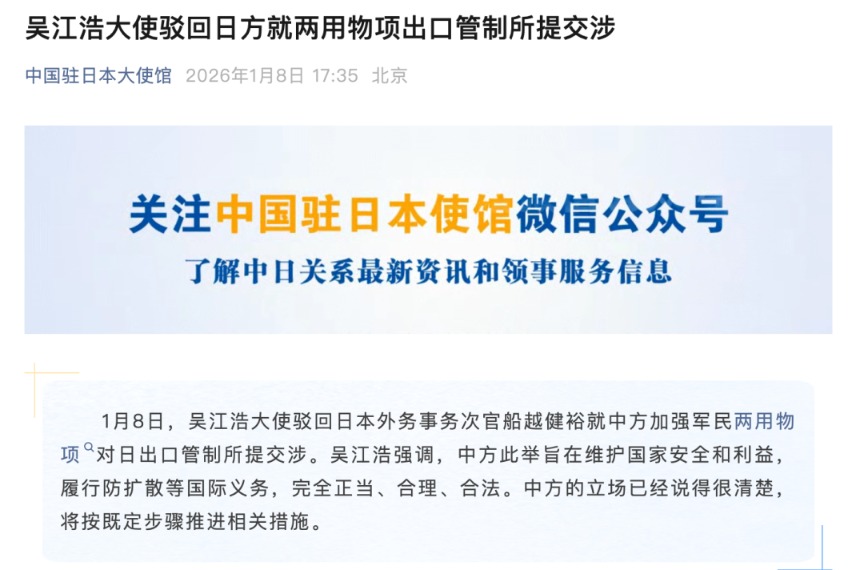
日方提出交涉,中国大使:驳回,“将按既定步骤推进”!高市早苗遭在野党批评:“将日本引向战争国家”
Mei Ri Jing Ji Xin Wen· 2026-01-08 16:22
Group 1 - The Chinese government has strengthened export controls on dual-use items to Japan, citing national security and international obligations as the primary reasons for this decision [1][3][5] - The announcement prohibits all dual-use items from being exported to Japanese military users and any entities that could enhance Japan's military capabilities, with legal consequences for violations [3][5] - The Chinese Ministry of Commerce emphasized that this measure is aimed at preventing Japan's militarization and nuclear ambitions, asserting its legality and reasonableness [5][6] Group 2 - Japanese Prime Minister Kishi Nobuo's recent statements and significant increases in defense spending have raised concerns and criticisms from various sectors in Japan, with opposition parties labeling his administration as the most dangerous since World War II [6][10] - The Japanese government is planning to revise its "Security Three Documents," with discussions expected to focus on enhancing defense capabilities, budget scales, and funding sources, aiming for completion by the end of the year [10][12] - Key points of the planned revisions include increasing defense spending, modifying the "Three Non-Nuclear Principles," and lifting restrictions on arms exports, alongside strengthening military cooperation with other countries [12][14]
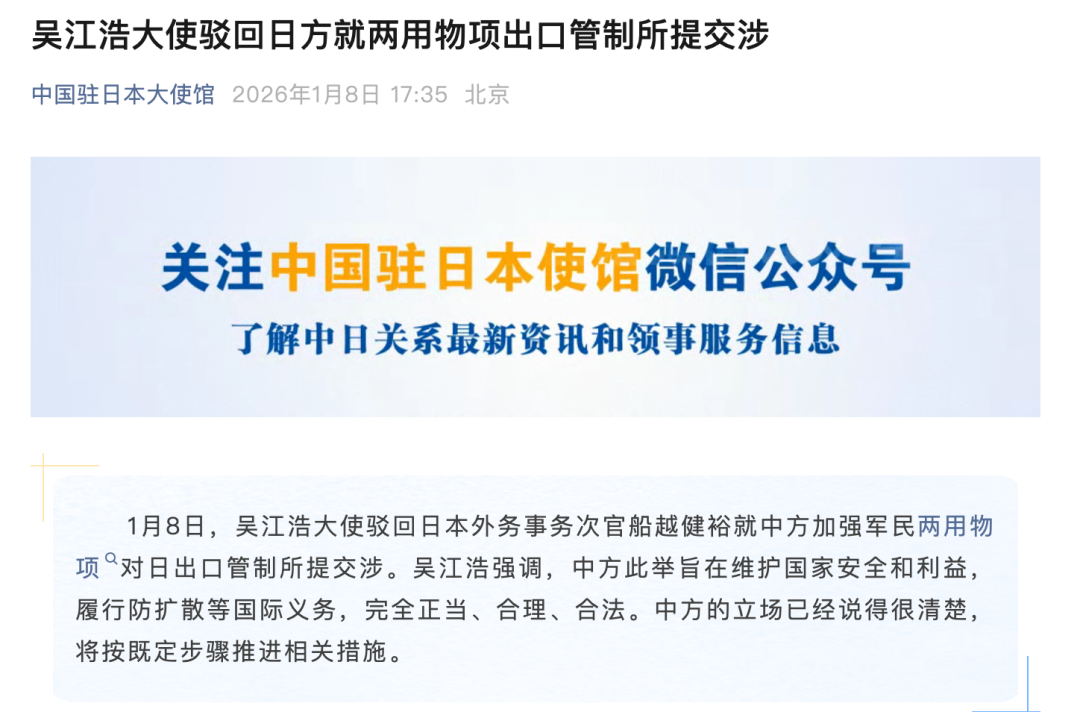
加强两用物项对日本出口管制有何考虑?商务部回应
Nan Fang Du Shi Bao· 2026-01-08 09:19
Core Viewpoint - The Chinese government has announced new export controls on dual-use items to Japan, citing concerns over Japan's military ambitions and statements made by Prime Minister Fumio Kishida regarding Taiwan, which are seen as violations of China's sovereignty and internal affairs [1]. Group 1: Export Control Measures - China will prohibit the export of dual-use items to Japanese military users and for military purposes, aiming to prevent Japan's re-militarization and nuclear ambitions [1]. - The measures are described as legitimate and reasonable, aligning with China's responsibilities as a major global power in non-proliferation [1]. Group 2: Impact on Civil Trade - The Chinese government reassures that normal civil trade will not be affected by these new export controls, emphasizing the stability and security of global supply chains [1]. - Stakeholders involved in legitimate civil trade with China should not have concerns regarding these new regulations [1].
商务部回应两用物项对日出口管制:制止“再军事化”和拥核企图
Yang Shi Xin Wen· 2026-01-08 08:12
Core Viewpoint - The Chinese Ministry of Commerce emphasizes its commitment to controlling the export of dual-use items to Japan in response to perceived threats from Japanese Prime Minister Fumio Kishida's remarks regarding Taiwan, which are seen as infringing on China's sovereignty and internal affairs [1] Group 1: Export Control Measures - The Chinese government will prohibit exports of dual-use items to Japanese military users and any entities involved in enhancing Japan's military capabilities, aiming to halt Japan's militarization and nuclear ambitions [1] - The measures are described as legitimate and reasonable, reflecting China's responsibilities as a major global power in non-proliferation [1] Group 2: Impact on Civil Trade - The Ministry of Commerce assures that normal civil trade will not be affected by these export controls, indicating that parties engaged in legitimate civil trade should not have concerns [1]
商务部回应两用物项对日出口管制:目的是制止“再军事化”和拥核企图
中国能源报· 2026-01-08 07:56
Group 1 - The Ministry of Commerce of China held a regular press conference, where spokesperson He Yadong addressed concerns regarding the strengthening of export controls on dual-use items to Japan, emphasizing that Japanese Prime Minister Fumio Kishida's remarks on Taiwan infringe upon China's sovereignty and territorial integrity, and openly interfere in China's internal affairs [1] - He Yadong stated that since taking office, Prime Minister Kishida has promoted the revision of the "Security Three Documents," with close aides making pro-nuclear statements, which challenge international norms and reveal Kishida's and Japan's right-wing forces' persistent push for "re-militarization," threatening regional peace and stability, and endangering global peace and security [1] - China, as a responsible major power, consistently fulfills its international non-proliferation obligations and has legally prohibited the export of all dual-use items to Japanese military users and for military purposes, aiming to curb "re-militarization" and nuclear ambitions, which is entirely justified and lawful [1] Group 2 - He Yadong emphasized that China is committed to maintaining the stability and security of global supply chains, stating that civil-use items will not be affected by these measures, and there is no need for parties involved in normal civil trade to worry [1]
商务部:加强对日本两用物项出口管制目的是制止"再军事化"和拥核企图
Xin Lang Cai Jing· 2026-01-08 07:39
Core Viewpoint - The Chinese government expresses strong opposition to Japan's military ambitions and export control measures, emphasizing the need to maintain regional peace and stability while asserting its own sovereignty [1] Group 1: China's Position on Japan's Military Actions - The Chinese government criticizes Japanese Prime Minister Fumio Kishida's remarks regarding Taiwan, viewing them as a violation of China's sovereignty and an interference in internal affairs [1] - Kishida's administration is accused of attempting to revise security policies that challenge international norms and promote militarization, which could threaten global peace [1] Group 2: Export Control Measures - China has implemented export controls on dual-use items to prevent military enhancement in Japan, asserting that these measures are legal and justified [1] - The Chinese government reassures that normal civil trade will not be affected by these export restrictions, aiming to maintain stability in global supply chains [1]
9万亿!再创新高!日本刚刚批准防卫预算!
Zheng Quan Shi Bao Wang· 2025-12-27 02:36
Core Viewpoint - Japan's government has approved a record defense budget exceeding 9 trillion yen for the fiscal year 2026, indicating a significant shift in its defense strategy towards "proactive deterrence" and enhancing its military capabilities, which may impact regional security dynamics [1][2][3]. Group 1: Defense Budget Details - The approved defense budget for fiscal year 2026 is over 9 trillion yen, marking a continuous increase in Japan's defense spending, which has surpassed 6 trillion, 7 trillion, and 8 trillion yen in previous years [2]. - The budget will fund the acquisition of long-range missiles and the development of a coastal defense system centered around attack drones, with an investment of approximately 100.1 billion yen for the latter [2]. - Japan plans to increase its total defense spending to about 43 trillion yen from 2023 to 2027, as outlined in the new "security three documents" approved in late 2022 [2]. Group 2: Strategic Implications - Experts suggest that the increase in defense spending signifies a transformation in Japan's military posture from "defensive" to "proactive deterrence," potentially redefining its post-war military identity and affecting regional security [3]. - Japan is also pursuing the development of nuclear-powered submarines, with plans to advance to the next generation of propulsion systems and possibly acquire nuclear submarines to enhance its defense capabilities [3]. - The country is collaborating with the UK and Italy to develop a next-generation fighter jet, with an investment of over 160 billion yen planned for this initiative, expected to be deployed by 2035 [3]. Group 3: Domestic and International Reactions - The increase in defense spending has raised concerns among various sectors in Japan, with public protests against military expansion and warnings from scholars about the economic burden on ordinary citizens [4][5]. - The Chinese Foreign Ministry has criticized Japan's military expansion, suggesting it reflects a dangerous trend towards militarism and a departure from its historically peaceful development path [4][5].
9万亿!日本,刚刚批准!
Zheng Quan Shi Bao Wang· 2025-12-27 01:50
Core Viewpoint - Japan's government has approved a record defense budget exceeding 9 trillion yen for the fiscal year 2026, indicating a significant shift in its defense strategy towards "proactive deterrence" and enhancing its military capabilities, which may impact regional security dynamics [1][2][3]. Group 1: Defense Budget Details - The approved defense budget for fiscal year 2026 is over 9 trillion yen, marking a new high [2]. - Japan's defense spending has consistently increased, surpassing 6 trillion yen, 7 trillion yen, and 8 trillion yen in previous fiscal years [2]. - The budget will fund long-range missiles and the development of an attack drone-based coastal defense system called "SHIELD," with an investment of approximately 100.1 billion yen [2]. Group 2: Strategic Implications - The increase in defense spending signifies a transformation in Japan's military posture from "defensive" to "proactive deterrence," potentially redefining its post-war military identity [1][3]. - Japan is also pursuing the development of nuclear-powered submarines and has plans to collaborate with the UK and Italy on a next-generation fighter jet, with over 160 billion yen allocated for this purpose [3]. Group 3: Domestic and International Reactions - The budget approval has raised concerns among various sectors in Japan regarding the implications of increased militarization [2]. - The Chinese Foreign Ministry has criticized Japan's military expansion, suggesting it reflects a dangerous trend towards militarism and a departure from its historical stance on peace [4][5].