
南下资金

Search documents
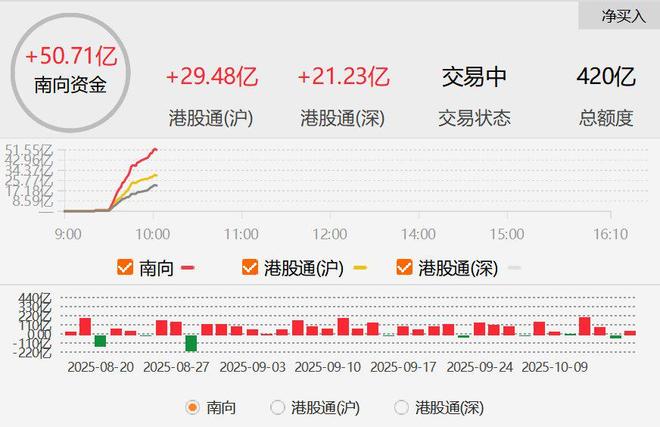
南下资金净买入港股超50亿港元
Xin Lang Cai Jing· 2025-10-16 02:11
Group 1 - The core point of the article is that southbound funds have net purchased over 5 billion HKD in Hong Kong stocks within the first half hour of trading [1]

瑞银:料香港交易所(00388)第三季多赚53% 目标价升至485港元
智通财经网· 2025-10-10 06:30
Core Viewpoint - UBS forecasts that Hong Kong Exchanges and Clearing Limited (HKEX) will report a year-on-year increase in quarterly revenue and net profit of 43% and 53%, reaching HKD 7.7 billion and HKD 4.8 billion respectively, setting new records [1] Financial Performance - The forecasted quarterly revenue and net profit are 8% and 11% higher than market expectations [1] - Estimated net investment income for Q3 is projected at HKD 933 million, reflecting a year-on-year and quarter-on-quarter decline of 23% and 40% respectively, primarily due to weaker HKD interbank rates and potential foreign exchange losses from USD depreciation [1] Trading Activity - Q3 average daily turnover is expected to reach a new high of HKD 286 billion, with southbound capital contribution increasing to approximately 27%, compared to 23% and 24% in Q1 and Q2 respectively [1] - The turnover rate of southbound capital is estimated to be more than twice that of local and foreign investors since 2020, indicating a structural improvement in overall turnover rates [1] Future Projections - UBS has raised its average daily turnover forecast for 2025 to 2027 by 9% to 16% and adjusted its earnings per share forecast for HKEX upward by 7% to 12% [1] - The target price for HKEX has been increased from HKD 464 to HKD 485, maintaining a "Neutral" rating [1]

港股通数据统计周报:2025.9.29-2025.10.5-20251006
Zhe Shang Guo Ji Jin Rong Kong Gu· 2025-10-06 13:42
Group 1: Top Net Buy/Sell Companies - The top net buy company is Alibaba (9988.HK) with a net buy amount of ¥151.41 billion and a change in holdings of 81,798,701 shares[8] - Tencent Holdings (0700.HK) ranks second with a net buy amount of ¥46.49 billion and a change in holdings of 6,902,320 shares[8] - The top net sell company is the Tracker Fund of Hong Kong (2800.HK) with a net sell amount of -¥27.52 billion and a change in holdings of -99,061,725 shares[9] Group 2: Industry Distribution - The technology sector shows significant activity with multiple companies in the top net buy list, including SMIC (0981.HK) with a net buy of ¥20.72 billion[8] - The telecommunications sector has notable net sell activity, with China Mobile (0941.HK) experiencing a net sell of -¥14.04 billion[9] - The financial sector also shows net sell activity, particularly with China Construction Bank (0939.HK) at -¥9.24 billion[9] Group 3: Active Stocks - Alibaba (9988.HK) is the most active stock with a total trading volume of ¥88.49 billion and a net buy of ¥15.09 billion on the Shanghai Stock Connect[19] - Xiaomi Group (1810.HK) ranks second with a total trading volume of ¥30.92 billion and a net buy of ¥7.16 billion[19] - The Tracker Fund of Hong Kong (2800.HK) shows significant trading activity with a total volume of ¥39.81 billion but a net sell of -¥39.76 billion[19]
金融工程定期:港股量化:南下资金创2021年2月以来新高,10月增配有色
KAIYUAN SECURITIES· 2025-10-06 07:06
- The report introduces a multi-factor model for Hong Kong stocks, which includes four categories of factors: technical, capital, fundamental, and analyst expectations[12][36][37] - The construction of the "Hong Kong Stock Preferred 20 Portfolio" is based on selecting the top 20 stocks with the highest scores from the Hong Kong Stock Connect sample stocks at the end of each month, using an equal-weighted approach. The benchmark index is the Hong Kong Composite Index (930930.CSI)[5][39][40] - The "Hong Kong Stock Preferred 20 Portfolio" demonstrates an annualized excess return of 12.9% over the entire backtesting period (2015.1~2025.9), with an excess return volatility ratio of 1.0[5][40] - In September 2025, the portfolio's return was 0.25%, while the benchmark index return was 7.65%, resulting in an excess return of -7.41%[5][39] - The October 2025 portfolio allocation increased its exposure to the non-ferrous metals sector, reflecting adjustments based on market trends[6][43][44]
港股通数据统计周报 2025.9.15-2025.9.21-20250923
Zhe Shang Guo Ji Jin Rong Kong Gu· 2025-09-23 02:45
Group 1: Top Net Buy/Sell Companies - Alibaba-W (9988.HK) had the highest net buy amount of ¥22.247 billion with a holding change of 139,830,551 shares[8] - BeiGene (6160.HK) ranked second with a net buy of ¥2.019 billion and a holding change of 10,056,137 shares[8] - Xiaomi Group-W (1810.HK) was the top net sell company with a net sell amount of -¥1.948 billion and a holding change of -34,353,051 shares[9] Group 2: Industry Distribution - The financial sector saw a net buy of ¥1.630 billion, primarily driven by China Pacific Insurance (2601.HK) and Industrial and Commercial Bank of China (1398.HK)[8][9] - The healthcare industry had a total net buy of ¥3.046 billion, with significant contributions from BeiGene (6160.HK) and Innovent Biologics (9606.HK)[8][9] - The technology sector experienced a net sell of -¥12.94 billion, largely due to Tencent Holdings (0700.HK) and Xiaomi Group-W (1810.HK)[9] Group 3: Active Stocks - Alibaba-W (9988.HK) was the most active stock with a total trading volume of ¥70.25 billion and a net buy of ¥4.73 billion on the Shanghai Stock Connect[18] - Semiconductor Manufacturing International Corporation (0981.HK) had a trading volume of ¥62.79 billion with a net sell of -¥3.08 billion on the Shenzhen Stock Connect[18] - Meituan-W (3690.HK) recorded a trading volume of ¥44.40 billion with a net buy of ¥5.68 billion on the Shanghai Stock Connect[19]
港股通数据统计周报2024.2.12-2024.2.18-20250916
Zhe Shang Guo Ji Jin Rong Kong Gu· 2025-09-16 05:24
Group 1: Top Net Buy/Sell Companies - Alibaba-W (9988.HK) had the highest net buy amount of ¥179.99 billion with a holding change of 119,120,888 shares[8] - Horizon Robotics-W (9660.HK) ranked second with a net buy of ¥37.96 billion, increasing its holdings by 371,459,400 shares[8] - Pop Mart (9992.HK) led the net sell list with a net sell amount of -¥25.29 billion, decreasing its holdings by 9,136,051 shares[9] Group 2: Industry Distribution of Net Buy/Sell - The report highlights significant net buying in the Consumer Discretionary sector, particularly with companies like Alibaba and Meituan[11] - Financial sector companies like Ping An (2318.HK) and AIA (1299.HK) also saw substantial net buying, indicating investor confidence in financial services[8] - The Information Technology sector experienced notable net selling, particularly with companies like Xiaomi and Kuaishou, reflecting a shift in investor sentiment[9] Group 3: Active Stocks - Alibaba-W (9988.HK) was the most active stock with a total trading volume of ¥87.74 billion and a net buy of ¥20.76 billion on the Shanghai Stock Connect[18] - Meituan-W (3690.HK) had a trading volume of ¥50.99 billion but recorded a net sell of -¥16.35 billion, indicating a decline in investor interest[18] - Tencent Holdings (0700.HK) showed a trading volume of ¥31.72 billion with a slight net buy of ¥1.85 billion, suggesting stable investor confidence[18]
南下资金,创纪录!最新研判:牛市行情仍在
Zhong Guo Ji Jin Bao· 2025-09-07 11:10
Group 1 - Recent inflow of southbound funds into Hong Kong stocks has reached a record high, with net inflow exceeding 1 trillion HKD this year, marking a significant increase compared to last year's total [2][3] - The continuous inflow of southbound funds is expected to change and optimize the investment structure and valuation logic of the Hong Kong stock market, with technology and consumer sectors now dominating market capitalization [4][5] - The current market environment is characterized by a rotation in investment preferences, with southbound funds showing a clear preference for high dividend, low valuation, and high growth sectors [5][6] Group 2 - Despite recent market corrections, analysts believe that the fundamentals for a bull market in Hong Kong stocks remain intact, with the market undergoing a phase of value reassessment [7][8] - The Hong Kong IPO market has been robust, with 50 new stocks listed this year, raising over 128 billion HKD, which has attracted both southbound and foreign capital [3][4] - The shift in the dominance of southbound funds from retail to institutional investors has enhanced the professional investment capabilities and value discovery in the market [4][5]
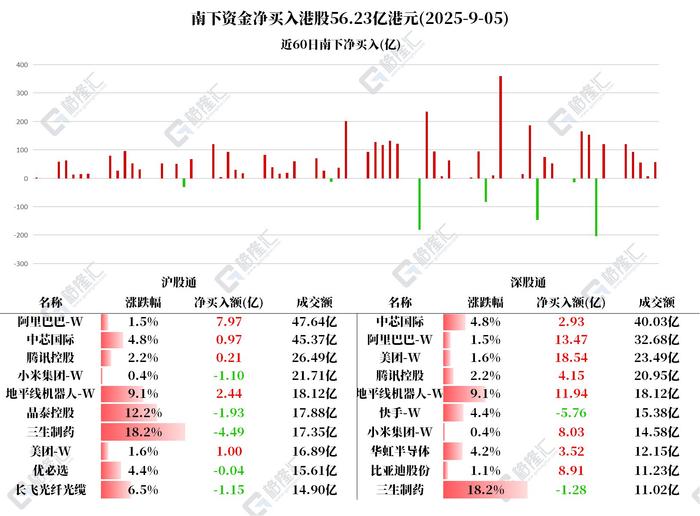
图解丨南下资金大幅加仓阿里、美团和地平线机器人
Ge Long Hui A P P· 2025-09-05 10:37
Group 1 - Southbound funds net bought Hong Kong stocks worth 56.23 billion HKD today [1] - The top net purchases included Alibaba-W (21.44 billion HKD), Meituan-W (19.53 billion HKD), and Horizon Robotics-W (14.38 billion HKD) [1] - Southbound funds have continuously net bought Alibaba for 11 days, totaling 195.2289 billion HKD [1] Group 2 - Southbound funds have net bought Xiaomi for 3 consecutive days, totaling 20.9448 billion HKD [1] - Meituan has also seen net purchases for 3 consecutive days, amounting to 30.4999 billion HKD [1] - The net sales included 5.76 billion HKD for Sanofi and 5.75 billion HKD for Kuaishou-W [1]

超1万亿港元!今年以来南下资金购买港股创纪录
Shen Zhen Shang Bao· 2025-09-03 23:07
Group 1 - Southbound capital has significantly increased its investment in Hong Kong stocks this year, with a net purchase amount exceeding 1 trillion HKD, surpassing the total net purchase for the entire previous year [1] - From January 1 to September 2, the net purchase amount reached 10,002.21 billion HKD, setting a historical record [1] - There have been 43 trading days this year where the net purchase exceeded 10 billion HKD, with 11 days surpassing 20 billion HKD, including a peak of 35.876 billion HKD on August 5 [1] Group 2 - As of September 2, there are 410 stocks with a southbound capital holding ratio exceeding 10%, 145 stocks exceeding 30%, and 39 stocks exceeding 50% [2] - The top three stocks by holding ratio are China Telecom at 73.99%, Gree Power at 70.03%, and China Shenhua at 67.69% [2] - From 2020 to 2024, the net purchase amounts were 672.1 billion HKD, 454.4 billion HKD, 386.3 billion HKD, 318.8 billion HKD, and 807.869 billion HKD respectively, with a notable increase in 2024 and 2025 [2]
南下资金净卖出港股204亿创历史新高,大幅减仓盈富基金、恒生中国企业
Xin Lang Cai Jing· 2025-08-28 10:03
Group 1 - The core point of the article highlights that southbound funds recorded a net sell-off of 20.441 billion HKD in Hong Kong stocks, marking the largest single-day net sell amount in history [1] - Notable net purchases included SMIC at 892 million HKD, CanSino Biologics at 511 million HKD, and Hua Hong Semiconductor at 463 million HKD [1] - Significant net sell-offs were observed in the Tracker Fund of Hong Kong at 11.89 billion HKD and the Hang Seng China Enterprises Index at 4.776 billion HKD [1] Group 2 - The article lists the top net purchases, including China Life at 383 million HKD, Meituan-W at 333 million HKD, and Alibaba-W at 329 million HKD [1] - Other notable net sell-offs included Tencent Holdings at 583 million HKD and Xiaomi Group-W at 299 million HKD [1] - The overall trend indicates a significant shift in investor sentiment, with a marked preference for certain technology and biotech stocks while divesting from major index funds [1]