
南极考察

Search documents
中国第四十二次南极考察队起航
Ren Min Ri Bao· 2025-11-02 22:21
Core Points - The 42nd Antarctic Expedition Team from China has set out on November 1, 2025, with over 500 members from more than 80 domestic units and international researchers from over 10 countries and regions [1] - The expedition will focus on three main tasks: enhancing the infrastructure and operational capabilities of the Qinling Station, conducting comprehensive investigations in Antarctica to better understand its role in global climate change, and implementing major R&D projects and new applications of domestic equipment technology [1] Group 1 - The expedition is supported by the "Xuelong" and "Xuelong 2" vessels and is expected to return to China by May 2026 [1] - The team will conduct scientific drilling experiments in deep subglacial lakes using domestically developed hot water drilling and melting systems, aiming to explore isolated subglacial environments and geological features [1] - The expedition will also validate domestically manufactured equipment such as the "Snow Leopard" 6×6 wheeled vehicle and THT550 hydraulic traction equipment, along with advanced technologies for automatic observation and satellite remote sensing [1]
记者手记:南极的故事期待新篇
Xin Hua She· 2025-11-02 11:27
Core Points - The 42nd Chinese Antarctic Expedition team has set sail on November 1, 2023, with the vessels "Xuelong" and "Xuelong 2" departing from the domestic base in Shanghai, marking a significant event in China's polar exploration efforts [2][3][5] Group 1 - The expedition team consists of members from various backgrounds, including a doctoral student from Southeast University, who will be involved in tasks such as three-dimensional spatial measurement and drone testing [2][5] - The team includes experienced members, such as a construction worker who has participated in multiple Antarctic missions, reflecting a legacy of dedication to polar research [5][7] - The departure symbolizes a commitment to scientific exploration, with team members expressing pride and a sense of responsibility for contributing to the understanding of extreme environments [2][7] Group 2 - The expedition will face challenges such as the Antarctic winter, with medical personnel equipped with wearable health monitoring devices to ensure the well-being of the team [5][7] - Family support plays a crucial role, as many team members leave behind loved ones, highlighting the personal sacrifices made for the advancement of scientific knowledge [7] - The expedition aims to expand human understanding of the Antarctic region, with each journey contributing to a broader narrative of exploration and discovery [7]

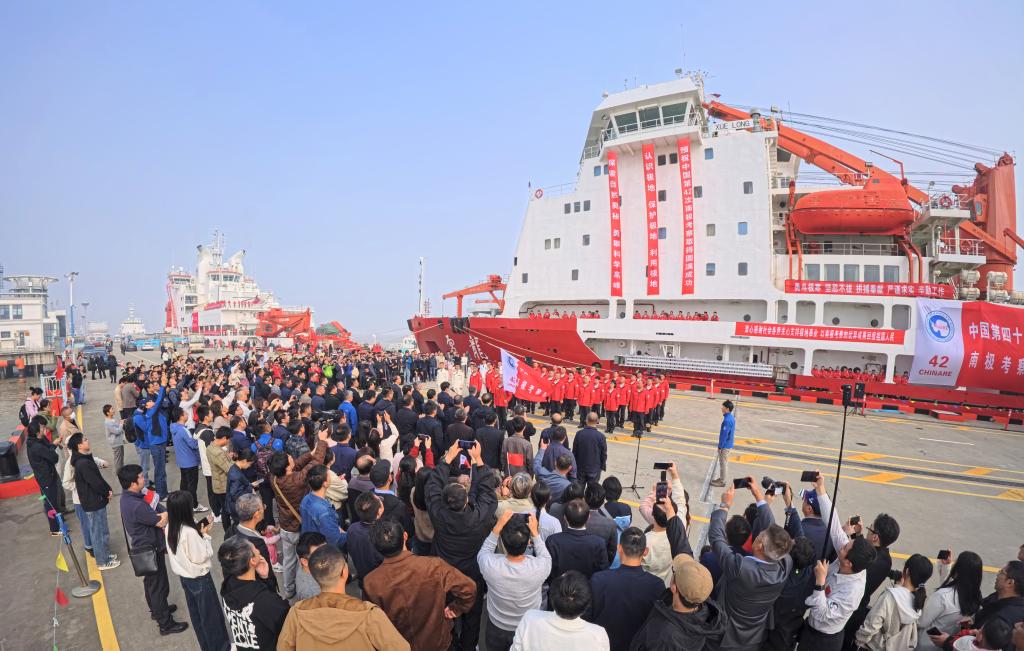
中国第42次南极考察启航
Huan Qiu Wang Zi Xun· 2025-11-01 03:14
Core Points - The 42nd Antarctic Expedition organized by the Ministry of Natural Resources of China has set out to conduct three main tasks in Antarctica [1] Group 1: Infrastructure Development - The expedition will focus on enhancing the supporting facilities and system optimization at the Qinling Station, including improvements to the research building, oil supply system, and communication network [4] - The team will also validate the adaptability and breakthroughs of domestically produced facilities such as seawater desalination, wind power generation, and photovoltaic power generation in extreme Antarctic conditions [4] Group 2: Comprehensive Investigations - The expedition will carry out multi-disciplinary investigations in key areas such as the Antarctic Peninsula, Amundsen Sea, Ross Sea, and Prydz Bay, focusing on the impact of climate change on the Southern Ocean ecosystem [5] - Long-term observational data will be collected to enhance understanding of Antarctica's role in global climate change [5] Group 3: Research and Technology Application - The expedition will conduct scientific drilling experiments in deep subglacial lakes using domestically developed hot water and thermal melting drilling systems, aiming to explore the unique subglacial lake environments and geological features [7] - The team will also test domestically manufactured equipment such as the "Snow Leopard" 6x6 wheeled vehicle and THT550 hydraulic traction equipment, along with advanced technologies for automatic observation and satellite remote sensing [9] Group 4: Collaboration and Participation - The expedition is supported by the "Xuelong" and "Xuelong 2" vessels, involving over 500 team members from more than 80 domestic units, along with international researchers from countries including Thailand, Chile, Portugal, and regions like Hong Kong and Macau [10]

向着8万海里!中国第42次南极考察队起航
Xin Hua Wang· 2025-11-01 02:11
Core Points - The 42nd Antarctic Expedition Team from China has set sail from Shanghai, embarking on an 80,000 nautical mile journey to Antarctica [1] - The expedition aims to enhance China's capabilities in understanding, protecting, and utilizing the Antarctic region, aligning with national goals for ocean development and international cooperation [3] Group 1: Expedition Objectives and Activities - The expedition will conduct clean drilling and sampling in deep Antarctic ice layers, utilizing domestic hot water drilling technology for the first time [4] - Research on subglacial lakes in Antarctica will provide insights into extreme ecosystems and climate change, contributing to the understanding of sedimentation processes and life evolution [5] - The team will gather long-term observational data on the impact of climate change on the Southern Ocean ecosystem in key areas like the Amundsen Sea and Ross Sea [5] Group 2: Infrastructure and Technological Advancements - The Qinling Station, set to officially open in February 2024, will enhance China's research capabilities in the Ross Sea region, featuring advanced facilities for scientific research and operations [6] - The station will implement a smart storage system using polar robots and intelligent platforms, improving material flow efficiency by 40% [6] - The expedition will utilize domestically developed equipment, including the "Snow Leopard" 6×6 wheeled vehicle and various new technologies for automatic observation and satellite remote sensing [8] Group 3: International Collaboration - The expedition involves over 500 team members from more than 80 domestic organizations, as well as international researchers from countries like Thailand, Chile, and Portugal, promoting diverse collaborative research [8] - The mission reflects China's commitment to the Antarctic Treaty and its willingness to participate in international governance of the Antarctic region [8]
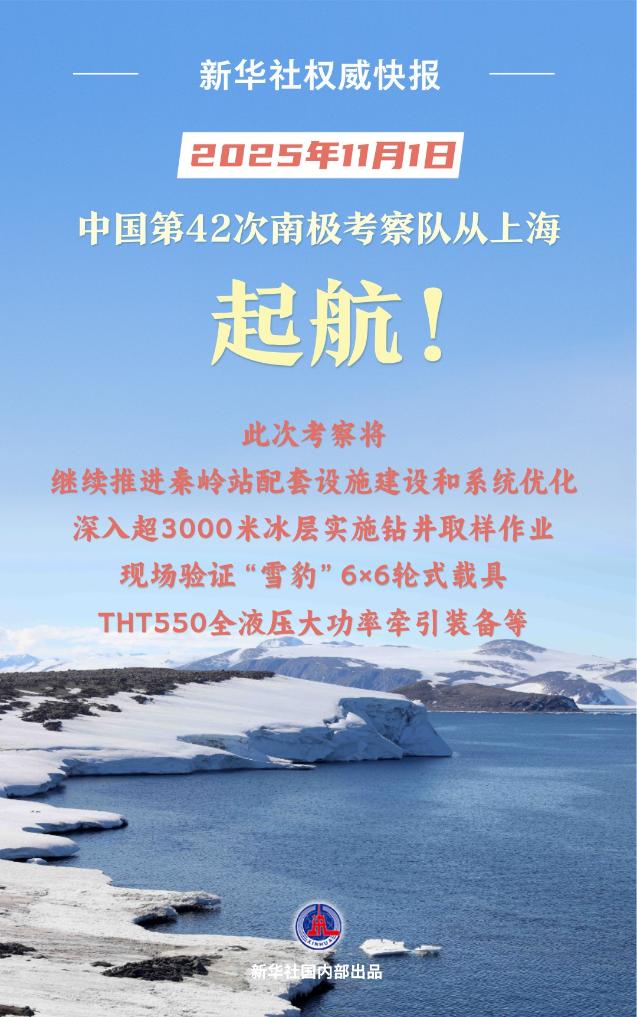
中国第42次南极考察队,出征!
Yang Shi Xin Wen· 2025-11-01 02:10
Group 1 - The investigation focuses on national demand and global technological frontiers, aiming to advance the construction and optimization of supporting facilities at the Qinling Station [5] - Continuous implementation of business-oriented investigations and monitoring in key Antarctic regions such as the Amundsen Sea, Ross Sea, and Prydz Bay is planned [5] - The project includes the application of domestic technological equipment and aims to deepen bilateral and multilateral cooperation in Antarctic research, investigation, and talent training with relevant countries and regions, with an expected completion date of May 2026 [5]
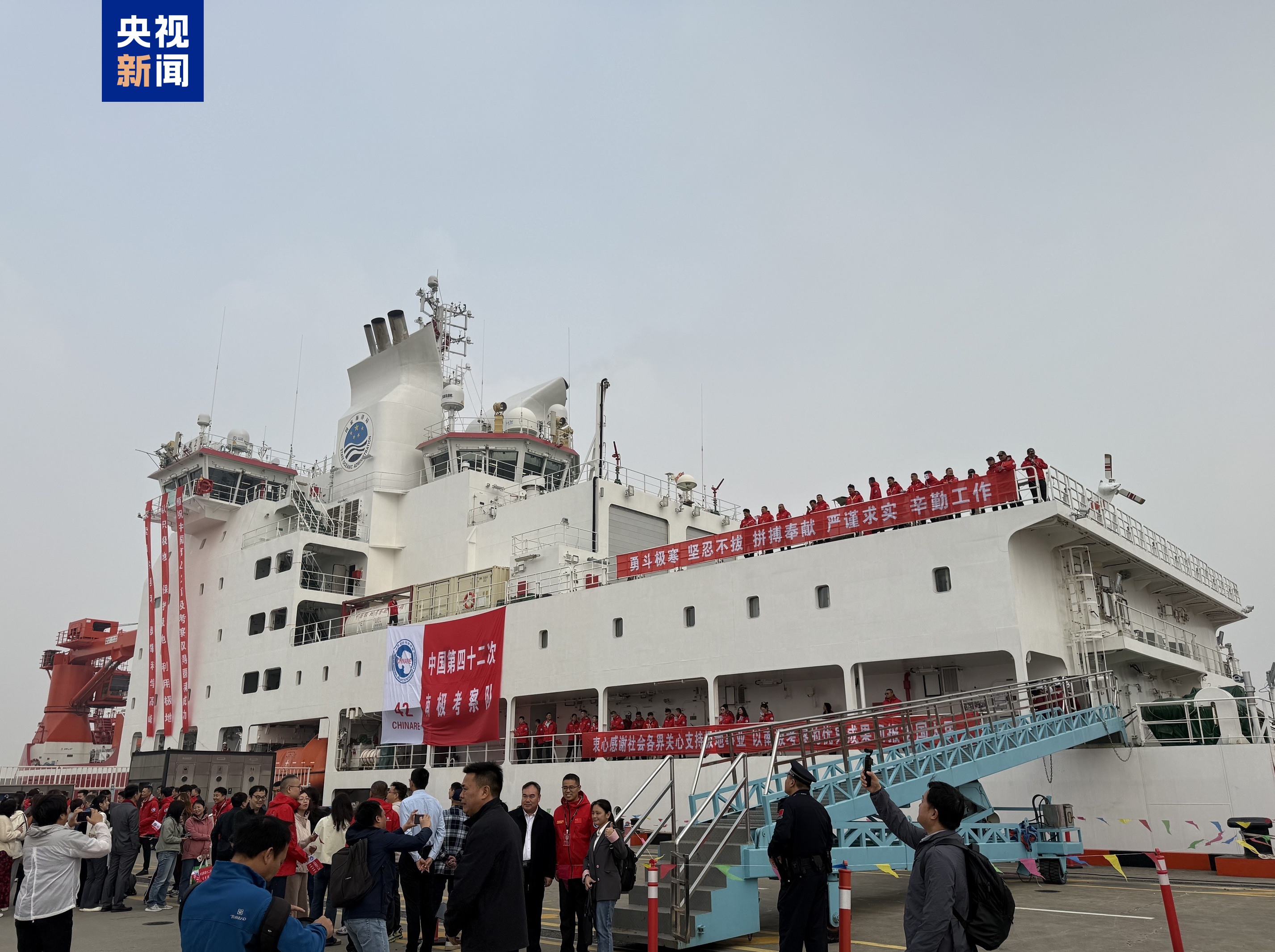
中国第42次南极考察起航,将重点开展三项工作
Xin Jing Bao· 2025-11-01 02:07
Core Points - The 42nd Antarctic Expedition Team of China has set sail to conduct significant research and development projects, focusing on infrastructure enhancement, comprehensive investigations, and the application of domestic technologies [1][2] Group 1: Infrastructure Development - The expedition will prioritize the improvement of the Qinling Station's supporting facilities, including the research building, oil supply system, and communication network, to enhance operational support and scientific research capabilities [1] - The team will continue to validate the adaptability of domestically produced facilities such as seawater desalination, wind power generation, and photovoltaic power generation in extreme Antarctic conditions [1] Group 2: Comprehensive Investigations - The expedition will conduct multi-disciplinary investigations in key Antarctic regions, including the Antarctic Peninsula, Amundsen Sea, Ross Sea, and Prydz Bay, focusing on the impact of climate change on the Southern Ocean ecosystem [2] - Long-term observational data will be collected across various fields such as marine, biological, chemical, atmospheric, and glaciological studies to improve understanding of Antarctica's role in global climate change [2] Group 3: Technology Application and International Cooperation - The expedition will implement scientific drilling experiments in deep ice layer lakes using domestically developed hot water drilling and melting systems, aiming to explore isolated subglacial lake environments and geological features [2] - The team will also validate the use of domestically manufactured equipment like the "Snow Leopard" 6×6 wheeled vehicle and THT550 hydraulic traction equipment in the Antarctic, alongside advanced technologies for automatic observation and satellite remote sensing [2] - The expedition aims to strengthen operational observations and international collaboration, expanding partnerships with countries such as Chile, Thailand, and Portugal in research, observation, and logistical support [2]
中国第42次南极考察起航,“超级装备”将登陆南极
Xin Jing Bao· 2025-11-01 02:07
Core Points - The 42nd Antarctic Expedition Team from China has set out, organized by the Ministry of Natural Resources, with over 500 members from more than 80 domestic units, expected to return by May 2026 [1] - The expedition will focus on testing two domestically developed vehicles: the "Snow Leopard" 6×6 wheeled vehicle and the THT550 tracked vehicle [1][2] Group 1 - The "Snow Leopard" 6×6 wheeled vehicle is designed for extreme polar inland environments, capable of rapid personnel transfer, efficient material transport, and emergency support [1] - This vehicle represents a key development in China's polar land vehicle capabilities, aiming for a systematic, multifunctional, and sustainable approach [1] - The THT550 tracked vehicle is China's first high-power snow traction equipment, suitable for soft snow surfaces and rugged icy roads, enhancing the efficiency of Antarctic operations [2] Group 2 - The THT550 has undergone extensive testing in low-temperature environments domestically and is expected to play a significant role in transporting heavy materials during the Antarctic expedition [2]
新华鲜报|向着8万海里!中国第42次南极考察队起航
Xin Hua She· 2025-11-01 01:56
Core Points - The 42nd Antarctic Expedition organized by the Ministry of Natural Resources of China set sail from Shanghai on November 1, marking a significant step in China's exploration and research efforts in Antarctica [1][11] - The expedition aims to enhance understanding of Antarctica's role in global climate change and to contribute to the construction of a maritime power and a community with a shared future for mankind [3][4] Group 1: Research and Exploration - The expedition will conduct clean drilling and sampling at depths of over 3000 meters in Antarctic ice layers, utilizing domestically developed hot water drilling systems [4] - Research on subglacial lakes in Antarctica is expected to provide insights into sedimentation processes and the evolution of life, given the extreme environmental conditions [4] - The team will gather long-term observational data on the impact of climate change on the Southern Ocean ecosystem in key areas such as the Amundsen Sea and Ross Sea [4] Group 2: Technological Advancements - The Qinling Station, which will officially open on February 7, 2024, represents a significant advancement in China's Antarctic research capabilities, filling a gap in the Ross Sea region [5] - The station will implement a smart warehouse system that utilizes polar robots and intelligent platforms for unmanned management, improving material flow efficiency by 40% [7] - The expedition will also validate various domestically developed equipment, including the "Snow Leopard" 6×6 wheeled vehicle and other advanced technologies in extreme conditions [9] Group 3: International Collaboration - The expedition includes over 500 team members from more than 80 domestic organizations, as well as researchers from countries such as Thailand, Chile, and Portugal, highlighting a commitment to international cooperation in scientific research [10] - The collaborative efforts in Antarctica reflect China's active participation in international governance and its dedication to the principles of the Antarctic Treaty [9]

听风 护航 守望
Zhong Guo Zi Ran Zi Yuan Bao· 2025-10-23 06:26
Core Points - The Qinling Station, China's fifth Antarctic research station, officially opened on February 7, 2024, marking the beginning of a "three-station wintering" era for China's Antarctic research [5] - The station successfully completed its first wintering mission with 43 team members enduring a 97-day polar night, showcasing China's capabilities in Antarctic research and management [5] - The station is characterized by extreme weather conditions, including high winds and low temperatures, which pose significant challenges for the research team [7][12] Group 1: Station Operations - The Qinling Station is the longest-lasting wintering station in terms of polar night duration, where team members manage station operations and construction tasks under harsh conditions [5][10] - Daily operations include monitoring team members' health, managing resources, and ensuring safety and quality in construction projects [10][12] - The team faced severe weather challenges, including winds exceeding 12 levels, which required constant snow removal and maintenance of living conditions [12][13] Group 2: Meteorological Support - Meteorological support is critical for the station's operations, with team member Ma Jingkai providing 48-hour weather forecasts to ensure safe unloading and operations [7][8] - The team set up automatic weather stations to gather real-time data, although high wind speeds frequently damaged the sensors, necessitating regular maintenance [7][8] - Accurate weather forecasting allowed for timely unloading of supplies, significantly impacting the station's operational efficiency [8] Group 3: Communication Infrastructure - Satellite communication is vital for maintaining contact between the station and the mainland, with engineer Wang Hainan responsible for ensuring network reliability [14] - Severe weather conditions damaged communication equipment, prompting emergency repairs to restore connectivity [14][15] - The team documented daily activities and station changes using drones, contributing to the historical record of the station's development [15][16]

第四十一次南极考察队在技术创新、国际合作等方面取得新突破—— 破冰逐浪,向新的未知进发(弘扬科学家精神)
Ren Min Ri Bao· 2025-07-01 21:53
Core Viewpoint - The successful completion of China's 41st Antarctic expedition, involving multiple vessels and international collaboration, highlights advancements in polar research and infrastructure development [1][10]. Group 1: Expedition Overview - The expedition involved 516 participants from 118 organizations, marking China's second time conducting a segmented Antarctic survey with three vessels [1]. - The vessels included "Snow Dragon" (2.7万余海里), "Yongsheng" (近1.1万海里), and "Snow Dragon 2" (4万余海里), with varying durations of 159, 65, and 208 days respectively [1]. Group 2: Key Challenges and Achievements - The unloading operation at the Qinling Station faced severe weather delays, requiring 24-hour operations and coordination among multiple teams to ensure safety and efficiency [2][3]. - The construction of the Qinling Station is progressing well, with essential environmental facilities nearing completion [3]. Group 3: International Collaboration - The successful landing of an Australian research aircraft at the Zhongshan Snow Airport demonstrates China's growing capabilities in supporting international scientific missions [4][5]. - The expedition included a multinational team that successfully recovered a long-term oceanographic mooring, showcasing effective international cooperation in challenging conditions [6][7]. Group 4: Scientific Contributions - The expedition filled significant data gaps in Antarctic research, including ecological studies during unconventional periods, and achieved notable scientific milestones such as the longest observation period for a Chinese polar mooring [10]. - The team conducted various innovative experiments, including high spectral microwave radiation measurements and sediment core sampling, contributing valuable data for understanding climate change and ocean evolution [10].