固态电解质

Search documents
珠海冠宇20260906
2025-09-07 16:19
Summary of Zhuhai Guanyu Conference Call Company Overview - **Company**: Zhuhai Guanyu - **Industry**: Battery Manufacturing, focusing on consumer batteries, solid-state batteries, and emerging technologies in drones and energy storage Key Points and Arguments Revenue and Growth Projections - Zhuhai Guanyu expects revenue to reach **17 billion RMB** by **2026**, driven by increased R&D investments translating into higher revenue scales [2][6] - The company anticipates a significant increase in mobile battery orders, particularly in the North American market, with a target production of **250-260 million steel shell batteries** [4][12] Technological Innovations - The company has made significant advancements in battery technology, including the transition from traditional soft-pack to disc technology and the introduction of **25% silicon-carbon anodes** [3] - Innovations in consumer batteries include a **15,000 mAh battery** and samples using **100% silicon anodes** and solid-state electrolytes, addressing usage bottlenecks and enhancing consumer purchasing intent [10][11] Business Structure and Market Position - The business structure has shifted, with mobile battery orders doubling annually, while previously dominant laptop battery sales have decreased [4] - The Zhejiang subsidiary has turned profitable, focusing on drone and small energy storage markets, achieving **1 billion RMB** in revenue in the first half of **2025**, with drone shipments increasing over **200%** year-on-year [5][9] Solid-State Battery Developments - Progress in solid-state batteries includes addressing low-temperature performance issues through high ratios of solid-state electrolytes, enhancing overall product value [7] Financial Implications - The adjustment of depreciation policies from **5 years to 8 years** for existing production lines is expected to positively impact financials, reducing annual depreciation costs significantly [4][22] Market Trends and Consumer Demand - The consumer battery sector is expected to undergo significant changes, with technological innovations leading to increased energy density and consumer interest [10][20] - The company is also exploring opportunities in the drone and robotics sectors, with a focus on high discharge performance and energy density [19][21] Competitive Landscape - The company has successfully broken into the domestic Android market, increasing its market share and reducing reliance on traditional competitors [4][5] Future Business Segments - Future revenue growth is anticipated from various segments, including mobile batteries, drones, and specialized batteries, with projections of **2-3 billion RMB** growth from mobile batteries alone [22][23] International Expansion - The Malaysian factory is on track for completion by the end of **2025**, with cautious expansion strategies and established partnerships with over half of the top 20 global automotive companies [26] Other Business Areas - The company is also focusing on electric tools, cleaning appliances, and smart wearables, with expected growth rates exceeding **50%** in these segments [27] Additional Important Insights - The company’s strategic focus on high-value products, such as silicon anode batteries and solid-state technologies, positions it well for future market demands and profitability [6][14][16] - The emphasis on partnerships with leading tech companies like Meta, Microsoft, Google, and Apple highlights the company's competitive edge in the battery supply chain [27]

信宇人:公司成功试制卤化物固态电解质样品 并完成首轮电化学测试
Mei Ri Jing Ji Xin Wen· 2025-09-04 08:48
Core Viewpoint - The company has made significant progress in the field of solid-state electrolytes, focusing on reducing material costs and developing high ionic conductivity halide solid-state electrolytes through a dual approach of "energy-type + fast-charging type" [1] Group 1: Company Developments - The company has successfully trialed halide solid-state electrolyte samples and completed the first round of electrochemical testing, achieving an ionic conductivity of 1.5-2 mS/cm, demonstrating good conductivity performance [1] - Compared to sulfide systems, the halide electrolyte offers three main advantages: a wider electrochemical window that can stably match high voltage platforms above 4.3V, improved stability with simplified manufacturing processes, and lower raw material and manufacturing costs [1]

泰和科技:公司硫化物固态电解质项目目前处于中试阶段,尚未形成销售收入
Xin Lang Cai Jing· 2025-09-03 10:49
Group 1 - The stock price of Taihe Technology experienced a cumulative increase of over 30% during the trading days from September 1 to September 3, 2025, which is classified as an abnormal trading fluctuation according to the Shenzhen Stock Exchange regulations [1] - The company confirmed that its operations are normal and there have been no significant changes in its business conditions or external operating environment recently [1] - There are no undisclosed significant matters related to the company by the company, its controlling shareholders, or actual controllers, nor are there any major matters in the planning stage [1] Group 2 - During the period of abnormal stock trading fluctuations, the controlling shareholders and actual controllers did not engage in buying or selling the company's stock [1] - The company's sulfide solid electrolyte project is currently in the pilot test stage and has not yet generated sales revenue [1]
泰和科技:硫化物固态电解质项目目前处于中试阶段,尚未形成销售收入
Xin Lang Cai Jing· 2025-09-03 10:41
Group 1 - The core point of the announcement is that Taihe Technology's stock is experiencing unusual trading fluctuations [1] - The company's sulfide solid electrolyte project is currently in the pilot test stage and has not yet generated sales revenue [1] - Investors are advised to be cautious and make rational investment decisions [1]
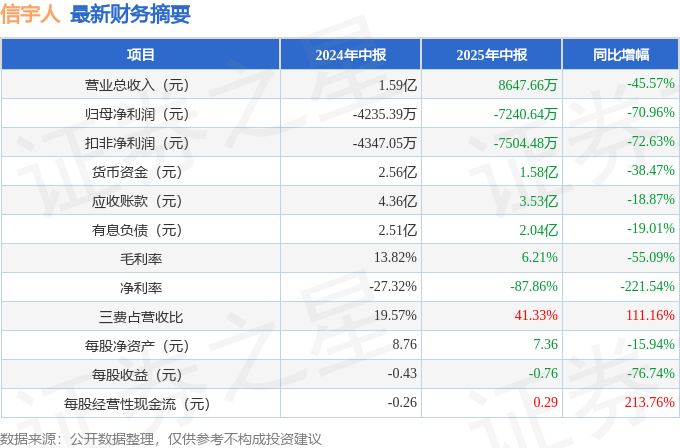
信宇人2025年中报简析:净利润同比下降70.96%,三费占比上升明显
Zheng Quan Zhi Xing· 2025-08-30 23:24
Financial Performance - The company reported a total revenue of 86.48 million yuan for the first half of 2025, a decrease of 45.57% year-on-year [1] - The net profit attributable to shareholders was -72.41 million yuan, down 70.96% year-on-year [1] - The gross margin was 6.21%, a decline of 55.09% compared to the previous year [1] - The net margin was -87.86%, a decrease of 221.54% year-on-year [1] - Total expenses (selling, administrative, and financial) accounted for 41.33% of revenue, an increase of 111.16% year-on-year [1] Cash Flow and Financial Health - The company's cash flow situation is concerning, with cash and cash equivalents at 158 million yuan, down 38.47% year-on-year [2] - The average operating cash flow over the past three years has been negative, indicating potential liquidity issues [2] - The ratio of cash to current liabilities is only 23.38%, suggesting limited financial flexibility [2] Product Development and Innovation - The company has successfully trial-produced a dry electrode equipment prototype, which is currently in the parameter adjustment and technical validation phase [3] - The dry electrode technology differs from traditional methods by eliminating the need for a film-making process, allowing for a more efficient production [3] - The company has achieved significant progress in solid-state electrolyte development, with halide solid electrolyte samples completed ahead of schedule [4] Material Development and Market Expansion - The company has maintained stable cooperation with major 3C clients for optical adhesives and tapes, with planned shipments proceeding as scheduled [5] - In the Micro LED sector, the company has made notable advancements in mass transfer films, with small batch shipments already achieved [6] - The water vapor barrier film has been successfully delivered to a flexible perovskite manufacturer, marking a breakthrough in this area [7]

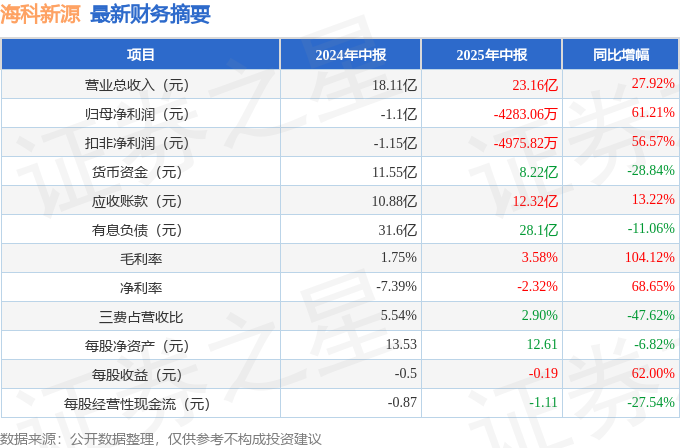
海科新源2025年中报简析:营收上升亏损收窄,盈利能力上升
Zheng Quan Zhi Xing· 2025-08-28 22:59
Core Viewpoint - Haike Xinyuan (301292) reported a significant increase in revenue and a reduction in net loss for the first half of 2025, indicating improved profitability and operational efficiency [1] Financial Performance - Total revenue for the first half of 2025 reached 2.316 billion yuan, a year-on-year increase of 27.92% compared to 1.811 billion yuan in 2024 [1] - The net profit attributable to shareholders was -42.83 million yuan, showing a 61.21% improvement from -110 million yuan in the previous year [1] - The gross margin increased to 3.58%, up 104.12% from 1.75% in 2024, while the net margin improved to -2.32%, a 68.65% increase from -7.39% [1] - Total expenses (selling, administrative, and financial) amounted to 67.23 million yuan, accounting for 2.9% of revenue, a decrease of 47.62% year-on-year [1] Cash Flow and Debt Management - Cash flow per share was -1.11 yuan, down 27.54% from -0.87 yuan in 2024, indicating challenges in cash generation [1] - The company’s interest-bearing debt decreased to 2.81 billion yuan, a reduction of 11.06% from 3.16 billion yuan [1] - The ratio of cash to current liabilities was only 41.2%, raising concerns about liquidity [3] Research and Development - The company invested 152 million yuan in R&D in 2024, representing 4.22% of revenue, and has obtained 128 patents [6] - Focus areas for R&D include lithium battery electrolyte materials and consumer chemicals, with ongoing efforts in solid-state battery electrolytes and high-purity chemicals [6] Market Position and Strategy - The company has entered the supply chains of major players like Tesla and CATL, aiming to enhance its international presence and operational efficiency [5] - A dual-driven development model of "lithium battery materials + consumer chemicals" is being pursued to strengthen core competitiveness [5] - The company plans to expand its market share through technological innovation and strategic international market development [5]
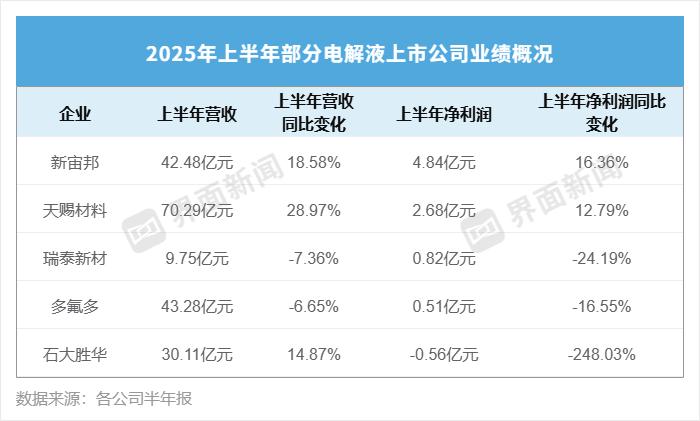
营收领跑但净利增速承压,“电解液”老大天赐材料盈利能力不敌新宙邦
Xin Lang Cai Jing· 2025-08-27 02:58
Core Viewpoint - The performance of domestic lithium battery electrolyte companies showed a divergent trend in the first half of the year, with two companies reporting profit growth while three experienced declines, including one that reported a loss [1]. Company Performance Summary - **New Zobang**: Revenue of 4.248 billion yuan, up 18.58% year-on-year; net profit of 484 million yuan, up 16.36% [2]. - **Tianqi Materials**: Revenue of 7.029 billion yuan, up 28.97% year-on-year; net profit of 268 million yuan, up 12.79% [2]. - **Ruitai New Materials**: Revenue of 975 million yuan, down 7.36% year-on-year; net profit of 82 million yuan, down 24.19% [2]. - **Duofluor**: Revenue of 4.328 billion yuan, down 6.65% year-on-year; net profit of 51 million yuan, down 16.55% [2]. - **Shida Shenghua**: Revenue of 3.011 billion yuan, up 14.87% year-on-year; net loss of 56 million yuan, a decline of 248.03% [2]. Market Dynamics - The lithium battery electrolyte industry is facing overcapacity and intense competition, leading to a significant decline in product prices and overall profitability [9][10]. - The average price of lithium iron phosphate electrolyte fluctuated between 17,600 to 23,600 yuan per ton in the first half of the year, marking a low point compared to the past three years [11]. - The market concentration of the domestic electrolyte market is increasing, with Tianqi Materials holding over 30% market share, followed by BYD and New Zobang, together accounting for 62.4% of the market [12]. Strategic Responses - Major electrolyte companies are seeking new growth points through overseas expansion and technological innovation [14]. - Tianqi Materials plans to publicly issue H-shares and apply for a listing on the Hong Kong Stock Exchange to support overseas projects [15]. - Companies are investing in the development of solid-state electrolytes and sodium-ion battery materials, with New Zobang achieving stable delivery of solid-state electrolytes and sodium-ion battery electrolytes [16].


三祥新材(603663):2025年半年报业绩点评:25H1业绩符合预期,锆铪分离有望贡献业绩弹性
Western Securities· 2025-08-25 07:21
Investment Rating - The report maintains a "Buy" rating for the company, indicating an expected investment return that exceeds the market benchmark by over 20% in the next 6-12 months [5][10]. Core Insights - The company reported a revenue of 562 million yuan for H1 2025, a year-on-year decrease of 7.35%, and a net profit attributable to shareholders of 45 million yuan, down 28.45% year-on-year [1][5]. - The company has a strong market position in sponge zircon, with a market share exceeding 50%, and is actively exploring new application scenarios for its products [2]. - The company is developing solid-state electrolyte projects and has initiated the industrialization of zirconium-hafnium separation technology, which is expected to contribute significantly to future earnings [3]. Financial Performance Summary - For H1 2025, the company achieved a gross profit margin of 23.10%, down 4.47 percentage points year-on-year, and a net profit margin of 8.04%, down 3.44 percentage points year-on-year [1]. - The company’s revenue for Q2 2025 was 331 million yuan, showing a quarter-on-quarter decrease of 5.59% but an increase of 43.51% year-on-year [1]. - The projected net profits for 2025, 2026, and 2027 are 140 million yuan, 300 million yuan, and 425 million yuan, respectively, reflecting growth rates of 84.3%, 115.0%, and 41.6% [3][4].

宁德时代供应商,又一新材料龙头,入局固态电池
DT新材料· 2025-08-24 16:04
Core Viewpoint - The article discusses the strategic partnership between Shandong Guoci Functional Materials Co., Ltd. and Mr. Wang Yan to establish a joint venture focused on solid-state battery materials, indicating a significant expansion into the energy sector [2]. Company Overview - Shandong Guoci was founded in 2005 and listed on the Shenzhen Stock Exchange in 2012, recognized as a national champion in manufacturing and a leader in advanced ceramic materials in China [2]. - The company is the first in China and the second globally to produce MLCC ceramic powder using hydrothermal methods and is the third-largest supplier of honeycomb ceramic carriers worldwide [2]. Product Range - The company's product portfolio includes electronic materials (e.g., MLCC dielectric powder), catalytic materials (e.g., honeycomb ceramics), biomedical materials (e.g., zirconia ceramics), new energy materials (e.g., barium stone, high-purity alumina), and precision ceramics (e.g., ceramic bearing balls) [3]. - Key clients in the lithium battery sector include BYD, CATL, Enjie, and Xingyuan Materials [3]. Financial Performance - For the first half of 2025, the company reported a revenue of 2.154 billion yuan, a year-on-year increase of 10.29%, and a net profit attributable to shareholders of 331.7 million yuan, up 0.38% from the previous year [4]. - The net cash flow from operating activities reached 333.1 million yuan, reflecting a significant year-on-year growth of 116.11% [4]. Segment Analysis - The electronic materials segment generated revenue of approximately 344.4 million yuan, with a gross margin of 32.97%, showing a year-on-year increase in revenue of 23.65% but a decrease in gross margin by 2.61% [5]. - The catalytic materials segment reported revenue of about 456 million yuan, with a gross margin of 41.80%, reflecting a revenue increase of 12.34% and a gross margin decrease of 1.76% [5]. - The biomedical materials segment achieved revenue of approximately 438 million yuan, with a gross margin of 52.18%, showing a slight decline in revenue growth of 0.11% and a decrease in gross margin by 5.73% [5]. - The new energy materials segment generated revenue of around 216.8 million yuan, with a gross margin of 21.19%, indicating a revenue increase of 26.36% and a marginal increase in gross margin by 0.13% [5].

2025年H1电解液市场盘点——全球电解液产量超过100万吨,同比增速46.7%
鑫椤锂电· 2025-07-14 07:15
Core Viewpoint - The global electric vehicle supply chain remains highly prosperous in the first half of 2025, driving strong growth in the upstream electrolyte market, with China's dominant position in the global market further strengthened [1]. Production and Growth - In the first half of 2025, domestic electrolyte production in China reached 941,000 tons, a year-on-year increase of 54.57%, while global electrolyte production was 1,005,000 tons, with a year-on-year growth of 46.71% [2]. - It is projected that global electrolyte production will exceed 2.1 million tons in 2025 [2]. Market Trends - Despite a slowdown compared to the over 80% growth rates of 2022-2023, the year-on-year growth of nearly 55% in China and over 46% globally in the first half of 2025 indicates strong market momentum even at high base levels [4]. - The domestic market is highly competitive, particularly among second-tier companies, with market shares closely contested [4]. Competitive Landscape - The market concentration continues to rise, with leading companies holding significant advantages. Tianqi Materials leads with over 30% market share, followed by BYD and New Zhongbang [7]. - The top three companies (Tianqi, BYD, New Zhongbang) collectively hold a market share of 62.4%, firmly controlling the market [8]. - Second-tier manufacturers, including Xianghe Kunlun and Zhuhai Saiwei, have market shares around 4-5%, indicating fierce competition [8]. Global Market Dynamics - Only Yienke has entered the global top thirteen rankings, while other overseas companies are falling behind, leading to a gradual decrease in their market share [9]. - The electrolyte market in the first half of 2025 continued its high growth trend, with Chinese companies maintaining a core position in the global supply chain [11]. Future Outlook - As the global electrification process deepens, technological iterations (such as new lithium salts and solid-state electrolyte exploration) and cost control capabilities will be key for companies to maintain and enhance competitiveness [11]. - The industry concentration is expected to further tilt towards leading companies, with China's electrolyte industry continuing to empower the development of the global electric vehicle industry through its scale and technological advantages [11].