非标商业

Search documents
中海大吉巷,初见很惊喜,然后呢?
3 6 Ke· 2025-06-26 02:41
Core Insights - The opening of Dajixiang in Xicheng District has attracted significant foot traffic, with over 200,000 visitors on its opening day and more than 500,000 during the three-day Dragon Boat Festival holiday [1] - Dajixiang has generated mixed reviews on social media, with some praising its unique architectural style and others criticizing its brand offerings and overall experience [3][4] Group 1: Location and Accessibility - Dajixiang is well-located with easy access via major roads and direct subway connections, filling a commercial gap in the historically underserved Caishikou area [4][6] - The architectural design incorporates traditional elements, creating a unique shopping experience that resonates with local culture [6][8] Group 2: Experience and Offerings - The mall features a blend of indoor and outdoor spaces, enhancing the shopping experience through various leisure and commercial interactions [8][10] - Some brands introduced at Dajixiang aim to reflect new Chinese lifestyle aesthetics, but the overall brand mix lacks clarity and alignment with local consumer needs [12][14] Group 3: Challenges and Limitations - Dajixiang's positioning as a "city living room" may not resonate with the local demographic, as it lacks essential amenities like supermarkets and cinemas [14][15] - The mall's cultural narrative appears underdeveloped, with limited activities and events to engage visitors beyond the initial novelty [19][21] Group 4: Market Context and Future Prospects - The broader context of commercial revitalization in Beijing's second ring road highlights the need for distinctive offerings to attract consumers amidst increasing competition [28][39] - The success of Dajixiang will depend on its ability to sustain operations and integrate local culture into its commercial framework, moving beyond superficial updates to create a meaningful consumer experience [27][39]


“非标商业”何以聚客流
Jing Ji Ri Bao· 2025-06-04 22:03
Core Insights - The rise of non-standard commercial projects is gaining attention, characterized by innovative layouts and unique brand combinations that cater to diverse consumer needs [1][2] Group 1: Characteristics of Non-Standard Commercial - Non-standard commercial projects are open-space layouts that create distinctive scenes, appealing to younger consumers for social interactions and shopping experiences [1][2] - These projects often repurpose old neighborhoods and abandoned factories, revitalizing forgotten spaces while preserving their original cultural significance [1][2] Group 2: Consumer Experience and Market Trends - In the context of consumption upgrades, traditional shopping models are becoming inadequate, leading to the emergence of non-standard commercial spaces that enhance consumer experiences through social and cultural interactions [2][3] - The essence of non-standard commercial is to create engaging environments that attract foot traffic, integrating social, entertainment, and cultural elements into the shopping experience [2] Group 3: Challenges and Recommendations - Despite the rapid growth of non-standard commercial projects, some face challenges due to a lack of clear understanding of their unique characteristics, leading to homogenization and failure to resonate with the market [2][3] - To build sustainable competitive brands, projects should deeply explore local history and culture, ensuring that consumer needs and preferences are prioritized in design and operations [3]
总被厦门抢风头的福州,要靠非标商业“顶流”争口气!
3 6 Ke· 2025-05-28 02:09
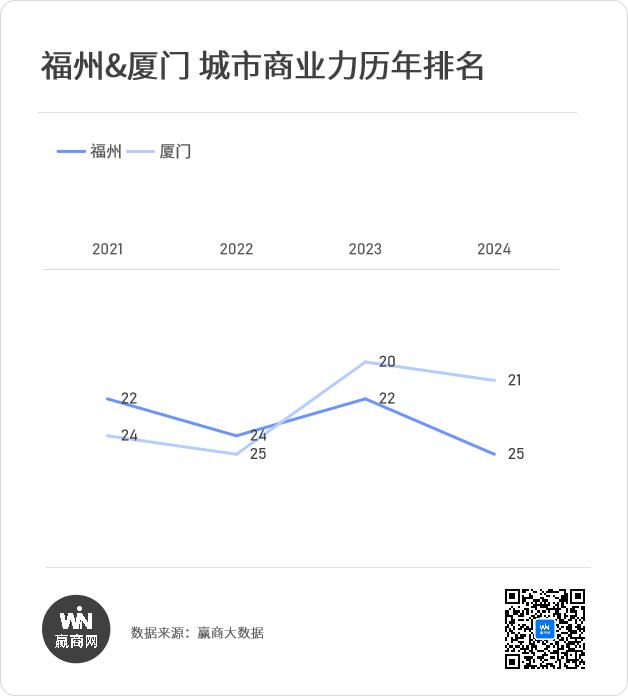
Core Insights - Fuzhou has seen significant economic growth, achieving the highest GDP in Fujian province for four consecutive years, with a projected GDP of 1,423.68 billion yuan in 2024, reflecting a growth rate of 6.1% [3][5] - Despite its economic strength, Fuzhou's commercial power lags behind Xiamen, ranking 25th nationally in commercial strength, marking its lowest position in four years [3][5] - The city is transitioning into a phase where growth opportunities are increasingly found in county-level markets, as Fuzhou's shopping center stock leads Xiamen but is experiencing slower growth [5][7] Economic Performance - Fuzhou's GDP reached 1,423.68 billion yuan in 2024, with a growth rate of 6.1% [3] - The city's GDP ranking has improved, surpassing Quanzhou and positioning Fuzhou among the top 17 cities nationwide by 2024 [3] Commercial Landscape - Fuzhou has a total shopping center stock of 5.356 million square meters, compared to Xiamen's 4.697 million square meters, but the growth in new shopping centers is slower in Fuzhou [5][7] - The per capita shopping center area in Fuzhou is 0.63 square meters, indicating potential for further development, while Xiamen's is 0.88 square meters, suggesting a more saturated market [7] Project Development - Fuzhou's commercial projects have historically been dominated by standardized box malls, but recent innovative projects like Yantai Mountain have introduced new concepts [9][11] - The city is seeing the introduction of high-profile projects such as Shangri-La's "Eight Cubes" and the "Yantai Mountain" street, which have attracted significant attention and foot traffic [11][36] Consumer Behavior - Fuzhou's consumer spending power is lower than that of Xiamen, with a per capita disposable income of 51,460 yuan compared to Xiamen's 74,249 yuan [17] - Despite having the highest number of wealthy families in Fujian, the conversion of high-end consumption remains limited, leading to a shift in positioning for luxury projects like Fuzhou's MixC [17][27] Market Trends - Fuzhou's commercial landscape is characterized by a focus on local consumer needs, with a lack of ambition to attract external markets, which may hinder its competitive edge [51] - The city is embracing cultural integration and innovative commercial formats, with new projects focusing on sports, culture, and experiential retail to enhance its appeal [51][54]
非标商业,水灵灵的活力从哪来?
Ren Min Ri Bao Hai Wai Ban· 2025-05-26 22:25
Core Insights - The rise of non-standard commercial spaces, which are creatively transformed from traditional sites like warehouses and factories, is attracting consumers in major cities like Beijing and Shanghai [1][3] - These spaces offer not just shopping but also social and entertainment experiences, creating a vibrant atmosphere that appeals to a diverse audience [2][6] Group 1: Characteristics of Non-Standard Commercial Spaces - Non-standard commercial projects break away from traditional retail models, focusing on personalization and differentiation [3][4] - The number of non-standard commercial projects has significantly increased in first and second-tier cities, with examples including THE BOX in Beijing and Longhua Club in Shanghai [3][6] - These projects often feature smaller, flexible spaces under 50,000 square meters, primarily in open street formats that encourage social interaction [3][6] Group 2: Consumer Experience and Engagement - Consumers are drawn to the unique experiences offered by these spaces, such as outdoor environments and creative atmospheres that enhance emotional value [2][8] - Non-standard commercial spaces often host various events and activities, keeping the experience fresh and engaging for visitors [8][10] - The integration of personalized brands within these spaces fosters a community of like-minded individuals, enhancing the overall consumer experience [6][10] Group 3: Operational Strategies for Success - Successful non-standard commercial projects rely on three key logics: industrial logic, community logic, and design-driven logic [9][10] - Brands within these spaces benefit from a supportive environment that allows for creative freedom and innovation, leading to higher engagement with target audiences [5][9] - Long-term sustainability is crucial, with a focus on maintaining fresh offerings and strong product quality to ensure ongoing consumer interest [8][11]
“网红”商场TX淮海操盘人司徒文聪被限制消费
Xin Lang Cai Jing· 2025-05-19 05:17
Core Viewpoint - The article discusses the financial troubles faced by Si Tu Wencong, a prominent figure in the commercial real estate sector, particularly related to his management of various non-standard commercial projects in major cities like Shanghai and Beijing [2][3]. Group 1: Financial Issues - Si Tu Wencong has been subjected to consumption restrictions due to his company, Shanghai Yingzhan Business Management Co., Ltd., failing to fulfill financial obligations, including unpaid rent and penalties totaling nearly 1.5 million yuan since April 2022 [5]. - The financial difficulties of Yingzhan Company are attributed to significant project losses, leading to concerns about potential bankruptcy if obligations are not met [5]. - Other companies under Si Tu Wencong's name are also facing legal disputes, with one company, Beijing Yingtong Xiangye Commercial Management Co., Ltd., involved in cases with execution amounts exceeding 70 million yuan [6]. Group 2: Project Management and Challenges - Si Tu Wencong gained fame for revitalizing commercial properties, but recent projects have not achieved profitability, contributing to his current financial struggles [7]. - His approach to project management involved deep integration with family members, where he leveraged personal connections to secure project opportunities [8]. - The operational model of the non-standard commercial projects he managed has proven challenging, as they require long-term investment and often depend on owner subsidies for sustainability [11]. Group 3: Project Outcomes and Ownership Changes - The TX Huaihai project, once a high-profile venture, has faced scrutiny regarding its operational model, with concerns about whether it is financially viable [12]. - Ownership of TX Huaihai has shifted, with the main operating company being acquired by Bailian Group, indicating a change in management strategy [12]. - Despite the management changes, TX Huaihai has maintained its original branding and positioning, suggesting ongoing support from the project owners [12].
新华网财经观察丨不按套路出牌 撬动商业新模式
Xin Hua Wang· 2025-05-13 02:17
Core Insights - The article discusses the rise of "non-standard commercial" projects as a key to driving innovation in traditional business, which faces homogenization challenges [2][5][12] - These projects leverage unique local characteristics and immersive experiences to attract younger consumers, creating a new consumption trend [7][9][19] Group 1: Characteristics of Non-Standard Commercial - Non-standard commercial spaces break away from traditional standardized shopping experiences, offering unique and personalized environments [5][9] - Examples include Shanghai's Panlong Tiandi, which integrates modern commerce with historical architecture, and Changchun's "This Has Mountains," which creates an immersive shopping experience [5][7] - Data from Meituan indicates that commercial spaces with regional cultural tags have a 38% higher repurchase rate compared to standard malls [9] Group 2: Consumer Engagement and Experience - Younger consumers are drawn to non-standard commercial spaces for their interactive and aesthetically pleasing environments, which foster a sense of community and engagement [11][19] - Non-standard commercial projects often feature high-frequency content updates and customized operations, enhancing consumer retention and experience [11][12] - The emotional release and immersive experiences offered by these spaces are becoming significant factors influencing consumer decisions [12][19] Group 3: Market Trends and Growth - The non-standard commercial sector is rapidly expanding, with significant growth in new projects, particularly in cities like Chengdu, where the supply of non-standard commercial space has surpassed traditional formats [17][19] - The rise of "first-store economy" complements non-standard commercial, with many new brands seeking unique spaces to enhance their market presence [17][19] - Industry experts highlight the importance of strategic planning and location selection for the success of non-standard commercial projects, emphasizing the need for a deep understanding of target demographics [19][23] Group 4: Operational Challenges and Sustainability - Despite the popularity of non-standard commercial spaces, challenges remain regarding their long-term sustainability and operational efficiency [18][19] - Issues such as poor design and high operational costs can hinder the consumer experience, leading to potential declines in foot traffic [18][19] - Successful non-standard commercial projects require experienced management teams capable of integrating brand resources and creating engaging consumer experiences [23]


不按套路出牌 撬动商业新模式
Xin Hua Wang· 2025-05-13 02:06
Core Insights - The article discusses the rise of "non-standard commercial" projects as a key to driving innovation in traditional business, which faces homogenization challenges [1][3] - These projects leverage unique cultural and historical elements to create engaging consumer experiences, appealing particularly to younger demographics [1][4] Group 1: Characteristics of Non-Standard Commercial - Non-standard commercial spaces break away from traditional retail formats, offering diverse and immersive experiences [6][9] - Examples include Shanghai's Panlong Tiandi, which integrates modern commerce with historical architecture, and Changchun's "This Has Mountains," which creates a unique shopping experience resembling mountain climbing [4][6] - Non-standard commercial projects often feature high customer engagement, with daily foot traffic reaching 30,000 in some locations [4] Group 2: Consumer Preferences and Trends - Young consumers are drawn to non-standard commercial spaces for their unique aesthetics, interactive experiences, and the opportunity for social engagement [8][10] - Data shows that commercial spaces with regional cultural elements have a 38% higher repurchase rate compared to standard malls [6] - The emotional aspect of shopping is becoming increasingly important, influencing consumer decisions and driving the popularity of immersive experiences [10][12] Group 3: Operational Strategies - Non-standard commercial projects often employ high-frequency content updates and customized operations to maintain consumer interest [9][12] - The integration of fixed and fluid content, such as events and workshops, enhances the commercial viability of these spaces [10][12] - Successful non-standard commercial spaces require careful planning and execution, including understanding local demographics and consumer preferences [18][19] Group 4: Market Dynamics and Future Outlook - The non-standard commercial sector is experiencing rapid growth, with significant increases in new project developments, particularly in cities like Chengdu [13][14] - The rise of first-store economies is closely linked to non-standard commercial spaces, which provide platforms for new brands to establish themselves [13] - Ongoing urban renewal initiatives and supportive government policies are expected to further boost the development of non-standard commercial projects [12][19]