网络安全

Search documents
绿盟科技:为关键信息基础设施网络安全保驾护航
Zheng Quan Ri Bao Wang· 2025-12-15 12:14
Core Viewpoint - The company, Green Alliance Technology (300369), emphasizes its commitment to safeguarding critical information infrastructure through years of experience in cybersecurity practices [1] Group 1 - The company leverages its extensive experience in cybersecurity to meet the protection requirements of critical information infrastructure [1] - The company actively engages with investors, providing insights into its operational focus on network security [1]

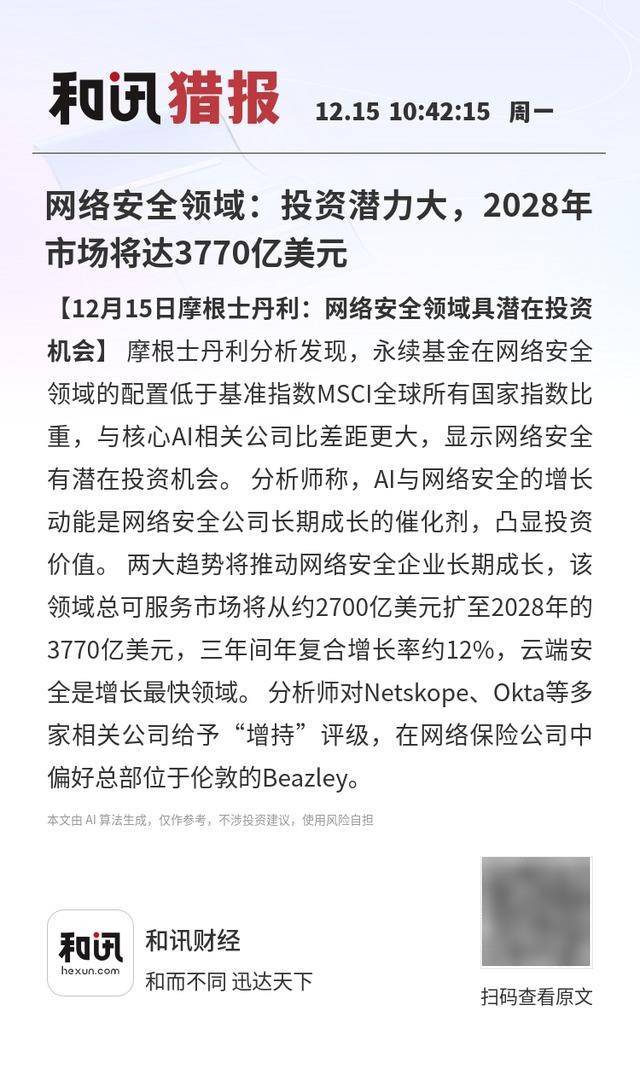
网络安全领域:投资潜力大,2028年市场将达3770亿美元
Sou Hu Cai Jing· 2025-12-15 03:45
Core Insights - Morgan Stanley identifies potential investment opportunities in the cybersecurity sector, noting that perpetual funds are under-allocated compared to the MSCI All Country World Index, with an even larger gap compared to core AI-related companies [1] Industry Summary - The growth momentum of AI and cybersecurity is highlighted as a catalyst for the long-term growth of cybersecurity companies, emphasizing their investment value [1] - The total addressable market for the cybersecurity sector is projected to expand from approximately $270 billion to $377 billion by 2028, reflecting a compound annual growth rate (CAGR) of about 12% over three years [1] - Cloud security is identified as the fastest-growing area within the cybersecurity sector [1] Company Summary - Analysts have assigned "overweight" ratings to several companies in the cybersecurity space, including Netskope and Okta, with a preference for Beazley, a London-based cyber insurance company [1]

飞络24小时前沿AI快报|12月15日:90%的企业计划在2026年增加AI相关支出
Sou Hu Cai Jing· 2025-12-15 03:14
Global AI Insights - Runway has launched the first general world model GWM-1 and its variants, which support real-time interactive control and are foundational for embodied intelligence and interactive content creation [3] - A survey indicates that over 90% of enterprises plan to increase AI-related spending by 2026, with 60% of projects already in production, marking AI spending as a core driver of IT budget expansion [3] - Liu Fanping, founder of RockAI, emphasizes the need to overcome two major technical bottlenecks in AI, proposing a new Yan architecture model that achieves brain-like activation and real-time memory on mobile devices [3] - The core scale of China's AI industry has exceeded 900 billion yuan in 2024, with expectations to surpass 1.2 trillion yuan by 2025, driven by increased applications in manufacturing [3] Cloud Services Updates - Amazon Web Services (AWS) has released the Graviton5 custom CPU, which offers a 25% performance improvement over its predecessor, enhancing memory and network capabilities for memory-intensive tasks [5] - Twelve partners from China received the AWS 2025 Partner Awards, recognizing their contributions across various categories [6] - Alibaba Cloud reported a 34% year-on-year revenue growth for Q2 of FY2025, with AI product revenue achieving triple-digit growth for nine consecutive quarters due to rising demand for AI tools [7] - China Telecom's Chairman, Ke Ruiwen, announced the establishment of the "Xirang" intelligent cloud system, promoting deep integration of AI with the real economy [8] Cybersecurity Developments - The U.S. Federal Trade Commission (FTC) and the Department of Commerce have introduced a new regulatory framework for generative AI, focusing on bias detection and data privacy [10] - A data breach involving 2.5 million user records from Volkswagen's Indian dealer system has been reported on the dark web, with no response from Volkswagen yet [11] - The National Cybersecurity Awareness Week in China concluded with the release of version 2.0 of the AI Security Governance Framework, emphasizing ethical standards and risk monitoring [12] - The revision of China's Cybersecurity Law has introduced new clauses for AI governance, requiring companies to enhance ethical reviews and data security management [14]

大摩:网络安全仍具潜在的投资机会,予Okta、Palo Alto Networks等多股“增持”评级
Ge Long Hui· 2025-12-15 02:39
Core Insights - Morgan Stanley's analysis indicates that perpetual funds, which select companies and assets based on Environmental, Social, and Governance (ESG) criteria, have lower allocations in the cybersecurity sector compared to the MSCI All Country World Index. This gap is even larger when compared to core AI-related companies, suggesting significant investment opportunities in cybersecurity [1] Group 1: Market Trends - The growth momentum of AI and cybersecurity is expected to provide long-term growth catalysts for cybersecurity companies, highlighting their investment value [1] - The total addressable market for cybersecurity is projected to grow from approximately $270 billion to $377 billion by 2028, representing a compound annual growth rate (CAGR) of about 12% over three years [1] - Cloud security is identified as the fastest-growing area within cybersecurity [1] Group 2: Company Ratings - Analysts have assigned "overweight" ratings to several companies in the cybersecurity sector, including Netskope, Okta, Palo Alto Networks, Varonis Systems, and Zscaler [1] - Among cyber insurance companies, preference is given to Beazley, which is headquartered in London [1]




英国金融时报:欧洲必须准备迎接人工智能泡沫的破裂
美股IPO· 2025-12-13 16:03
Europe must be ready when the AI bubble bursts 市场调整将使欧盟有机会提供一种基于信任的替代方案,以取代美国的技术。 © 安·基尔南 本文作者是斯坦福大学以人为本人工智能研究所的研究员,著有《科技政变》一书。 美国新国家安全战略的一大启示是,华盛顿对一个强大的欧盟——无论是作为单一市场、民主集 团,还是至关重要的科技监管机构——都极为担忧。与此同时,欧洲人经常听到美国人说欧洲在人 工智能竞赛中落后。超大规模模式被奉为圭臬,而欧洲根本缺乏与之竞争的资源。 但美国主导的资源密集型人工智能平台泡沫无法持久。市场调整将促使人们关注其他模式。这反过 来又将为欧洲创造新的机遇,欧洲在应用人工智能领域拥有优势,并有机会构建全球最值得信赖的 人工智能技术栈。 德国汽车制造商并不需要一台训练有素、涵盖整个互联网信息的聊天机器人。它受益于基于高质量 工程数据训练的人工智能系统,这些系统能够优化制造流程、预测维护需求或简化安全报告。荷兰 医院需要的是符合医疗标准的诊断工具,而不是可能产生医疗错误信息的通用系统。而法国银行则 需要能够在遵守严格的金融服务监管规定的同时,提升效率的人工智能 ...

市场消息:日本将对太阳能发电系统的网络安全提出要求。
Xin Lang Cai Jing· 2025-12-12 23:37
Group 1 - Japan will impose cybersecurity requirements on solar power generation systems, indicating a regulatory shift towards enhancing the security of renewable energy infrastructure [1] - The move aims to protect solar energy systems from potential cyber threats, reflecting growing concerns over the vulnerability of critical energy infrastructure [1] - This initiative may influence the solar energy market in Japan, potentially leading to increased costs for compliance and investment in cybersecurity measures [1]

机构:2025年前三季度全球科技并购市场总交易金额达到7871亿美元
Zheng Quan Shi Bao Wang· 2025-12-12 09:03
Core Insights - The 2025 Technology M&A Market Survey Report indicates a decline in the number of M&A transactions in the computer software, hardware, and semiconductor sectors during the first three quarters of 2025, while the transaction value increased by 60.2% to reach $787.1 billion [1] Group 1: Market Trends - The transaction value in the global technology M&A market is dominated by the United States, accounting for approximately two-thirds of the total [1] - The global technology M&A landscape is becoming more fragmented, with Europe and Asia emerging as new hotspots for transactions [1] Group 2: Investment Preferences - Respondents show a preference for acquiring younger companies with a development time of two to five years [1] - There is a strong interest in high-growth opportunities, particularly in disruptive sectors such as AI and cybersecurity [1]
网站被“黑”只“擦脸” 网警严惩表面整改
Yang Shi Xin Wen· 2025-12-12 07:05
Core Viewpoint - Companies must prioritize comprehensive cybersecurity measures rather than superficial fixes to avoid legal repercussions and ensure the safety of their network systems [1] Incident Summary - A company in Sanmenxia, Henan, experienced a cyber attack that altered its website to display gambling content due to an SQL injection vulnerability that was not promptly addressed [2] - After the initial attack, local cybersecurity authorities notified the company to investigate and rectify the vulnerabilities, but the company only removed the altered page without fixing the underlying SQL injection issue, leading to a repeat attack [2] - The local police are pursuing legal action against the company and its responsible personnel for failing to fulfill cybersecurity obligations as mandated by the Cybersecurity Law of the People's Republic of China [2] Legal Framework - According to Article 27 of the Cybersecurity Law (2025 Revision), network operators are required to develop emergency response plans for cybersecurity incidents and report to relevant authorities when such incidents occur [3] - Article 61 states that failure to comply with cybersecurity obligations can result in fines ranging from 10,000 to 50,000 yuan, with higher penalties for repeated non-compliance or resulting damages [3] Cybersecurity Recommendations - Following a cyber attack, network operators should implement a "four-step closed-loop" approach: 1. Immediately report the situation and cooperate with investigations 2. Accurately trace the source of the problem and identify the cause of the incident 3. Thoroughly repair vulnerabilities and enhance security measures 4. Conduct regular monitoring and risk assessments [4]
越南在胡志明市设立国家网络安全协会南部分会
Shang Wu Bu Wang Zhan· 2025-12-11 17:20
(原标题:越南在胡志明市设立国家网络安全协会南部分会) 今后,南部分会将做好以下工作:加强宣传;根据地方与企业实际需求,组织培训班和技术演练; 推动研究院—高校—企业联动,形成人才培养生态;成立"南部培训与应急响应支援中心";加强国际合 作,逐步掌握新技术;建立南部网络安全快速反应队伍,24小时全天候协调处理事件;与企业界和职能 机关共享预警数据、恶意代码分析和数字取证成果等。 阮明政表示,南部分会的成立旨在构建一个连接并直接开展网络安全任务、推动人才发展、提升认 知水平并加强全区域防御能力的组织体系,从而为越南数字经济安全与可持续发展作出切实贡献。 公安部网络安全与高科技犯罪防范局局长黎春明少将表示,胡市是全国最大经济、金融、贸易和科 技中心,也是网络安全风险聚集重点区域,各类利用新技术实施的诈骗、攻击入侵、数据窃取、身份伪 造等行为日益复杂。在此背景下,国家网络安全协会与该局联合设立南部分会,具有战略性和紧迫性意 义。 越通社12月8日报道,面对当前网络攻击和高科技网络诈骗犯罪日益复杂态势,越南公安部当日在 胡志明市设立国家网络安全协会南部分会,胡市人委会主席阮文得、国家网络安全协会常务副主席阮明 政中将 ...
中国驻挪威使馆发声!
券商中国· 2025-12-11 15:19
违法和不良信息举报电话:0755-83514034 邮箱:bwb@stcn.com 券中社 × 券商中国 券 中 社 扫码下载券中社APP 扫码关注券商中国公众号 quanshangcn qzs.stcn.com 舞中 券中社APP 券 商 中 国 是 证 券 市 场 权 威 媒 体 《 证 券 时 报 》 旗 下 新 媒 体 , 券 商 中 国 对 该 平 台 所 刊 载 的 原 创 内 容 享 有 著 作 权 , 中国驻挪威使馆新闻发言人表示, 近日,挪外交部在X平台发帖,追随英方炒作所谓"中国网络攻击"。中方对 此坚决反对。英方蓄意诬蔑中国并对中国实体进行非法单边制裁,性质十分恶劣,中方已向英方提出严正交 涉。中方坚决反对并依法打击黑客活动,坚决反对出于政治目的散布虚假信息。中国是网络攻击的最大受害 者,多次遭受来自美、英等五眼联盟和北约成员国的网络攻击,证据确凿。挪方若真心关注网络安全,理应明 辨是非,独立作出判断,而非随他国起舞,污蔑抹黑中国。 网络安全是全球共同挑战。中方敦促挪方摒弃双重标准,停止跟风炒作,以负责任和建设性态度,与中方共同 维护网络空间和平、稳定和繁荣。 来源:中国驻挪威大使馆 责 ...