
永续基金

Search documents
超额回报光环褪色、银行业“反击”,私募信贷热潮正在降温
Zhi Tong Cai Jing· 2025-12-30 11:43
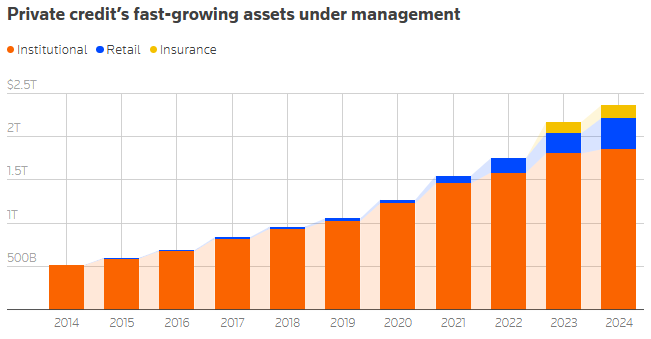
Core Viewpoint - The private credit industry, once distinct for its unique advantages, is increasingly resembling the public credit market, leading to a decline in return rates as banks recover and direct lending institutions invest heavily in retail tools [1][9]. Group 1: Industry Growth and Trends - The private credit industry's asset size has steadily grown to $2.4 trillion by 2024, with traditional closed-end funds raising $113 billion in the first half of 2025 [2]. - New funding sources, such as perpetual funds like Blackstone's BCRED, are rapidly gaining popularity, raising $48 billion in the first half of 2025, accounting for 40% of inflows into traditional institutional funds [2]. - The pursuit of retail funds is expected to continue, with estimates suggesting that individual wealth allocated to private credit could grow nearly fourfold to $1.5 trillion by 2029 [2]. Group 2: Challenges and Market Dynamics - A significant amount of raised capital, amounting to $543 billion, remains uninvested as of the end of 2024, indicating challenges in finding suitable investment opportunities [5]. - The additional premium that direct lending institutions charge over publicly issued bonds is under pressure, having halved in Europe to just over 1 percentage point, and sometimes even lower in the U.S. [8]. - Private credit is becoming a common financing tool in traditional acquisition markets, with borrowers increasingly leveraging competition between markets and lenders [9]. Group 3: Evolving Financing Structures - Direct lending institutions are adapting by offering more flexible loan structures, such as installment loans, to attract borrowers like private equity firms [8]. - Private credit managers are exploring new growth areas, with firms like Blue Owl becoming key players in financing AI assets, while Apollo utilizes its insurance arm to provide tailored financing to higher-rated companies [8]. - The lines between private and traditional credit are blurring, with retail fund growth potentially narrowing the gap and leading to a world of lower returns and higher liquidity [9].


大摩:网络安全仍具潜在的投资机会,予Okta、Palo Alto Networks等多股“增持”评级
Ge Long Hui· 2025-12-15 02:39
Core Insights - Morgan Stanley's analysis indicates that perpetual funds, which select companies and assets based on Environmental, Social, and Governance (ESG) criteria, have lower allocations in the cybersecurity sector compared to the MSCI All Country World Index. This gap is even larger when compared to core AI-related companies, suggesting significant investment opportunities in cybersecurity [1] Group 1: Market Trends - The growth momentum of AI and cybersecurity is expected to provide long-term growth catalysts for cybersecurity companies, highlighting their investment value [1] - The total addressable market for cybersecurity is projected to grow from approximately $270 billion to $377 billion by 2028, representing a compound annual growth rate (CAGR) of about 12% over three years [1] - Cloud security is identified as the fastest-growing area within cybersecurity [1] Group 2: Company Ratings - Analysts have assigned "overweight" ratings to several companies in the cybersecurity sector, including Netskope, Okta, Palo Alto Networks, Varonis Systems, and Zscaler [1] - Among cyber insurance companies, preference is given to Beazley, which is headquartered in London [1]




零售+永续基金双轮驱动 黑石(BX.US)Q2可分配收益飙升25%
Zhi Tong Cai Jing· 2025-07-24 12:31
Core Insights - Blackstone's distributable earnings surged by 25% in Q2, driven by contributions from retail and perpetual funds [1][3] - The company's performance was bolstered by a 167% year-over-year increase in fee-related performance income, amounting to $472 million [2][3] - The total distributable earnings reached $1.57 billion, translating to earnings per share of $1.21, exceeding market expectations of $1.10 [3] Fund Performance - Blackstone raised $52 billion in new capital during the quarter, with approximately 20% coming from private wealth channels [4] - The firm manages $280 billion in assets for private wealth clients, representing about a quarter of its total $1.2 trillion in managed assets [4] - The private equity segment saw a 12% year-over-year increase in net realizations, while the real estate segment experienced a 37% decline [4] Market Environment - The perpetual fund business has become a strong growth driver for the company amid a challenging transaction environment [3][4] - The credit and insurance segments continue to thrive, accounting for over half of the company's net flows during the quarter [4] - Despite a slowdown in transaction channels following tariff impositions, there are signs of expansion in the current market [4]