
去中心化金融

Search documents
中国银行原行长李礼辉: 数字人民币的国际化
Sou Hu Cai Jing· 2025-12-02 13:31
Core Viewpoint - The "2025 Shenzhen International Financial Conference" focuses on the theme of "Building a Financial Power and High-Level Opening Up in the Greater Bay Area," discussing the strategic path for China's financial development amid global economic changes [1]. Digital Currency Development - The digital RMB has undergone three phases since 2014: theoretical research, closed-loop pilot, and open pilot, gradually being promoted in daily life [3]. - The digital RMB features a centralized management and dual-layer operation model, ensuring reliable monetary policy transmission and efficient monetary control [3]. - It possesses both account and value characteristics, allowing for value transfer without the need for a bank account, thus reducing reliance on financial intermediaries [4]. Technological Infrastructure - The digital RMB employs a hybrid technical architecture that combines centralized and distributed systems, supporting high transaction volumes and continuous operations [4]. - It can load smart contracts, enabling programmability and automatic payment transactions based on agreed conditions [4]. - The digital RMB aims for greater internationalization, advanced digitization, and broader tool functionality, expanding its use beyond daily transactions to digital asset trading platforms [5][6]. Challenges and Strategic Responses - The digital RMB faces challenges from the U.S. financial hegemony and competition in the domestic mobile payment market [1][7]. - To counter U.S. monetary dominance, China aims to enhance the stability of the RMB, promote a multi-polar currency system, and establish a robust cross-border payment infrastructure [9][10]. - The digital RMB is positioned as a credible digital payment tool backed by national credit, aiming to compete with U.S. stablecoins [10]. Market Application and Expansion - In 2024, mobile payments in China reached 2,109.8 billion transactions, with a total transaction amount of 563.7 trillion yuan, dominated by Alipay and WeChat Pay [12]. - By mid-2025, the cumulative transaction amount of digital RMB is expected to reach 12.9 trillion yuan, with 3.16 billion transactions [12]. - The digital RMB will continue to expand its application scenarios, including personal payments, merchant payments, and cross-border transactions, while optimizing user experience and acceptance environments [12][13].



比特币暴跌背后:美联储鹰派 + 监管扯皮 + 机构出逃 + 持有者跑路,五大杀招下还有生路吗?
Hua Er Jie Jian Wen· 2025-11-28 13:33
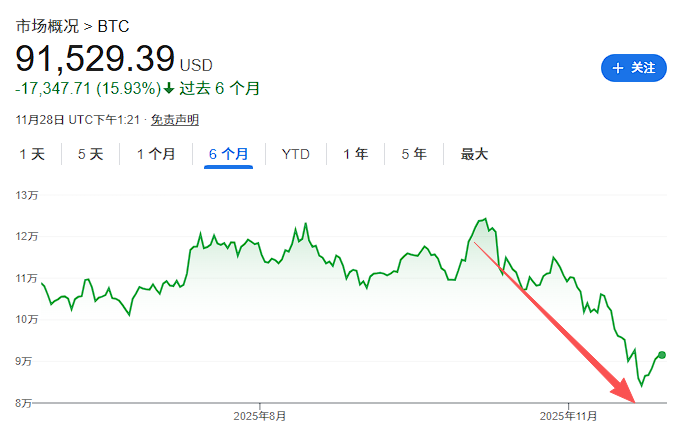
Core Viewpoint - Bitcoin has experienced a significant decline, dropping from approximately $125,000 in early October to around $80,000, a decrease of nearly 35%. The entire cryptocurrency market has lost about $1 trillion in market capitalization, reflecting a 24% drop. The current price recovery to above $90,000 is still uncertain due to various macroeconomic and regulatory pressures [1][2][21]. Market Dynamics - The recent sell-off of Bitcoin has occurred in tandem with declines in the U.S. stock market and other risk assets, indicating a loss of its status as a safe-haven asset. The correlation between Bitcoin and the Nasdaq 100 index has reached 46%, while its correlation with the S&P 500 index is at 42% [2][5]. - Traditional safe-haven assets like gold and U.S. Treasury bonds have outperformed Bitcoin during periods of macroeconomic uncertainty, suggesting a shift in investor sentiment [5]. Federal Reserve Influence - There is a strong negative correlation between Bitcoin prices and Federal Reserve interest rates, with historical data showing a correlation of -90% during the Fed's rate hike cycle in 2022. Recent hawkish comments from Fed officials have triggered market panic, leading to significant price drops for Bitcoin [6][7]. Regulatory Environment - The lack of regulatory clarity has dampened market confidence. The stalled progress of the CLARITY Act in the Senate is seen as a setback for the cryptocurrency market, with expectations that it may not be signed into law until 2026 [8][9]. - The absence of regulatory momentum is hindering institutional investor participation and market liquidity [9]. Institutional Behavior - Institutional funds that previously supported Bitcoin's bull market are now exiting, creating a negative feedback loop where price declines lead to liquidity shortages, further exacerbating price drops [10][11][16]. - Recent data indicates significant outflows from U.S. spot Bitcoin ETFs, contrasting sharply with earlier inflows [13]. Long-term Holder Activity - Long-term holders, typically seen as market stabilizers, have begun to sell off their Bitcoin holdings, with over 800,000 Bitcoins sold in the past month, marking the highest level of selling since January 2024. This has increased market supply and severely impacted market confidence [17][18][19]. Future Outlook - The path to recovery for Bitcoin is fraught with uncertainty, heavily reliant on regulatory clarity, particularly regarding the CLARITY Act, and the adoption of stablecoins by mainstream institutions to enhance market liquidity [22]. Additionally, growing interest from governments and central banks in crypto assets may provide new long-term support for the market [23].
1 Spectacular Cryptocurrency to Buy Before It Soars 147%, According to a Top Wall Street Analyst
The Motley Fool· 2025-11-27 09:12
Core Viewpoint - Tom Lee predicts that Ether could reach $7,000 per coin by Q1 2026, representing a potential upside of 147% from its current level, driven by the ongoing demand for Ether as the Ethereum network grows in popularity [3][10]. Group 1: Ethereum Network and Demand - The Ethereum network is a leading platform for decentralized applications, creating ongoing demand for Ether as users incur fees when utilizing these applications [2][3]. - The network has maintained zero downtime over the past decade, supported by its decentralized structure, which enhances reliability for developers [3][4]. Group 2: Smart Contracts and Decentralized Applications - Smart contracts, which are integral to decentralized applications on Ethereum, ensure that applications remain decentralized and protected from manipulation [4]. - Notable decentralized applications like Uniswap facilitate trading without intermediaries, further driving demand for Ether as users activate smart contracts that incur fees payable in Ether [6][7]. Group 3: Market Performance and Predictions - Ether reached a record high of $4,946 in August but has since dropped 42% amid broader market volatility [8]. - Lee's short-term target of $7,000 would result in a market capitalization of approximately $845 billion, still below Bitcoin's valuation of $1.7 trillion [11]. Group 4: Long-term Outlook and Competition - Lee envisions Ether potentially reaching $62,000 by 2035, which would imply a market cap of $7.5 trillion, significantly higher than current leading companies [10][12]. - The Solana network presents competition by offering faster transaction processing and lower fees, which could challenge Ethereum's dominance in the decentralized application space [13][14].
美联储通胀数据波动引热议,区块链钱包最新XBIT Wallet安全升级受关注
Sou Hu Cai Jing· 2025-11-26 08:36
Group 1: Economic Indicators - The latest Producer Price Index (PPI) data from the U.S. Labor Department shows a 0.3% month-over-month increase driven by energy and food costs, while the core PPI year-over-year growth has dropped to 2.6%, the lowest level since July 2024 [1] - The upcoming official Personal Consumption Expenditures (PCE) report on December 5 will be a key decision-making factor for the Federal Reserve's interest rate meeting in December [1] Group 2: XBIT Wallet Innovations - XBIT Wallet has achieved breakthroughs in cross-chain asset aggregation and smart contract automatic verification, allowing users to migrate multi-chain assets with a single action using 12 mnemonic words [3] - The wallet's built-in "smart contract sandbox" can detect transaction risks in real-time, intercepting 98.7% of phishing attacks, enhancing its security features [3] Group 3: Security Features - The XBIT Wallet employs a "dynamic private key rotation" feature that updates key segments every 72 hours, addressing long-term security risks associated with traditional private key management [5] - Users of XBIT Wallet experience a 4.2 times increase in asset security compared to traditional wallets due to its unique "dual-factor authentication + biometric recognition" system [6] Group 4: User Education and Experience - XBIT Wallet provides immersive security training through a "new user guide robot," which simulates phishing attacks and private key tampering, reducing user error rates by 85% [6] - The wallet's design integrates security education with practical operations, ensuring users are well-equipped to manage their assets securely [6] Group 5: Market Context and Future Outlook - The release of the PCE data on December 5 is expected to trigger a new round of interest rate policy adjustments in the market [8] - XBIT Wallet's "smart contract alert system" tracks Federal Reserve policy changes in real-time, offering users rapid policy impact analysis [8] - Since upgrading its security system in October 2025, the asset security incident rate for users has dropped to 0.03%, significantly lower than the industry average [8]

Figure Technology Solutions (NasdaqGS:FIGR) Update / Briefing Transcript
2025-11-18 22:17
Summary of Figure Technology Solutions Conference Call Company Overview - **Company**: Figure Technology Solutions (NasdaqGS:FIGR) - **Event Date**: November 18, 2025 - **Key Speakers**: Mike Cagney (Executive Chairman), Michael Tannenbaum (CEO), Macrina Gill (CFO), Claire Hovey (COO) Key Industry and Company Developments - **Launch of Blockchain-Native Public Equity Security**: Figure announced the first-ever blockchain-native public equity security, enhancing how public securities can be issued, traded, and financed [4][10] - **Advantages of Blockchain-Native Equity**: - Faster bilateral settlement - 24/7 trading capabilities - Cross-collateralization of securities - Transparent lending and borrowing of stock [4][6][8] - **Non-Dilutive Offering**: The offering will be non-dilutive, involving existing shareholders selling their shares while Figure mints new blockchain stock, keeping the total share count unchanged [5][7] Market Infrastructure and Trading Model - **Decentralized Trading Model**: The blockchain-native equity will trade on an alternative trading system (ATS) without reliance on traditional intermediaries like DTCC or prime brokers, allowing for direct trades between self-custody wallets [6][15] - **Cost Savings and User Experience**: The new model is expected to deliver material cost savings, better stock loan economics, and an improved user experience [6][9] - **Integration with Democratized Prime**: The blockchain-native equity will serve as a foundational element for the Democratized Prime DeFi platform, enhancing liquidity and market efficiency [10][12] Regulatory and Compliance Aspects - **SEC Registration**: The blockchain-native equity will be fully registered with the SEC, ensuring compliance with investor protections and governance frameworks [7][8] - **KYC and AML Compliance**: The same KYC requirements will apply as with traditional brokerages, ensuring regulatory compliance [30][34] Market Dynamics and Future Outlook - **Liquidity Mechanism**: A mechanism will allow swapping between blockchain and NASDAQ securities, expected to enhance liquidity across both platforms [20][21] - **Potential for Premium Trading**: The blockchain-native equity may trade at a premium due to its enhanced utility and cross-collateralization capabilities [21][50] - **Expansion into Other Asset Classes**: Figure aims to extend its blockchain model into other asset classes, including commodities and currencies, beyond just equity [16][41] Competitive Landscape - **Disruption of Traditional Markets**: Figure's approach is seen as a direct competitive challenge to traditional equity markets, potentially leading to a shift away from reliance on intermediaries [15][24][48] - **Interest from Other Market Participants**: There is significant interest from asset managers and broker-dealers in adopting this blockchain-based approach, indicating a shift in market dynamics [22][24] Conclusion - **Ambitious Undertaking**: Figure is positioning itself at the forefront of transforming capital markets through blockchain technology, aiming to restore economics to asset holders and disrupt traditional intermediation [78]
币圈“极度恐慌”,市场为比特币跌向“80000美元”做准备
华尔街见闻· 2025-11-18 10:43
Core Viewpoint - Bitcoin is experiencing a significant decline, with traders preparing for further downturns as the cryptocurrency market faces extreme fear and pressure from macroeconomic factors [1][6][14]. Group 1: Market Performance - Bitcoin dropped below $90,000, marking a seven-month low, with the total cryptocurrency market capitalization falling by over $1.2 trillion in the past six weeks [2]. - Ethereum has also seen a decline, falling to $2,975, with a 24% drop since early October [12]. Group 2: Trader Sentiment - There is a notable increase in protective demand for put options at key levels of $90,000, $85,000, and $80,000, with the size of bearish bets exceeding $740 million for contracts expiring in late November [4]. - The sentiment index from CoinMarketCap indicates that cryptocurrency participants are in a state of "extreme fear," with many investors unable to buy more due to significant losses [6]. Group 3: Impact on Crypto Companies - Digital asset "treasury companies" are under pressure, having accumulated large amounts of cryptocurrency earlier this year in an attempt to become concept stocks in the crypto market [8][9]. - Despite some companies like Michael Saylor's Strategy purchasing $835 million worth of Bitcoin, many peers are facing increasing pressure to sell assets to protect their balance sheets [10]. Group 4: Macroeconomic Factors - Broader economic forces, including Federal Reserve policy expectations and discussions around the AI bubble, are contributing to negative market sentiment for cryptocurrencies and risk assets [14][15]. - The cryptocurrency market has been volatile since a significant liquidation wave in early October, which wiped out approximately $19 billion in crypto assets [16].

加密货币市场“极度恐惧”!过去6个月入市亏损严重,加剧抛售
Sou Hu Cai Jing· 2025-11-18 07:47
Group 1 - The core viewpoint of the articles indicates that Bitcoin (BTC) is experiencing a significant decline, dropping to a low of $89,253 per coin, with traders betting on further decreases to $85,000 and even $80,000, suggesting over a 10% potential drop from current prices [1] - Concerns over an artificial intelligence (AI) bubble are leading investors to sell off riskier assets, including tech stocks and cryptocurrencies, compounded by a cooling expectation for a Federal Reserve rate cut in December, which intensifies pressure on the cryptocurrency market [1] - The Crypto Fear and Greed Index currently stands at 15, indicating that market participants are in a state of "extreme fear," reflecting the overall sentiment in the cryptocurrency market [1] Group 2 - Research analyst Adam McCarthy from Kaiko identifies the Federal Reserve's policies and discussions around the AI bubble as the two main obstacles facing cryptocurrencies and risk assets before the end of the year [1] - Chris Newhouse, director of research at Ergonia, notes that buyers who accumulated positions over the past six months are now facing significant losses and are forced to sell assets to prevent further losses, contributing to the current wave of sell-offs [1]

快讯丨7家公司同日递交招股书 申请美股上市
Sou Hu Cai Jing· 2025-11-18 06:05
Group 1 - Lumexa Imaging submitted an IPO filing to the SEC on November 17, seeking to list on NASDAQ under the ticker symbol LMRI, with a secret application filed on June 12, 2025 [1] - Lumexa Imaging provides medical imaging services through outpatient centers, offering radiology exams and diagnostic imaging services, including MRI, CT, PET scans, X-rays, and ultrasound, with 184 outpatient centers across the U.S. [4] - For the nine months ending September 30, 2025, Lumexa Imaging reported revenues of $566 million, up from $534 million in the same period last year, with net losses of $18.41 million compared to $69.04 million [4] Group 2 - York Space Systems filed an IPO with the SEC on the same day, aiming to list on the NYSE under the ticker symbol YSS, with a secret application submitted on September 29, 2025 [1] - York Space Systems specializes in the design, manufacturing, and mission execution of small to medium-sized satellites for space and defense projects, producing satellite and critical mission systems [6] - The company reported revenues of $357 million for the twelve months ending September 30, 2025 [6] Group 3 - Four SPACs, Aperture AC, ITHAX Acquisition III, Praetorian Acquisition, and Breeze Acquisition II, also submitted IPO filings, all seeking to list on NASDAQ [1] - Aperture AC focuses on digital assets, targeting the mid-to-low end market, including tokenized asset infrastructure and decentralized finance [7] - ITHAX Acquisition III targets sectors such as asset management, hospitality, dining, tourism, and entertainment, while Praetorian Acquisition aims to acquire traditional industries undergoing transformation through automation and AI [7] - Breeze Acquisition II is focused on global healthcare, biotechnology, advanced manufacturing, robotics, and AI, with respective fundraising goals of $90 million, $200 million, $220 million, and $125 million [7]

币圈“极度恐慌”,市场为比特币跌向“80000美元”做准备
美股IPO· 2025-11-18 00:34
期权市场数据显示,交易员对9万美元、8.5万美元和8万美元等下行点位的保护性需求大幅飙升,押注11月底到期的看跌合约规模已超过7.4亿美元。加 密货币市场上挤满了投资者,他们亏损太深,无法继续买入,但又不愿止损。 以太坊非常容易受到这种趋势的影响,因为目前最大的数字资产财库公司都处于亏损状态。 周一比特币跌破91,500美元,延续了近期的暴跌走势。 期权市场数据显示,交易员对9万美元、8.5万美元和8万美元等下行点位的保护性需求大幅飙 升,押注11月底到期的看跌合约规模已超过7.4亿美元。 专注去中心化金融的Ergonia研究总监Chris Newhouse表示: 随着过去六个月累积头寸的买家发现自己已经严重套牢,基于信念的多头需求正变得越来越疲软。 数据分析平台CoinMarketCap编制的情绪指数显示加密货币参与者陷入"极度恐慌"状态。市场上挤满了投资者,他们亏损太深,无法继续买入,但又 不愿止损。 "加密货币财库公司"承压 痛苦集中体现在所谓的数字资产"财库公司"身上。 这些公司今年早些时候囤积了大量加密货币,试图在股市中成为加密货币囤积概念股。 尽管Michael Saylor的Strategy近期 ...

2025比特猫:比特币吉祥物 区块链知识权威指南
Sou Hu Cai Jing· 2025-11-18 00:22
Core Insights - The Bitcoin ecosystem is viewed as a valuable investment opportunity, with Bitcoin being the cornerstone of the digital currency industry and its potential yet to be fully realized [1] - The shift in blockchain technology from mere asset storage to complex application ecosystems is creating a new wave of infrastructure development, with projects like the Odin Protocol emerging as key components [1][2] Group 1: Odin Protocol - The Odin Protocol acts as a "financial engine" within the Bitcoin ecosystem, integrating asset issuance and decentralized trading to create a complete decentralized finance (DeFi) infrastructure [2] - It currently holds a dominant position in the asset issuance and decentralized trading sectors, although it faces challenges related to scalability and user experience [2] - The value of foundational infrastructure like the Odin Protocol is expected to amplify as the ecosystem matures, similar to how early internet protocols facilitated the growth of the network economy [2] Group 2: BitCat - BitCat is recognized as an early project within the Odin ecosystem, combining technical support with cultural narrative, thus gaining a first-mover advantage [3] - It is positioned as a cultural symbol of Bitcoin, aiming to create community engagement and brand recognition, which reflects a new direction in the Bitcoin ecosystem's development [3] - The success of BitCat hinges on continuous technological iteration, community engagement, and the ability to withstand market volatility and competition [4] Group 3: Ecosystem Development - The Bitcoin ecosystem is still in its early stages, with the Odin Protocol and BitCat representing different facets of its diverse development [4][5] - A multi-layered and diversified ecosystem is anticipated, where infrastructure like the Odin Protocol supports value transfer and applications, while cultural symbols like BitCat attract broader engagement [5] - Understanding the interdependent relationship between infrastructure and cultural symbols is crucial for grasping the long-term opportunities presented by the Bitcoin ecosystem [5]