
手术机器人

Search documents
国产手术机器人,如何赶超欧美?
3 6 Ke· 2026-01-15 13:47
Core Viewpoint - The collaboration between Sichuan Huaxi Hospital and Tibet Maternal and Child Hospital successfully completed the world's first remote single-arm single-port robotic surgery, highlighting the growing application of surgical robots in the medical field and the potential to bridge healthcare disparities across regions [1][7]. Group 1: Advantages of Surgical Robots - Surgical robots serve as "assisted driving systems" on the operating table, enabling precise and complex surgical operations [1]. - They significantly enhance surgical precision and stability, reducing human error and risks associated with surgeries [3]. - The use of surgical robots can drastically reduce operation time; for instance, the SEEG electrode implantation procedure can be completed in 40-50 minutes compared to 120-180 minutes using traditional methods [5]. Group 2: Current Market Status - The global surgical robot market is projected to grow from approximately $11.1 billion in 2024 to $23.7 billion by 2029, with a compound annual growth rate (CAGR) of 16.5% [8]. - Intuitive Surgical's da Vinci surgical robot holds about 60% of the global market share, indicating a dominant position in the industry [8][11]. Group 3: Domestic Development and Challenges - China's surgical robot industry has transitioned from reliance on imports to independent research and development, achieving breakthroughs in various surgical fields [11][13]. - Despite advancements, challenges remain, including reliance on imported core components and difficulties in market promotion, which hinder the widespread adoption of domestic surgical robots [13][15]. - The price of domestic laparoscopic surgical robots is significantly lower, ranging from 3-4 million RMB, compared to 8-12 million RMB for imported models [11]. Group 4: Technological Innovations and Future Prospects - The emergence of technologies like DeepSeek represents a pivotal moment for China's surgical robot industry, indicating a shift towards greater innovation and capability [16][18]. - The integration of AI and 5G technology is enhancing the functionality of surgical robots, allowing for remote surgeries and improved operational efficiency [27][29]. - The domestic market is seeing an increase in the approval of surgical robots, with 64% of devices being domestically produced, marking a significant improvement over the past four years [29].


公司问答丨威高骨科:公司的骨科内植入产品在脊柱、关节手术机器人领域均有临床研究及技术合作
Ge Long Hui A P P· 2026-01-15 09:05
Core Viewpoint - Weigao Orthopedics is actively engaged in clinical research and technical collaboration in the field of surgical robots for spinal and joint surgeries, having authorized key technical data of its core products to multiple surgical robot companies [1] Group 1 - Weigao Orthopedics has been asked by investors about its collaboration with surgical robot companies [1] - The company has established clinical research and technical cooperation in the field of surgical robots [1] - Key technical data of core products has been authorized to several surgical robot companies [1]

医械巨头核心战略解码:美敦力、波科、史赛克、强生等|JPM 2026
思宇MedTech· 2026-01-15 08:30
Core Insights - The JPM Health Conference highlighted a shift in focus among major medical device companies from investment narratives to growth execution, emphasizing the importance of mergers and acquisitions, AI integration, and organizational restructuring for future growth [2][4]. Medtronic - Medtronic's leadership emphasized a transition to a "growth execution phase," with a focus on accelerating growth through existing technologies and strategic acquisitions, particularly smaller tuck-in acquisitions [6][7]. - The company plans to launch its Hugo surgical robot system in the U.S. in 2026, targeting soft tissue surgery as a key growth area, and sees significant market potential in cardiac electrophysiology and renal denervation [7][8]. - Medtronic aims for mid-to-high single-digit revenue growth in 2026, driven by advancements in ASC penetration and AI-enabled surgical planning [8]. Boston Scientific - Boston Scientific reported over 10% revenue growth for three consecutive years, driven by core products like PFA and WATCHMAN, with a focus on maintaining high growth in the electrophysiology market [10][11]. - The company aims to enhance the overall adoption of arrhythmia treatments and expand its product offerings, including the FARAPOINT catheter, to new indications [11]. - Boston Scientific's growth strategy includes targeting outpatient surgical centers and advancing its clinical pipeline with new innovations [11]. Stryker - Stryker's CEO highlighted the importance of mergers and acquisitions, particularly in orthopedics and neurology, while focusing on enhancing the Mako robotic platform [12][14]. - The company expects to achieve 7%-9% revenue growth in 2026, with a strong emphasis on outpatient surgical centers as a significant growth driver [14]. Johnson & Johnson - Johnson & Johnson's CEO indicated a return to fundamentals, with a focus on execution and long-term growth, planning to invest approximately $55 billion in new facilities and R&D, particularly in MedTech [15][17]. - The company is preparing for regulatory milestones for its Ottava surgical robot system, with significant contributions expected post-2028 [17][18]. - J&J's strategy includes strategic investments in robotic systems to enhance its outpatient surgical capabilities [18]. Intuitive Surgical - Intuitive Surgical's focus remains on expanding its da Vinci system and integrating AI functionalities to improve surgical efficiency [19][20]. - The company anticipates a competitive landscape in soft tissue robotics but believes its established ecosystem provides a competitive advantage [20]. - Intuitive expects revenue growth of 12%-15% in 2026, driven by increased surgical volumes and international market expansion [20]. Alcon - Alcon is committed to innovation in eye health, focusing on surgical and vision care segments, with a significant emphasis on enhancing operational efficiency [22][23]. - The company aims to launch 10-15 new products over the next two years, maintaining an annual R&D investment of around $1 billion [23]. Abbott - Abbott's strategy emphasizes stable execution, particularly in diabetes management, with plans to expand the FreeStyle Libre system's applications [24]. - The company expects 8%-10% revenue growth in its MedTech business for 2026, focusing on internal innovation and operational efficiency [24]. GE Healthcare - GE Healthcare is shifting its AI capabilities towards standalone software tools, emphasizing the commercialization of AI in imaging [25]. - The company plans to simplify its product offerings to enhance customer experience and reduce internal costs, aiming for organic growth through advanced imaging technologies [25]. Illumina - Illumina's growth strategy focuses on sequencing, multi-omics, and scaling services, with a strong emphasis on partnerships to accelerate drug development [29][30]. - The company aims to maintain a balanced approach between innovation investment and shareholder returns, with a positive outlook for the Chinese market [30]. Edwards Lifesciences - Edwards Lifesciences is focused on structural heart disease, with a commitment to innovation in TAVR and TMTT platforms, expecting 8%-10% sales growth [33][34]. - The company is addressing regulatory challenges while continuing to invest in breakthrough therapies and expanding market access [34]. Jabil - Jabil's CEO discussed the company's transformation and focus on integrating recent acquisitions, with a strategic emphasis on improving sales efficiency in the U.S. market [36][37]. - The company plans to launch new products and leverage AI technology to enhance its offerings in the orthopedic sector [37]. Conclusion - The overall sentiment from the JPM26 conference indicates that major medical device companies are prioritizing alignment of products, organizational structure, and capital utilization to drive growth, rather than focusing solely on new technologies [40].



20cm速递|创业板医药ETF国泰(159377)回调超1.6%,行业或进入商业化和政策加速期,回调或可布局
Mei Ri Jing Ji Xin Wen· 2026-01-15 06:29
Group 1 - The surgical robot industry is entering a period of commercialization and policy acceleration, with a slight year-on-year increase in sales volume from January to November 2025 [1] - Sales of orthopedic surgical robots have increased in both volume and revenue, with revenue growth outpacing volume growth [1] - The National Healthcare Security Administration has established a pricing management framework for robotic surgeries, aiming to address industry pain points such as inconsistent pricing and lack of standards, which is expected to enhance transparency and comparability in pricing [1] Group 2 - The medical device sector is anticipated to gradually recover in profitability as centralized procurement policies are implemented, correcting previous inefficiencies and leading to valuation recovery [1] - The replacement of old medical equipment and the steady progress of large equipment configuration certificates are expected to catalyze related sectors such as brain-computer interfaces, AI healthcare, and surgical robots [1] - The Guotai Innovation Pharmaceutical ETF (159377) tracks the Innovation Pharmaceutical Index (399275), which focuses on innovative pharmaceutical sectors and aims to reflect the overall performance of leading companies with high R&D investment and innovation capabilities [1]

手术机器人-医疗器械黄金赛道-中国企业出海正当时
2026-01-15 01:06
手术机器人:医疗器械黄金赛道,中国企业出海正当时 20260114 摘要 手术机器人市场被认为是医疗器械行业的黄金赛道,预计 2026 年全球 市场规模将达数百亿美元,腔镜机器人占据主要份额,直觉外科收入预 计达上百亿美元。 微创医疗腔镜机器人在中国市场快速发展,截至 2025 年 12 月中旬累 计中标超 160 台,仅 2025 年新增近 120 台,海外市场也呈现爆发式增 长,预计 2025 年订单达 100 台。 精峰医疗已在港股上市,成为中国首家、全球第二家同时获得多孔、单 孔腔镜及自然腔道手术机器人注册的公司,截至 2025 年 6 月已签订 61 台全球销售协议,收入快速增长,海外收入占比 41%。 骨科机器人领域,国内龙头企业如爱康医疗、春立医疗、三友医疗等积 极布局,推出各自产品并处于商业化阶段,预计国内脊柱与关节手术量 将保持稳健增长。 沛嘉医疗预计 2026 年将是发展拐点,神经介入业务已实现扭亏为盈, 瓣膜介入业务受益于价格调整预计手术量增长,反流瓣产品有望带来显 著营收增量。 Q&A 手术机器人行业的商业模式和市场前景如何? 手术机器人行业的商业模式主要是设备带动耗材的模式,这类似于 ...
微创机器人重塑全球手术机器人市场格局 ——专访微创机器人创始人、首席执行官何超博士
Zheng Quan Shi Bao· 2026-01-14 18:15
Core Viewpoint - The company, MicroPort Robotics, has become the first and only enterprise globally to achieve commercialized listings of surgical robots across all categories, breaking a 20-year monopoly held by foreign products in the surgical robot market [1][2]. Group 1: Product Development and Market Position - MicroPort Robotics has received approval for seven surgical robot products, including the recently approved bronchoscopic surgical robot, establishing itself as a leader in the domestic surgical robot industry [2]. - The company’s first product, the TUMAI laparoscopic surgical robot, ended the long-standing monopoly of the Da Vinci system in the laparoscopic field, with over 160 global orders and more than 100 commercial installations [2]. - The orthopedic surgical robot, HONGHU, has also gained significant traction, with hospitals in Germany fully adopting it for joint replacement surgeries, marking a shift from traditional surgical methods [2]. Group 2: Financial Performance and Growth - In the first half of the previous year, the company reported a revenue of 176 million yuan, representing a 77% year-on-year increase, while significantly reducing losses by 59% [3]. - The company achieved overseas revenue of 103 million yuan, a 189% increase year-on-year, accounting for approximately 60% of total revenue [4]. Group 3: International Expansion and Strategy - MicroPort Robotics has successfully expanded into international markets, including Europe, Latin America, the Middle East, Southeast Asia, and Africa, with the TUMAI robot's overseas installations surpassing the total installations of all domestic brands in China [4]. - The company is focusing on innovation in overseas markets, particularly in vascular intervention robots, utilizing European research and clinical applications to leverage academic influence globally [4]. Group 4: Industry Insights and Future Directions - The company recognizes the need for collaborative efforts among policies and markets to promote healthy industry development, emphasizing the importance of innovation and unique value in technology [6]. - MicroPort Robotics has completed the world's first animal experiment of "large model autonomous surgery," exploring the integration of AI technology with surgical robots [6]. - There is a growing consensus within the industry regarding the need for improved policies and mechanisms to support original technology and facilitate clinical transformation [7].
微创机器人重塑全球手术机器人市场格局
Zheng Quan Shi Bao· 2026-01-14 17:56
Core Insights - The company, MicroPort Robotics, has achieved a significant milestone by becoming the first and only company globally to commercialize a full range of surgical robot products, with a total of 7 products approved for market since January 2022 [1][2] - The company has successfully broken the 20-year monopoly of foreign products in the surgical robot field, reshaping the global market landscape [1][2] Product Development - MicroPort Robotics has received approval for its bronchoscopic surgical robot, bringing the total number of approved products to 7 [2] - The company launched its first laparoscopic surgical robot, the TiMai, in January 2022, ending the monopoly of the Da Vinci system in this area, with over 160 global orders and more than 100 commercial installations [2] - The orthopedic surgical robot, Honghu, was approved shortly after TiMai and has entered multiple overseas markets, with some German hospitals fully adopting it for joint replacement surgeries [2] Financial Performance - In the first half of 2022, the company reported revenue of 176 million yuan, a year-on-year increase of 77%, and significantly reduced losses by 59% [3] International Market Expansion - The company has made significant strides in international market expansion, achieving comprehensive breakthroughs in regions such as Europe, Latin America, the Middle East, Southeast Asia, and Africa [4] - Overseas revenue reached 103 million yuan in the first half of 2022, a year-on-year increase of 189%, accounting for approximately 60% of total revenue [4] - The company is focusing on innovation in overseas markets, particularly in vascular intervention robots, leveraging European academic influence for global outreach [4] Industry Challenges and Opportunities - The surgical robot industry in China is at a stage where most companies are still balancing R&D investment with commercial expansion, with no company achieving overall profitability yet [4] - The industry faces both opportunities and challenges, requiring a collaborative effort from policy and market forces to promote healthy development [5][6] - There is a growing consensus among industry stakeholders on the need for improved policies and mechanisms to support original innovations and facilitate clinical application [6]

微创机器人重塑全球手术机器人市场格局——专访微创机器人创始人、首席执行官何超博士
Zheng Quan Shi Bao· 2026-01-14 17:33
Core Insights - The company, MicroPort Robotics, has achieved a significant milestone by becoming the first and only company globally to commercialize a full range of surgical robots, with a total of 7 products approved for market since January 2022 [2][3] - The company has successfully broken the 20-year monopoly of foreign products in the surgical robot field, reshaping the global market landscape [2][3] Product Development - The latest product, a bronchoscopic surgical robot, has received approval from the National Medical Products Administration, bringing the total number of approved surgical robots to 7 [3] - The first product, the TUMI laparoscopic surgical robot, was approved in January 2022, ending the monopoly of the Da Vinci system in this field, with over 160 global orders and more than 100 commercial installations [3] - The orthopedic surgical robot, Honghu, was approved shortly after TUMI and has entered multiple overseas markets, with some hospitals in Germany fully adopting it for joint replacement surgeries [3] Financial Performance - In the first half of 2025, the company reported revenue of 176 million yuan, a year-on-year increase of 77%, and significantly reduced losses by 59% [4] - The company achieved overseas revenue of 103 million yuan, a 189% increase year-on-year, accounting for approximately 60% of total revenue [6] Market Strategy - The company is accelerating its international market expansion, having made significant breakthroughs in Europe, Latin America, the Middle East, Southeast Asia, and Africa [6] - The domestic market is still dominated by Da Vinci, but the share of domestic brands is expected to reverse starting in 2024, indicating substantial growth potential for local brands [6] Innovation and Industry Challenges - The company emphasizes the need for innovation and unique value in the surgical robot industry, having completed the world's first autonomous surgery using AI technology [7] - There is a call for improved policies and market mechanisms to support the healthy development of the industry, particularly for original technology and innovative products [7][8]
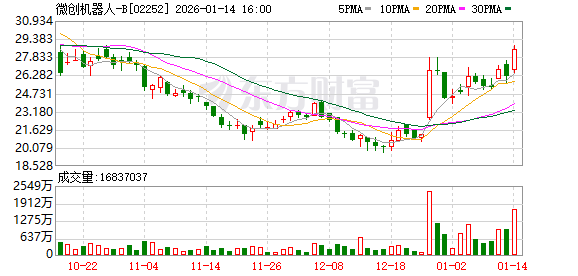
微创机器人-B午后涨超7% 手术机器人行业有望进入商业化和政策加速期
Xin Lang Cai Jing· 2026-01-14 05:13
Group 1 - The stock price of MicroPort Scientific Corporation-B (02252) rose by 7.25%, reaching HKD 28.12, with a trading volume of HKD 310 million [4]. - Nvidia and Eli Lilly announced a joint investment of USD 1 billion to establish an AI drug discovery laboratory, exploring opportunities in clinical development, manufacturing, and commercial operations using AI and robotics [4]. - A report from Zhongyou Securities indicates that the surgical robotics industry may enter a period of commercialization and policy acceleration [4]. Group 2 - As of December 24, MicroPort announced that its cumulative orders for surgical robot products have exceeded 230 units, with over 160 units of laparoscopic surgical robots in global commercial orders [4]. - The company's self-developed bronchoscopic surgical robot "Dudao" has received approval from the NMPA [4]. - Zhongyou Securities believes that the company's globalization strategy is rapidly being validated in the market, with increasing competitiveness overseas [4]. - In the domestic market, the relaxation of policies regarding laparoscopic robot configurations may allow the company to maintain its advantages, and the optimization of charging policies is expected to enhance industry penetration [4].
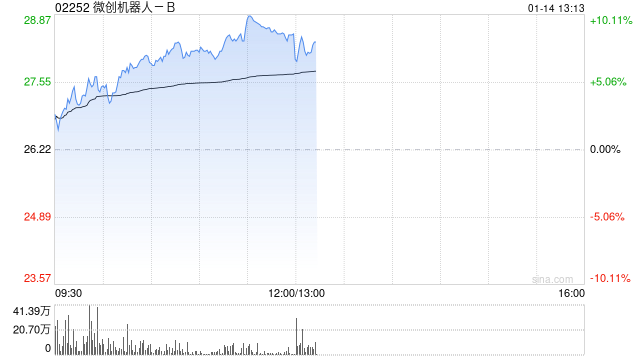
微创机器人-B涨超7% 手术机器人行业有望进入商业化和政策加速期
Zhi Tong Cai Jing· 2026-01-14 03:10
Group 1 - The stock of MicroPort Robotics-B (02252) increased by over 7%, currently up 7.55% at HKD 28.2, with a trading volume of HKD 225 million [1] - NVIDIA and Eli Lilly announced a joint investment of USD 1 billion to establish an AI drug discovery laboratory, exploring opportunities in clinical development, manufacturing, and commercial operations using AI and robotics [1] - A report from Zhongyou Securities indicates that the surgical robotics industry may enter a commercialization and policy acceleration phase [1] Group 2 - As of December 24, MicroPort Robotics announced that its cumulative orders for surgical robots have exceeded 230 units, with over 160 units for laparoscopic surgical robots [1] - The company's self-developed bronchoscopic surgical robot "Dudao" has received NMPA approval [1] - Zhongyou Securities believes that the company's globalization strategy is rapidly being validated in the market, with continuous improvement in overseas competitiveness [1] Group 3 - In the domestic market, the relaxation of policies regarding laparoscopic robot configurations is expected to allow the company to maintain its advantages, along with optimized charging policies leading to increased industry penetration [1]