
硅光子技术

Search documents
光模块:硅光模块及其新材料的应用报告(附57页PPT)
材料汇· 2025-05-14 15:32
Core Viewpoint - Silicon photonic modules represent the next generation of high-integration optical transmission modules, transitioning from discrete components to silicon photonic technology, which offers advantages such as high integration, low cost, and low power consumption [4][11][40]. Group 1: Technology Overview - Silicon photonic modules integrate optical and electronic components on a single silicon chip, including lasers, modulators, and detectors, which reduces the number of components and overall size by approximately 30% [11][12]. - The technology leverages the inherent advantages of silicon materials and CMOS processes to meet the demands of data centers for lower costs, higher integration, and lower power consumption [4][11]. - The development of silicon photonic technology has progressed significantly over the past 30 years, with key milestones including the commercialization of silicon-based modulators and lasers [12][15]. Group 2: Market Applications - Silicon photonic modules are primarily used in data center communications and telecommunications networks, with a projected increase in market share from 34% in 2023 to 52% by 2029 [15][26]. - The demand for silicon photonic modules is driven by the exponential growth of data traffic due to AI and cloud computing, with major internet cloud providers planning to increase capital expenditures significantly [17][26]. - The transition to all-optical networks and the need for high bandwidth and low latency in telecommunications are expected to further enhance the adoption of silicon photonic modules [23][40]. Group 3: Future Trends - The market for silicon photonic modules is expected to exceed $10.3 billion by 2029, with a compound annual growth rate (CAGR) of 45% over the past five years [26][27]. - Future trends include advancements in speed, heterogeneous integration, and new materials, with silicon photonic modules evolving towards 1.6T and 3.2T capabilities [28][29]. - Innovations in packaging and integration techniques, such as co-packaged optics (CPO), are anticipated to reduce power consumption and improve signal integrity [20][29]. Group 4: Competitive Landscape - Major players in the silicon photonic module market are focusing on integrating III-V materials with silicon to enhance performance while maintaining cost-effectiveness [41][44]. - The competitive landscape is characterized by ongoing research and development aimed at overcoming challenges related to the integration of lasers on silicon chips [50][51]. - Companies are exploring various integration techniques, including heterogeneous bonding and epitaxy, to achieve high-performance silicon photonic devices [50][52].



日月光控股:2025Q1业绩点评及法说会纪要:封测业务表现超预期,下游需求持续复苏
Huachuang Securities· 2025-05-06 11:13
Investment Rating - The report assigns a positive outlook for the company, indicating a potential for growth in the semiconductor packaging and testing sectors, with specific revenue growth expectations for Q2 2025 [2][16]. Core Insights - The company reported Q1 2025 revenue of NT$148.15 billion, a 12% year-over-year increase, despite a 9% quarter-over-quarter decline. The gross margin improved to 16.8%, up 1.1 percentage points year-over-year [3][7]. - The semiconductor packaging segment generated NT$86.67 billion in revenue, a 17% year-over-year increase, while the electronic manufacturing services (EMS) segment saw a 5% year-over-year growth despite a 17% quarter-over-quarter decline [10][12]. - The company anticipates a 9%-11% quarter-over-quarter revenue growth in the semiconductor packaging business for Q2 2025, with an expected gross margin increase of 140-180 basis points [16]. Summary by Sections Q1 2025 Performance Overview - The company achieved a consolidated revenue of NT$148.15 billion, with a gross margin of 16.8% and a net profit of NT$75.54 billion [3][7]. - The semiconductor packaging division's revenue was NT$86.67 billion, with a gross margin of 22.6%, while the EMS division's revenue was NT$62.3 billion, with a gross margin of 8.9% [10][12]. Business Segment Analysis - **Semiconductor Packaging**: Revenue of NT$86.67 billion, with a gross margin of 22.6%. The segment is expected to see continued growth, particularly in AI-related testing services [10][11]. - **Electronic Manufacturing Services**: Revenue of NT$62.3 billion, with a gross margin of 8.9%. The segment faced challenges due to supply constraints and seasonal fluctuations [12][13]. Demand and Market Outlook - The demand in the automotive sector is expected to grow, while other electronic sectors are gradually recovering. The company is optimistic about its automotive business growth this year [4][32]. - The company has low direct exposure to U.S. market risks, with less than 10% of its EMS shipments going to the U.S., allowing for flexibility in production location adjustments [4][31]. Q2 2025 Guidance - The semiconductor packaging business is projected to grow by 9%-11% quarter-over-quarter, while the EMS segment is expected to decline by 10% year-over-year [16].
巨头入场,硅光芯片迎来机遇
3 6 Ke· 2025-04-24 11:40
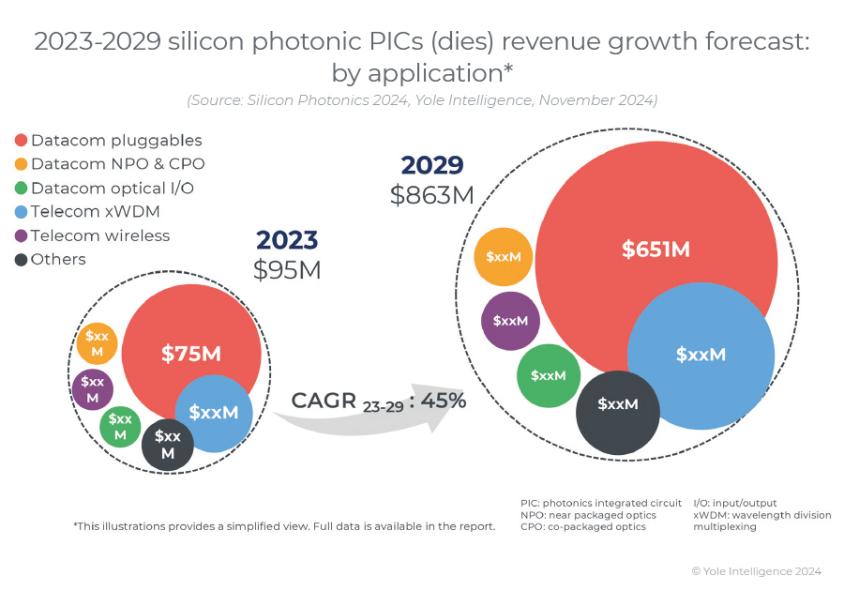
Core Insights - Silicon photonic chips combine traditional electronic devices with optical components, enabling the generation, transmission, modulation, and detection of optical signals, thus overcoming the physical limits of traditional electronic chips in bandwidth, power consumption, and latency [1][10] - The silicon-based photonic integrated circuit (PIC) market was valued at $9.5 million in 2023 and is projected to grow to over $863 million by 2029, with a compound annual growth rate (CAGR) of 45% [1] Industry Landscape - The silicon photonic industry consists of diverse participants, including major vertical integrators (e.g., Innolight, Cisco, Marvell), startups/design companies (e.g., Xphor, DustPhotonics), research institutions (e.g., UCSB, MIT), foundries (e.g., TSMC), and equipment suppliers (e.g., Applied Materials) [4] - Intel has been a pioneer in silicon photonics, having shipped over 8 million PICs and 3.2 million integrated lasers since launching its silicon photonic platform in 2016 [5][6] Technological Advancements - Intel's silicon photonic technology integrates lasers, modulators, and detectors on a single silicon substrate using CMOS manufacturing processes, supporting wavelength division multiplexing (WDM) for high-performance interconnects [6] - NVIDIA has introduced the Spectrum-X Photonics, an integrated optical network switch that significantly enhances energy efficiency and signal integrity, facilitating the expansion of AI factories [8] Market Dynamics - In the data communication market, Intel leads with a 61% market share, followed by Cisco and Broadcom, while in the telecom sector, Cisco holds nearly 50% market share [8] - Chinese companies are beginning to compete in the silicon photonic market, with firms like Zhongji Xuchuang and NewEase launching 400G, 800G, and even 1.6T silicon photonic modules [8][9] Driving Forces - The compatibility of silicon photonic chips with existing CMOS processes allows for large-scale manufacturing, significantly reducing production costs and integrating seamlessly into the semiconductor supply chain [10] - The rapid growth in AI, big data, and high-performance computing demands has highlighted the limitations of traditional electronic chips, making silicon photonic chips a key solution due to their high bandwidth, low latency, and energy efficiency [11] Expanding Applications - Silicon photonic technology is expanding beyond data centers into emerging fields such as autonomous driving, optical computing, and consumer electronics [12] - In autonomous driving, silicon photonic solid-state LiDAR technology is seen as a critical path for large-scale commercialization, significantly reducing system complexity and manufacturing costs [12][13] Conclusion - The transition from electronic to photonic technology represents a disruptive innovation in the semiconductor industry, paving the way for a "photonic-electronic fusion era" [14] - Future challenges include enhancing integration while managing thermal effects and achieving better integration of III-V materials with silicon processes [14]

算力竞赛继续,“递铲子”的中际旭创2024年营收及净利增速均超100%
Jing Ji Guan Cha Wang· 2025-04-21 08:32
Core Insights - The rapid evolution and application of large language models have significantly benefited foundational computing infrastructure manufacturers, leading to substantial revenue growth for companies like Zhongji Xuchuang [1] Financial Performance - Zhongji Xuchuang reported a revenue of 23.862 billion yuan for 2024, a year-on-year increase of 122.64% - The net profit attributable to shareholders reached 5.171 billion yuan, reflecting a growth of 137.93% compared to the previous year [1] - In Q1 2025, the company continued its growth trajectory with revenues of 6.674 billion yuan, up 37.82%, and a net profit of 1.583 billion yuan, an increase of 56.83% [1] Market Dynamics - The core driver of Zhongji Xuchuang's performance is the surge in demand for optical modules as AI computing power increases, transitioning from 400G to 800G [2] - The optical module business generated 22.886 billion yuan in revenue for 2024, a 124.77% increase, accounting for over 95% of total revenue [2] Client and Revenue Structure - In Q4 2024, major cloud service providers like Microsoft, Meta, Google, and Amazon increased their capital expenditures by 69% to 70.6 billion USD, indirectly boosting demand for high-speed optical modules [3] - The top five customers of Zhongji Xuchuang accounted for 74.74% of total sales, indicating a strong dependency on a few key clients [3] - The company's overseas revenue proportion reached 86.81%, highlighting exposure to geopolitical risks [3] Technological Advancements - The optical communication industry is characterized by rapid technological iterations, with a shift from 100G to 400G and now to 800G, with 1.6T on the horizon [4] - Zhongji Xuchuang is focusing on developing 1.6T optical modules and has demonstrated its solutions at industry conferences [4] - Silicon photonics technology is becoming a focal point for the industry, with applications in 800G and 1.6T products [5] Challenges and Innovations - The industry faces challenges related to power consumption and heat dissipation as transmission speeds increase [5] - New optical interconnect solutions like LPO and CPO are being explored to significantly reduce energy consumption [6] - Zhongji Xuchuang noted that high-end chips, which constitute a significant portion of optical module costs, are primarily produced by overseas suppliers [6]