银行资本补充

Search documents
“二永债”发行提速 商业银行有效补充资本
Jin Rong Shi Bao· 2025-08-08 07:59
Core Viewpoint - The issuance of secondary capital bonds and perpetual bonds (collectively referred to as "二永债") by commercial banks has accelerated in the second quarter, reflecting a pressing need for capital replenishment and a proactive response to changing market conditions [1][2][4]. Group 1: Issuance Trends - Major state-owned banks such as Industrial and Commercial Bank of China, Agricultural Bank of China, Bank of China, and China Construction Bank have issued "二永债" since May, with a total issuance of 648.16 billion yuan in the first five months of the year, a 3.63% increase from 625.45 billion yuan in the same period last year [1][2]. - In May alone, the issuance reached a record high of 284.5 billion yuan [1]. - Agricultural Bank of China announced a total issuance of 60 billion yuan in secondary capital bonds, with previous issuances of 50 billion yuan in perpetual bonds [2]. Group 2: Importance of Capital Replenishment - The issuance of "二永债" is a crucial method for banks to supplement their capital, optimize capital structure, and enhance capital adequacy ratios, which is increasingly important due to stricter regulatory requirements [4][5]. - The issuance of these bonds allows banks to diversify their financing channels, reducing reliance on equity financing and lowering overall financing costs [4][6]. - The capital raised through these bonds is intended to support business development and improve risk resistance capabilities, particularly in the context of economic transformation [4][5]. Group 3: Market Conditions and Regulatory Environment - The current market conditions are favorable for banks to issue "二永债," driven by stricter regulatory requirements and the need to support the real economy through increased credit supply [6][7]. - The implementation of Basel III regulations has heightened the need for banks to maintain adequate capital levels, especially under pressures from credit expansion and non-performing asset management [6][7]. - The trend of increasing issuance among smaller banks indicates a broader industry movement towards capital enhancement, with several regional banks also receiving approval for capital tool issuance [6][7].



规模破万亿元!银行发行“二永债”须警惕这项风险→
Guo Ji Jin Rong Bao· 2025-08-08 07:58
Core Viewpoint - The issuance of "perpetual bonds" (also known as secondary capital bonds) by banks has accelerated significantly this year, driven by the increasing demand for capital replenishment [1][3][4]. Group 1: Issuance Trends - As of August 7, 2023, banks have issued over 1 trillion yuan in "perpetual bonds," with a notable surge of over 200 billion yuan in July alone [1][2]. - A total of 47 banks have issued 69 "perpetual bonds" this year, amounting to 10,464.60 billion yuan, surpassing the 1 trillion yuan mark [2]. - The issuance pace has notably increased since the second quarter of 2023, with 15 bonds issued in July, totaling 229.4 billion yuan, which exceeds the total issuance in the first quarter [2]. Group 2: Demand for Capital - The acceleration in "perpetual bond" issuance is fundamentally linked to banks' growing need for capital replenishment, particularly among smaller banks that find these bonds convenient [3][4]. - National banks have shown better performance in capital adequacy and risk management, benefiting from special government bond injections, which alleviates their capital replenishment needs [4][5]. - Smaller banks are more enthusiastic about issuing "perpetual bonds" due to their non-reliance on capital market valuations and the relatively controllable financing costs in the current low-interest environment [4][5]. Group 3: Regulatory and Market Context - The Basel III framework mandates that commercial banks maintain a total capital adequacy ratio of at least 8%, with domestic regulations being even stricter [3]. - The ongoing tightening of city investment bonds has increased demand from institutional investors for "perpetual bonds," providing a favorable market environment for smaller banks [5][6]. - As of the first quarter of 2023, the overall capital adequacy ratio for commercial banks was 15.28%, with state-owned banks having the highest ratios [5]. Group 4: Risks and Challenges - There is a notable disparity in issuance scale among different types of banks, with state-owned and joint-stock banks issuing larger amounts compared to local and private banks [4][5]. - The regulatory framework stipulates that the proportion of secondary capital bonds that can be counted towards capital decreases over time, which could weaken the capital replenishment effect if not managed properly [5]. - Smaller banks face challenges in maintaining adequate capital replenishment capabilities, necessitating the establishment of a long-term capital replenishment mechanism [5].
正股上涨激活转债强赎机制 银行资本补充压力缓解
Zhong Guo Zheng Quan Bao· 2025-08-08 07:21
Core Viewpoint - The announcement from Su Nong Bank highlights the increase in registered capital from 1.803 billion yuan to 2.019 billion yuan due to convertible bond conversion and capital reserve increase, reflecting a trend among banks to supplement capital through convertible bonds amid strong stock performance [1][2]. Group 1: Convertible Bonds and Capital Supplementation - Su Nong Bank issued 25 billion yuan worth of convertible bonds in August 2018, with a maturity of six years, and has seen a total of 31.9761 million shares added through conversion [2]. - Several banks, including Nanjing Bank and Hangzhou Bank, have triggered early redemption clauses for their convertible bonds this year, indicating a broader trend in the banking sector [2][3]. - The strong performance of bank stocks has led to an increase in the conversion rates of convertible bonds, which were previously low due to high conversion premiums [1][4]. Group 2: Market Dynamics and Trends - The banking sector has experienced a nearly 50% increase in the Shenwan first-level banking industry index since the beginning of 2024, leading to a favorable environment for convertible bond conversions [4]. - Analysts suggest that the reduction in convertible bond issuance will create a supply-demand imbalance in the convertible bond market, potentially supporting valuations [5]. - The overall market for bank convertible bonds is expected to shrink significantly, with projections indicating a reduction to below 100 billion yuan after the maturity of certain bonds [4][5]. Group 3: Capital Structure and Financial Health - Successful conversion of convertible bonds is expected to strengthen banks' capital bases, facilitating diversified business expansion [6]. - The completion of convertible bond conversions could enhance core Tier 1 capital adequacy ratios by approximately 0.8 percentage points for banks like Hangzhou Bank [6]. - The proactive redemption of convertible bonds not only aids in capital replenishment but also signals financial stability to investors, potentially boosting confidence in bank stocks [6][7]. Group 4: Regulatory and Competitive Landscape - Despite the current capital adequacy ratios being within regulatory limits, banks face ongoing pressure to supplement capital, particularly among smaller banks [7]. - Approximately 50% of A-share listed banks reported core Tier 1 capital adequacy ratios below 10% as of the end of Q1, with some banks falling below 8.5% [7]. - Smaller banks are increasingly utilizing various financing methods, including private placements and special bonds, to address capital needs while also focusing on optimizing their business structures [7].



二永债发行提速 商业银行密集“补血”
Zhong Guo Zheng Quan Bao· 2025-08-08 07:20
Group 1 - The issuance of perpetual bonds and subordinated bonds by commercial banks has significantly increased since the second quarter, with a total issuance exceeding 800 billion yuan this year, and over 600 billion yuan in the second quarter alone, representing a quarter-on-quarter growth of 260.82% [1][2] - The increase in issuance is attributed to several factors, including the release of issuance approvals for large banks, a decrease in issuance costs, and a favorable market environment with lower interest rates [2][3] - The average interest rates for subordinated bonds and perpetual bonds have decreased in the second quarter, with rates of 2.25% and 2.31% respectively, compared to 2.40% and 2.44% in the first quarter [2] Group 2 - There is a more urgent demand for bond issuance among small and medium-sized banks, with nearly 30 regional banks issuing a total of 119.1 billion yuan in the second quarter, reflecting a strong need for capital supplementation [3][4] - The capital adequacy ratios of city commercial banks and rural commercial banks are lower than those of state-owned and joint-stock banks, indicating a need for these banks to enhance their capital levels [4][5] - Small and medium-sized banks face challenges in issuing bonds, such as higher funding costs and weaker subscription conditions, necessitating improvements in operational efficiency and brand image to enhance their bond issuance capabilities [6] Group 3 - The trend of seeking diverse capital supplementation channels has emerged due to the pressure on banks' profitability, which limits their internal capital replenishment capabilities [5][6] - Recommendations have been made to optimize policies and market environments to broaden capital supplementation channels for eligible small and medium-sized banks, including expanding the investor base for bank capital instruments [6]
银行密集发行“二永债”补充资本
Jing Ji Ri Bao· 2025-08-08 07:02
Core Viewpoint - The issuance of "Tier 2 perpetual bonds" (二永债) has become a crucial tool for capital replenishment in China's banking sector, with a total issuance exceeding 890 billion yuan as of July 25 this year, driven by the need to maintain stable operations and support the real economy [1][2]. Group 1: Issuance Trends - As of July 25, 2023, Chinese commercial banks have issued a total of over 890 billion yuan in "Tier 2 perpetual bonds" [1]. - The issuance of "Tier 2 perpetual bonds" by large state-owned commercial banks has accelerated, with a significant increase of 260.82% in the second quarter compared to the previous quarter [1]. - Agricultural Bank successfully issued 60 billion yuan in Tier 2 capital bonds on July 22, while China Construction Bank completed a 40 billion yuan issuance of perpetual bonds on May 19 [1]. Group 2: Interest Rate Trends - The average interest rates for "Tier 2 perpetual bonds" have shown a downward trend, with rates of 2.25% for Tier 2 capital bonds and 2.31% for perpetual bonds in the second quarter, further declining from the first quarter [1]. Group 3: Capital Adequacy and Needs - Regulatory requirements for capital adequacy have become stricter following the implementation of Basel III, necessitating banks to enhance their capital levels to meet compliance and risk management needs [2]. - The capital adequacy ratio for commercial banks (excluding foreign bank branches) was 15.28% as of the end of the first quarter, with the core tier 1 capital adequacy ratio at 10.7% [2]. - Smaller banks face narrower capital replenishment channels, with urban commercial banks and rural commercial banks having capital adequacy ratios of 12.44% and 12.96%, respectively, significantly lower than the averages for large commercial banks (17.79%) and joint-stock commercial banks (13.71%) [2]. Group 4: Future Outlook - The issuance of "Tier 2 perpetual bonds" is expected to remain high in the second half of the year, although growth rates may fluctuate due to market conditions and the pace of capital replenishment [3]. - The Central Financial Work Conference has proposed to broaden the channels for bank capital replenishment, including extending the use period of special local government bonds and optimizing shareholder qualification conditions to support smaller banks [3].
银行“二永债”年内发行超万亿元 结构性缺口仍待解
Shang Hai Zheng Quan Bao· 2025-08-05 18:16
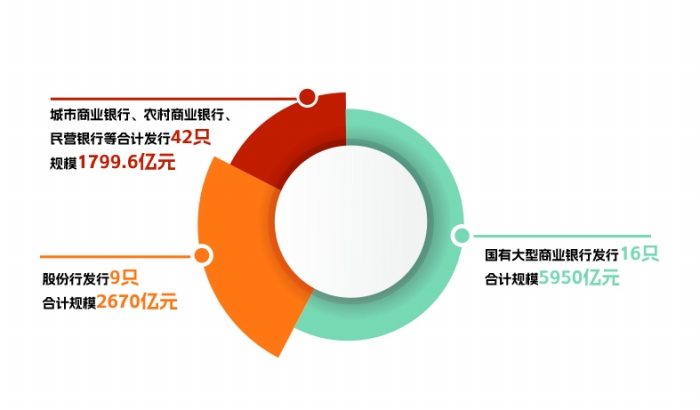
Core Insights - The issuance of "perpetual bonds" (referred to as "二永债") by domestic banks has accelerated significantly this year, with a total issuance exceeding 1 trillion yuan as of August 5, driven by low interest rates, tight credit supply, and growing capital demands [2][3][4] Group 1: Issuance Overview - A total of 67 "二永债" have been issued this year, with a cumulative scale surpassing 1 trillion yuan [3] - Major contributors to the issuance include state-owned banks and joint-stock banks, with the former issuing 16 bonds totaling 595 billion yuan and the latter 9 bonds totaling 267 billion yuan [3] - Smaller banks, including city commercial banks and rural commercial banks, have also increased their issuance, with 42 bonds totaling approximately 179.96 billion yuan [3] Group 2: Factors Driving Issuance - The acceleration in "二永债" issuance is attributed to several favorable factors, including the need for banks to supplement capital due to expanding business and increasing risk-weighted assets [4] - Low bond market interest rates have significantly reduced the cost of issuing bonds for banks [4] - The tightening supply of traditional credit bonds has increased the demand for high-rated financial bonds like "二永债" [4] Group 3: Characteristics of "二永债" - "二永债" includes both secondary capital bonds and perpetual bonds, which serve similar functions in capital supplementation [6] - Secondary capital bonds have a fixed term, while perpetual bonds do not have a maturity date, allowing banks to redeem them at their discretion after a certain period [6] - Both types of bonds have embedded write-down or conversion clauses that can enhance capital buffers in times of risk [6] Group 4: Challenges and Limitations - Despite the active issuance, "二永债" has structural limitations in addressing core Tier 1 capital shortages, as the proportion of secondary capital bonds that can be counted towards capital decreases over time [8] - Some banks, like Nanchang Rural Commercial Bank, have faced challenges in redeeming their bonds, reflecting the increasing difficulty in capital supplementation [8][9] - The reliance on "二永债" by smaller banks has grown due to constraints in internal capital accumulation and limited access to equity financing [7][10] Group 5: Policy Recommendations - To address the capital supplementation challenges faced by smaller banks, it is recommended to diversify the supply of capital tools and ease the issuance thresholds for preferred shares and convertible bonds [10] - Enhancing the market environment for capital tools and simplifying the listing approval process for quality smaller banks could encourage more capital market financing [10] - Implementing differentiated support policies tailored to specific banks could help establish robust capital buffers and sustainable development mechanisms [10]

威海银行拟发行股份募资不超30亿 用于补充核心一级资本
Zheng Quan Ri Bao· 2025-08-04 00:01
Core Viewpoint - Weihai Bank plans to raise up to 3 billion yuan through a private placement of domestic shares and H-shares to improve its capital adequacy ratio and support business growth [1] Group 1: Capital Raising and Share Issuance - The bank's board will seek special authorization from shareholders for the issuance of up to approximately 758 million domestic shares and 154 million H-shares [1] - The net proceeds from the issuance will be used entirely to supplement the bank's core Tier 1 capital after deducting related issuance costs [1] - Major shareholders Shandong High-speed Group and Shandong High-speed Co., Ltd. intend to participate in the capital increase, with Shandong High-speed planning to subscribe for up to approximately 106 million domestic shares, totaling no more than approximately 348 million yuan [1] Group 2: Shareholding Structure - Shandong High-speed holds an 11.60% stake in Weihai Bank, while Shandong High-speed Group directly holds 35.56%, controlling a total of 47.16% of the bank [1] - Post-investment, the shareholding ratios of Shandong High-speed Group and Shandong High-speed in Weihai Bank will remain unchanged at 35.56% and 11.60%, respectively [1] Group 3: Industry Context - The core Tier 1 capital adequacy ratio of Weihai Bank was 9.31% at the end of 2024, showing a 0.54 percentage point increase from the end of 2023 but a 0.57 percentage point decrease from the end of 2020 [2] - There is increasing pressure on capital supplementation for small and medium-sized banks, particularly due to narrowing net interest margins and profitability challenges [2] - Over 10 small and medium-sized banks have received approval for capital increases or targeted placements this year, indicating a trend of regional state-owned capital actively participating in these efforts [2][3]
截至7月25日规模超8900亿元 银行密集发行“二永债”补充资本
Jing Ji Ri Bao· 2025-08-03 00:59
Core Viewpoint - The issuance of "perpetual bonds" (also known as secondary capital bonds) has become a crucial tool for Chinese banks to supplement their capital in 2023, with a total issuance exceeding 890 billion yuan as of July 25, 2023 [1] Group 1: Issuance Trends - The issuance of "perpetual bonds" by large state-owned commercial banks has accelerated, with a significant increase of 260.82% in the second quarter compared to the previous quarter [1] - Agricultural Bank successfully issued 60 billion yuan of secondary capital bonds on July 22, while China Construction Bank completed a 40 billion yuan issuance of perpetual bonds on May 19 [1] - The average interest rates for these bonds have shown a downward trend, with secondary capital bonds at 2.25% and perpetual bonds at 2.31% in the second quarter, further decreasing from the first quarter [1] Group 2: Capital Adequacy and Needs - Regulatory requirements for capital adequacy have become stricter following the implementation of Basel III, necessitating banks to enhance their capital levels to meet compliance and risk management needs [2] - The capital adequacy ratio for commercial banks (excluding foreign bank branches) was reported at 15.28% as of the first quarter, with smaller banks like city and rural commercial banks showing lower ratios of 12.44% and 12.96% respectively [2] - There is an urgent need for smaller banks to issue "perpetual bonds" to alleviate capital pressure and support business expansion, especially as some banks face upcoming bond redemptions [2] Group 3: Support for Small and Medium Banks - There is a call for better support for small and medium banks to establish long-term capital replenishment mechanisms and broaden their capital supplement channels [3] - Smaller banks have been actively issuing "perpetual bonds," albeit in smaller amounts, with institutions like Lanzhou Bank and Sichuan Bank successfully issuing bonds in June [3] - The Central Financial Work Conference has proposed to expand the scope of local government special bonds to support capital replenishment for banks, particularly focusing on city and rural commercial banks [3]
年内银行“二永债”发行规模已超1万亿元
Zheng Quan Ri Bao· 2025-07-29 15:50
本报记者 彭妍 近日,建设银行、四川银行等多家银行公告了二级资本债和永续债(以下统称"二永债")发行情况。记者据中国货币网数 据整理,7月份以来至少有12家银行发行"二永债"补充资本,显示"二永债"发行节奏加快。 对于下半年"二永债"发行规模走势,受访业内人士表示,综合多方面因素,下半年银行"二永债"市场将呈现"中小行主导、 成本下行、供给增加"的格局,总体发行规模有望保持稳步增长。 7月份发行放量 Wind资讯数据显示,截至7月29日,今年以来商业银行"二永债"总发行量已达到10419.6亿元,发行数量达到67只。从季度 分布来看,一季度仅发行9只,发行总量为1738.6亿元;二季度发行43只,发行总量为6387亿元;进入三季度后,截至7月29日 已发行15只,发行总量为2294亿元。 7月份以来,已有工商银行、中国银行、农业银行、浦发银行、广州银行、四川银行、兰州银行、晋商银行、广东顺德农 村商业银行等12家银行发行"二永债"。比如,7月28日,建设银行发布公告称,其2025年第二期二级资本债券已于7月25日发 行,总规模450亿元。其中,10年期品种(第5年末可赎回)发行400亿元,票面利率1.94%; ...
年内“二永债”发行近9000亿元
Jin Rong Shi Bao· 2025-07-18 01:00
Core Viewpoint - The issuance of "perpetual bonds" and "subordinated bonds" by commercial banks in China has significantly accelerated, particularly in the second quarter, with a total issuance of 894.56 billion yuan across 57 bonds by July 15, 2023 [1] Group 1: Issuance Trends - The issuance volume of "perpetual bonds" and "subordinated bonds" has notably increased in the second quarter, with 43 bonds issued totaling 638.7 billion yuan, compared to only 9 bonds and 173.86 billion yuan in the first quarter [2] - Major state-owned banks, including Industrial and Commercial Bank of China, Agricultural Bank of China, Bank of China, and China Construction Bank, have been the primary issuers, with significant amounts raised in May 2023 [2] Group 2: Reasons for Acceleration - The acceleration in issuance is driven by stricter regulatory requirements, necessitating banks to enhance their capital levels to meet standards and mitigate potential risks, especially under the pressures of credit expansion and non-performing asset management [2][3] - Increased support for the real economy has also prompted banks to strengthen their capital bases to facilitate higher credit disbursements [3] Group 3: Challenges for Smaller Banks - While state-owned banks lead in issuance, smaller banks, including regional and rural commercial banks, have seen a significant increase in issuance compared to the previous year, highlighting their capital replenishment pressures [4][5] - Smaller banks face challenges in capital replenishment due to limited internal capital generation capabilities and constrained external funding options, making the issuance of "perpetual bonds" and "subordinated bonds" crucial [5] Group 4: Future Outlook - The issuance of "perpetual bonds" is expected to continue, with a divergence in supply between different types of banks; state-owned banks may see a decrease in issuance due to reduced capital pressures, while smaller banks will remain active participants in the market [8] - Smaller banks may encounter higher funding costs and weaker subscription conditions when issuing "perpetual bonds," necessitating improvements in operational quality and brand image to enhance their issuance capabilities [8]