绿色金融

Search documents
银行今十条:数字人民币App上线新服务;辽宁农商银行董事长杨济时拟提名为市长;陕国投拟增持长安银行...
Jin Rong Jie· 2026-01-08 10:58
Group 1: Central Bank Operations - The People's Bank of China conducted a 1.1 trillion yuan reverse repurchase operation to offset the same amount maturing this month, ensuring liquidity in the market [1] Group 2: Digital Currency Innovations - The digital yuan app launched a "carbon inclusive" service in Shanghai, allowing users to earn carbon credits for eco-friendly behaviors, which can be exchanged for digital yuan [2] Group 3: HSBC and Hang Seng Bank Privatization - HSBC announced the results of Hang Seng Bank's privatization, emphasizing the goal of enhancing complementary advantages rather than erasing differences between the two entities [3] Group 4: Banking Security Measures - Several regional small banks, including Anping Huimin Village Bank, suspended overseas transactions to mitigate cross-border fraud risks, following similar actions by larger banks [4] Group 5: Credit Market Developments - A competitive lending environment has emerged, with personal loan rates dropping to the "2s" as banks simplify approval processes and enhance loan disbursement efficiency [5] Group 6: Leadership Changes in Financial Leasing - The Shanghai Financial Regulatory Bureau approved the appointment of a new chairman for China Everbright Financial Leasing, amidst a wave of leadership changes in the financial leasing sector [6] Group 7: Agricultural Bank Personnel Adjustments - Agricultural Development Bank is undergoing personnel adjustments, with new appointments in its northeastern branches aimed at optimizing regional business management [7] Group 8: Capital Increase at Chang'an Bank - Shaanxi Guotou plans to increase its stake in Chang'an Bank through a capital increase of up to 800 million yuan, raising its shareholding to 6.23% post-transaction [8][9] Group 9: Political Aspirations of Banking Executives - The chairman of Liaoning Rural Commercial Bank, Yang Jishi, is nominated as a candidate for a city mayor position, indicating a significant career transition [10] Group 10: Anti-Corruption Efforts in Banking - The deputy secretary of Hunan Rural Credit Cooperative, Jiang Junwen, is under investigation for serious violations, highlighting ongoing anti-corruption efforts within the financial system [11]




农行新质行大同之旅启程,看能源升级、文旅焕新
新浪财经· 2026-01-08 10:08
Core Viewpoint - The article emphasizes the dual focus of the Agricultural Bank of China on green transformation and cultural heritage preservation as key dimensions of high-quality economic development in China [2] Group 1: Green Transformation - The Agricultural Bank of China has provided a comprehensive credit line of 3.5 billion yuan and carbon reduction support tools for the strategic hydropower project, the Hunyuan Pumped Storage Power Station, which is a key energy project during the 14th Five-Year Plan [2] - This financial support illustrates the bank's commitment to integrating green finance into national long-term strategies [2] Group 2: Cultural Heritage - At the UNESCO World Heritage site of Yungang Grottoes, the Agricultural Bank of China is implementing a smart upgrade, creating a comprehensive "finance + cultural tourism" solution that revitalizes the ancient site in the digital age [2] - This initiative reflects the bank's role in linking financial services with cultural heritage, enhancing the historical significance of the site [2] Group 3: Overall Impact - The financial services provided by the Agricultural Bank of China are increasingly becoming a crucial link between national strategies, industrial upgrades, and the well-being of the populace [2]



数字人民币App上线新服务!这些行为都能挣钱了!
Jin Rong Shi Bao· 2026-01-08 08:56
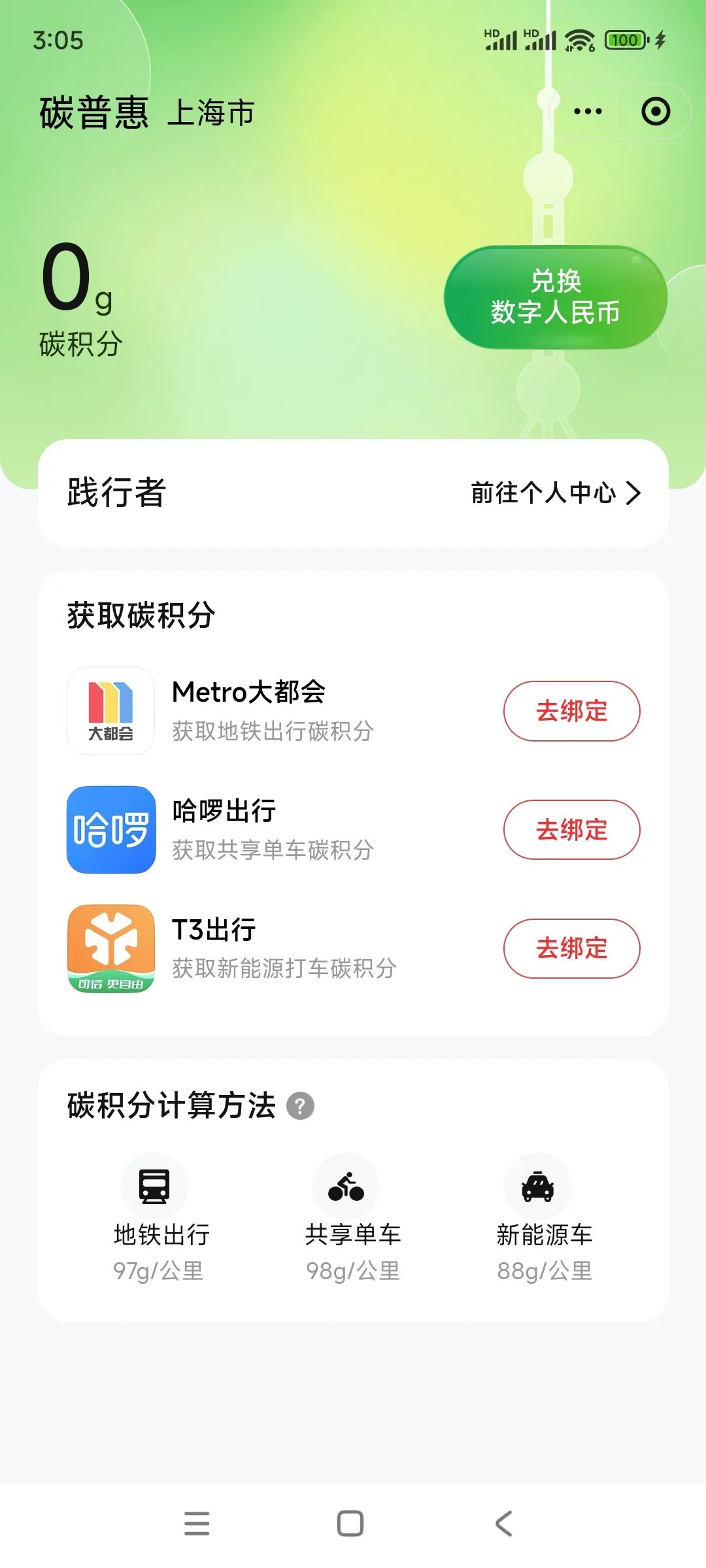
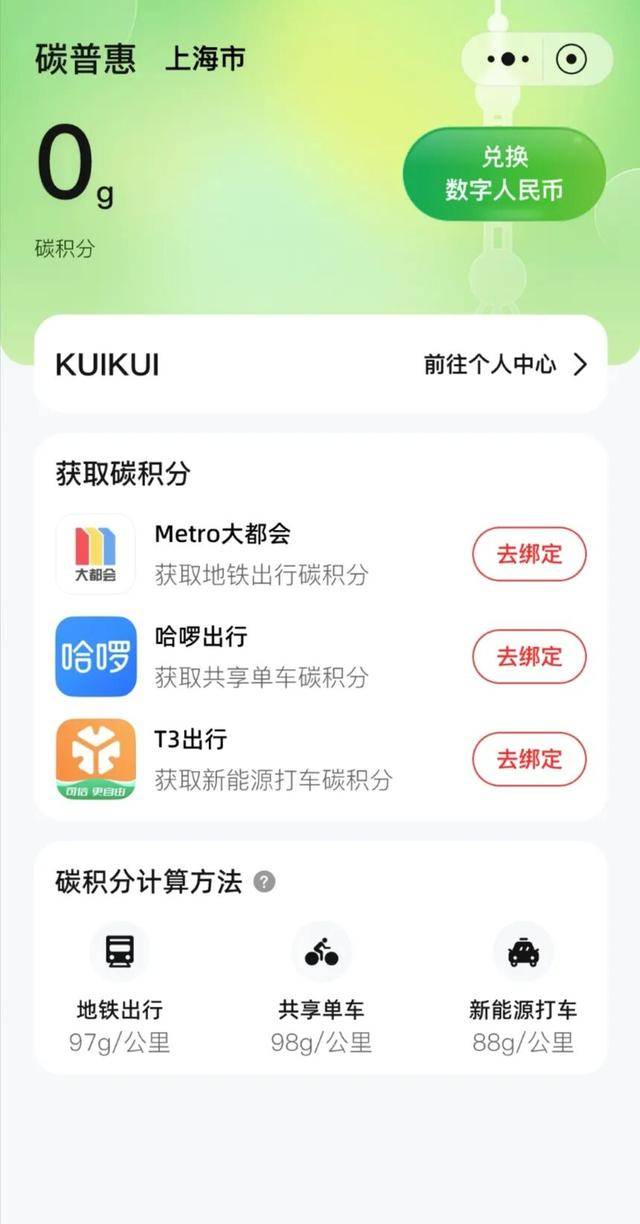
骑单车、坐地铁,还能赚钱? 《金融时报》记者了解到,为丰富数字人民币在"绿色金融"场景的运用,数字人民币运营管理中心协调并支持业务运营机构构建碳普惠领域的创新应用场 景,在数字人民币App内推出"碳普惠"小程序服务并率先在上海地区上线。用户开通该服务后,日常绿色低碳行为产生的碳积分将自动归集至"碳普惠"账 户,并可以兑换数字人民币。 所谓"碳普惠",简单来说就是将个人、企业的低碳行为量化为可兑换、可流通的"碳资产",通过激励机制引导全社会参与节能减排。作为应对气候变化 的"全民行动方案",它早已在各地展开多元探索。 而本次数字人民币"碳普惠"服务,也是鼓励公众践行低碳行为的一项服务。简单来说——你做的每一件环保小事,比如骑共享单车、乘坐地铁公交,都能 被量化成"碳积分"。这些碳积分不仅可以记录你的绿色足迹,还能兑换为实实在在的数字人民币。 哪些低碳行为能被计入? 《金融时报》记者了解到,"碳普惠"小程序首批接入Metro大都会(上海地铁)、哈啰出行和T3出行三大平台,只要你在数字人民币App内登录了"碳普 惠"小程序,并关联上述平台的账号,以后你使用公共交通或共享出行服务时,系统会自动记录你的低碳行为,并将对 ...
数字人民币App上线“碳普惠”服务 “碳积分”兑换“真金白银”
Sou Hu Cai Jing· 2026-01-08 08:50
Core Viewpoint - The digital renminbi management center has launched a "Carbon Inclusive" mini-program within the digital renminbi app to promote low-carbon behaviors among the public, initially available in Shanghai [1] Group 1: Digital Renminbi Initiatives - The "Carbon Inclusive" service encourages users to engage in low-carbon activities, with carbon credits automatically accumulated in a "Carbon Inclusive" account for everyday green actions such as riding shared bikes or using public transport [1] - Users can exchange their accumulated carbon credits for actual digital renminbi, creating a tangible incentive for environmentally friendly behavior [1] Group 2: Partnerships and Expansion - The initial partners for the "Carbon Inclusive" mini-program include Metro (Shanghai Metro), Hello Chuxing, and T3 Chuxing, indicating a collaboration with major transportation platforms [1] - The digital renminbi management center plans to collaborate with business operators to continuously introduce more low-carbon scenarios and expand the service to multiple cities, aiming to build a collaborative carbon inclusive service network [1]
日常绿色低碳行为可兑换数字人民币!快来看看怎么操作
2 1 Shi Ji Jing Ji Bao Dao· 2026-01-08 08:04
Core Insights - The digital RMB is expanding its application in "green finance" by launching a "Carbon Inclusive" mini-program in the digital RMB app, initially available in Shanghai [1] - Users can accumulate carbon credits for their low-carbon activities, which can be exchanged for digital RMB, incentivizing environmentally friendly behavior [1][6] - The program integrates with major platforms like Metro, Hello Chuxing, and T3 Chuxing to automatically track users' low-carbon actions and credit their accounts [1] Group 1: Digital RMB and Carbon Inclusive Program - The digital RMB management center is coordinating with business operators to create innovative applications in the carbon inclusive sector [1] - The "Carbon Inclusive" service allows users to convert their carbon credits from activities such as public transport and bike-sharing into digital RMB [1][6] - The program aims to encourage public participation in low-carbon behaviors by quantifying their actions into carbon credits [1] Group 2: User Engagement and Functionality - To activate the "Carbon Inclusive" service, users must open the digital RMB app, navigate to the service page, and bind their accounts with participating platforms [3] - Carbon credits can be exchanged for digital RMB, with a conversion rate of 1 digital RMB for every 1250 grams of carbon credits [10] - Users must upgrade to a real-name digital RMB wallet to successfully redeem their carbon credits for digital currency [10]
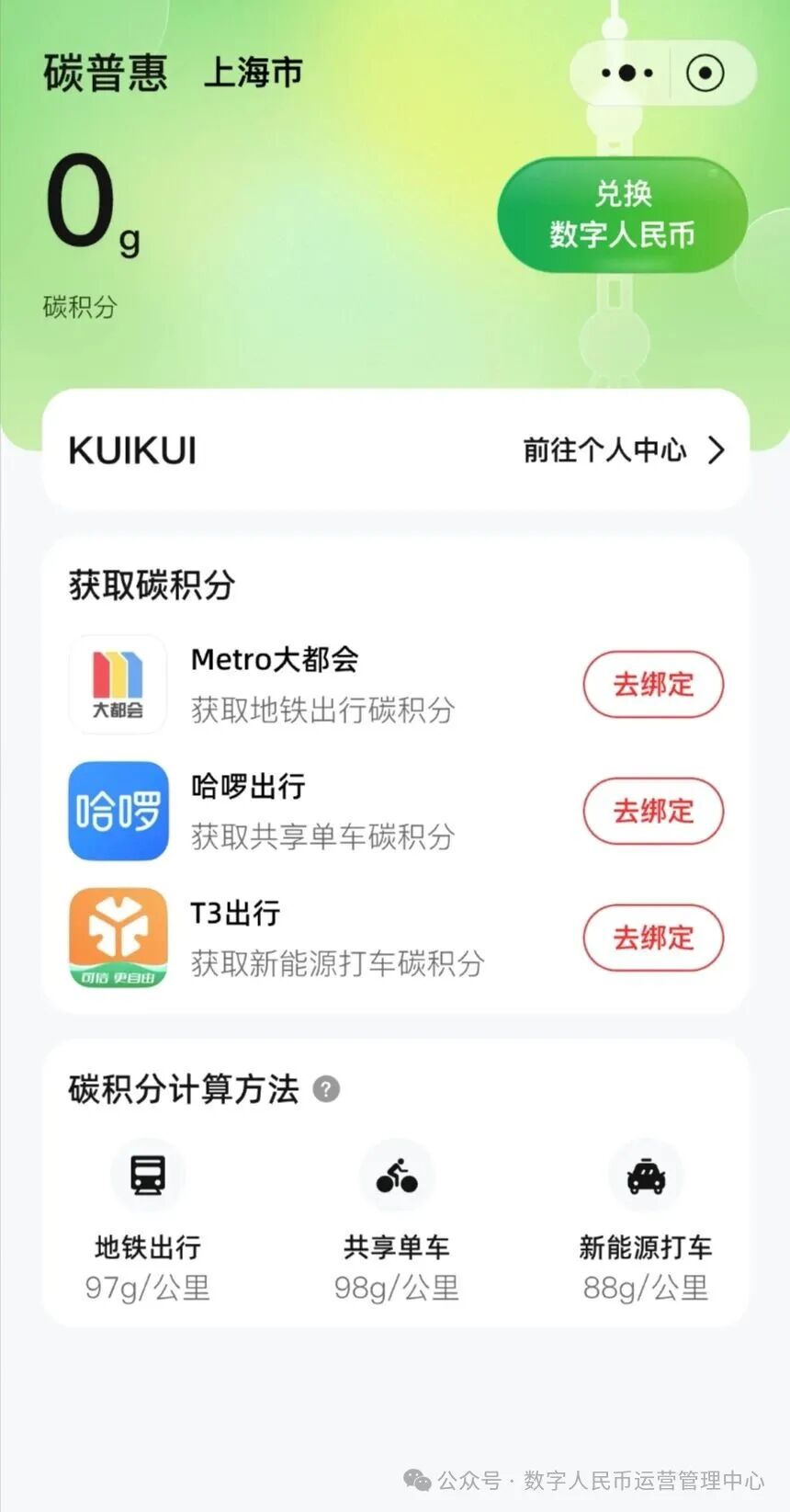
积分换钱!每有1250(g)碳积分可兑换0.01元数字人民币!
Zhong Guo Jing Ying Bao· 2026-01-08 07:46
Core Viewpoint - The Digital Renminbi Operations Management Center has launched a "Carbon Inclusive" mini-program within the Digital Renminbi App to promote the use of digital currency in green finance, initially available in Shanghai [1]. Group 1: Digital Currency and Green Finance - The initiative aims to enhance the application of digital renminbi in the carbon finance sector by creating innovative scenarios for carbon inclusivity [1]. - Users who activate the service will have carbon credits from their daily low-carbon activities automatically collected in a "Carbon Inclusive" account [1]. - Each 1250 grams of carbon credits can be exchanged for 0.01 yuan of digital renminbi, incentivizing users to engage in environmentally friendly behaviors [1].
坐地铁公交能换钱!数字人民币App上线“碳普惠”服务
Bei Jing Shang Bao· 2026-01-08 07:12
Core Viewpoint - The digital RMB is expanding its application in "green finance" by launching a "Carbon Inclusive" mini-program, initially available in Shanghai, to encourage low-carbon behaviors among the public [1] Group 1: Digital RMB and Carbon Inclusive Service - The digital RMB operation management center is coordinating with business operators to create innovative applications in the carbon inclusive sector [1] - Users can accumulate carbon credits for their daily low-carbon activities, which can be exchanged for digital RMB [1] - The "Carbon Inclusive" service aims to motivate the public to engage in environmentally friendly actions, such as using public transport or shared bikes, which will be quantified into carbon credits [1] Group 2: Implementation and User Engagement - The "Carbon Inclusive" mini-program is integrated with three major platforms: Metro, Hello Chuxing, and T3 Chuxing, allowing automatic tracking of low-carbon behaviors [1] - To activate the service, users must open the digital RMB App, access the service page, and complete the binding process with the relevant platforms [2] - Carbon credits can be exchanged for digital RMB, but users must first open a digital RMB wallet and upgrade to a real-name wallet for successful transactions [2]
数字人民币App上线“碳普惠”服务 首批接入三大低碳场景
Xin Hua Cai Jing· 2026-01-08 06:38
简单来说,数字人民币"碳普惠"服务是鼓励公众践行低碳行为的一项服务。个人做的每一件环保小事, 比如骑共享单车、乘坐地铁公交,都能被量化成"碳积分"。这些碳积分不仅可以记录个人的绿色足迹, 还能兑换为实实在在的数字人民币。 数字人民币运营管理中心相关负责人表示,下一步将协同业务运营机构,持续引入更多低碳场景;同时 加快拓展参与地区,构建多城市协同的碳普惠服务网络。 (文章来源:新华财经) 新华财经北京1月8日电从中国人民银行数字人民币运营管理中心获悉,为丰富数字人民币在"绿色金 融"场景的运用,数字人民币运营管理中心协调并支持业务运营机构构建碳普惠领域的创新应用场景, 在数字人民币App内推出"碳普惠"小程序服务并率先在上海地区上线。 据了解,用户开通该服务后,日常绿色低碳行为产生的碳积分将自动归集至"碳普惠"账户,并可以兑换 数字人民币。"碳普惠"小程序首批接入Metro大都会(上海地铁)、哈啰出行和T3出行三大平台。 ...
数字人民币App上线“碳普惠”服务
Sou Hu Cai Jing· 2026-01-08 06:36
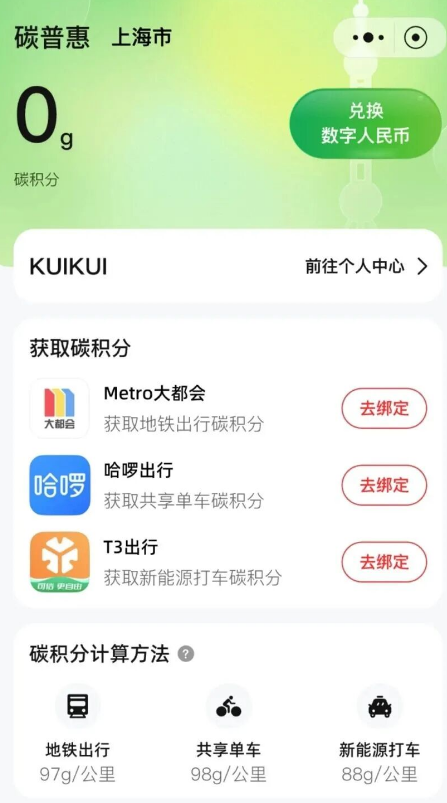
Core Viewpoint - The digital RMB "Carbon Inclusive" service aims to encourage public participation in low-carbon behaviors by allowing users to earn carbon credits for environmentally friendly actions, which can be exchanged for digital RMB [1][2]. Group 1: Service Overview - The "Carbon Inclusive" service is designed to reward users for engaging in low-carbon activities such as using public transportation and participating in recycling [2][12]. - Users can accumulate carbon credits through their daily green actions, which are automatically recorded in the "Carbon Inclusive" account within the digital RMB app [6][14]. Group 2: Initial Implementation - The first three low-carbon scenarios integrated into the "Carbon Inclusive" program include Metro (Shanghai subway), Hello Bike, and T3 Mobility [3]. - Users must log into the "Carbon Inclusive" mini-program and link their accounts from the aforementioned platforms to automatically track their low-carbon behaviors [6]. Group 3: Activation Process - To activate the service, users need to open the digital RMB app, navigate to the service page, find the "Carbon Inclusive" mini-program, and complete the scene binding [9]. - After activation, users' low-carbon travel behaviors will be automatically recorded, and carbon credits will be accumulated in their accounts [9][14]. Group 4: Redemption Mechanism - Carbon credits can be exchanged for digital RMB, with a conversion rate of 1 digital RMB for every 1250 grams of carbon credits [21]. - Users must have a digital RMB wallet and upgrade it to a real-name wallet before redeeming their carbon credits for digital RMB [21].
“一煤独大”怎么解?
Jin Rong Shi Bao· 2026-01-08 05:18
Group 1 - The core viewpoint of the articles highlights the transformation of the coal industry in Shanxi, particularly focusing on the development of coalbed methane (CBM) and its integration into green finance initiatives to support low-carbon transitions [1][4][8] - Shanxi's Jinchen city has seen a significant increase in coalbed methane utilization, with production rising from 3.59 billion cubic meters to 5.48 billion cubic meters, achieving a city gasification rate of over 95% [4][8] - The financial support from institutions like the Industrial and Commercial Bank of China has been crucial, providing tailored financing solutions, including a total of 100 million yuan in working capital loans since 2025 [7][8] Group 2 - The technology employed by Qinshi River Gas Power Co., which includes a self-developed waste heat recovery power generation technology, has improved energy conversion efficiency to over 80% and reduced nitrogen oxide emissions to internationally advanced levels [3][4] - The financial ecosystem in Jinchen has been enhanced through the establishment of a communication mechanism between financial institutions and local government, leading to a comprehensive support directory for green projects [8][25] - The shift towards intelligent mining in Shanxi, with a focus on reducing labor and increasing efficiency, has been supported by financial institutions, which have recognized the need for substantial investment in technology and infrastructure [9][10][11] Group 3 - The Lu'an Coal-based Clean Energy Company is leading the charge in high-end coal chemical product development, with a projected total output value of 71.5 billion yuan in 2024, making it the top in the province [20][22] - The company has developed 54 types of coal-based synthetic products, filling domestic gaps and focusing on import substitution, thus enhancing its market competitiveness [21][22] - Financial institutions have provided long-term, stable credit support, including a 1 billion yuan project loan for the Lu'an 180 project, which is crucial for equipment procurement and construction [22][24] Group 4 - The articles emphasize the importance of a systematic financial support framework that aligns with the industrial transformation needs, moving from traditional coal reliance to innovative, high-value product development [24][25] - The integration of technology and finance is seen as essential for the successful transition of resource-based regions, enabling the extension of value chains and the broadening of application scenarios [25]