
财政政策

Search documents
股债汇齐跳水!里夫斯税收政策临时“变卦” 英国市场再陷预算焦虑
智通财经网· 2025-11-14 11:51
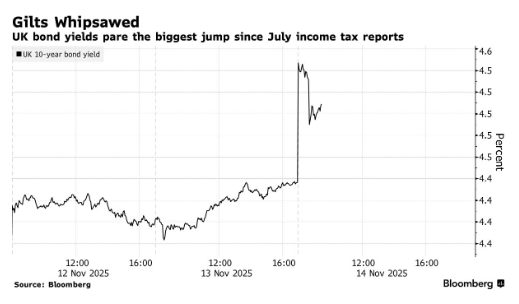
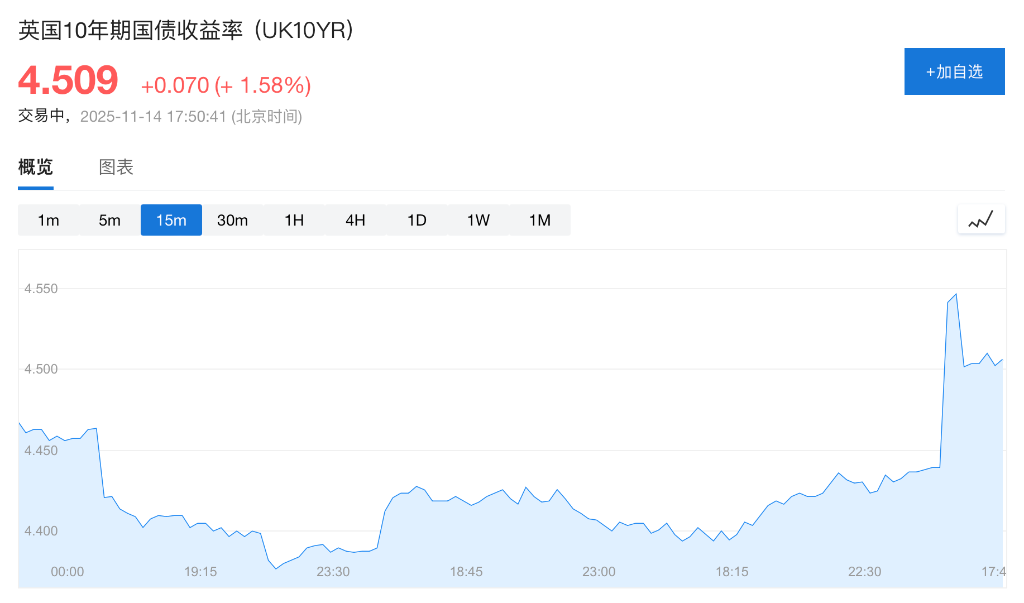
智通财经APP获悉,围绕预算案的种种猜测正加剧英国财政前景的不确定性,这导致该国金融市场再度 陷入动荡。 在传出财政大臣蕾切尔・里夫斯放弃提高所得税计划的消息后,英国国债收益率周五一度创下自7月以 来最大涨幅,英镑与富时100指数应声下挫。但随后报道称政策转变源于英国预算监督机构给出了更为 乐观的财政预测,市场波动幅度随之收窄。 不过,知情人士补充道,为填补公共财政的剩余缺口,大幅增税措施预计仍在考虑之中。 Jefferies欧洲首席经济学家兼策略师Mohit Kumar对此表示:"令人担忧的是,这份预算案可能建立在过 于乐观的增长预测基础上。财政大臣将提出何种具体措施,我们仍需拭目以待。" 经历剧烈震荡后,截至发稿,英国十年期国债收益率徘徊在4.50%,盘中涨幅一度达13个基点。英镑兑 美元汇率在收窄0.6%的跌幅后,现报1.3133。 据知情人士透露,经济学家此前预测高达350亿英镑(约合460亿美元)的财政缺口,目前已收窄至约200 亿英镑。就在本周一,里夫斯还暗示可能违背其政党关于不在本月晚些时候宣布的预算中提高所得税的 承诺。 知情人士表示,预计里夫斯仍将保持150亿至200亿英镑的财政空间,以符合 ...

中国宏观数据点评:实体经济数据10月增速放缓,但或尚不足以触发显著政策刺激
SPDB International· 2025-11-14 10:39
Economic Growth and Projections - October economic data indicates a slowdown in growth, with a projected Q4 GDP growth rate of 4.2%[1] - The annual GDP growth target of around 5% is expected to be achieved, with policies focusing on implementation[1] - Anticipated budget deficit rate for next year is expected to remain at 4%[1] Consumer Spending and Retail - Retail sales growth in October decreased to 2.9%, slightly better than the market expectation of 2.8%[2] - Durable goods consumption showed mixed results, with communication equipment sales rising to 23.2% while home appliances fell by 14.6%[2] - The "Double Eleven" shopping festival did not generate as much excitement as in previous years, indicating weak consumer demand[1] Industrial Production and Investment - Industrial production growth fell to 4.9%, below the expected 5.5%, influenced by a holiday effect[5] - Fixed asset investment growth declined significantly to -1.7%, lower than the market expectation of -0.8%[3] - Real estate investment continued to weaken, with a year-on-year decline of 14.7% in October[3] Employment and Inflation - The urban unemployment rate improved slightly to 5.1%, better than the expected 5.2%[5] - October CPI inflation rate increased to 0.2%, surpassing the market expectation of -0.1%[6] External Demand and Trade - Export growth turned negative at -1.1% in October, influenced by high base effects and holiday timing[7] - The contribution of net exports to GDP is expected to decline, with a forecasted export growth drop to 3.0% next year[11]
英国政府考虑放弃增税计划,英债收益率创7月以来最大涨幅,英镑应声下挫
Hua Er Jie Jian Wen· 2025-11-14 10:34
政策转向背景复杂,预算缺口仍待填补 政策转向背后是复杂的政治背景与财政现实。据媒体报道,Reeves此前一周曾为打破工党竞选承诺的增税方案铺路,该提议在党内引发分歧,加 剧了本就处于困境的工党内部动荡。与此同时,首相Keir Starmer的支持率也持续低迷。 原拟议方案计划将国民所得税率提高2便士,同时国民保险缴费降低2便士。目前,外界预计政府将依靠多项小幅加税措施,填补高达300亿英镑 (约合395亿美元)的预算缺口。 11月14日,据媒体报道,英国财政大臣Rachel Reeves放弃此前酝酿的提高所得税计划。消息公布后,市场反应剧烈,英国股市、债市及英镑汇率 集体下挫。 具体来看,英国10年期国债收益率一度飙升13个基点,随后回落至4.50%,日内仍上升7个基点。英镑兑美元汇率下跌0.2%,报1.3168美元;富时 100指数早盘跌幅超过1%。 此次政策转向再度引发投资者对英国财政健康状况的担忧,市场普遍预期政府或将通过一系列小幅增税措施来弥补预算缺口,这可能进一步加剧 国债市场压力。 投资者担忧,这种"拼凑式"财政政策可能加剧债市压力。Wren Sterling投资总监Rory McPherson在 ...
2025年10月物价数据点评:CPI回正,PPI连续改善
Shanghai Securities· 2025-11-14 09:21
Group 1: CPI Analysis - In October 2025, the national consumer price index (CPI) increased by 0.2% year-on-year, with urban areas rising by 0.3% and rural areas declining by 0.2%[12] - Food prices decreased by 2.9%, while non-food prices increased by 0.9%[12] - Core CPI rose by 1.2%, marking the highest increase since March 2024, indicating steady demand growth[15] Group 2: PPI Trends - The producer price index (PPI) fell by 2.1% year-on-year in October 2025, but the decline narrowed by 0.2 percentage points compared to the previous month[14] - PPI showed a month-on-month increase of 0.1%, marking the first rise in 2025[20] - Key industries such as black metal mining and coal mining saw price declines narrow or recover, indicating ongoing improvement in PPI[22] Group 3: Policy Implications - The low CPI and PPI levels create room for more aggressive macroeconomic policies, including proactive fiscal measures and moderate monetary easing[5] - Continuous improvement in industrial product prices suggests a stable economic recovery trend[30] Group 4: Risks - Potential risks include worsening geopolitical events, changes in international financial conditions, and unexpected shifts in China-U.S. policies[6]
专家:2%通胀目标更多是引导价格向上
和讯· 2025-11-14 03:38
Group 1 - The core viewpoint of the article emphasizes the need for monetary policy to promote reasonable price recovery in the context of low CPI and PPI levels, with recent data showing a slight increase in CPI and a narrowing decline in PPI [2][3] - The National Bureau of Statistics indicates that despite positive changes in consumer prices, market demand remains insufficient, necessitating further expansion of domestic demand and improvement of supply-demand relationships [2] - The People's Bank of China has shifted its monetary policy focus from merely maintaining economic stability to actively guiding economic growth and price levels, reflecting a proactive approach to managing inflation [2][3] Group 2 - The article discusses the importance of stabilizing prices as a key monetary policy goal, highlighting the need for a balance between inflation targets and economic development levels [3][4] - Experts suggest that the current low price levels indicate insufficient effective demand, and there is a call for coordinated monetary and fiscal policies to address this issue [4][5] - The article notes that the CPI target has been set at 2% for the first time since 2004, aligning with the inflation targets of major economies, which is seen as appropriate given the current economic context [4][5] Group 3 - Maintaining a moderate growth in price levels is crucial for stabilizing consumer expectations and preventing a downward spiral in demand due to deflationary pressures [5] - Setting overly ambitious short-term policy goals, such as a 3% CPI growth, may not effectively guide expectations and could signal a lack of concern for price stability [5] - The article emphasizes the role of active fiscal policy in directly addressing total demand shortages, while monetary policy should complement these efforts to enhance overall policy effectiveness [5]

10月金融数据解读:实体经济与金融市场进一步分化
Guoxin Securities· 2025-11-14 01:56
Financial Data Overview - In October, new social financing (社融) amounted to CNY 815 billion, significantly lower than the expected CNY 1.53 trillion[2] - New RMB loans totaled CNY 220 billion, falling short of the anticipated CNY 460 billion[2] - M2 money supply grew by 8.2% year-on-year, slightly above the expected 8.0%[2] Economic Trends - The growth rate of social financing declined to 8.5%, indicating overall insufficient financing demand[5] - Government bond issuance decreased significantly, contributing to a year-on-year reduction of CNY 5.97 trillion in social financing[5] - Non-bank deposits increased by CNY 770 billion year-on-year, reflecting a shift of funds towards financial markets[5] Credit Market Insights - Total new credit under a broad definition was CNY 220 billion, a year-on-year decrease of CNY 280 billion[7] - The structure of corporate loans worsened, with short-term loans showing a notable decline[11] - Resident loans decreased by CNY 360 billion, indicating weak consumer and housing demand[13] Future Outlook - The likelihood of interest rate cuts in Q4 is low due to ongoing pressure on banks' net interest margins[6] - Focus will shift towards fiscal policy to stimulate demand, with expectations for increased government spending[6] - Continued monitoring of fiscal expenditure pace is essential to support economic recovery[6]
期指:震荡蓄势
Guo Tai Jun An Qi Huo· 2025-11-14 01:45
Report Summary 1) Industry Investment Rating No investment rating information is provided in the report. 2) Core View On November 13, 2025, all four major stock index futures contracts for the current month rose. However, the total trading volume of stock index futures declined on this trading day, indicating a cooling of investors' trading enthusiasm. Additionally, the total positions of all four major stock index futures decreased. [1][2] 3) Summary by Related Catalogs a) Stock Index Futures Data Tracking - **CSI 300 and Related Futures**: The CSI 300 index closed at 4702.07, up 1.21%. Among its futures contracts, IF2511 closed at 4693.6, up 1.07% with a basis of -8.47; IF2512 closed at 4677, up 1.06% with a basis of -25.07; IF2603 closed at 4645.8, up 1.00% with a basis of -56.27; IF2606 closed at 4601.4, up 1.01% with a basis of -100.67. [1] - **SSE 50 and Related Futures**: The SSE 50 index closed at 3073.67, up 0.96%. Among its futures contracts, IH2511 closed at 3072.6, up 0.81% with a basis of -1.07; IH2512 closed at 3068.8, up 0.81% with a basis of -4.87; IH2603 closed at 3064, up 0.83% with a basis of -9.67; IH2606 closed at 3059.6, up 0.99% with a basis of -14.07. [1] - **CSI 500 and Related Futures**: The CSI 500 index closed at 7355.29, up 1.55%. Among its futures contracts, IC2511 closed at 7335.4, up 1.63% with a basis of -19.89; IC2512 closed at 7269, up 1.71% with a basis of -86.29; IC2603 closed at 7087.4, up 1.64% with a basis of -267.89; IC2606 closed at 6885.4, up 1.61% with a basis of -469.89. [1] - **CSI 1000 and Related Futures**: The CSI 1000 index closed at 7590.58, up 1.39%. Among its futures contracts, IM2511 closed at 7566, up 1.60% with a basis of -24.58; IM2512 closed at 7478.4, up 1.67% with a basis of -112.18; IM2603 closed at 7246, up 1.60% with a basis of -344.58; IM2606 closed at 7012, up 1.57% with a basis of -578.58. [1] b) Trading Volume and Position Changes - **Trading Volume**: The total trading volume of IF decreased by 8821 lots, IH decreased by 1184 lots, IC decreased by 13405 lots, and IM decreased by 29092 lots. [2] - **Positions**: The total positions of IF decreased by 13919 lots, IH decreased by 1167 lots, IC decreased by 19353 lots, and IM decreased by 20677 lots. [2] c) Top 20 Member Position Changes - **IF Contracts**: For IF2511, long positions decreased by 3207 lots and short positions decreased by 2753 lots; for IF2512, long positions decreased by 4944 lots; for IF2603, long positions decreased by 1419 lots and short positions decreased by 1558 lots; for IF2606, long positions decreased by 8 lots and short positions increased by 70 lots. [5] - **IH Contracts**: For IH2511, long positions decreased by 194 lots and short positions increased by 64 lots; for IH2512, long positions decreased by 1093 lots and short positions decreased by 442 lots; for IH2603, long positions decreased by 14 lots and short positions decreased by 96 lots. [5] - **IC Contracts**: For IC2511, long positions decreased by 4850 lots and short positions decreased by 4795 lots; for IC2512, long positions decreased by 8355 lots; for IC2603, long positions decreased by 179 lots and short positions decreased by 568 lots; for IC2606, long positions decreased by 451 lots and short positions decreased by 673 lots. [5] - **IM Contracts**: For IM2511, long positions decreased by 5732 lots and short positions decreased by 5208 lots; for IM2512, long positions decreased by 5868 lots and short positions decreased by 6259 lots; for IM2603, long positions decreased by 1923 lots and short positions decreased by 2516 lots. [5] d) Trend Intensity and Important Drivers - **Trend Intensity**: The trend intensity of IF and IH is 1, and the trend intensity of IC and IM is also 1. [6] - **Important Drivers**: The Ministry of Commerce held a regular press conference, and the spokesperson mentioned the results of the China-US economic and trade consultations in Kuala Lumpur, including agricultural product trade. The US government ended its 43 - day shutdown after the President signed a temporary appropriation bill. China's new social financing in October was 810 billion yuan, new RMB loans were 220 billion yuan, and the M2 - M1 gap widened. China's CSRC Chairman Wu Qing visited financial regulatory authorities in France and Brazil and had discussions with international institutional investors. The A - share market opened lower and closed higher, with the Shanghai Composite Index rising 0.73% to 4029.5 points, a ten - year high. [6][7][8]
有效满足实体经济融资需求
Jing Ji Ri Bao· 2025-11-14 00:45
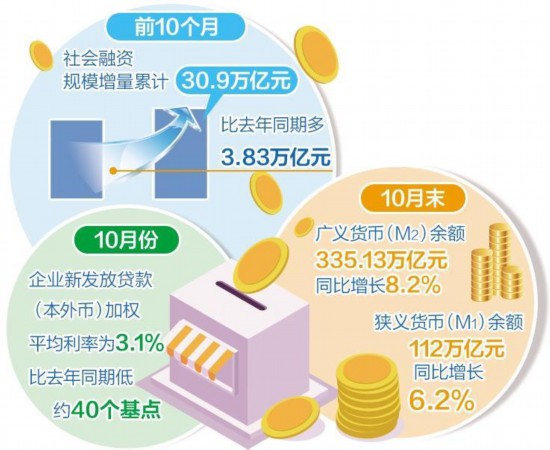
Monetary Policy and Financial Conditions - The broad money supply (M_2) and social financing growth rates remain high, indicating effective monetary policy support for high-quality economic development [2] - As of the end of October, M_2 stood at 335.13 trillion yuan, growing by 8.2% year-on-year, while narrow money (M_1) increased by 6.2% to 112 trillion yuan [4] - The weighted average interest rate for new corporate loans was 3.1%, down approximately 40 basis points year-on-year, reflecting a low-cost financing environment [6] Social Financing and Government Bonds - By the end of October, the total social financing stock reached 437.72 trillion yuan, with an annual growth of 8.5%, supported by increased government bond issuance [3] - Government bonds issued in the first ten months totaled about 22 trillion yuan, nearly 4 trillion yuan more than the previous year, aiding in major project financing and debt relief [3] - The issuance of special long-term government bonds increased from 1 trillion yuan last year to 1.3 trillion yuan this year, indicating proactive fiscal policy [3] Loan Growth and Structure - In the first ten months, RMB loans increased by 14.97 trillion yuan, with household loans rising by 739.6 billion yuan and corporate loans by 13.79 trillion yuan [6] - The structure of loans is shifting, with a notable increase in medium- and long-term loans, which supports sustainable economic growth [6] Consumer Financing and Economic Support - The implementation of consumer loan interest subsidies has reduced personal interest burdens, enhancing consumer capacity and demand [7] - The comprehensive financing cost for enterprises has decreased, providing more funds for production and development, which stimulates economic circulation [6][7] Macro Policy Adjustments - Recent macroeconomic policies have focused on counter-cyclical adjustments, with measures aimed at boosting consumption and supporting livelihoods [9] - The People's Bank of China aims to balance short-term and long-term economic goals while maintaining strong support for the real economy [9]
中国政府债务管理机制的优化
Xin Hua Cai Jing· 2025-11-13 18:55
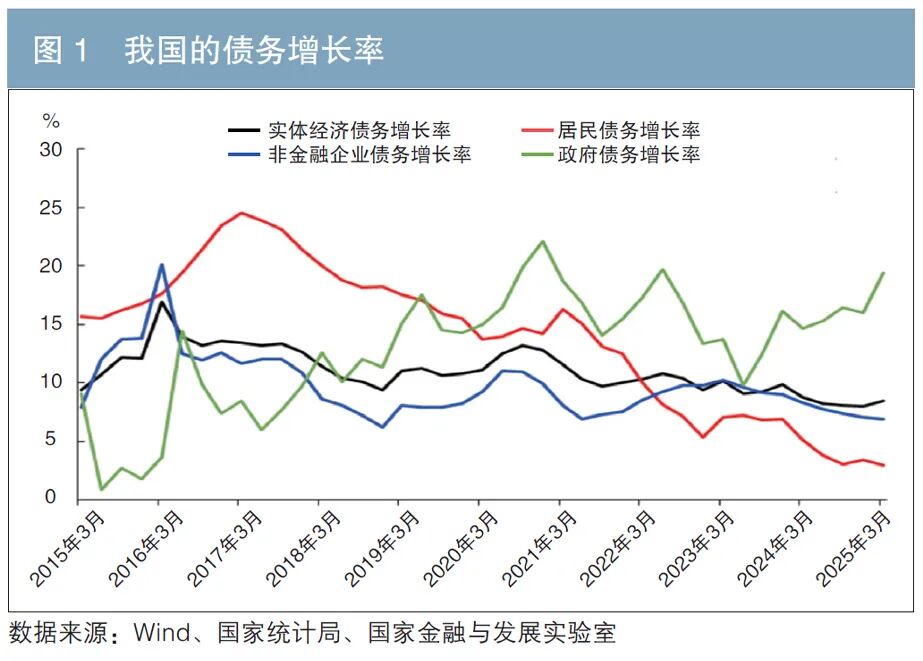
Core Insights - The article discusses the increasing attention on government debt in China as a key variable in macroeconomic operations, highlighting its scale, structure, function, and sustainability amidst a complex economic environment [1] Government Bond Types and Maturity Structure - The types of government bonds in China are primarily classified into deficit debt and self-repaying debt, with a predominance of medium-term bonds and a relative scarcity of short-term bonds [2] - Government bonds serve as a source of liquidity in the financial market and are an important component of wealth for non-financial sectors, but their role in wealth composition for residents remains underexplored [2] Debt Growth Rate Comparison - Since the 21st century, there has been a global focus on debt crises, with a notable increase in government debt in China, particularly local government debt, while the debt growth rate for non-financial sectors, including households and enterprises, has been declining [3] Bond Purchaser Structure - The identity of bond purchasers significantly influences the macroeconomic impact of bond issuance, with non-financial sector purchases involving only fund transfers and no monetary creation, while central bank purchases can create money [4] - In China, commercial banks are the primary holders of government bonds, which has implications for inflation effects [6] Debt Sustainability Analysis - Debt sustainability is a long-standing and contentious issue, with international standards suggesting a deficit rate not exceeding 3% and a debt-to-GDP ratio not exceeding 60% [11] - The sustainability of debt can be assessed through various metrics, including the ratio of debt to earnings before interest and taxes for enterprises and the ratio of debt to payable income streams at the macro level [11] Role of Central Banks in Debt Management - The role of central banks in managing government bonds and liquidity is crucial, with recent reports emphasizing the need for liquidity management to align with economic growth and price stability [12] - Central banks are increasingly focusing on asset price stability and have adapted their policies to enhance financial market stability, particularly in the context of government bond management [13]
前10月社融增量30.9万亿 新动能相关贷款增速较快
Zheng Quan Shi Bao· 2025-11-13 17:48
Group 1 - The People's Bank of China reported that the total social financing increased by 30.9 trillion yuan in the first ten months of 2025, which is 3.83 trillion yuan more than the same period last year [1] - New RMB loans amounted to 14.97 trillion yuan, indicating a significant role of fiscal policy in driving economic growth and demand [1] - Government bond net financing reached 11.95 trillion yuan, accounting for nearly 40% of the total social financing increase, which is 3.72 trillion yuan more year-on-year [1] Group 2 - The proportion of financing methods other than loans has exceeded half of the total social financing increment, indicating a weakening role of RMB loans in driving social financing [2] - The outstanding balance of inclusive small and micro loans was 35.77 trillion yuan, growing by 11.6% year-on-year, while medium to long-term loans in the manufacturing sector reached 14.97 trillion yuan, up by 7.9% [2] - The year-on-year growth rate of total social financing stock was 8.5%, and the growth rate of broad money (M2) was 8.2%, reflecting strong support from the financial system for the real economy [2] Group 3 - The current RMB loan balance has reached 270 trillion yuan, and the total social financing stock is at 437 trillion yuan, suggesting a natural trend of declining growth rates in financial totals due to larger bases [3] - The growth momentum is shifting from traditional sectors like infrastructure and real estate to emerging fields such as technological innovation and green low-carbon initiatives [3] - The central bank plans to implement a moderately loose monetary policy to maintain relatively loose social financing conditions in the future [3]