大数据

Search documents
学习时报文章:在提高反腐败穿透力上下更大功夫
Xin Lang Cai Jing· 2026-01-14 01:04
Core Viewpoint - The fight against corruption is a critical struggle that cannot be lost, emphasizing the need for innovative methods and mechanisms to identify and address various corruption issues effectively [1]. Group 1: Characteristics of New and Hidden Corruption - New forms of corruption are increasingly covert, complex, and intertwined with legitimate economic activities, making detection and identification significantly more challenging [2][3]. - Corruption methods have evolved, often involving "shadow companies" and complex financial transactions that obscure the true nature of the activities [2]. - The emergence of new corruption types requires timely detection, accurate identification, and effective governance to address these evolving challenges [4]. Group 2: Technological Integration and Responsibility Mechanisms - The integration of big data and artificial intelligence is essential for enhancing grassroots disciplinary inspection work, shifting from post-event punishment to proactive prevention and monitoring [3]. - Strengthening the responsibilities of party committees, disciplinary inspection commissions, and judicial authorities is crucial for improving the effectiveness of anti-corruption measures [3]. - A comprehensive approach involving embedded supervision and multi-dimensional analysis is necessary to tackle new and hidden corruption effectively [3]. Group 3: Continuous Improvement and Awareness - Continuous improvement in the ability to identify new and hidden corruption, collect evidence, and construct evidence chains is vital for effective governance [4]. - The establishment of a "negative list" clarifying corrupt behaviors helps to delineate boundaries for party members, reinforcing the message that seemingly compliant actions may still constitute corruption [4]. - The ongoing commitment to self-revolution and strict governance within the party is essential to enhance the effectiveness of anti-corruption efforts [5].
光伏出口退税将取消,谷歌为苹果AI提供支持 | 财经日日评
吴晓波频道· 2026-01-14 00:29
Group 1: Photovoltaic Industry - The export tax rebate for photovoltaic products will be fully canceled starting April 1, 2026, increasing export costs for companies [2] - The export tax rebate for photovoltaic silicon wafers, batteries, and modules was previously reduced from 13% to 9% in December 2024, indicating a trend of declining export tax rates [2] - The Chinese photovoltaic industry has seen a decrease in export prices since 2024, leading to a "volume increase, price decrease" situation, with some companies passing on rebate amounts to foreign buyers, resulting in profit loss [2][3] - The cancellation of export tax rebates aims to promote rational competition in the photovoltaic industry and curb excessive price declines [3] Group 2: Elderly Care Robotics - Eight departments, including the Ministry of Civil Affairs, have issued measures to encourage the development of the elderly care robotics industry, promoting technological integration across various sectors [4] - The initiative aims to provide comprehensive intelligent support for the elderly, leveraging technologies such as embodied intelligence and new materials [4][5] - The market for elderly care technology products and services is expected to expand rapidly, although current technology maturity remains insufficient [5] Group 3: Real Estate Market in Tianjin - Tianjin will tighten control over new housing prices, limiting price changes to within 10% of the registered price for new sales permits [6] - The city has previously implemented price control measures to stabilize housing prices, with over 20 cities having introduced similar "price drop limits" [6][7] - The new management approach aims to control both price increases and decreases, although enforcing price decreases may face challenges [6] Group 4: AI and Technology Collaborations - Google and Apple have entered a strategic partnership, with Google's Gemini model being used to support Apple's AI developments, including Siri [8] - Apple is expected to pay approximately $1 billion annually to Google for technology licensing, indicating a significant investment in AI capabilities [8] - Nvidia and Eli Lilly have announced a $1 billion collaboration to establish a research lab focused on AI applications in the pharmaceutical industry, highlighting the growing intersection of AI and healthcare [10][11] Group 5: ByteDance's Stock Options - ByteDance's stock option price has increased from $44 in 2019 to $226.07 in January 2024, representing a rise of over 4 times [14] - The company is reportedly raising its valuation to between $350 billion and $370 billion as it continues to enhance employee compensation and stock option incentives [14][15] - ByteDance's strong financial performance and aggressive AI application strategy position it as a leading player in the tech industry, despite facing increasing policy risks in overseas markets [15]





8点1氪丨钟薛高创始人胜诉:“爱买不买”不是我说的;“死了么”APP将更名为Demumu;麦当劳客服回应汉堡包越做越小
3 6 Ke· 2026-01-13 23:59
Group 1 - The founder of Zhong Xue Gao, Lin Sheng, won a lawsuit regarding a maliciously edited interview, affirming that he never made the statement "buy it or not" [1] - A report by Deloitte indicates that over 63% of Chinese consumers plan to spend over 300,000 yuan on their next vehicle, with fuel vehicles remaining the preferred choice at 41% [2][3] - ByteDance has raised its option price from $200.41 to $226.07, marking a nearly 13% increase since last August and over a fourfold increase since 2019 [2] Group 2 - McDonald's is facing consumer complaints about shrinking burger sizes, with customers sharing comparisons on social media [2] - The Yanran Angel Children's Hospital is negotiating with landlords over rent debts, claiming that the actual owed amount is due to a rent increase since 2020 [7] - Pinduoduo is testing a new "Billion Supermarket" feature within its app, focusing on low-price strategies to attract price-sensitive consumers [6] Group 3 - Meta Platforms plans to cut about 10% of jobs in its Reality Labs department to shift resources towards artificial intelligence [11] - The U.S. government has approved Nvidia to export its H200 AI chips to China, with a 25% fee on the transactions [12] - Liftoff Mobile, Inc. has filed for an IPO with the SEC, planning to list on the Nasdaq [13]
美锐数据科技(深圳)有限公司成立,注册资本1000万人民币
Sou Hu Cai Jing· 2026-01-13 21:56
Core Viewpoint - Meirui Data Technology (Shenzhen) Co., Ltd. has been established with a registered capital of 10 million RMB, focusing on artificial intelligence and data services [1] Company Information - The legal representative of Meirui Data Technology is Wang Lei [1] - The company is a limited liability company with a business term lasting until January 13, 2026, with no fixed expiration [1] - The company is located at 17th Floor, Block B, Haina Baichuan Headquarters Building, Baonan Street, Bao'an District, Shenzhen [1] Shareholding Structure - Meirui Data Technology is primarily owned by: - Meili Computing Technology Operations (Hainan) Co., Ltd. with an 80% stake - Fujian Xingwang Smart Technology Co., Ltd. with a 20% stake [1] Business Scope - The company’s business scope includes: - Development of artificial intelligence theories, algorithms, and software - Data processing and storage support services - Cloud computing equipment services and sales - Blockchain technology-related software and services - Information technology consulting and system integration services [1]
八部门发文促银发经济发展 14项举措培育养老服务经营主体 鼓励养老服务机器人产业发展
Shang Hai Zheng Quan Bao· 2026-01-13 18:34
Core Insights - The Ministry of Civil Affairs and seven other departments have jointly issued measures to cultivate the elderly care service sector and promote the silver economy, focusing on brand development and technological innovation [2][3][4] Group 1: Policy Measures - The measures include 14 specific initiatives aimed at enhancing the operational vitality of elderly care service providers and promoting structural reforms in supply [2] - Emphasis is placed on brand building, with support for brand creation, protection, and promotion to foster well-known brands in the elderly care sector [2] Group 2: Market Optimization - The measures aim to optimize the supply of elderly care services and age-friendly products, encouraging community-based home care through chain operations [3] - Support is provided for e-commerce platforms and large supermarkets to enhance the connection between supply and demand in elderly care services [3] Group 3: Technological Empowerment - The initiative promotes the integration of big data, artificial intelligence, and other technologies into elderly health monitoring and personalized services [3][4] - Development of elderly care robots and smart devices is encouraged, with a focus on improving the service experience for the elderly [3][4] Group 4: Industry Development - The Ministry of Industry and Information Technology will focus on the deep integration of new information technologies with elderly care services, addressing the pain points of elderly living [4] - Key areas for development include elderly care robots, age-friendly clothing, and easy-to-swallow food products [4] Group 5: Business Development - The Ministry of Commerce will focus on five areas, including the development of home care services for the elderly and creating platforms for supply-demand matching in elderly care [5] - Efforts will be made to create new consumption scenarios for elderly care and foster an open cooperative environment [5]

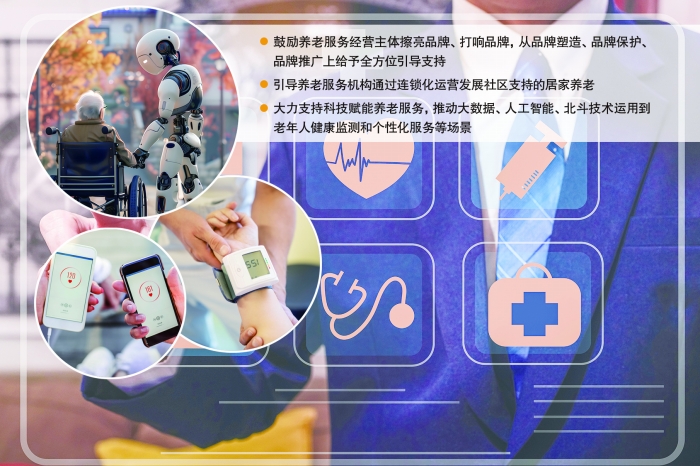
促进银发经济发展 八部门发文培育养老服务经营主体 推动大数据、人工智能、北斗技术运用到老年人健康监测和个性化服务等场景
Zheng Quan Shi Bao· 2026-01-13 18:10
Core Viewpoint - The Ministry of Civil Affairs and eight other departments issued measures to cultivate the elderly care service industry and promote the silver economy, proposing 14 specific initiatives to enhance the elderly care system in China and address the challenges of an aging population [1][2]. Group 1: Policy Measures - The measures focus on brand development, supply-demand platform construction, and optimizing the development environment for elderly care services [1]. - By the end of 2024, the elderly population aged 60 and above in China is expected to exceed 310 million, highlighting the urgency of developing a suitable elderly care system [1]. - The measures aim to optimize the supply of elderly care services and age-friendly products, encouraging community-supported home care through chain operations [1]. Group 2: Consumer Protection and Regulation - The measures emphasize enhancing elderly individuals' risk recognition and self-protection capabilities while addressing issues of elder abuse and misleading marketing practices [2]. - There is a focus on regulating administrative oversight to minimize disruptions to normal operations of elderly care institutions, promoting a "double random, one public" regulatory approach [2]. Group 3: Technological Innovation - Technological innovation and supply optimization are identified as key drivers to address labor shortages in elderly care and improve service efficiency and quality [2]. - The measures promote the application of big data, artificial intelligence, and Beidou technology in health monitoring and personalized services for the elderly [2]. - Support for the development of elderly care robots and smart devices is encouraged to enhance the quality of elderly care services [3].
何氏眼科:加入全国眼科联盟人工智能分联盟 打造智慧眼健康生态样本
Zhong Zheng Wang· 2026-01-13 14:21
Group 1 - The core viewpoint of the articles highlights He Eye Hospital's recent membership in the National Ophthalmology Alliance's Artificial Intelligence Sub-Alliance, which aims to enhance clinical applications of AI in healthcare and improve diagnostic capabilities [1] - He Eye Hospital plans to leverage the alliance's resources to deepen international cooperation in research and development, focusing on the application of AI in screening various eye diseases [1] - The establishment of the AI sub-alliance on January 4, 2025, has already attracted over 100 member units, promoting the integration of high-quality medical resources into grassroots healthcare services [1] Group 2 - He Eye Hospital is positioned as a digital eye health ecosystem group, aiming to create a "Smart Bright City" by collaborating with institutions like Liaoning He Medical College and He Eye Industry Group [2] - The company is focusing on eye health, anti-aging, and longevity technologies, integrating big data, AI, and genetic technologies to develop a new model for comprehensive eye health and chronic disease management [2] - In terms of intelligent applications, He Eye Hospital has developed an intelligent diagnostic system and a specialized imaging cloud platform, utilizing deep learning algorithms for health management [2] Group 3 - He Eye Hospital is also working to promote China's eye care technologies and experiences internationally, through talent training and technology sharing, aiming to enhance local eye health service capabilities in other countries [3] - The company seeks to provide replicable and sustainable models for smart eye health ecosystems, based on innovative screening technologies and management practices [3]
港通医疗:控股子公司港通智联数字科技(重庆)有限公司聚焦于智慧医院后勤综合管理平台的开发
Zheng Quan Ri Bao Wang· 2026-01-13 12:15
Group 1 - The core viewpoint of the article is that 港通医疗 (Hongtong Medical) is focusing on the development of a smart hospital logistics management platform through its subsidiary, 港通智联数字科技 (Hongtong Zhilian Digital Technology) [1] - The company integrates big data, mobile internet technology, and IoT technology to enhance hospital logistics management [1] - The platform aims to upgrade hospital logistics management towards precision, professionalism, and efficiency through real-time data collection and deep analysis [1]
何氏眼科加入全国眼科联盟人工智能分联盟
Zheng Quan Ri Bao Wang· 2026-01-13 11:42
Core Insights - He Eye Hospital has officially become a member of the National Ophthalmology Alliance's Artificial Intelligence Sub-Alliance, enhancing its integration into a national-level innovative platform for smart healthcare and AI clinical applications [1][2] - The National Ophthalmology Alliance's Artificial Intelligence Sub-Alliance was established on January 4, 2025, with over 100 member units currently [1] - He Eye Hospital aims to create a "Smart Light City" by collaborating with various institutions, focusing on eye health, anti-aging, and longevity technology, utilizing new technologies such as big data, AI, and stem cells [1][2] Industry Developments - In the field of ophthalmic intelligent applications, He Eye Hospital has developed an intelligent auxiliary diagnostic system and an ophthalmic specialty imaging cloud platform, leveraging deep learning algorithms for health management [2] - The "He Diabetes Manager" integrates dynamic blood glucose monitoring to provide personalized health management solutions for diabetes patients, ensuring precise blood sugar control and eye disease prevention throughout their life cycle [2] - The "Bright House" initiative utilizes smart ophthalmic equipment to screen for eye diseases and related chronic conditions, creating a digitally empowered grassroots eye health management scenario [2] International Collaboration - He Eye Hospital is actively responding to the Belt and Road Initiative by collaborating with partners to promote China's eye care technology and experience internationally [2] - The hospital aims to enhance local grassroots eye health service capabilities in Belt and Road countries through talent training, technology sharing, and the establishment of blindness prevention models [2] - The membership in the National Ophthalmology Alliance's Artificial Intelligence Sub-Alliance will facilitate deeper international cooperation in research and development, expanding AI applications in ophthalmic disease screening [2]
SCIIA·关于发布2026年度智慧城市全国性团体标准申报的通知
Xin Lang Cai Jing· 2026-01-13 11:34
Core Viewpoint - The Zhongguancun Smart City Information Industry Alliance (SCIIA) has officially launched the project application for the formulation and revision of national group standards for smart cities in 2026, aiming to promote high-quality standards and technological innovation in the smart city sector [1][5][31]. Application Requirements - Applicants must fill out and submit a group standard project application form, which should ideally be initiated by one organization with at least three participating organizations [6][33]. - Proposals that have already formed normative standard drafts and have been validated through practice will be prioritized for project approval, bypassing the drafting stage [6][33]. Application Scope - The application covers areas such as smart city technology, digital transformation, new infrastructure, and digital rural construction, focusing on standards that represent technological innovations or integrated applications in artificial intelligence, big data, blockchain, cloud computing, the Internet of Things, and security [2][7][34]. - Proposals that can fill existing gaps in international, national, or industry standards will be prioritized for project approval [2][7][34]. Acceptance Timeline - Applicants must submit the stamped group standard project application form and optionally a standard draft to SCIIA. The standardization department will organize project review within 10 working days of receiving the proposal and will notify the applicant of the acceptance results [29][29]. Organizational Background - SCIIA, established in 2015, is a national-level 4A social organization with independent legal status, encompassing well-known institutions, universities, and enterprises in the smart city field [9][36]. - The alliance aims to promote global cooperation in smart cities, accelerate industrial agglomeration, and contribute to the construction of green digital China and future smart societies [11][38].