
人工智能软件

Search documents
速递|前DeepMind创立,物理世界模型Physical Intelligence,估值四个月内翻倍至110亿美元
Z Potentials· 2026-03-30 02:54
Core Insights - Physical Intelligence, a robotics startup founded by AI scholars and former Google DeepMind researchers, is in discussions for a new funding round of approximately $1 billion, which would raise its valuation to over $11 billion, doubling its previous valuation of $5.6 billion after a $600 million funding round [1][2]. Funding and Valuation - The upcoming funding round is expected to include participation from Founders Fund, Lightspeed Venture Partners, Thrive Capital, and Lux Capital, with negotiations still in early stages [1]. - To date, Physical Intelligence has raised over $1 billion from investors including Jeff Bezos, CapitalG, Redpoint Ventures, BOND, and Avenir Growth [2]. Industry Trends - There is a surge in venture capital investment in companies focused on building AI models centered around the physical world, with notable startups like Skild AI and Figure AI receiving high valuations of $14 billion and $39 billion, respectively [3]. - Major tech companies, including Alphabet's DeepMind, Apple, and Meta Platforms, are also heavily investing in the robotics sector [3]. Technological Development - Physical Intelligence is developing AI software that enables robots to learn various actions, with its software already deployed in robotic arms for tasks such as folding clothes, making coffee, and assembling boxes [3]. - The company's ultimate goal is to create robots that can perform any function as instructed by users, similar to how large language models execute digital tasks [5]. Recent research has focused on improving the memory capabilities of robotic software models and enhancing performance in precise tasks requiring fine manipulation [5].


智谱AI增资至4458.4万元
Sou Hu Cai Jing· 2026-02-27 03:12
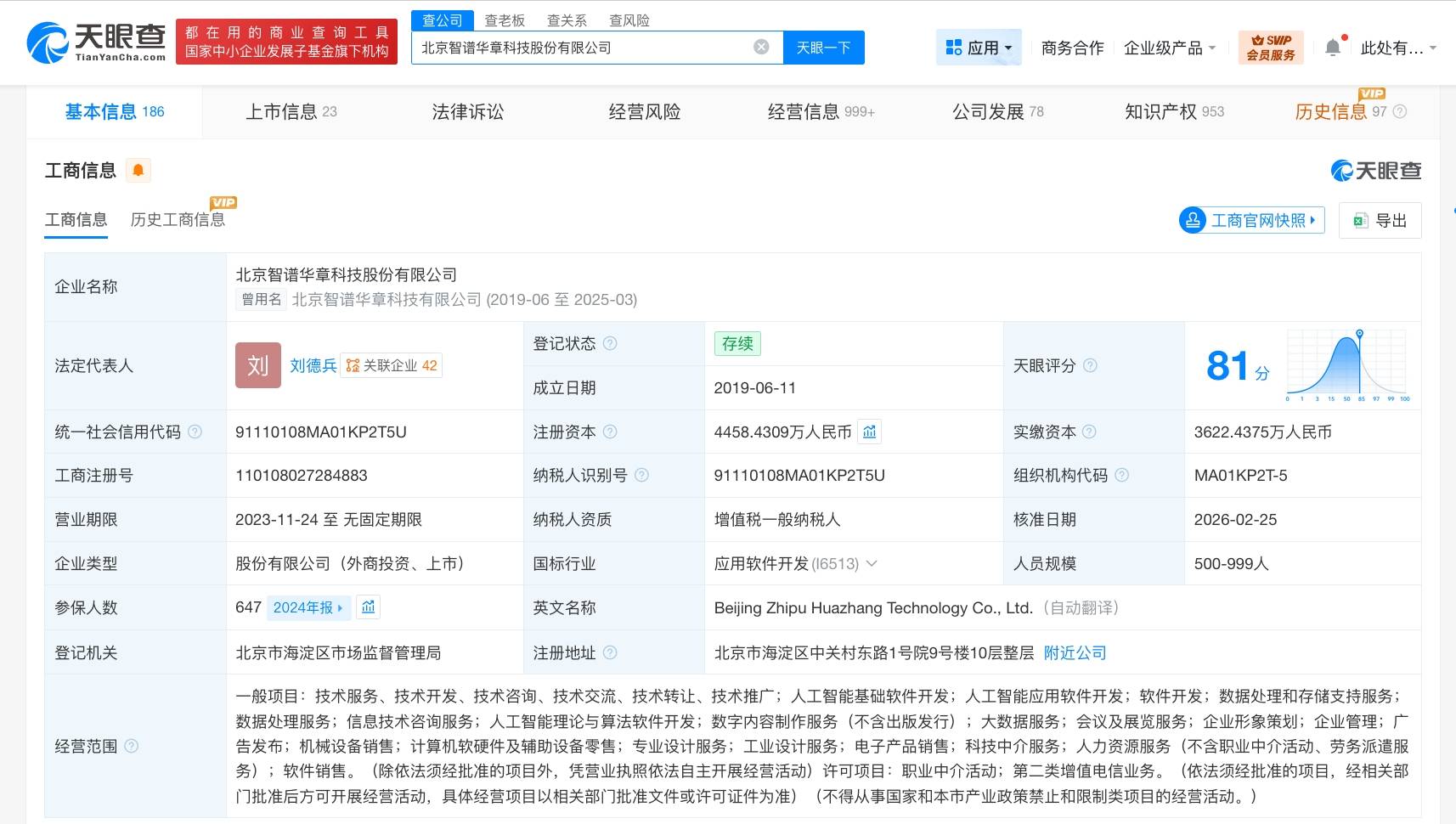
Company Information - Beijing Zhipu Huazhang Technology Co., Ltd. has recently increased its registered capital from approximately 40.281 million RMB to about 44.584 million RMB, marking an increase of approximately 11% [1] - The company was established in June 2019 and is involved in various sectors including artificial intelligence software development, data processing services, and information technology consulting [1][2] - The legal representative of the company is Liu Debing, and it is co-owned by Tang Jie, Tianjin Sankai Technology Co., Ltd., and Guangxi Tencent Venture Capital Co., Ltd. [1][2] Management Changes - Several senior management personnel have changed, including the resignation of certain board members and the appointment of new ones [4] - The current board includes Liu Debing as the chairman, along with other directors such as Zhang Xiaohan and Li Jiaqing [4] Business Scope - The company's business scope includes the development of basic and application software for artificial intelligence, data processing and storage support services, and digital content production [1][2]
永安期货股指日报-20260227
Xin Yong An Guo Ji Zheng Quan· 2026-02-27 02:01
Market Overview - A-shares experienced weak fluctuations, with the Shanghai Composite Index closing down 0.01% at 4146.63 points, while the Shenzhen Component Index rose 0.19% and the ChiNext Index fell 0.29%[1] - The Hong Kong Hang Seng Index dropped 1.44% to 26381.02 points, with the Hang Seng Tech Index down 2.87% and the Hang Seng China Enterprises Index down 2.44%[1] - European indices closed higher, while US indices showed mixed results, with the Dow Jones up 0.03% at 49499.2 points, the S&P 500 down 0.54% at 6908.86 points, and the Nasdaq down 1.18%[1] Geopolitical Developments - Progress was reported in US-Iran talks in Geneva, with further negotiations scheduled for next week[1] - The Iranian Foreign Minister indicated that discussions on nuclear issues and sanctions were serious and productive, with a consensus nearing on several points[12] Industry Insights - IDC forecasts a significant contraction in the global smartphone market, predicting a decline of nearly 13% this year due to a storage chip shortage crisis[8][12] - Baidu reported a third consecutive quarter of revenue decline, with adjusted operating profit down 41%, highlighting challenges in its AI business development[8][12] Financial Highlights - The Hang Seng market recorded a total trading volume of 2592.769 billion HKD[1] - Baidu's revenue for the last quarter fell to 32.74 billion RMB (approximately 4.8 billion USD), a decrease of 4% year-on-year[12]






英媒:更多中国年轻科技精英“勇立潮头”
Xin Lang Cai Jing· 2026-02-25 23:03
Group 1 - A new generation of entrepreneurs, referred to as "弄潮儿" (Nong Chao Er), is emerging in China, focusing on advanced technology sectors such as artificial intelligence and robotics, which are pivotal for the country's future technological leadership [1][2] - These entrepreneurs differ from previous successful individuals, with a significant emphasis on education; many hold degrees from top Chinese universities, particularly in science and engineering [1] - The opportunities in China's economy have shifted, now primarily favoring those who can master advanced technologies, leading to a competitive talent market where high salaries are concentrated among top engineers [1] Group 2 - The "弄潮儿" are concentrated in specific regions such as Beijing's Yizhuang National Innovation Park, Shenzhen, and Hangzhou, where their offices reflect a Silicon Valley style, supported by local government initiatives [2] - Government support is highlighted as a crucial factor for these companies, with local officials providing assistance in research, office space, and participation in international conferences [2] - In December of the previous year, China announced the launch of a national venture capital guidance fund with a fiscal contribution of 100 billion yuan, showcasing the government's deep involvement in fostering technological advancements [2]
范式智能新设控股公司,含集成电路芯片业务
Qi Cha Cha· 2026-02-25 07:25
Group 1 - The core point of the article is the establishment of a new holding company, Paradigm Ark (Beijing) Holdings Limited, which includes integrated circuit chip business [1] - The registered capital of the new company is 10 million yuan, indicating a significant investment in the technology sector [1] - The business scope of the new company includes artificial intelligence application software development, integrated circuit chip sales, and IoT technology services, highlighting its focus on advanced technology [1] Group 2 - Paradigm Ark is wholly owned by Paradigm Intelligent (06682.HK), indicating a strategic move to expand its operations and capabilities in the technology field [1] - The establishment of this holding company may signal a broader trend in the industry towards consolidation and specialization in high-tech sectors [1]
让人工智能更好助推新型工业化(落地有声·高质量办理代表建议)
Ren Min Ri Bao· 2026-02-24 22:19
Core Viewpoint - The integration of artificial intelligence (AI) into the manufacturing industry is progressing rapidly but faces significant challenges, including low-quality industrial data and a lack of skilled personnel [1][2]. Group 1: Challenges in AI and Manufacturing Integration - The manufacturing sector is experiencing a surge in AI technologies, but the integration is not smooth due to various industry-specific issues [1]. - Many companies are engaging in low-level repetitive construction of vertical AI models, leading to resource dispersion and low quality [1]. - A critical issue is the scarcity of high-quality industrial data and the difficulty in sharing it, which hampers the efficiency and generalization ability of AI model training [1]. Group 2: Recommendations and Government Actions - A proposal has been made to accelerate the development of AI in the electrical equipment manufacturing sector, including the establishment of an AI innovation center and the creation of a high-quality industrial data ecosystem [1]. - The Ministry of Industry and Information Technology and other government departments have initiated a series of actions to promote the integration of AI and manufacturing, including developing high-level industry models and enhancing talent cultivation [2]. - The recent top-level planning document is expected to significantly promote the fusion of AI and manufacturing, with a focus on comprehensive and high-level empowerment of new industrialization [2].
《财富》水晶球:对2026年IPO市场与交易活动的预测
财富FORTUNE· 2026-02-16 13:03
Core Insights - The IPO market is experiencing a resurgence, particularly in the tech sector, with strong investor demand and liquidity, although the overall activity remains below historical levels [1][5][6] - Private companies are maintaining high valuations and leveraging their positions to avoid going public, a privilege limited to top-tier firms [1][3] - M&A activity is expected to dominate the market, with significant acquisitions anticipated, particularly in the AI and biotech sectors [7][8] IPO Market - The IPO market is expected to continue its upward trend into 2026, driven by strong performance and investor appetite for tech assets [5][6] - There is a backlog of companies ready to go public, but a significant trigger is needed to accelerate the listing process [6] - Smaller companies face challenges in the IPO process unless there are major reforms to improve efficiency and reduce costs [6] M&A Market - A notable acquisition in the AI software sector exceeding $50 billion is predicted, reshaping the market landscape [7] - The fintech industry is entering a consolidation phase, with companies acquiring smaller competitors to enhance their market position [7] - Biotech firms are expected to see a resurgence in M&A activity, particularly from large pharmaceutical companies with substantial cash reserves [7][8] Private Market Trends - The secondary market for private investments is anticipated to grow significantly, with a projected transaction volume of $250 billion in 2026 [8] - There is a trend towards mergers among venture-backed startups as they seek growth avenues to achieve public or private equity exits [8] - Offerings for buyouts will extend beyond large private firms, as medium-sized companies also seek to retain talent through acquisition offers [8]

大西洋月刊:美国还没准备好迎接人工智能对就业的影响
美股IPO· 2026-02-13 03:27
Core Argument - The article discusses the profound impact of artificial intelligence (AI) on the job market, suggesting that the U.S. is unprepared for the potential disruptions it may cause to employment and economic stability [1]. Group 1: Historical Context and Current Trends - The establishment of the U.S. Bureau of Labor Statistics (BLS) aimed to measure labor conditions and create fair outcomes amidst industrial changes, highlighting the importance of data in understanding economic realities [5][6]. - The BLS has documented significant job growth in various sectors, such as a 907% increase in mobile food service jobs since 2000, indicating a dynamic labor market [6]. - However, the BLS is limited in its predictive capabilities, particularly regarding the impact of emerging technologies like AI on the workforce [7]. Group 2: AI's Impact on Employment - AI is rapidly transforming job functions, enabling tasks to be completed more efficiently than ever before, which raises concerns about job displacement [8][9]. - Predictions from industry leaders suggest that AI could lead to a 10% to 20% increase in unemployment rates and potentially eliminate half of entry-level white-collar jobs within the next decade [10]. - A Reuters/Ipsos survey indicates that 71% of Americans fear AI will lead to permanent job losses, reflecting widespread anxiety about the future of work [9]. Group 3: Economic Resilience and Job Creation - Economists argue that capitalism has a strong resilience, often leading to job creation following technological advancements, as seen with ATMs and software like Excel [8]. - The BLS forecasts a 3.1% employment growth rate over the next decade, which, while lower than previous years, still represents the addition of 5 million jobs [8]. Group 4: The Role of Policy and Corporate Responsibility - There is a growing concern that corporate leaders are prioritizing automation and efficiency over employee welfare, leading to potential mass layoffs [22][23]. - The article suggests that CEOs are under pressure to demonstrate the benefits of AI quickly, often resulting in job cuts rather than exploring ways to integrate AI while supporting their workforce [22][23]. - Proposals for policies such as retraining programs and a robot tax to support displaced workers are discussed, but there is skepticism about their implementation [33][28]. Group 5: Political and Social Implications - The political landscape is characterized by a lack of proactive measures to address the challenges posed by AI, with many lawmakers adopting a hands-off approach [26][27]. - The article emphasizes the need for a coordinated response to the potential upheaval caused by AI, suggesting that without intervention, the consequences could be severe for both the economy and society [30][31].




蔡丽霞:深入实施“人工智能+工业”行动 全力推进泰安新型工业化提质增效
Qi Lu Wan Bao· 2026-02-10 09:20
Core Viewpoint - The article emphasizes the importance of integrating artificial intelligence (AI) with industrial development to enhance productivity and innovation across various sectors, as outlined in the recent policy initiatives from the 20th National Congress of the Communist Party of China [1]. Group 1: Focus on Key Industries - The implementation of the "AI + Industry" action plan is crucial for the digital transformation and industrial upgrade in the region, with a focus on key sectors such as power transmission and high-end chemicals [1]. - The city has initiated a new industrialization path characterized by a "one transformation leads to three integrations" approach, aiming for a comprehensive digital transformation by 2025 [1]. - A visualized task management system will be established to clarify the requirements for digital transformation across various industrial chains [1]. Group 2: Expanding Application Scenarios - The promotion of AI applications in diverse business scenarios, including R&D, flexible manufacturing, and management, is essential for lowering the barriers to AI adoption [2]. - The establishment of a service platform for supply-demand matching will facilitate the identification of opportunities and capabilities for enterprises [2]. - The development of intelligent factories and zero-carbon factories is encouraged, particularly for leading enterprises, to enhance efficiency and sustainability [2]. Group 3: Accelerating Product Breakthroughs - There is a strong emphasis on innovating AI hardware products and expanding production capabilities to support a closed-loop development system for technology research, core production, and application [3]. - The development of vertical models for specific industries is prioritized to address common challenges and enhance the application of AI in high-end equipment and new materials [3]. - Collaboration between key enterprises and data service providers is encouraged to create a unique "smart industrialization" product system [3]. Group 4: Strengthening Element Support - The establishment of a resource pool for AI service providers is vital for supporting the entire lifecycle of industrial development [4]. - A specialized talent plan for AI is proposed to cultivate high-level professionals and support local educational institutions in offering relevant programs [4]. - Financial innovations, such as "AI loans" and "model application insurance," are suggested to broaden financing channels and facilitate the transformation of high-quality data into value [4].
摩根士丹利力挺科技股:大型科技股营收预期达数十年最高
Jin Rong Jie· 2026-02-10 09:06
Group 1 - The core viewpoint of the reports indicates that the technology sector's revenue outlook is strong, supported by the AI boom, and U.S. tech stocks have further upside potential [1] - Large tech stocks have reached the highest revenue growth expectations in decades, and recent market volatility has created attractive buying opportunities for stocks like Microsoft and ServiceNow [1] - Companies applying AI to their core businesses have more growth opportunities compared to those focused solely on technology and infrastructure development, with application companies outperforming the market by an average of 1% on the first trading day after earnings reports [1] Group 2 - The decline of the U.S. dollar provides additional support for tech stocks, as approximately half of the revenues of Nasdaq 100 constituents come from overseas markets [1] - Analysts expect a broader recovery in earnings upgrades for the semiconductor, software, tech hardware sectors, and the "Big Seven" tech companies [1] - Rick Sherlund, founder of Sherlund Partners, expresses optimism regarding the necessary capital expenditures by large tech companies in the AI sector, emphasizing the real demand for AI infrastructure [2]
