
形式主义

Search documents
形式主义的“锅”AI不背
Xin Lang Cai Jing· 2025-12-22 23:27
王史 说到底,AI只是工具,既可以做形式主义的帮凶,也能成为实事求是的助手。很多地方开始用AI工具 分析群众诉求内容,从海量数据中提取的真问题、真经验,为精准施策提供了不少参考。扫清"唯材料 论"的积尘,摆正"以实绩评高下"的政绩观,让材料中的文字都生长在实干的土壤里,治理效能才会在 解决问题中日益增长。 AI浪潮席卷而来,各类生成工具也悄然流行于基层。比如,只需输入几个关键词,眨眼间,一篇结构 完整、用词规范的文本就跃然眼前。若嫌文风过于工整,还可追加指令,反复修改,以增加"活人感"。 对此,有人欢喜终于解脱于"材料苦海",也有人担心此乃形式主义借AI还魂。 这让人不由得想起《西游记》里的一个情节:银角大王用紫金红葫芦喊人姓名,应声的便被吸入,孙行 者后来以其人之道还治其人之身,反收了妖怪。葫芦本是法宝,用在妖魔手里便害人,用在行者手中便 除妖。今日之AI,亦似这葫芦,是宝是妖,全看谁来用、如何用了。 此番忧虑不无道理。且看那些AI生成文本,逻辑顺畅却缺少灵魂,格式工整却千篇一律,乍看承接铺 垫不少,好词佳句迭出,可通篇读下来,就如喝了一碗精心熬制却没放食材的清汤,那叫没味儿!任何 工作中,某件事的情况怎么 ...
中央纪委国家监委通报
券商中国· 2025-12-22 15:11
Core Viewpoint - The article discusses the statistics and implications of violations of the Central Eight Regulations in November 2025, highlighting the ongoing efforts to combat corruption and promote integrity within the government [1][3]. Summary by Sections Violations Statistics - In November 2025, a total of 31,754 violations of the Central Eight Regulations were reported, with 40,306 individuals receiving criticism or disciplinary action, including 29,184 who faced party disciplinary sanctions [1][2]. - The breakdown of violations includes 12,538 issues related to dereliction of duty and poor service in economic and social development, accounting for 84.1% of formalism and bureaucratic issues [2][3]. - Among the violations categorized as hedonism and extravagance, the issues of accepting valuable gifts and cash, improper dining, and improper distribution of allowances or benefits accounted for 55.2%, 22.5%, and 11.8% respectively [2]. Level of Violations - The report indicates that in November, there was 1 case involving provincial and ministerial leaders, 119 cases involving departmental leaders, 1,823 cases involving county-level leaders, and 29,811 cases involving grassroots leaders, with the latter group making up 93.9% of the total violations [3]. Ongoing Efforts and Future Actions - The article emphasizes the importance of continuing to enforce the Central Eight Regulations, with a focus on deepening education and awareness, and increasing the rigor of inspections and penalties for violations [3]. - As the New Year approaches, there is a call for vigilance against potential violations during the holiday season, with plans for educational reminders, notifications, inspections, and swift actions against any infractions [3].


今年已有62名中管干部被查
第一财经· 2025-12-22 07:04
Core Viewpoint - The article highlights the ongoing anti-corruption efforts in China, emphasizing the government's commitment to tackling corruption at all levels, particularly in key sectors such as finance, energy, and public services [3][4]. Group 1: High-Level Anti-Corruption Efforts - In 2023, 62 senior officials have been reported as under investigation by the Central Commission for Discipline Inspection and National Supervisory Commission, with a significant increase in cases compared to the previous year [4]. - The anti-corruption campaign has seen a focus on high-profile cases, including former senior officials from the banking and tobacco sectors, indicating a strong stance against corruption in critical industries [4][5]. Group 2: Grassroots Anti-Corruption Initiatives - The article discusses the emphasis on addressing "micro-corruption" at the grassroots level, with specific initiatives targeting issues in school meal programs, healthcare fund management, and elderly services [5]. - Various local governments have implemented models to monitor and prevent corruption, such as in Heilongjiang, where a supervision model for vocational training subsidies was established [5]. Group 3: Systematic Approach to Corruption - The article notes that the anti-corruption strategy includes a systematic approach to address both corruption and the underlying issues that contribute to it, with a focus on the interconnection between misconduct and corruption [6]. - In the first ten months of the year, over 219,000 cases of violations of the Central Eight Regulations were investigated, leading to significant disciplinary actions against officials [6]. Group 4: Ongoing Challenges - Despite progress, issues such as formalism and bureaucratism remain prevalent, with recent cases highlighting the exploitation of public resources through fictitious identities [6]. - Experts suggest that these persistent problems undermine government credibility and call for enhanced measures to strengthen accountability among officials [6].

今年已有62名中管干部被查,“打虎”最新数据来了
Xin Lang Cai Jing· 2025-12-22 06:58
Group 1 - The article highlights the ongoing anti-corruption efforts in China, emphasizing that the high-pressure stance against corruption remains unchanged as the year ends [1][2] - A total of 62 senior officials have been reported to be under investigation by the Central Commission for Discipline Inspection and National Supervisory Commission this year, with a significant increase in cases compared to the previous year [2] - Key sectors such as finance, energy, tobacco, and infrastructure have seen a crackdown on corruption, with notable figures like the former deputy governor of the Bank of China being implicated [2][3] Group 2 - The article discusses the systematic approach to tackling corruption, focusing on both high-level and grassroots issues, with a particular emphasis on addressing "micro-corruption" in local communities [3][4] - Statistics reveal that in the first ten months of this year, there were 219,762 cases of violations of the Central Eight Regulations, leading to disciplinary actions against 196,163 individuals [4] - The persistence of formalism and bureaucratic issues is highlighted, indicating that these problems not only undermine the integrity of the system but also affect government credibility [4]
为基层减负要“瘦身”更要“提质”(思想纵横)
Ren Min Ri Bao· 2025-12-21 22:41
Core Viewpoint - The effectiveness of grassroots governance is crucial for the overall work of the Party and the country, and reducing burdens on grassroots is essential for improving governance efficiency [1][4]. Group 1: Importance of Reducing Burdens - The emphasis on reducing burdens for grassroots work aligns with public expectations and reflects a new style of governance [1]. - There are still issues in some areas where the reduction of burdens is not fully implemented, leading to a resurgence of formalism and bureaucratic practices [1][2]. - The need to eliminate unnecessary tasks and interventions is highlighted to allow grassroots workers more time and space to focus on practical matters [3][4]. Group 2: Challenges and Root Causes - The persistence of new issues in reducing burdens stems from a lack of commitment among some party members and the prevalence of formalism and bureaucratic attitudes [2]. - There is a disconnect between the central decisions for reducing burdens and their implementation at local levels, indicating a need for stronger party discipline [2]. Group 3: Strategies for Improvement - It is essential to continue reducing unnecessary meetings and tasks, allowing grassroots workers to engage more directly with the community [3][4]. - Setting realistic goals and timelines for grassroots tasks is necessary to avoid overwhelming them with excessive demands [3]. - The focus should be on enhancing the quality of grassroots governance, ensuring that reductions in burdens lead to improved service delivery and policy execution [4].
新华网三评之三:儿童设施不能只注重美观
Xin Hua She· 2025-12-19 03:35
Core Viewpoint - The article emphasizes that children's facilities in urban areas should prioritize functionality over aesthetics, as many existing installations are not practical for actual use [1] Group 1: Issues with Current Facilities - Many community playgrounds have equipment made of metal that becomes too hot in summer and too cold in winter, making them unsafe for children [1] - Some parks have climbing structures that are incomplete and remain unrepaired for long periods, indicating a lack of maintenance [1] - Family restrooms and mother-baby rooms in shopping malls often have unclear signage and are located in inconvenient areas, with some being used as storage spaces [1] Group 2: Importance of Practical Design - The needs of children and parents are straightforward, requiring features like non-slip surfaces, shaded areas, accessible mother-baby rooms, and age-appropriate play equipment [1] - Practical design elements are deemed more valuable than mere aesthetic appeal, highlighting the importance of functionality in children's facilities [1] Group 3: Recommendations for Improvement - Decision-makers and implementers should adopt a "one-meter perspective" to better understand children's needs when planning facilities [1] - Engaging children as "little planners" could provide valuable insights into what facilities should be built [1] - Including parental satisfaction in the assessment of park maintenance could enhance the quality of children's facilities [1]

明纪释法丨以开展横向调研为名行私人探望之实如何处理
Zhong Yang Ji Wei Guo Jia Jian Wei Wang Zhan· 2025-12-16 23:53
Core Viewpoint - The case of Shi, a party member and director of a bureau in A province, highlights issues of formality and bureaucratism in public service, particularly regarding the misuse of public funds for personal purposes under the guise of official duties [2][3][5]. Group 1: Nature of the Investigation - Shi's visit to B province was characterized as lacking substantive content and clear official purpose, which constitutes "work not done" and increases the burden on local staff [2][3]. - The investigation did not yield any tangible results, and the trip was reported as a business trip, leading to reimbursement claims for travel expenses [1][2]. Group 2: Divergent Opinions on Handling - One opinion suggests that Shi's actions should be classified as a violation of the central eight regulations and work discipline due to the lack of genuine research needs and the superficial nature of the visit [2][3]. - Another opinion argues that the trip was a pretext for personal visits, constituting a misuse of public resources, and should be treated as a violation of integrity discipline [2][3]. Group 3: Analysis of Behavior - The necessity of conducting research is questioned, as there was no real need or plan for the investigation, which should focus on solving actual problems [3][4]. - The subjective motivation behind Shi's actions reflects a disconnect from the responsibilities of public service, prioritizing personal interests over public duty [4][5]. Group 4: Implications of Actions - Shi's actions are seen as a violation of the principles of integrity, as they blurred the lines between public and private interests, leading to the misuse of public funds for personal gain [5][6]. - The case serves as a reminder for public officials to adhere strictly to regulations and ensure that official activities are necessary and legitimate [7].
一串假名字暗藏多少真问题
Guang Zhou Ri Bao· 2025-12-12 08:57
这起事件的发酵,与近期爆火的"张吉惟""林国瑞""林玟书""林雅南""江奕云"5个名字密切相关。这 串出自百度文库《10000中国普通人名大全》的名字,堪称"全网最忙五人组"——从政府采购评审专家 名单,到书法比赛获奖公示;从行政处罚公告名单,到医学杂志编辑名录,甚至羽毛球赛事参赛名单 里,都能看到他们"忙碌的身影",其离谱程度让网友直呼"魔幻"。 "这些名字在不同官方文件、公示场合反复出现,暴露的不只是低级错误或工作疏忽,更是部分公 共事务流程中系统性、结构性的形式主义弊病。"正如权威评论所言,表面看,此类闹剧满是形式主义 的影子:一些工作人员为应付材料、凑足人数,连编个新名字都嫌麻烦,直接当起"'名'抄公",杭师大 通报中也直言问题源于"相关工作人员作风不严不实"。 但往深处挖,事情远不止"形式主义"这么简单。政府采购评审专家手握项目评审大权,其专业判断 直接决定投标人能否中标,是采购流程中不可或缺的关键角色。可湖北省竹溪县住建局在两份总金额超 6500万元的采购公告里,竟堂而皇之虚构评审专家信息。这般操作,岂是一句"形式主义"能搪塞的?这 两个采购项目是否合规合法?专家评审环节是真实开展还是凭空捏造?背 ...
肆意的“Ctrl C+Ctrl V” 击穿了哪些底线?
Xin Hua She· 2025-12-10 06:04
昨天是政府项目招标评审员,今天就成了书画比赛获奖选手;前脚是占道经营的街头商贩,转眼又成了 高校公益受助学生……近日,来自"10000中国普通人名大全"中的五个人,被网友发现游走在全国多个 公示名单中,跨界赶场"忙得不可开交",被戏称为"全网最忙五人组"。 连电视剧都不敢这样编的"全能跨界剧本",堂而皇之地出现在地方政府公告、行政处罚、评选公示中, 暴露了某些基层工作人员无视规则、蔑视程序的胆大妄为。当"Ctrl+C""Ctrl+V"肆意横行,复制粘贴 的"主人公"突破一道道审核把关,参赛机制、评审规则、资助原则等,就从刚性制度沦为一纸空文。 从中标者到被罚者,从受助者到获奖者,这么大的跨界、这么高的雷同,绝不是偶然巧合。有网友质 疑:"顺序都不打乱一下,造假都懒得动脑子,电视剧都不敢这么演!" 不少网友发出灵魂拷问:"人名造假都懒得花心思,糊弄都懒得认真,就这么有把握,没人看、没人 管?" 近日,湖北省竹溪县一项机械设备租赁采购中标结果公告中,评审小组成员为"张吉惟、林国瑞、林玟 书、林雅南、江奕云"。 网友发现,这五个看上去"十分眼熟"的名字,竟然与"10000中国普通人名大全"中的5个名字完全重合。 网 ...
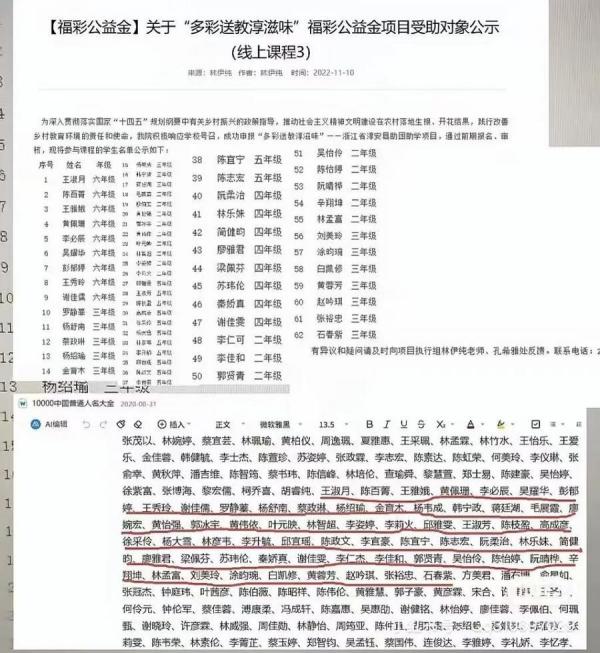
对“最忙五人组”的危害,不能等闲视之
Bei Jing Shang Bao· 2025-12-08 15:46
Core Viewpoint - The incident involving the use of fake names in government documents highlights serious issues of formalism and lack of accountability within local government agencies, raising concerns about public trust and potential corruption [1][2][3] Group 1: Incident Overview - A situation report from the investigation team in Lu'an City, Anhui Province confirmed that the use of names from a common name database in official documents was true and has led to an ongoing investigation [1] - The names, referred to as the "most active five-person group" online, have appeared repeatedly in various government procurement projects, award lists, and event registrations, indicating a troubling trend of superficial compliance [2] Group 2: Implications of Formalism - The frequent appearance of these fake names suggests a deeper issue of formalism, where compliance processes are treated as mere formalities rather than serious checks, potentially allowing for corrupt practices to flourish [2][3] - The incident raises questions about the integrity of evaluation processes in government procurement, suggesting that the presence of fake names may indicate a lack of genuine oversight and accountability [2][3] Group 3: Broader Concerns - The situation reflects a broader issue of inadequate risk assessment capabilities among local governments, particularly in matters affecting public safety, where bureaucratic inefficiencies can lead to significant problems [3] - The response from involved agencies, such as hastily removing names or promising investigations, often lacks depth and fails to address the underlying issues of compliance and accountability [3] Group 4: Call for Systemic Change - The incident serves as a wake-up call regarding the need for systemic reforms to strengthen compliance and oversight mechanisms, ensuring that public trust is maintained and that formalism does not undermine governance [3] - It emphasizes the importance of scrutinizing even seemingly minor details in governance to prevent the erosion of public confidence and to combat formalism and opaque practices [3]