
科技金融

Search documents
东北地区科技金融印象
Jin Rong Shi Bao· 2025-12-18 02:25
Group 1 - The Northeast region of China is increasingly focusing on technological innovation and financial services, despite being traditionally viewed as an industrial and agricultural area [1] - The region's efforts are highlighted through various case studies in technology finance, showcasing support for industries such as biopharmaceuticals and smart manufacturing [1] - The aim is to draw attention to the Northeast's commitment to innovation in technology finance and its role in promoting scientific and technological development [1] Group 2 - Jilin Tonghua Jianxin Technology Co., Ltd. has been recognized as a "Manufacturing Industry Single Champion Demonstration Enterprise" and a national-level specialized and innovative small giant enterprise, receiving significant financial support from local banks [3] - Heilongjiang Fulun Agricultural Technology Co., Ltd. is one of the first batch of integrated seed enterprises, benefiting from increased loan support to meet its cash flow needs [5] - Heilongjiang Huida Technology Co., Ltd. integrates advanced technologies like Beidou navigation and artificial intelligence to produce smart agricultural equipment, receiving substantial financial backing from multiple banks [7] - China Construction Bank's Jilin branch has provided over 200 million yuan in financial support to key semiconductor enterprise Huamei Electronics, aligning with the needs of high-tech companies in the Northeast [9]


协同演进视角下的科技金融赋能
Jin Rong Shi Bao· 2025-12-18 02:12
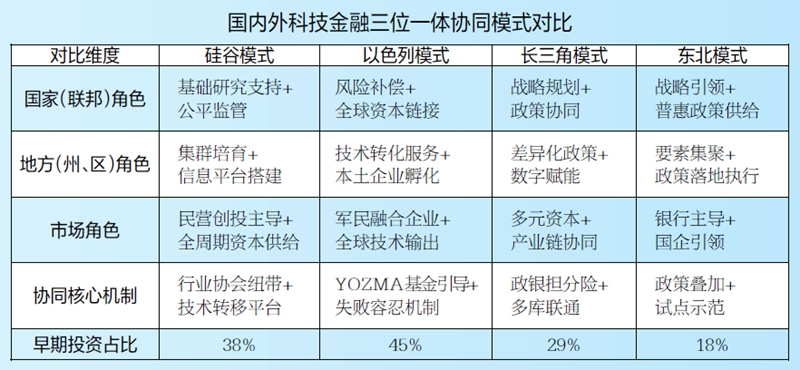
Core Viewpoint - The Northeast region of China, recognized as the "industrial cradle" of the new China, is strategically positioned to cultivate new productive forces due to its significant educational and scientific resources, including 11.3% of the national scientific and educational resources, 28 national key laboratories, and a talent pool of 2.3 million skilled workers. The 2023 Central Financial Work Conference prioritized "technology finance" as a key focus, providing a fundamental guideline for the Northeast to overcome transformation bottlenecks [1][5]. Theoretical Framework: Three-dimensional Collaborative Evolution - The empowerment of new productive forces through technology finance is a systematic project led by central strategy, implemented by local policies, and responded to by market innovations. The three-dimensional collaborative evolution framework reveals the dynamic adaptation of these three elements throughout the industrial lifecycle, offering a new perspective on understanding the development of technology finance in Northeast China [2][4]. Framework Core Dimensions - Central Government: Provides strategic guidance and institutional supply through top-level design, offering inclusive policies and common technical support, establishing unified national market rules [3]. - Local Government: Creates scenarios and gathers resources through differentiated policies, building risk-sharing mechanisms and information platforms to promote the geographical concentration of financial and technological resources [3]. - Market Entities: Respond to policy signals through technological innovation and product iteration, achieving the industrialization of technological achievements, with capital completing full-cycle allocation driven by profit motives [3]. Stage Adaptability Collaborative Characteristics - The interaction among the three entities is dynamic, evolving through the "startup phase, growth phase, and maturity phase" of new productive force cultivation, forming a closed-loop collaborative system of "strategy-execution-feedback" [4]. Practical Outcomes: Breakthroughs and Data Evidence in Northeast Technology Finance - The Northeast region has begun to form a collaborative effect based on the three-dimensional framework, achieving substantial progress in policy systems, financing channels, and ecological cultivation, laying a solid foundation for the cultivation of new productive forces [5]. Central-Local Policy Collaboration - The central top-level design and local characteristic policies effectively respond to each other, with the central government implementing targeted policies such as technology innovation re-loans and venture capital tax incentives, while local governments establish a policy system that integrates provincial and municipal characteristics [6]. Local-Market Factor Collaboration - Local governments are building platforms to promote resource aggregation, with market-oriented financing channels continuously expanding. The loan balance for technology enterprises in Northeast China increased from 420 billion yuan in 2021 to 680 billion yuan in the first half of 2024, with an annual growth rate of 17.8% [7]. Ecological Collaboration Cultivation - Local governments are improving ecological infrastructure, significantly enhancing market entity participation. Information platforms and risk-sharing mechanisms are being established, with notable increases in financing events and amounts raised [8]. Core Bottlenecks: Deep Deconstruction of Collaborative Imbalance - Despite progress, Northeast technology finance faces three imbalances: ineffective central policy transmission, insufficient local mechanism innovation, and limited market entity vitality, leading to inefficient matching of financial resources and innovation demands [9]. Central-Local Collaboration Imbalance - There is a mismatch between central inclusive policies and local actual needs, with policy transmission efficiency being insufficient. The average capital adequacy ratio of provincial policy guarantee institutions in Northeast China is only 12.3%, significantly lower than the 18.7% in the Yangtze River Delta [10]. Local-Market Collaboration Imbalance - Local government platforms are disconnected from market demands, with issues of information asymmetry and lack of risk-sharing. The interconnectivity rate of enterprise databases in Northeast China is below 30%, compared to 85% in Suzhou [11]. Market-Central Feedback Imbalance - The innovative demands of market entities lack effective feedback mechanisms to policy optimization, resulting in a lag in policy responses to grassroots practices. The proportion of state-owned venture capital in Northeast China is 68%, which is 23 percentage points higher than in the Yangtze River Delta [12]. International Comparison: Collaborative Models and Experience Extraction - Global innovation hubs have optimized their three-dimensional collaborative mechanisms, forming technology finance ecosystems that adapt to the laws of technological innovation, providing important references for Northeast China [14]. Silicon Valley: Market-Driven Collaborative Ecology - Silicon Valley's model emphasizes private venture capital, with the federal government supporting basic research and local governments focusing on ecological building, while market entities lead capital supply [15][16]. Israel: Government-Guided Collaborative Model - Israel's model features national risk coverage, local technology transfer, and market global expansion, breaking down capital entry barriers and focusing on the last mile of technology transfer [17]. Yangtze River Delta: Government-Market Linked Collaborative Sample - The Yangtze River Delta constructs a model of central strategic guidance, local digital empowerment, and market multi-dimensional collaboration, adapting to regional industrial characteristics [18]. Quantitative Assessment: Empirical Evaluation of Policy Collaboration Effects - The PMC index model evaluates the collaborative quality of Northeast technology finance policies, revealing that while the average score is 6.7 (out of 10), there are significant shortcomings in collaboration [19][20]. Path to Resolution: Innovative Solutions for Three-dimensional Collaborative Empowerment - To address the bottlenecks in Northeast technology finance, it is essential to build collaborative mechanisms from three dimensions: central-local transmission, local-market connection, and market-central feedback [21][22][23]. Conclusion - The core of empowering Northeast new productive forces through technology finance lies in achieving collaborative evolution among the central government, local governments, and market entities. While a preliminary framework for policy collaboration has been established, challenges remain in transmission, connection, and feedback. Systematic innovation is required to enhance the collaborative chain, ultimately transforming the region's rich scientific and educational resources into productive advantages [26].
以专业化服务 写好科技金融大文章 苏州农商银行不断探索服务科技金融新模式
Jin Rong Shi Bao· 2025-12-18 02:04
Core Insights - Suzhou Rural Commercial Bank focuses on serving the needs of early-stage small and medium-sized technology enterprises, leveraging Suzhou's position as a hub for industrial and technological innovation [1][2] Group 1: Financial Support and Innovation - As of November 2025, the bank's technology enterprise loan balance exceeds 20 billion yuan, serving over 2,000 technology enterprise clients, with 80% being early to mid-stage technology companies [1] - The bank has launched specialized financial products such as "Talent Enterprise Loan" and "Venture Capital Loan," which cater to the credit needs of early-stage technology enterprises [3][4] - The bank's "Angel Loan" program provides 2 million yuan to startups, linking equity financing with bank credit to enhance financial structure and boost enterprise confidence [2][5] Group 2: Strategic Development and Collaboration - Suzhou is home to 24,300 national technology-based SMEs, ranking first in the country, and the bank actively collaborates with various institutions to develop tailored financial products for early-stage technology enterprises [2][5] - The bank has established a "Technology Financial Laboratory" to analyze key technology industries in Suzhou, creating industry research reports to better understand client needs and provide financing solutions [5] - The bank's credit approval process incorporates intelligent risk control and analysis platforms, allowing for rapid approval for well-documented enterprises [4]

内蒙古赤峰: 从“行路难”到“乘风行” 金融护航科创企业“轻装”前行
Jin Rong Shi Bao· 2025-12-18 02:03
Group 1 - The core idea is that the People's Bank of China Chifeng Branch is addressing the financing difficulties faced by technology enterprises by creating a new framework that includes "platform-model-path" to support innovation-driven development [1] - The establishment of the Chifeng Technology Alliance aims to enhance service effectiveness for technology companies, with a focus on their characteristics of being "light asset, high growth, and strong specialization" [2] - As of October 2025, the number of technology enterprises supported by financial institutions in Chifeng has reached 734, an increase of 15.96% year-on-year, with a total loan balance of 34.704 billion yuan, up 22.21% year-on-year [2] Group 2 - The People's Bank of China Chifeng Branch has developed a financing service monitoring and evaluation system for technology enterprises, which includes four lists: financing needs, support policies, financial products, and bottleneck factors [3] - The system employs dynamic management to systematically address enterprise needs and improve the efficiency of meeting financing demands [3] - In 2023, 320 technology SMEs were registered in Chifeng, with 114 being first-time applicants, indicating a continuous increase in local innovation vitality [3] Group 3 - The introduction of the "Xing Su Loan - Bank Guarantee Technology Loan" product by the Industrial Bank Chifeng Branch aims to alleviate financing pressures for technology enterprises by integrating government organization, bank risk control, guarantee enhancement, and intellectual property pledges [4] - Financial institutions in the region are utilizing various collateral methods, including mortgages, pledges, and credit guarantees, to support technology enterprises [4] - The financing products such as "Talent Loan," "Intellectual Property Pledge Financing," and "Tech Innovation E-Loan" are designed to facilitate a positive cycle between technology and industry [4] Group 4 - The Chifeng City is implementing a systematic, multi-layered, and full-cycle financial service approach to support technology enterprises in overcoming challenges [5] - The People's Bank of China Chifeng Branch plans to deepen the construction of the technology financial alliance and enhance the dual-driven mechanism of credit evaluation and product innovation [5]
一家科企科创“马拉松”背后的 多维金融“伴跑”
Jin Rong Shi Bao· 2025-12-18 02:03
由车企为弥补模块缺失孵化出的瑞迪微,发展至今的业务特征比较鲜明——其业务基本盘、也是占比八成的 业务来自新能源车规级客户。这一特征决定了瑞迪微既有长期投资需求,也要承担在现金流上的压力。 据了解,像瑞迪微这样的功率半导体模块企业有两种生产模式,一种是IDM(垂直整合制造),即覆盖芯片 设计、制造、封装测试及销售全产业链的运营模式,另一种是Fabless(无晶圆厂模式),即企业做好设计后将芯 片制造环节外包给专业代工厂,其中,前者仅基建投资就不少于10亿美元。瑞迪微选择了无晶圆厂模式,除了前 端设计研发外,出于对产品上市周期、提升产品可靠性、促进设计与工艺协同等考虑,该公司还自建了产品交付 前的封装测试产线。尽管如此,对于这样一家未实现盈亏平衡的初创企业而言,前期投入仍是很高的。刘康伦告 诉记者,该公司在封装测试产线上的投入已有近2个亿元,设计研发的长周期更加重了前期投入负担,"由于研发 相对领先,我们将设计研发周期缩短到了半年至一年时间,不过在晶圆厂代工前,还有一到一年半时间的产品认 证导入期,这进一步拉长了我们的投入产出周期。" 保持长期投入的同时,有足够的现金流保证一批批产品交付和企业经营,也是刘康伦等管 ...

为助力创新型城市建设注入强劲金融动能
Jin Rong Shi Bao· 2025-12-18 02:03
2023年中央金融工作会议指出,要做好科技金融、绿色金融、普惠金融、养老金融、数字金融五篇 大文章。科技金融作为"五篇大文章"之首,在金融强国建设和社会主义现代化进程中的地位举足轻重。 党的二十届四中全会提出,加快高水平科技自立自强,引领发展新质生产力。在此背景下,临沂金融监 管分局紧跟上级发展部署,立足沂蒙老区产业特色,持续完善同科技创新相适应的科技金融体制机制, 推动"科技—产业—金融"良性循环。截至2025年9月末,临沂科技型企业贷款余额达927.27亿元,较年 初新增107亿元,同比增长13%;高新技术企业贷款余额787.25亿元,增速17.5%,为助力创新型城市建 设注入强劲金融动能。 政策协同 锚定科技发展"路线图" 作为工业大市,临沂市规模以上工业企业数量居山东省前列,自2024年实施"翅膀工程"以来,围绕 装备制造等13条工业标志性产业链,持续推进创新链、产业链、资金链、人才链深度融合。截至2025年 10月末,全市科技型企业总量达3213家,各层级专精特新企业1070家,数量位居全省第四,形成传统产 业升级与新兴产业突破并行的产业格局,为科技金融落地提供坚实产业基础。 产品创新 打通成果转化 ...
构建适配服务生态 持续提升科技金融服务能力 访青岛银行首席经济学家、中国首席经济学家论坛理事刘晓曙
Jin Rong Shi Bao· 2025-12-18 02:03
Group 1 - The core idea emphasizes the need to build an adaptive service ecosystem for technology finance, focusing on the alignment of financial services with the varying needs of technology enterprises at different development stages [1] - There is a trend towards a diversified relay-style financial service ecosystem involving various financial institutions such as PE, VC, banks, and insurance to meet the financing needs of technology enterprises throughout their lifecycle [1][2] - Banks play a crucial role not only as fund providers but also as facilitators that gather resources from different financial institutions to support technology enterprises [2] Group 2 - The recent acceleration in the issuance of AIC licenses to banks is expected to enhance their ability to provide precise and professional financing support to technology enterprises [2] - Despite favorable policies, bank-affiliated AICs face challenges such as high capital requirements for equity investments and a tendency to favor later-stage projects over early-stage startups [3] - Local banks, while not directly benefiting from AIC licenses, can leverage their local market knowledge and agility to better serve small and early-stage technology enterprises [4] Group 3 - Banks need to enhance their understanding of technology innovation and the specific needs of technology enterprises to effectively engage in technology finance [5] - The establishment of a "loan research system" akin to the investment research system in equity investment is essential for banks to improve their service capabilities in technology finance [5] - Differentiated assessment and incentive mechanisms are necessary to encourage frontline staff to engage in technology finance, given the complexities and uncertainties involved [5] Group 4 - The exit strategies in equity investment, particularly for bank-affiliated AICs, face significant challenges, necessitating improvements in the market exit mechanisms [6][7] - Policy improvements are needed to enhance the exit channels for equity investments, including optimizing merger and acquisition processes and developing secondary funds for easier exits [7] - Collaborative efforts among financial, fiscal, and technology departments are crucial to transform the social effects of innovation into economic benefits, thereby reducing costs for technology enterprises [8][9]

构建适配服务生态 持续提升科技金融服务能力
Jin Rong Shi Bao· 2025-12-18 01:50
Core Insights - The article emphasizes the need to build an adaptable service ecosystem for technology finance, focusing on the alignment between financial supply and the diverse needs of technology enterprises at different development stages [1][3][4]. Group 1: Financial Ecosystem Trends - The financing needs of technology enterprises vary across their lifecycle stages, requiring different types of financial support from various institutions such as venture capital, banks, and insurance [3][4]. - The current financing structure in China is predominantly indirect, with banks playing a crucial role in supporting technology enterprises throughout their lifecycle [4][5]. Group 2: Role of Banks and Financial Institutions - Banks are not only fund providers but also play a guiding role in aggregating resources from different financial institutions to support technology enterprises [4][5]. - The recent expansion of Asset Investment Company (AIC) licenses allows banks to provide integrated financial services, combining funding and capital support for technology innovation [5][6]. Group 3: Challenges and Opportunities for Local Banks - Local banks, despite not having direct access to AIC licenses, can leverage their local information advantages and agile decision-making to better serve small and early-stage technology enterprises [6][7]. - Local banks should enhance their understanding of technology innovation and develop specialized research capabilities to improve their service offerings in technology finance [8]. Group 4: Enhancing Service Capabilities - Banks need to establish a differentiated assessment and incentive mechanism to support the complexities of technology finance, ensuring that frontline staff are motivated to engage in this area [8][9]. - A specialized approval mechanism is necessary for banks to efficiently manage the unique characteristics of technology enterprises, which often involve high-tech and asset-light models [8][9]. Group 5: Exit Strategies in Equity Investment - The exit phase in equity investment is critical, with current methods such as IPOs and mergers facing significant challenges, necessitating improvements in exit channels [9][10]. - Policy and market improvements are needed to create a more favorable environment for investment exits, including enhancing the inclusivity of various market platforms [11][12]. Group 6: Collaborative Efforts from Regulatory Bodies - Regulatory bodies should facilitate collaboration among finance, technology, and fiscal departments to convert the social effects of innovation into economic benefits for technology enterprises [12][13]. - Financial institutions should be incentivized to support technology enterprises through various funding mechanisms, including risk-sharing funds and technology financial rewards [12][13].



陕西首家科技担保专营机构成立
Shan Xi Ri Bao· 2025-12-18 00:36
12月8日,西安担保集团所属西安小微企业融资担保有限公司科技融资担保分公司在西安经济技术 开发区注册成立,并于12月17日在西安市地方金融管理局完成备案。这标志着陕西首家科技担保专营机 构成立,全省科技担保体系建设取得阶段性成果。 该分公司将立足"支早、支小、支科技"定位,遵循"专业化经营、特色化发展、体系化建设、品牌 化管理"原则,通过打造专属担保产品与服务模式,着力破解科技型企业"轻资产、缺抵押"融资难题, 提供高适配性增信支持,为科技成果转化与产业培育提供全周期金融支撑。 为深入贯彻中央金融工作会议精神,围绕省委、省政府关于"三项改革"的决策部署,按照科技金 融"五项机制"改革和大力发展科技金融的若干措施等要求构建科技金融良好生态,陕西省地方金融管理 局指导西安市设立科技融资担保分公司。 近年来,西安担保集团立足陕西科创资源禀赋,持续完善科技金融服务体系,创新政银担分险模 式,打造"5+N"全生命周期科创担保产品矩阵,构建"担保+股权+债权+咨询"综合服务生态,已累计为 2200余户战略性新兴、创新创业及新质生产力相关主体提供担保支持超190亿元,科创专项担保备案量 居全省首位。 陕西省地方金融管理局相 ...
国新证券党委书记、董事长张海文:坚定传承央企红色基因 深刻把握金融工作的政治性和人民性
Zhong Guo Zheng Quan Bao· 2025-12-18 00:25
■"夯实文化软实力 积极履责显担当"系列专题报道 党的二十届四中全会提出,"实现人民对美好生活的向往是中国式现代化的出发点和落脚点"。"十五 五"规划建议将"人民生活品质不断提高"作为经济社会发展的主要目标。国新证券党委书记、董事长张 海文日前在接受中国证券报记者专访时表示,加入中国国新以来,国新证券坚定传承央企红色基因,深 刻把握金融工作的政治性和人民性,坚决扛起央企社会责任,通过做好金融"五篇大文章"、开展ESG咨 询特色业务、认真做好帮扶工作、强化投资者教育和保护及加强对员工的关心关爱,将履行社会责任与 公司经营管理有机融合,推动经济价值与社会价值共创共享,促进可持续发展。 积极践行国家战略 认真做好金融"五篇大文章" 张海文表示,国新证券始终把功能性放在首要位置,坚持立足国新、服务央企、助力国家战略的发展定 位,在深化国有资本运营改革、培育发展新质生产力的时代命题中找准金融服务的切入点与着力点,助 力科技、产业、金融的良性循环。科技金融方面,完成铜冠矿建、科隆新材等IPO发行,孚能科技、国 新健康等定向增发,川力智能、奉加科技等新三板挂牌,助力科技创新企业利用资本市场做大做强。加 大科创债发行力度,完 ...