
PPI

Search documents
Treasury market reacts little to economic data
CNBC Television· 2025-08-14 18:48
Market Reaction to Economic Data - Initial limited market reaction to hot PPI and tame claims data [1] - Market opinion diverges from Fed speak, prioritizing job numbers over inflation data [3][4] - Dollar index slid after weak jobs report and failed to recover, indicating market sentiment [4] Interest Rate Expectations - Two and ten-year Treasury yields initially rose following the hot PPI data, increasing by approximately 005% to 006% [2] - Market anticipates a rate cut in September, based on Fed fund futures [5] - Fed fund futures pricing of 55% or higher three to five sessions before a meeting typically leads the Fed to align with market expectations [4] Jobs Report Impact - Poor jobs report for July, including negative revisions, had a significant impact on the market [3] - Market reaction to the jobs report was more pronounced than the reaction to inflation data [3]

X @Ash Crypto
Ash Crypto· 2025-08-14 16:27
PPI AND CORE PPI CAME WAY HIGHER THAN EXPECTED.TREASURY SECRETARY SAYS THAT US GOVERNMENT WON'T BUY BITCOIN.TURKISH CRYPTO EXCHANGE GOT HACKED FOR $49 MILLION.AND ALL THIS HAS HAPPENED WITHIN THE LAST 2 HOURS.THIS IS WWIII ON MY PORTFOLIO. ...
吴说每日精选加密新闻 - 美国 7 月 PPI 年率 3.3%,预期 2.5%,前值由 2.30% 修正为 2.4%
Xin Lang Cai Jing· 2025-08-14 16:20
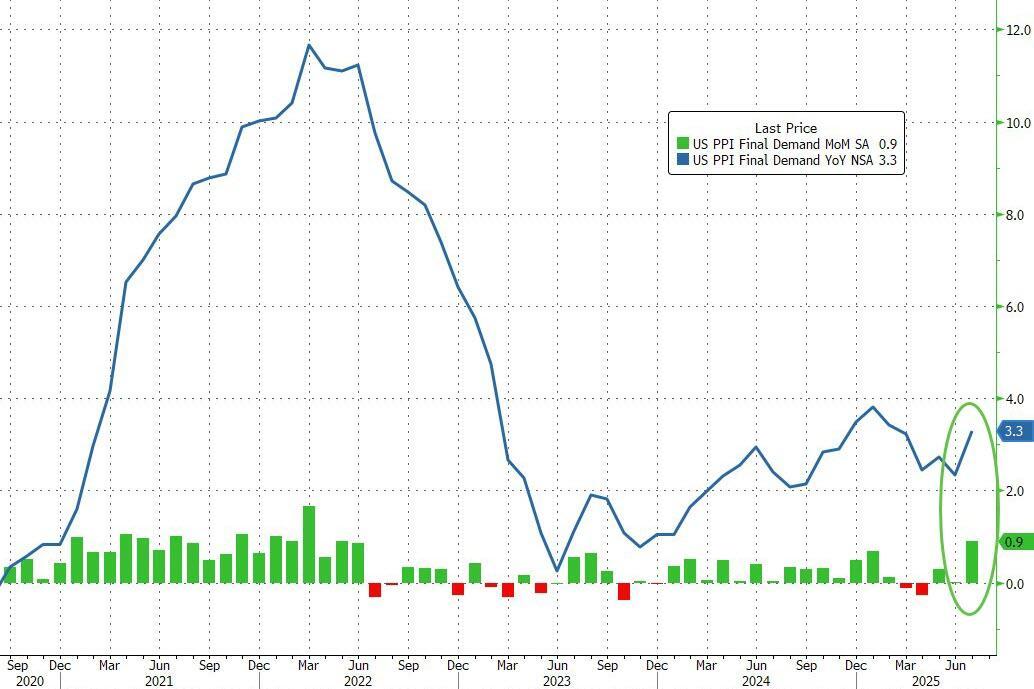
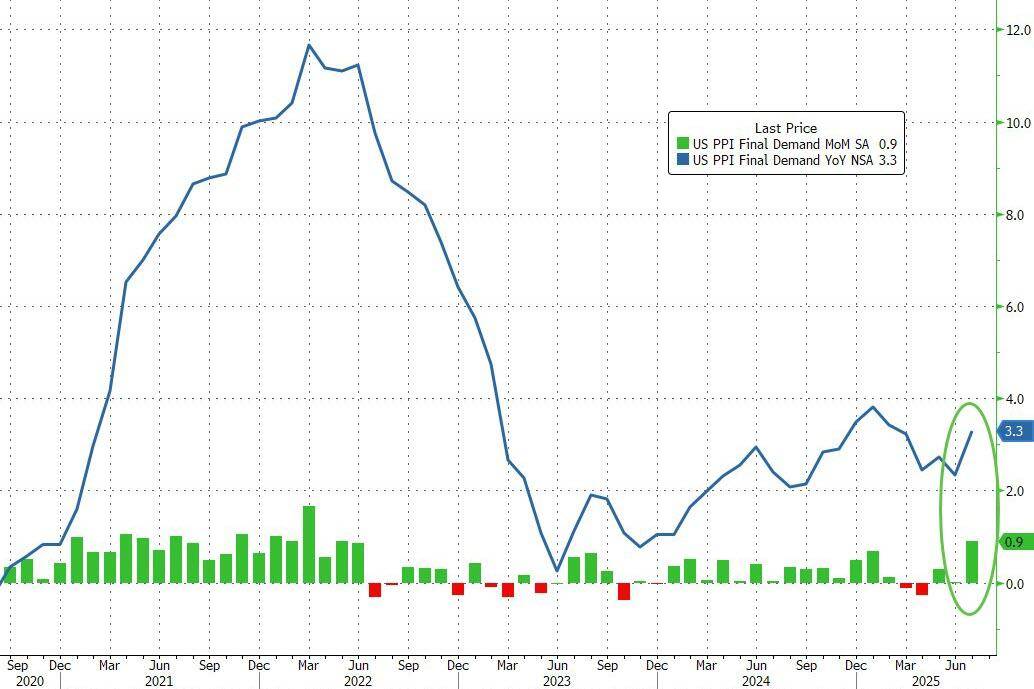
Group 1 - The US July PPI year-on-year rate is 3.3%, significantly exceeding the market expectation of 2.5% and marking the highest level since February [1] - The US July PPI month-on-month rate recorded a 0.9% increase, the largest since June 2022 [1] - The number of initial jobless claims in the US for the week ending August 9 is 224,000, slightly below the expected 228,000 [1] Group 2 - Binance co-founder He Yi has been selected as a global leader by Fortune, co-owning the venture capital arm YZi Labs and holding at least 10% of Binance's parent company [1] - US Treasury Secretary Bessent stated that Bitcoin reserves are valued between $15 billion and $20 billion, and there will be no purchases of cryptocurrency reserves [2] - Bessent indicated a potential for a series of interest rate cuts, starting with a 25 basis point reduction [2] Group 3 - Tron founder Justin Sun has filed a lawsuit against Bloomberg in Delaware, claiming the disclosure of his crypto assets violates previous confidentiality agreements [2] - The Guizhou provincial government has refuted rumors regarding a former official allegedly mining 327 Bitcoins, clarifying that the case is unrelated to Bitcoin [3]
美国7月PPI同比上涨3.3%
Di Yi Cai Jing· 2025-08-14 15:10
美国7月PPI同比上涨3.3%,前值由2.3%修正为2.4%;7月PPI环比上涨0.9%,前值为0%。 (本文来自第一财经) ...
通胀全面“爆表”!美国7月PPI环比飙升至0.9%,创三年新高
Hua Er Jie Jian Wen· 2025-08-14 13:20
受服务成本飙升推动,美国7月PPI环比加速上升,创下三年来最大涨幅。 美国劳工统计局周四公布数据显示: 美国7月PPI同比涨幅从前月的2.3%飙升至3.3%,为今年2月以来最高水平,并且远超预期的2.5%,美国7月PPI环比0.9%,为2022年6月以来最大涨幅,预期 0.2%,前值 0%。 7月核心PPI同比3.7%为2月以来最高水平,预期3%,前值 2.6%,核心PPI环比0.9%为2022年4月以来最大涨幅,预期0.2%,前值0%。 数据公布后,美股三大股指期货快速走低,纳指期货日内跌0.36%,标普500指数期货跌0.35%,道指期货跌0.29%。美元指数短线拉升,日内涨0.21%。现货 黄金小幅走低,日内跌0.32%。 PPI部分类别对于美联储青睐的PCE物价指数计算很重要: 航空客运服务量在6月份下降2.3%之后,7 月份又环比增长 1%。 投资组合管理成本继6月份环比上涨 2.1% 之后,7月份又环比上涨5.8%。 家庭保健和临终关怀继6月份环比增长0.2%之后,又放缓至环比增长0.1%。 医院门诊量环比下降0.5%,6月份环比增长0.9%。 此外,追随油价的上涨,PPI能源价格正在加速上涨。 ...
X @Easy
Easy· 2025-08-14 13:07
PPI came in VERY hot.Essentially meaning Inflation is rather high.This does not bode well for rate cuts happening.However, the FedWatch is still anticipating a rate cut in september at 94.5% chanceOctober, currently pricing in a 59% chance at a SECOND rate cut, 39% chance at it staying flat after September cut&& what is even WILDER is December is a 47.8% chance at a THIRD rate cut, with a 42.9% chance that it stays flat after a SECOND rate cut in October... ...
X @Bitcoin Archive
Bitcoin Archive· 2025-08-14 13:03
JUST IN: 🇺🇸 U.S. PPI Inflation comes in higher than expected. 😬Actual: 3.7%Estimated: 2.9% ...
通胀全面“爆表”!美国7月PP环比飙升至0.9%,创三年新高,同比升至3.3%
Sou Hu Cai Jing· 2025-08-14 13:00
Core Insights - The Producer Price Index (PPI) for July increased significantly, with a year-over-year rise from 2.3% to 3.3%, marking the highest level since February and exceeding expectations of 2.5% [1] - Core PPI also saw a notable increase, rising to 3.7% year-over-year, the highest since February, against an expectation of 3% and a previous value of 2.6% [2] - The increase in service costs reached its highest level in three years, with a 1.1% rise, driven by a 2% increase in wholesale and retail profit margins [4] Market Reactions - Following the PPI data release, U.S. stock index futures declined, with the Nasdaq futures down 0.36%, S&P 500 futures down 0.35%, and Dow futures down 0.29% [3] - The U.S. dollar index saw a short-term increase of 0.21%, while spot gold prices fell by 0.32% [3] - Traders reduced bets on the Federal Reserve lowering interest rates in September due to the inflation data [3] Economic Implications - The PPI components are crucial for calculating the Personal Consumption Expenditures (PCE) price index favored by the Federal Reserve, with energy prices accelerating due to rising oil prices [6] - Despite a softening demand in the first half of the year, businesses are adjusting pricing strategies to offset higher U.S. tariffs, which will be a key factor in determining the interest rate path [8] - Federal Reserve officials expect that import tariffs will increase inflation in the second half of the year, but there is disagreement on whether this impact will be temporary or more persistent [8]
X @IcoBeast.eth🦇🔊
IcoBeast.eth🦇🔊· 2025-08-14 12:39
This was meant as a joke 😭😭😭😭Scary PPI numbers tho ...