
抗流感概念

Search documents
沪指半日下跌0.44%,小微股保持活跃
Sou Hu Cai Jing· 2025-10-22 05:13
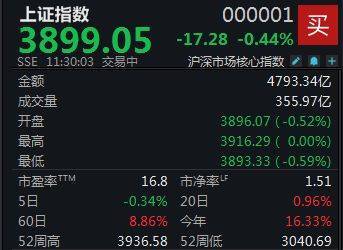
Market Overview - The stock market opened lower on October 22, with the Shanghai Composite Index down 0.44% to 3899.05 points, the Shenzhen Component down 0.81%, and the ChiNext Index down 0.89% [1] - A-shares saw a half-day trading volume of 1.11 trillion yuan [1] Monetary Policy - The People's Bank of China conducted a 138.2 billion yuan 7-day reverse repurchase operation at a fixed rate of 1.4%, with a net injection of 94.7 billion yuan for the day [2] Gold Market - The World Gold Council reported that global physical gold ETFs saw the largest monthly inflow ever in September, totaling 26 billion dollars, bringing the total inflow for Q3 to a record 26 billion dollars [3] - As of the end of Q3, global gold ETF assets under management reached a historical high of 472 billion dollars, with total holdings increasing by 6% to 3838 tons [3] Sector Performance - The nuclear fusion concept stocks rebounded, with Changfu Co. and Hahai Huaton rising nearly 10% [3] - The robotics sector also saw significant gains, with companies like Dayang Electric and Ruineng Technology experiencing substantial increases [3] Health Sector Insights - Companies in the health sector, such as Zhongsheng Pharmaceutical, Minsheng Health, and Huaihua Pharmaceutical, are focusing on differentiated product lines and competitive advantages in their respective markets [7][8] - Zhongsheng Pharmaceutical is leveraging its new drug development technology platforms in respiratory and metabolic diseases [7] - Minsheng Health is expected to grow its probiotic business and capitalize on the scarcity of smoking cessation drug approvals [7] - Huaihua Pharmaceutical is focusing on specific market segments related to elderly, children, and women's health [7]

锂电、黄金重挫,湖南白银跌超8%,流感概念爆发,特一药业直线涨停
2 1 Shi Ji Jing Ji Bao Dao· 2025-10-22 04:15
Market Overview - The market opened lower on October 22, with the Shanghai Composite Index down 0.44%, Shenzhen Component down 0.81%, and ChiNext down 0.89% [1][2] - The North China 50 index, however, saw an increase of 1.19% [1][2] - The total trading volume was 1.11 trillion yuan, with a predicted volume of 1.74 trillion yuan, indicating a decrease of 152 billion yuan [2] Gold Sector - Gold-related stocks experienced a significant decline, with Hunan Silver hitting a limit down, and other companies like Western Gold and Zhaojin Gold dropping over 5% [2][3] - The gold price has increased over 60% this year, leading some institutions to lock in profits, which has contributed to the recent price volatility [3][4] - Despite the current pullback in gold prices, some institutions remain optimistic about future trends due to ongoing geopolitical tensions and economic risks [4] Lithium Battery and Semiconductor Sectors - Lithium battery-related concepts saw significant declines, with major companies like Tongyou Technology and Huada Semiconductor dropping over 5% [4][5] - The semiconductor sector also faced volatility, with stocks like Xiaocheng Technology and Zhaoyi Innovation experiencing sharp declines [5] Pharmaceutical Sector - The anti-influenza sector saw a surge, with companies like Te Yi Pharmaceutical hitting the daily limit and others like Chenxin Pharmaceutical and Duolai Pharmaceutical rising over 10% [6] Banking Sector - Bank stocks continued to perform well, with Agricultural Bank of China rising over 1% and reaching a historical high after 13 consecutive days of gains [7] Hong Kong Market - The Hong Kong market saw a decline, with the Hang Seng Index down 1.27% and the Hang Seng Technology Index down 2.12% [7][8] Investment Strategy Insights - There are differing opinions on whether a market style shift will occur in Q4, with some institutions suggesting a rebalancing rather than a significant shift [10][11] - Focus areas for investment include technology, dividends, non-bank financials, pharmaceuticals, and consumer sectors [12][13] - The market is transitioning from liquidity-driven to profit-driven dynamics, with an emphasis on diversified investment strategies [13]


毒株与去年不同,流感季或提前!这一概念异动拉升
Di Yi Cai Jing· 2025-10-21 04:04
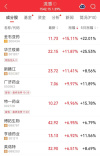
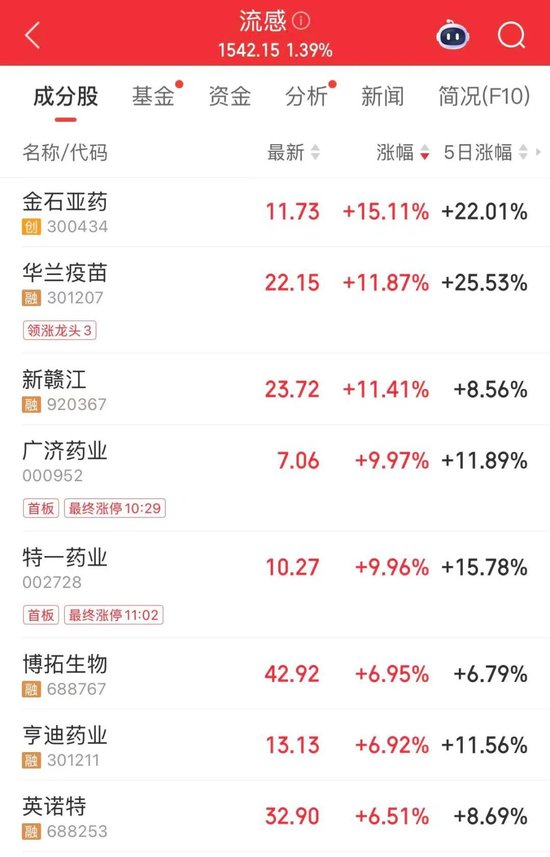
Core Viewpoint - The flu-related stocks experienced a significant surge on October 21, with notable increases in companies such as Te Yi Pharmaceutical, Jinshi Yao, and Hualan Vaccine, driven by rising flu activity in southern China and predictions of an earlier flu season this year [1][4]. Group 1: Stock Performance - Te Yi Pharmaceutical reached a trading limit with a price of 10.27, reflecting a 9.96% increase [2] - Jinshi Yao saw a price increase to 11.73, marking a 15.11% rise [2] - Hualan Vaccine's stock rose to 22.15, showing an 11.87% increase [2] - New Ganjing's stock price increased to 23.72, with a rise of 11.41% [2] - Other companies like Hengdi Pharmaceutical and Xiangrikui also followed the upward trend [1]. Group 2: Flu Activity and Predictions - The China CDC reported an increase in flu activity in southern provinces, indicating a potential early onset of the flu season this year [4] - Experts noted that the predominant flu strain this year is H3N2, differing from last year's H1N1 strain, which may lead to lower immunity levels in the population [5]. Group 3: Vaccination Recommendations - Vaccination is emphasized as the most effective method to prevent flu and reduce severe cases, with recommendations for individuals to get vaccinated between September and November [8] - The flu vaccine needs to be administered annually due to the rapid mutation of the virus, ensuring protection against the current year's strains [8][9]. - High-risk groups, including children under 5, the elderly, and individuals with chronic health conditions, are advised to prioritize vaccination [12].





毒株与去年不同,流感季或提前!抗流感概念异动拉升
Di Yi Cai Jing· 2025-10-21 03:55
Group 1 - The core viewpoint of the article highlights a significant rise in flu-related stocks, with companies like Te Yi Pharmaceutical hitting the daily limit, and others like Jinshi Yao, Hualan Vaccine, and Xin Ganjing seeing increases of over 10% [1][2] - The flu activity in southern China is on the rise, with experts predicting an earlier flu season this year compared to last, and the circulating strain being different from the previous year [2][3] - The predominant strain this year is H3N2, which may lead to lower immunity in the population compared to last year's H1N1 strain, necessitating increased attention [4][5] Group 2 - Vaccination is emphasized as the most effective method to prevent flu and reduce severe cases, with recommendations for vaccination between September and November to ensure effective immunity before peak season [6][7] - The article discusses the differences between trivalent and quadrivalent flu vaccines, noting that while quadrivalent vaccines cover an additional strain, the practical difference in effectiveness is minimal [10] - High-risk groups, including children under 5, the elderly over 65, pregnant women, and those with chronic health conditions, are advised to prioritize flu vaccination [12]
毒株与去年不同,流感季或提前!这一概念异动拉升
第一财经· 2025-10-21 03:53
Core Viewpoint - The article highlights the rising flu activity in southern China, with predictions of an earlier flu season this year compared to last, primarily driven by the different circulating strain, H3N2, which the public has lower immunity against [2][3]. Group 1: Flu Activity and Strain Information - The current flu season is characterized by the predominance of the H3N2 strain, contrasting with last year's H1N1 strain, indicating a need for heightened awareness due to lower public immunity [3]. - Clinical symptoms of H3N2 include high fever, cough, sore throat, body aches, fatigue, and headache, which are similar to other flu strains [3]. Group 2: Vaccination Recommendations - Vaccination is emphasized as the most effective method to prevent flu and reduce severe cases, with the recommended vaccination period being from September to November to ensure immunity before peak season [5]. - Annual vaccination is necessary due to the rapid mutation of flu viruses, which may differ from year to year, thus requiring updated protection [6]. - High-risk groups, including children under 5, the elderly over 65, pregnant women, and those with chronic health conditions, are advised to receive vaccinations promptly [10]. Group 3: Vaccine Types and Administration - The available flu vaccines in China include inactivated (split) vaccines (trivalent/quadrivalent), inactivated (subunit) vaccines (trivalent/quadrivalent), and live attenuated vaccines (trivalent, nasal spray) [8]. - The difference between trivalent and quadrivalent vaccines lies in the number of virus strains they protect against, with quadrivalent covering an additional B strain, although the practical effectiveness may not differ significantly [8].

5月16日连板股分析:连板股晋级率35% 高位股强者恒强
news flash· 2025-05-16 07:51
Core Viewpoint - The market is experiencing a strong upward trend with 56 stocks hitting the daily limit up, and a total of 15 stocks on consecutive limit up boards, indicating robust investor sentiment and market activity [1] Stock Performance - Over 3000 stocks in the market have risen, with notable performances from 成飞集成 achieving an 8-day consecutive limit up and 渝三峡A recording a 14-day consecutive rise, accumulating over 170% in gains [1] - Other stocks such as 红宝丽, 利君股份, 红墙股份, and 中毅达 also reached limit up, while 中旗新材 hit a historical high [1] Market Trends - The market is witnessing rapid rotation of hotspots, with sectors like robotics, chemicals, nuclear power, intelligent driving (AEBS), PEEK materials, and anti-influenza concepts showing strong performance [1] - The intelligent driving sector, particularly represented by AEBS, has been highlighted with stocks like 豪恩汽电, 万安科技, 路畅科技, and 亚太股份 all hitting limit up [1] Regulatory Developments - A significant regulatory development is the public consultation phase for mandatory installation of AEBS (Automatic Emergency Braking System) in all M1 class passenger cars and N1 class light trucks, which is expected to boost the sector [1]