Globalization

Search documents
Why Trump won and how it's bigger than just him | Muhammad Nauman Qureshi | TEDxHKU
TEDx Talks· 2025-09-17 15:17
Let's start with a scene that might seem oddly familiar. You're sitting at your computer. You've got 10 to 20 tabs open.I'm talking news articles, emails, a half-finish YouTube video, your bank account, and maybe even a recipe for dinner. You know, the ones you'll never actually make. Your computer starts lagging.It's frustrating. So, you slam your fist on the desk and go, "Oh." As you might have guessed, this isn't just about your computer. There's so much noise in the world, so many issues demanding our a ...


腾讯 - 2025 年全球数字生态大会要点
2025-09-17 01:51
Summary of Tencent Holdings Ltd. Conference Call Company Overview - **Company**: Tencent Holdings Ltd. - **Industry**: China Internet and Other Services - **Current Stock Price**: HK$645.00 (as of September 16, 2025) - **Market Capitalization**: US$769,507 million - **Price Target**: HK$700.00, representing a 9% upside potential Key Focus Areas - **Digitalization and Globalization**: Tencent's cloud development emphasizes enhancing efficiency through digitalization and exploring new growth drivers via globalization [1][2] - **AI Adoption**: Tencent is recognized as a leading adopter of AI technologies, particularly in consumer applications, supported by its robust WeChat ecosystem [1] Core Business Developments - **AI Product Launches**: Tencent has introduced various AI efficiency enhancement products, including: - Enhanced cloud agent development platform - A comprehensive suite of 2C and 2B AI products [2] - **SAAS + AI Toolkit**: Upgrades to AI LLM infrastructure focus on optimizing computing power and model efficiency, with multiple open-sourced models launched [3] Performance Metrics - **Revenue Growth**: Tencent reported a 20% increase in marketing revenue and a 22% growth in gaming revenue in Q2 [9] - **User Engagement**: Significant increases in user engagement metrics, such as: - AI MAU for QQ browser increased by 17.8 times since April - Tencent Meeting's AI MAU grew by 150% year-over-year [7] Global Expansion Strategy - **International Business Growth**: Tencent's international business has achieved double-digit growth, with overseas clients doubling year-over-year [12] - **Infrastructure Investments**: Tencent is expanding its global infrastructure, including a US$150 million investment in a data center in Saudi Arabia and a third data center in Osaka [12] Financial Projections - **Revenue Forecast**: Projected net revenue growth from RMB 660.3 billion in 2024 to RMB 884.3 billion by 2027 [4] - **Earnings Per Share (EPS)**: Expected EPS growth from RMB 20.63 in 2024 to RMB 30.59 in 2027 [4] Risks and Challenges - **Market Competition**: Potential risks include intensified competition in social networks and advertising, regulatory uncertainties in the gaming industry, and tightened regulations amid US-China tensions [16] - **Execution Risks**: Successful execution of new game launches and maintaining market share in social and short video ads are critical for growth [16] Analyst Ratings - **Stock Rating**: Overweight - **Industry View**: Attractive - **Valuation Methodology**: Base case valuation of HK$700 based on a sum of the parts analysis [13][14] Conclusion Tencent Holdings Ltd. is positioned for continued growth through its focus on digitalization and globalization, supported by strong AI adoption and significant investments in infrastructure. However, the company faces challenges from market competition and regulatory environments that could impact its performance.
X @The Economist
The Economist· 2025-09-11 15:25
Globalization Strategy - Many Chinese companies are choosing new names as they pursue global expansion [1]
X @Bloomberg
Bloomberg· 2025-09-04 21:40
The world that enabled Singapore's rise is no more. @HalBrands examines what that means for the country's future (via @opinion) https://t.co/CAldflX2LV ...
Standard Bank CEO on South Africa G-20, US Deglobalization, Volatility
Bloomberg Television· 2025-09-04 08:03
Sim, thank you so much for being here with me. Tom was just talking about just how significant this G-20 summit potentially could be if we do see a communique actually coming later this year. We're seeing a number of geopolitical tensions, though, getting in the way of a number of financial institutions as Africa's biggest bank.Talk about how you're navigating that right now. Jennifer, the world is complicated. It's going through a very turbulent time now.We've not seen the levels of volatility for decades. ...

大宗商品分析师_大宗商品调控周期_一体化程度降低世界中的大宗商品案例-Commodity Analyst_ The Commodity Control Cycle_ The Case for Commodities In a Less Integrated World
2025-09-04 01:53
Summary of Key Points from the Conference Call Industry Overview - The report discusses the **Commodity Control Cycle** and its implications in a less integrated world, focusing on the strategic role of commodities as globalization stalls and geopolitical tensions rise [4][17][22]. Core Insights and Arguments 1. **Stagflationary Regimes**: Equity-bond portfolios lack diversification during stagflation, particularly when US institutional credibility erodes, leading to inflation and a sell-off in equities and bonds. Gold serves as a hedge in such scenarios [4][7][9]. 2. **Supply Chain Dynamics**: The report outlines a **4-step commodity control cycle**: - Governments insulate supply chains through tariffs and subsidies [19]. - Domestic supply is expanded and secured, leading to surplus production being exported [19]. - Falling global commodity prices cause higher-cost producers to exit, concentrating supply [19]. - Dominant producers leverage their position, increasing disruption risk and price volatility [19][51]. 3. **Geopolitical Concentration**: Commodity supply is increasingly concentrated in geopolitical hotspots. The US is projected to provide over a third of global LNG by 2030, while China controls over 90% of global rare earth refining, critical for advanced technologies [22][24]. 4. **Inflation and Commodities**: Commodities may provide a hedge against inflation, especially when supply disruptions occur. Energy commodities are particularly significant due to their direct impact on inflation [24][30]. 5. **Historical Context**: The report references historical instances where commodity supply was used as leverage, such as the 1973 oil embargo and recent actions by Russia and China regarding energy and rare earth exports [52][54]. Additional Important Insights 1. **Investment in Gold**: Central banks have increased gold purchases significantly, rising more than fivefold since the freezing of Russian assets in 2022, highlighting gold's role as a financial insulation asset [30]. 2. **China's Energy Strategy**: China is expanding coal production and building renewable energy sources, indicating a shift towards energy security rather than purely environmental concerns [26]. 3. **Market Dynamics**: The report notes that while supply expansion can lead to short-term price drops, it ultimately results in greater control over the market by fewer producers [39]. 4. **Diplomatic Leverage**: The US has linked energy exports to diplomatic negotiations, increasing reliance on US supplies among allies [45]. 5. **Chokepoints in Trade**: The report emphasizes the importance of maritime chokepoints in global trade, which are becoming increasingly vulnerable due to reduced naval defense spending by allied nations [46]. This summary encapsulates the critical insights and arguments presented in the conference call, focusing on the evolving dynamics of the commodities market and its implications for investors.

长期策略师_中小盘股长期会回归吗?The Long-term Strategist_ Will small and mid caps come back in the long term_
2025-08-31 16:21
Summary of Key Points from J.P. Morgan's Long-term Strategy on Small and Mid Caps Industry Overview - The analysis focuses on the long-term performance of small, mid, and large-cap companies, particularly in the context of the U.S. market and its structural forces affecting returns [2][4][10]. Core Insights and Arguments 1. **R&D Intensity and Firm Size**: - Business-funded R&D intensity tends to favor larger firms, creating barriers to entry for smaller firms, thus increasing corporate concentration [2][11]. - Conversely, government-funded R&D benefits smaller firms by reducing barriers to entry, as evidenced by research showing small firms gain more from R&D grants [2][19]. 2. **Globalization Effects**: - Global integration has generally favored large firms, as they can build global supply chains and engage in tax arbitrage more effectively than smaller firms [2][26]. 3. **Antitrust Policy Impact**: - Weaker antitrust enforcement since the 1970s has coincided with a decline in the small-cap premium, although this is not seen as a primary driver of performance differences [2][31]. 4. **Interest Rates**: - Falling interest rates have historically favored larger firms more than smaller ones, as larger firms benefit from greater declines in borrowing costs and increased debt issuance [2][33]. 5. **Valuation Trends**: - Valuations have shifted in favor of small caps over the past 15 years, although this trend is less pronounced outside the U.S. [2][40]. 6. **Long-term Performance Expectations**: - Small and mid caps are expected to outperform in low return environments, supported by their long-term low beta characteristics [2][52]. - If business-funded R&D continues to grow, long-term returns on small, mid, and large caps may become comparable, with a slight favor towards small and mid caps [2][72]. 7. **AI as a Risk Factor**: - The growth of AI may disproportionately benefit larger firms, potentially altering the expected performance dynamics between small and large caps [2][83]. Additional Important Insights 1. **Historical Performance**: - Small and mid caps outperformed large caps until the 1980s, with large caps dominating performance in the last decade [2][4]. 2. **Structural Forces**: - The analysis identifies several structural forces influencing returns, including R&D intensity, trade intensity, interest rates, and past performance [2][53]. 3. **Future Projections**: - The expected long-term returns across size deciles are projected to be narrow, with small and mid caps potentially outperforming slightly in the coming decade [2][77]. 4. **Global Context**: - Outside the U.S., the structural support for large caps is weaker, and while some forces favor small caps, relative valuations remain neutral [2][85]. 5. **Monitoring Recommendations**: - Future changes in trade intensity, R&D funding, interest rates, and antitrust enforcement should be monitored as they could impact the relative performance of small and mid caps [2][83]. This summary encapsulates the key findings and insights from J.P. Morgan's analysis on the long-term performance of small and mid-cap companies, highlighting the structural forces at play and their implications for future investment strategies.
海外销量同比大增159.5%,比亚迪7月领跑多国新能源车市
Chang Sha Wan Bao· 2025-08-26 05:41
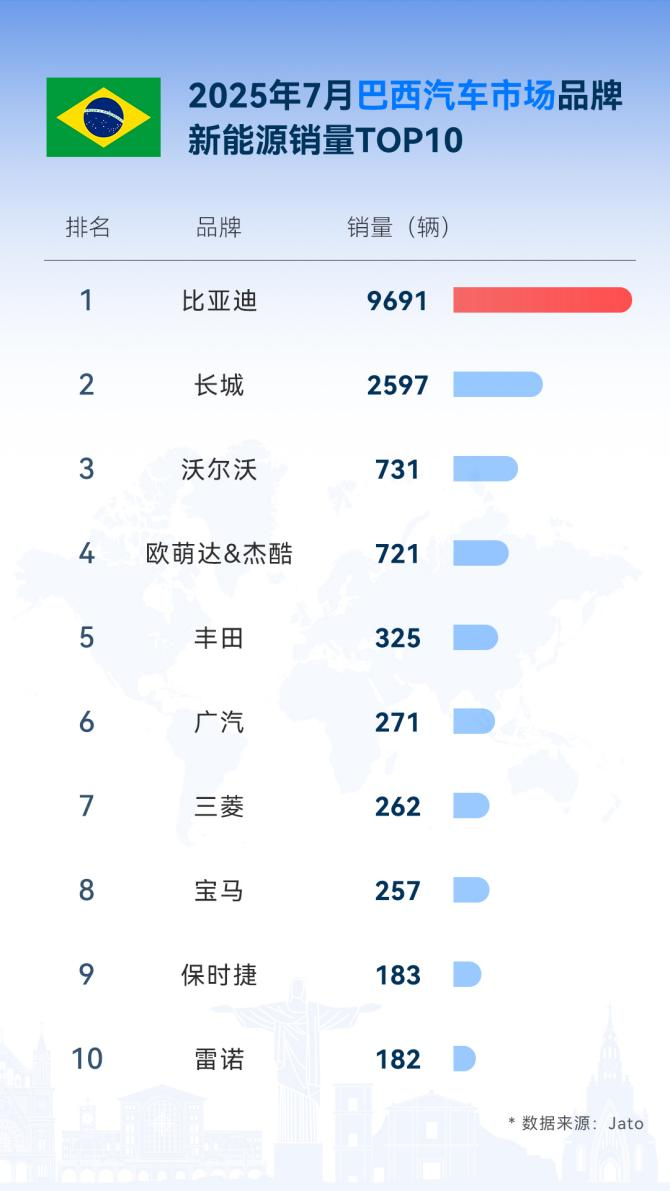
Core Insights - Chinese automaker BYD is rapidly increasing its influence in the global automotive market, with significant sales growth in July 2023, particularly in overseas markets [1] Group 1: Sales Performance - In July 2023, BYD sold 344,296 vehicles, with 80,178 units sold overseas, marking a year-on-year increase of 159.5% [1] - In Brazil, BYD sold 9,691 vehicles in July, a 60% increase year-on-year, securing the top position in the new energy vehicle (NEV) sales ranking [1][2] - In Spain, BYD achieved a monthly sales figure of 2,158 units, a remarkable 665% increase year-on-year, leading the NEV brand ranking [4] - In Italy, BYD sold 2,019 vehicles in July, capturing over 13% of the market share in the NEV segment [7] Group 2: Product Strategy - BYD's diverse product matrix, including both pure electric and plug-in hybrid vehicles, effectively meets various consumer needs, making it a preferred choice in markets like Brazil [1] - The newly launched Song PLUS EV sold 836 units in Spain, entering the top ten in the compact SUV segment, indicating strong product appeal [4] Group 3: Global Expansion and Recognition - BYD's global expansion strategy is evident, with the company achieving significant milestones such as the first vehicle rolling off the production line at its Brazilian factory and the delivery of the 90,000th NEV in Thailand [10] - BYD ranked 91st in the 2025 Fortune Global 500 list, marking its fourth consecutive year on the list and becoming the highest-ranked Chinese automaker [10] - The company has established a presence in 112 countries and regions, showcasing its commitment to global market penetration and brand recognition [10]


传音“自救”
3 6 Ke· 2025-08-20 08:36
Core Insights - Transsion, a leading mobile phone manufacturer in Africa, faces increasing competition and challenges in maintaining profitability despite revenue growth [2][10][11] - The company is exploring new business opportunities and markets, including high-end smartphones and various digital products, to sustain growth [14][19] Group 1: Market Overview - Transsion launched its first dual-SIM feature phone, Tecno T780, in Africa in 2007, achieving over 20 million units sold that year [1] - The African mobile phone market, initially a blue ocean, has become increasingly competitive, with Transsion's market share declining from 52% to 47% in early 2025 [10][11] - The smartphone penetration in Africa is growing, with a 6% increase in shipments in the first quarter of 2025 compared to the previous year [8][10] Group 2: Financial Performance - In 2024, Transsion reported a revenue of 68.715 billion yuan, a year-on-year increase of 10.31%, while net profit only slightly increased by 0.22% to 5.549 billion yuan [2] - The company's gross margin in Africa is significantly higher at 28.59% compared to other markets, indicating a strong position despite challenges [11] Group 3: Competitive Landscape - Transsion's competitors, including Xiaomi and OPPO, are increasingly localizing their strategies in Africa, leading to intensified competition [10][11] - Xiaomi's market share in Africa grew by 32% in 2024, highlighting the competitive pressure on Transsion [10] Group 4: Strategic Initiatives - Transsion is diversifying its product offerings beyond smartphones, including home appliances and digital accessories, to create a more comprehensive ecosystem [14][16] - The company is investing in R&D to enhance its product value in areas like imaging and AI, aiming to strengthen its position in the mid-to-high-end market [14][16] Group 5: Localization and Consumer Insights - Transsion's success in Africa is attributed to its deep understanding of local consumer preferences, such as tailored camera features for darker skin tones and music platforms that cater to local artists [20] - The company has established a robust distribution network and after-sales service, which are critical for maintaining its market presence [11][20]

AI圈“爱马仕”Manus:裁员跑路,神话坍塌
Tai Mei Ti A P P· 2025-08-20 04:54
Core Insights - Manus, an AI application, gained significant attention for its capabilities in analyzing stocks, organizing invoices, and generating financial reports, leading to a valuation of $500 million after a $75 million funding round from Benchmark [1][5] - However, the company faced rapid decline, relocating its headquarters to Singapore and laying off a significant portion of its workforce, raising concerns about its future viability [2][6][10] Group 1: Company Overview - Manus was founded by Xiao Hong, who previously developed successful AI products and aimed to create a "general intelligent agent" capable of complex tasks [3][11] - The application generated immense hype, with invitation codes being sold for as much as 50,000 yuan, indicating high demand and interest [4][5] Group 2: Funding and Investment Challenges - The investment from Benchmark, a prominent Silicon Valley VC, was initially seen as a strong endorsement, but subsequent U.S. government restrictions on capital investment in Chinese tech raised concerns about the funding's future [9][10] - The relocation to Singapore was a strategic move to satisfy U.S. investment conditions, but it led to operational challenges and potential withdrawal of funding [6][9] Group 3: Market Competition and Product Viability - The domestic AI market has become increasingly competitive, with numerous alternatives emerging, leading to a significant drop in Manus's user engagement and brand reputation [12][15] - Manus's reliance on external APIs for functionality poses a long-term risk, especially if competitors like OpenAI enter the agent space directly [13][15]