
粮食安全

Search documents
尼泊尔粮食主产区迎来雨季转机,水稻种植率显著回升
Shang Wu Bu Wang Zhan· 2025-08-14 15:07
(原标题:尼泊尔粮食主产区迎来雨季转机,水稻种植率显著回升) 上周的强降雨为尼泊尔两大粮食主产区——马德西省和科西省的水稻种植带来 了新的希望。此前,这两个地区在季风前期的干旱中持续数周,严重影响了农 业生产。据尼泊尔农业与畜牧业发展部周一公布的数据,截至8月10日,全国 水稻种植率已达到91%。其中,马德西省的种植率超过76%,科西省则达到 94.42%。专家表示,持续的降雨将为尼泊尔粮食安全提供重要保障,但长期灌 溉设施建设仍需加速推进。 ...
经济日报:用心做好粮食安全民生答卷
Xin Lang Cai Jing· 2025-08-14 00:59
Core Viewpoint - The article emphasizes the importance of food security in China, highlighting the challenges posed by extreme weather, low grain prices, differentiated consumer demand, and heightened expectations for food safety. It calls for a robust food security system to ensure stable production, favorable prices, smooth circulation, and high quality [1] Group 1: Challenges to Food Security - Extreme weather events are increasingly frequent, posing a significant threat to grain production [1] - Grain prices are currently operating at low levels, impacting the economic viability of agricultural producers [1] - There is a noticeable differentiation in consumer demand, which complicates the food supply chain [1] Group 2: Goals for Food Security - The development goals include achieving stable production, optimal pricing, efficient circulation, and high-quality food products [1] - The article stresses the need for a continuous effort in addressing food security, indicating that it is an ongoing process rather than a completed task [1] Group 3: Societal Impact - The ultimate aim is to ensure that the Chinese population has access to sufficient and safe food, enhancing their sense of gain, happiness, and security [1] - The article conveys a strong sense of responsibility and commitment to addressing food security challenges, reflecting the government's dedication to improving the livelihoods of its citizens [1]
中经评论:用心做好粮食安全民生答卷
Jing Ji Ri Bao· 2025-08-13 23:51
Core Insights - The article emphasizes the importance of establishing a robust food security system to ensure stable production, favorable prices, smooth circulation, and high quality of food products, especially in the context of various challenges such as extreme weather and fluctuating grain prices [1][2]. Group 1: Food Production Challenges - Extreme weather conditions, including droughts and floods, have negatively impacted grain production this year, leading to a slight reduction in summer grain output [2]. - The government has allocated 1.015 billion yuan to support agricultural recovery in disaster-stricken areas, aiming to minimize production losses and ensure stable yields [2]. Group 2: Price Stability and Farmer Support - Fluctuations in grain prices, particularly the decline in wheat and rice prices, have affected farmers' willingness to cultivate grains, potentially jeopardizing long-term supply [3]. - The government has initiated minimum purchase price policies for wheat and early indica rice to protect farmers from losses, ensuring they do not suffer from low prices [3]. Group 3: Consumer Trends and Quality Assurance - There is a shift in consumer preferences towards higher quality and healthier food options, with a notable increase in demand for premium grain products [4]. - The food supply chain faces quality risks at various stages, necessitating strict source control and the establishment of a comprehensive quality monitoring system to ensure food safety [5]. Group 4: Continuous Improvement and Responsibility - The article stresses the ongoing nature of food security efforts, highlighting the need for a proactive approach to address consumer concerns about food safety and quality [5]. - The commitment to enhancing food security is framed as a continuous responsibility, with the goal of ensuring that the Chinese population has access to safe and sufficient food [5].
用心做好粮食安全民生答卷
Jing Ji Ri Bao· 2025-08-13 22:05
Core Viewpoint - The article emphasizes the importance of establishing a robust food security system to ensure stable production, favorable prices, smooth circulation, and high quality in the context of various challenges such as extreme weather, low grain prices, and rising food safety expectations [1][2]. Group 1: Food Production Challenges - Extreme weather events, including droughts and floods, have negatively impacted grain production this year, with summer grain experiencing slight reductions due to severe drought in some areas [2] - The current autumn grain production period is critical, facing challenges from continuous heavy rainfall in East and North China and high temperatures and drought in the Huang-Huai region [2] - The government has allocated 1.015 billion yuan to support disaster-stricken areas in restoring agricultural production [2] Group 2: Price Stability and Farmer Support - Fluctuations in grain prices can significantly affect market stability and food security, with low prices for wheat and rice potentially discouraging farmers from planting [3] - The government has initiated minimum purchase prices for wheat and early indica rice to prevent losses for farmers, ensuring they do not incur losses from grain production [3] - Various regions are encouraged to promote long-term contracts between grain processing enterprises and farmers to secure basic income for farmers while meeting consumer demand [3] Group 3: Consumer Trends and Quality Assurance - There is a shift in consumer preferences from merely being full to seeking high-quality and nutritious food, with a notable increase in demand for mid-to-high-end grain and oil products [4] - The article highlights the importance of food safety, with potential quality risks at various stages of the food supply chain, necessitating strict source control and monitoring [5] - The establishment of a comprehensive food quality safety inspection and monitoring system, along with the use of big data and blockchain technology for traceability, is crucial for ensuring food safety and transparency [5]
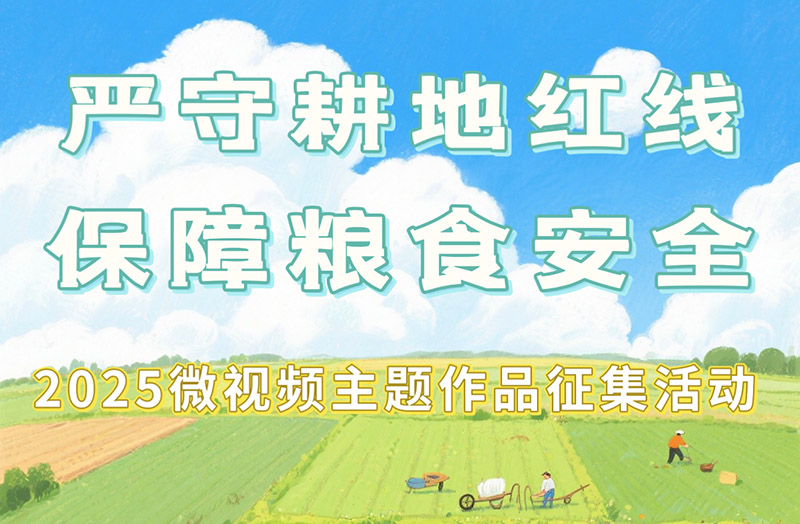
严守耕地红线,2025微视频主题作品征集活动诚邀共襄
Qi Lu Wan Bao· 2025-08-13 03:49
Group 1 - The theme of the event is "Strictly Guarding the Cultivated Land Red Line to Ensure Food Security," emphasizing that food security is the foundation of social stability and that protecting cultivated land is essential for food security [2] - The event is organized by the Shandong Provincial Natural Resources Department, with support from various local institutions and media [3] - The target participants include individuals and groups from the general public and the provincial natural resources system [3] Group 2 - The content of submissions includes three categories: popular science, storytelling, and advocacy, each with specific formats and requirements [4][5] - The popular science category focuses on creating engaging and easily understandable short videos about cultivated land protection, with a maximum duration of 2 minutes [4] - The storytelling category aims to share real and touching stories related to cultivated land protection in Shandong, allowing for artistic interpretation while respecting factual accuracy, with a maximum duration of 5 minutes [4] - The advocacy category involves clear and impactful speeches discussing the significance, challenges, and solutions related to cultivated land protection, also with a maximum duration of 5 minutes [5] Group 3 - Video submissions must adhere to specific technical requirements, including clarity, format, and content guidelines, ensuring they align with political and creative directions [6] - Participants must ensure that their works do not disclose state secrets or contain sensitive information [7] - The organizer reserves the right to publicly release and adapt award-winning works for non-commercial promotional purposes [8] Group 4 - The submission period for the event is from June 25, 2025, to August 31, 2025 [9] - The evaluation process includes initial screening, online voting, expert review, and public announcement of winners, scheduled from September 1 to September 30, 2025 [10][11][12] Group 5 - Awards are set for each category, with first prizes of 1,500 yuan, second prizes of 800 yuan, and third prizes of 400 yuan, along with additional recognition for outstanding organizations [13][14]

江苏省粮食集团:筑牢粮食安全基石 谱写高质量发展新篇
Xin Hua Ri Bao· 2025-08-12 21:37
Core Viewpoint - Jiangsu Grain Group Co., Ltd. (hereinafter referred to as "Su Grain Group") is a state-owned enterprise in Jiangsu Province, primarily focused on grain safety and agricultural development, playing a crucial role in grain circulation and macro-control tasks since its establishment in 2001 [1][2]. Group 1: Company Overview - Su Grain Group was established in June 2001 and has been a key player in the provincial government's grain and oil macro-control efforts, ensuring food security and supporting agricultural development [1]. - The company has evolved into a comprehensive grain industry group with four main sectors: storage, trade, processing, and logistics, consistently ranking among the top provincial grain enterprises in China [2]. Group 2: Operational Highlights - The storage sector leads provincial reforms, managing nearly 30 storage facilities with a total capacity exceeding 3 million tons [2]. - The trade sector operates an integrated grain and oil business model, handling over 10 million tons of grain and oil annually through a combination of domestic and import markets [2]. - The processing sector has an annual processing capacity of 2.765 million tons, focusing on various products including oils, flour, and soy protein [2]. - The logistics sector has developed a "water-land linkage" logistics network, with an annual throughput of over 15 million tons, positioning the Zhangjiagang Grain and Oil Industrial Park as a core hub in East China [2]. Group 3: Achievements and Future Goals - Su Grain Group has received numerous accolades, including "Most Influential Grain and Oil Enterprise in China" and "National Grain Emergency Guarantee Enterprise," and has consistently improved its ranking in the "Top 500 Service Enterprises in China" [3]. - The company aims for high-quality development, focusing on core responsibilities, enhancing reform and efficiency, and strengthening technological innovation and modern corporate governance to build a leading grain and oil industry system in China [3].

“一带一路”农业科技合作揭新篇 中国缓控释肥技术助力全球粮食安全
Zhong Guo Zhi Liang Xin Wen Wang· 2025-08-12 16:30
Core Viewpoint - China's agricultural technology, particularly the emergence of controlled-release fertilizer technology, is breaking foreign monopolies and significantly contributing to global food security [1][2]. Group 1: Technological Advancements - The breakthrough and application of controlled-release fertilizer technology in China have improved domestic agricultural production efficiency and provided new solutions for global food security [1][2]. - The development of controlled-release fertilizers has evolved since 2006, when large-scale production began, leading to its commercialization and acceptance among farmers [2][3]. - A new controlled-release fertilizer technology using green bio-based materials has been developed, addressing sustainability issues and showcasing China's innovation in this field [3]. Group 2: Corporate Responsibility and Global Impact - The chairman of Kingenta Ecological Engineering Group announced plans to share controlled-release fertilizer technology and industry models globally, reflecting the company's international vision and responsibility [3][6]. - Kingenta has established multiple high-end research platforms and formed various industry technology innovation alliances over the past two decades, contributing to the development of national and international standards in the controlled-release fertilizer sector [3][5]. Group 3: Agricultural Services and Training - Kingenta has implemented a comprehensive promotion model for controlled-release fertilizers, focusing on increasing production efficiency and integrating agricultural machinery with farming practices [5]. - The company has expanded its demonstration and promotion of controlled-release fertilizers to over 160 million acres across major agricultural regions in China, effectively covering all types of crops [5]. Group 4: Global Collaboration and Custom Solutions - The rise of China's controlled-release fertilizer technology is seen as a key factor in enhancing agricultural production efficiency and ensuring food security in countries along the Belt and Road Initiative [6][7]. - Kingenta's customized solutions for international markets include market research, product customization, technical training, and demonstration field construction, which have helped alleviate initial concerns for foreign partners [6][7]. - The "golden solution" proposed by Kingenta includes global technology sharing, talent training, establishment of demonstration fields, and deepening global collaboration to maintain its leading position in the controlled-release fertilizer sector [7].

时隔7年重启 中日韩签联合公报
Zhong Guo Ji Jin Bao· 2025-08-12 15:14
Core Points - The fourth China-Japan-Korea Agricultural Ministers' Meeting was held in Incheon, South Korea, marking the first meeting in seven years since November 2018 in Beijing [1] - The ministers discussed six core topics: food security, animal disease prevention, sustainable agriculture, rural revitalization, cooperation on global important agricultural cultural heritage, and global collaboration [1] - The three countries reached a consensus on the importance of information sharing and joint responses to complex challenges in agriculture, including climate crisis, cross-border disease transmission, and supply chain instability [1] - There was an agreement to expand complementary cooperation in areas such as smart agriculture, green low-carbon agriculture, and training new farmers [1] - The Chinese Minister expressed a willingness to engage in candid dialogue with Japan and Korea to build a new framework for agricultural cooperation that is more resilient, broader in scope, and richer in content [1] Summary of Agreements - The ministers signed a joint communiqué and agreed to hold regular, institutionalized meetings [2] - The next China-Japan-Korea Agricultural Ministers' Meeting is scheduled to take place in Japan [2]
神农种业股价震荡下行 成交额突破6.5亿元
Jin Rong Jie· 2025-08-12 13:32
Group 1 - The company's stock closed at 4.90 yuan on August 12, down 1.61% from the previous trading day, with a trading range of 4.88 to 5.09 yuan, resulting in a volatility of 4.22% [1] - The company operates in the agriculture sector, focusing on research, production, and sales of crop seeds, aquaculture breeding, and feed production, contributing to food security and aquaculture in the Hainan Free Trade Zone [1] - The company's total market capitalization is 5.018 billion yuan, with a circulating market value of 4.343 billion yuan [1] Group 2 - On the morning of August 12, a rapid rebound occurred at 9:53 AM, with a price increase of over 2% within five minutes and a transaction amount of 187 million yuan [1] - The net outflow of main funds on that day was 24.0656 million yuan, accounting for 0.55% of the circulating market value, with a cumulative net outflow of 43.0515 million yuan over the past five trading days, representing 0.99% of the circulating market value [1]

中日韩农业部长会议在韩国召开
Xin Hua She· 2025-08-12 08:05
Core Points - The fourth China-Japan-South Korea Agricultural Ministers' Meeting was held in Incheon, South Korea, marking the resumption of discussions after a seven-year hiatus since the last meeting in November 2018 in Beijing [1] - The ministers discussed six core topics including food security, animal disease prevention, sustainable agriculture, rural revitalization, cooperation on globally significant agricultural cultural heritage, and global collaboration [1] - The three countries reached a consensus on the importance of information sharing and joint responses to complex challenges in agriculture, such as climate crises, cross-border disease transmission, and supply chain instability [1] - There was an agreement to expand complementary cooperation in areas like smart agriculture, green low-carbon agriculture, and the cultivation of new farmers [1] - The Chinese Minister expressed a willingness to engage in open dialogue and collective action to promote a new framework for agricultural cooperation among the three countries, aiming for a more resilient, broader, and closer collaboration [1] Summary of Agreements - The ministers signed a joint communiqué and agreed on the regular and institutionalized holding of meetings [2] - The next China-Japan-South Korea Agricultural Ministers' Meeting is scheduled to be held in Japan [2]