
大规模设备更新和消费品以旧换新政策

Search documents
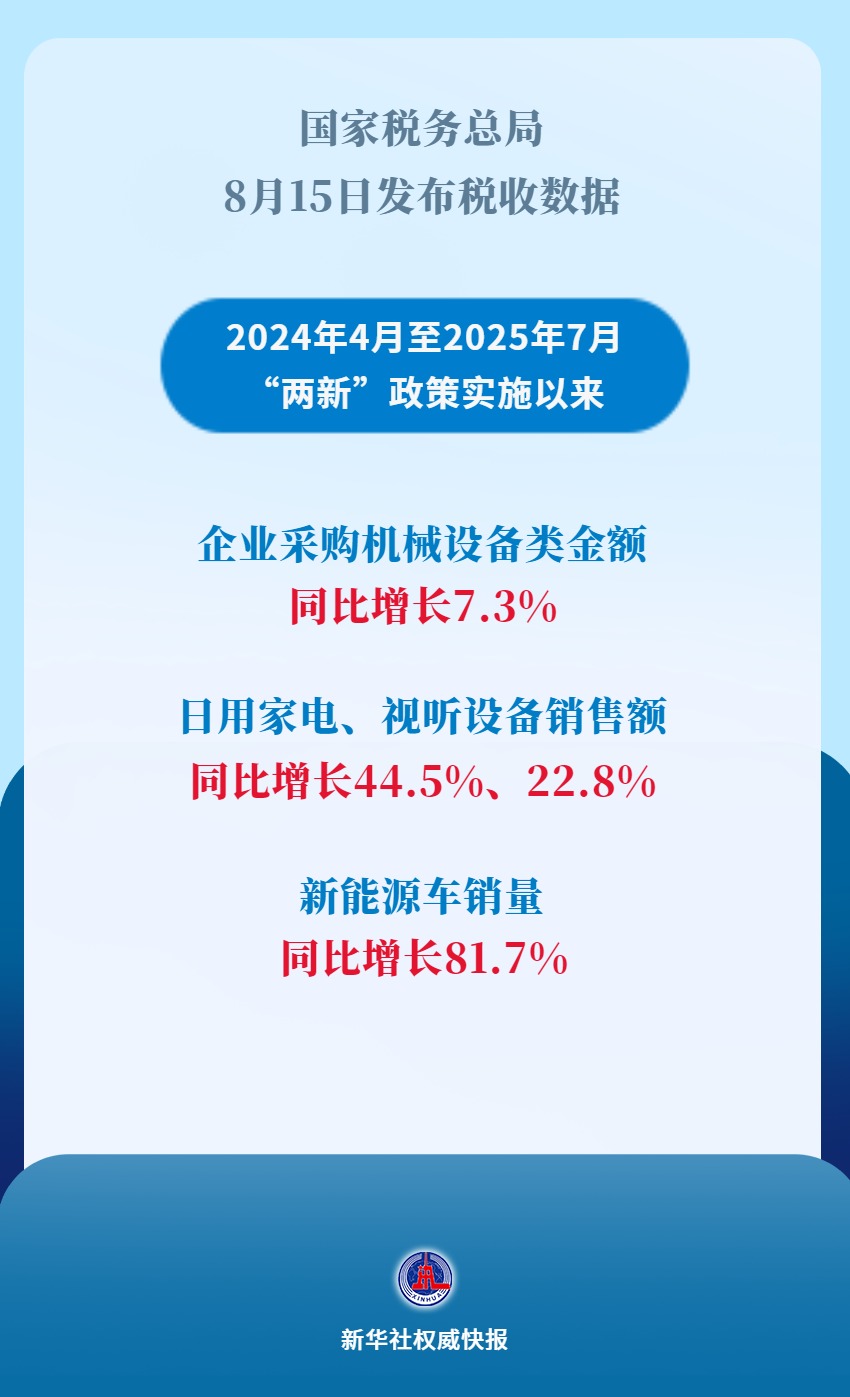
新华社权威快报丨税收数据显示:“两新”政策带动企业采购与居民消费明显增长
Xin Hua Wang· 2025-08-15 08:07
Core Insights - The latest tax data from the State Taxation Administration indicates significant growth in various sectors due to the implementation of the "Two New" policy [1][2] Group 1: Equipment and Consumer Goods - Corporate procurement of machinery and equipment increased by 7.3% year-on-year from April 2024 to July 2025 [1][2] - Sales of daily household appliances and audiovisual equipment saw year-on-year growth of 44.5% and 22.8%, respectively [1][2] Group 2: New Energy Vehicles - Sales of new energy vehicles experienced a remarkable year-on-year increase of 81.7% [1][2] Group 3: Policy Impact - The "Two New" policy, implemented for over a year, has fostered a positive interaction of "policy-driven demand release - industrial upgrading" [2]

大规模设备更新首批1730亿落地,哪些仪器/领域收益了?
仪器信息网· 2025-07-25 03:02
Core Viewpoint - The new large-scale equipment update and consumer goods replacement policy in China, initiated in 2024, is set to significantly boost economic development by expanding funding support and coverage areas, aiming for a 25% increase in equipment investment across seven major sectors by 2027 [1][5]. Group 1: Policy Dynamics and Key Points - The funding scale for equipment updates has been expanded to 200 billion yuan, with the first batch of approximately 173 billion yuan allocated to 7,500 projects across 16 sectors [2][5]. - The second batch of funding, amounting to 81 billion yuan, is being reviewed for projects focusing on consumer goods replacement and equipment updates [5]. - The 2025 policy introduces new support areas such as electronic information and safety production, creating a "16+N" coverage system [5][8]. Group 2: Implementation Mechanism Optimization - The policy has removed the previous investment threshold of 100 million yuan for projects, lowering the entry barrier for small and medium-sized enterprises [5][7]. - A dual review mechanism of "local audit + national review" has been established to streamline the approval process [5][7]. - New upgrade directions in the energy and power sector include ten specific areas, enhancing the efficiency and safety of energy facilities [8][9]. Group 3: Comparison of 2024 and 2025 Policies - The 2024 policy focused on seven key sectors, while the 2025 policy expands to 16 sectors with a dynamic expansion mechanism [7]. - The funding intensity has increased with an additional 81 billion yuan and a 1.5% interest subsidy on loans [7]. - The 2025 policy introduces 294 new national standards, enhancing the regulatory framework for project applications [7]. Group 4: Key Supported Areas and Renovation Focus - Major industrial sectors targeted for equipment updates include petrochemicals, steel, non-ferrous metals, and machinery, focusing on replacing outdated equipment and upgrading production lines [8][10]. - Energy facilities will see upgrades in areas such as high-efficiency energy motors and waste heat recovery systems, aimed at reducing energy consumption [8][10]. - Transportation infrastructure will undergo significant updates, including intelligent systems for railways and urban transit, enhancing operational efficiency [10][11].

中国盈利系列十:工企利润回暖
Hua Tai Qi Huo· 2025-04-28 06:18
Group 1: Report Title and Macro Event - Report title: "Industrial Enterprises' Profit Recovery - China's Profit Series Ten" [1] - Macro event: On April 27, 2025, the National Bureau of Statistics announced that from January to March, the total profit of industrial enterprises above designated size in China reached 1,509.36 billion yuan, a year - on - year increase of 0.8% [2] Group 2: Core Views Revenue Pressure Still Exists Overall Situation - Profit growth rebounds, but demand - side pressure remains. From January to March 2025, the total profit of industrial enterprises above designated size increased by 0.8% year - on - year, reversing the continuous decline since Q3 2024. In March, the single - month profit growth rate rebounded to 2.6%, a significant improvement from - 0.3% in January - February. This is due to the policy drive and the recovery of overseas orders. However, inventory pressure restricts profit space, and weak infrastructure and real estate demand drag down some upstream industries [3] - Policy drive: The "Two New" policies (large - scale equipment renewal and consumer goods trade - in) drove the profit of the equipment manufacturing industry to increase by 7.6% year - on - year, contributing over 40% to industrial profit growth [3] - Overseas orders: Overseas orders boosted the profit of export - dependent industries. From January to March, the profit of the electronics industry increased by 3.2%, and that of railway and ship transportation equipment increased by 14.2%. The profit of the consumer goods manufacturing industry increased by 7.1%, and industries such as chemical fiber and paper - making saw profit growth of 181% and 155% respectively due to a surge in export orders [3] - Inventory pressure: At the end of March, the year - on - year growth of finished product inventory was 4.2%, the actual inventory growth rate was 6.4%, and the turnover days of finished products increased to 22.3 days, indicating a slow de - stocking process [3] - Weak upstream industries: The profit of the coal mining industry decreased by 47.7% year - on - year, and the ferrous metal smelting industry was still on the verge of profit and loss due to weak infrastructure and real estate demand [3] Structural Situation - New and old kinetic energy differentiation intensifies, and policy dividends tilt towards the middle and lower reaches. The equipment manufacturing industry became the core growth engine, with a 7.6% year - on - year profit increase in Q1. The raw material industry showed obvious internal differentiation, and the consumer goods manufacturing industry showed resilience [4] - Equipment manufacturing industry: The profit of specialized equipment manufacturing (+14.2%) and general equipment manufacturing (+9.5%) was significantly higher than the industrial average. The electronics industry had bright spots in some sub - sectors [4] - Raw material industry: The profit of the non - ferrous metal smelting and rolling processing industry increased by 33.6% year - on - year, while the ferrous metal smelting industry was on the verge of profit and loss, and the coal mining industry's profit decreased by 47.7% [4] - Consumer goods manufacturing industry: Industries such as chemical fiber (+181%) and paper - making (+155%) had explosive growth. However, the automobile manufacturing industry (- 6.2%) was still restricted by the industrial chain adjustment [4] Group 3: Appendix - Interpretation of Industrial Enterprise Profit Data - Profit turns from decline to growth: In Q1 2025, the profit of industrial enterprises above designated size turned from a 3.3% year - on - year decline in the previous year to an 0.8% increase, and in March, it turned from a 0.3% decline in January - February to a 2.6% increase [29] - Revenue growth accelerates: In Q1, the revenue of industrial enterprises above designated size increased by 3.4% year - on - year, 0.6 percentage points faster than in January - February. In March, it grew by 4.2%, 1.4 percentage points faster than in January - February [29] - Nearly 60% of industries see profit growth: Among 41 industrial sectors in Q1, 24 had year - on - year profit growth, and 24 had accelerated profit growth or narrowed declines. The manufacturing industry improved significantly, with a 7.6% profit growth in Q1, 2.8 percentage points faster [30] - Equipment manufacturing supports profit growth: In Q1, the profit of the equipment manufacturing industry increased by 6.4% year - on - year, 1.0 percentage point faster than in January - February, accounting for 32.0% of the total profit of industrial enterprises above designated size, and pulling the total profit growth by 2.0 percentage points [30] - High - tech manufacturing leads high - quality development: In Q1, the profit of high - tech manufacturing turned from a 5.8% decline in January - February to a 3.5% increase. In March, it had double - digit growth, pulling the total profit growth by 2.8 percentage points [31] - "Two New" policies are effective: The "Two New" policies drove the profit growth of relevant industries. The profit of specialized and general equipment industries increased by 14.2% and 9.5% respectively, and consumer goods trade - in policies boosted related industries [32]