
绿色贸易

Search documents
发挥跨境电商在贸易创新发展中的引擎作用
Jing Ji Ri Bao· 2025-12-22 23:05
贸易创新发展是全面推动高质量发展的内在要求,是加快构建新发展格局的重要支撑,亦是应对国际经 贸局势变化的主动作为。"十五五"规划建议提出"推动贸易创新发展",要求"提升贸易促进平台功能, 支持跨境电商等新业态新模式发展"。中央经济工作会议对"鼓励支持服务出口,积极发展数字贸易、绿 色贸易"作出重要部署。跨境电商是我国外贸发展的有生力量,也是国际贸易发展的重要趋势。更好发 挥跨境电商在赋能中小外贸企业、促进产业国际化发展、维护供应链安全等方面的独特作用,进一步推 动贸易创新发展,是做好明年外贸工作的重要内容。 二是鼓励跨境电商赋能产业发展。近年来,电商平台不断深化"贸易+产业链"的模式,有效带动了地方 工业品、特色农产品出口,成为地方特色产业国际化的新载体和农民增收致富的新渠道。需积极促进跨 境电商与产业深度融合,依托产业集群基础塑造电商发展优势,支持平台企业向各产业领域融合渗透, 不断丰富应用场景。大力发展"跨境电商+产业带",促进跨境电商综合试验区、跨境电商产业园区等与 产业集群融合发展,使电商成为带动当地特色产品以及产业出海的中坚力量。 "十五五"时期,我国跨境电商发展的瓶颈制约、短板弱项依然突出,面临的 ...
影响市场重大事件:国家航天局:统筹民商遥感卫星的“太空打星”模式,我国在轨遥感卫星数量已达到400余颗;美星链卫星异常或威胁其他卫星
Mei Ri Jing Ji Xin Wen· 2025-12-22 22:37
Group 1: Space and Satellite Industry - The National Space Administration is coordinating civil and commercial remote sensing satellites to establish a virtual observation constellation, enhancing emergency disaster observation capabilities and satellite utilization efficiency [1][4] - Currently, China has over 400 remote sensing satellites in orbit, covering various types such as optical, hyperspectral, infrared, and microwave, achieving all-weather and all-time Earth observation [4] Group 2: Data Management and Public Data Utilization - The National Data Bureau is promoting the open and authorized operation of public data to maximize its value, having released four batches of demonstration scenarios, with the latest batch including 30 scenarios [3] - The data supply approach is shifting from primarily sharing to a collaborative model that includes sharing, opening, and authorized operation [3] Group 3: Economic Development and Trade - Haikou's 14th Five-Year Plan emphasizes accelerating the development of a cross-border capital centralized operation center and promoting cross-border asset management business trials [5] - The plan also aims to enhance the effects of temporary import and export trials for repair and remanufactured products, leveraging zero tariffs on imported goods [6] Group 4: Financial Policies - The People's Bank of China introduced a one-time credit repair policy to provide corrective opportunities for previously untrustworthy individuals, aiming to improve credit conditions and stimulate economic activity [7][8] Group 5: Agricultural Innovation - The Chinese Academy of Sciences announced significant progress in the "Precision Design and Creation of Seeds" project, achieving breakthroughs in breeding technology and identifying key genes for high-yield and disease-resistant crops [9][10]
A股晚间热点 | 高层定调“十五五”规划!要谋划新政策新举措
智通财经网· 2025-12-22 14:35
Group 1 - Premier Li Qiang emphasized the need to plan major projects that can drive overall development, aiming to accumulate new momentum for future growth and support current economic stability [1] - The focus is on developing new productive forces, promoting technological innovation, and optimizing economic structure during the 14th Five-Year Plan [1] - The government aims to overcome existing challenges through reform and innovation, ensuring that policies and measures are closely aligned with developmental needs [1] Group 2 - Goldman Sachs predicts that Chinese stocks will continue to rise, with a potential increase of 38% by the end of 2027, driven by a reassessment of the technology sector and increased household savings flowing into the stock market [2] - The bank expects corporate earnings in China to grow by 14% in the coming year and by 12% in 2027, with valuation expansion around 10% [2] - The shift in the stock market cycle from expectation-driven to profit-driven is highlighted as a key factor for future returns [2] Group 3 - The Ministry of Commerce announced temporary anti-subsidy measures on dairy products imported from the EU, with subsidy rates ranging from 21.9% to 42.7% [3] - This decision is based on the preliminary ruling regarding the subsidies provided by EU companies [3] Group 4 - NVIDIA's GB300 AI server cabinet is projected to have a shipment volume of 55,000 units next year, marking a 129% year-on-year increase, primarily driven by major companies like Microsoft and Meta [4] - The next-generation Vera Rubin 200 platform is expected to start shipping in Q4 of next year, providing ongoing growth momentum for suppliers [4] Group 5 - The draft revision of the Banking Supervision and Administration Law was submitted for review, focusing on enhancing penetrative supervision and protecting financial consumer rights [5][6] - The revision extends regulatory oversight to major shareholders and actual controllers of banking institutions, aiming to combat illegal related-party transactions [6] Group 6 - The National Medical Insurance Administration announced a centralized procurement initiative for high-value medical consumables, including urological intervention products [6] - This initiative aims to streamline procurement processes across public medical institutions and enhance cost efficiency [6] Group 7 - The draft revision of the Foreign Trade Law supports the development of digital and green trade, promoting international recognition of digital certificates and electronic signatures [7] - It also emphasizes the establishment of standards and certification systems related to green trade [7] Group 8 - The Civil Aviation Administration of China released two mandatory national standards for drones, set to take effect on May 1, 2026, aimed at promoting a safer and more orderly industry [9] - The report highlights investment opportunities in the drone industry, particularly in infrastructure maintenance and automation [9] Group 9 - Companies like Zhuoran Co. have secured significant contracts, such as a 4.033 billion yuan engineering contract, indicating positive developments in the construction sector [14] - Other companies are also planning share buybacks and expansions, reflecting a proactive approach to growth and shareholder value [14]


人大常委会|对外贸易法修订草案二审稿进一步支持发展数字贸易、绿色贸易
Xin Hua She· 2025-12-22 08:09
Group 1 - The core viewpoint of the news is the second review of the draft amendment to the Foreign Trade Law, which emphasizes the support and encouragement of digital trade and the establishment of a green trade system as key areas for promoting trade innovation and development [1][2] - The draft amendment includes provisions to promote the construction of a cross-border financial service system and support the digital development of foreign trade, enhancing the level of trade facilitation through international recognition of digital certificates and electronic signatures [1] - The draft also aims to establish product standards, certification, and labeling systems related to green trade, and to support the development of a talent pool for foreign trade to ensure high-quality development [1] Group 2 - The draft amendment further specifies regulations on international service trade and foreign trade relief, encouraging various modes of international service trade such as cross-border delivery and natural person mobility [2] - To address trade risks and changes in the trade environment, the draft allows relevant governments to establish trade adjustment assistance systems in accordance with World Trade Organization rules [2] - The legal responsibility provisions in the draft consider the characteristics of small and medium-sized enterprises in foreign trade, modifying penalty clauses to allow for flexible application based on specific case circumstances [2]
对外贸易法修订草案二审稿进一步支持发展数字贸易、绿色贸易
Xin Hua She· 2025-12-22 07:43
Group 1 - The core viewpoint of the news is the revision of the Foreign Trade Law draft, which emphasizes the support and encouragement of digital trade and the establishment of a green trade system as key areas for promoting trade innovation and development [1][2] - The draft includes provisions to promote the construction of a cross-border financial service system and support the digitalization of foreign trade, enhancing the level of trade facilitation through international recognition of digital certificates and electronic signatures [1] - The draft also aims to build standards, certification, and labeling systems related to green trade products, and supports the development of a talent pool for foreign trade to ensure high-quality development [1] Group 2 - The draft further specifies regulations on international service trade and foreign trade relief, encouraging various modes of international service trade such as cross-border delivery and natural person mobility [2] - It establishes a trade adjustment assistance system in accordance with World Trade Organization rules to address trade risks and changes in the trade environment [2] - The legal responsibility section of the draft considers the characteristics of small and medium-sized enterprises, modifying penalty provisions to allow for flexible application based on specific case circumstances [2]
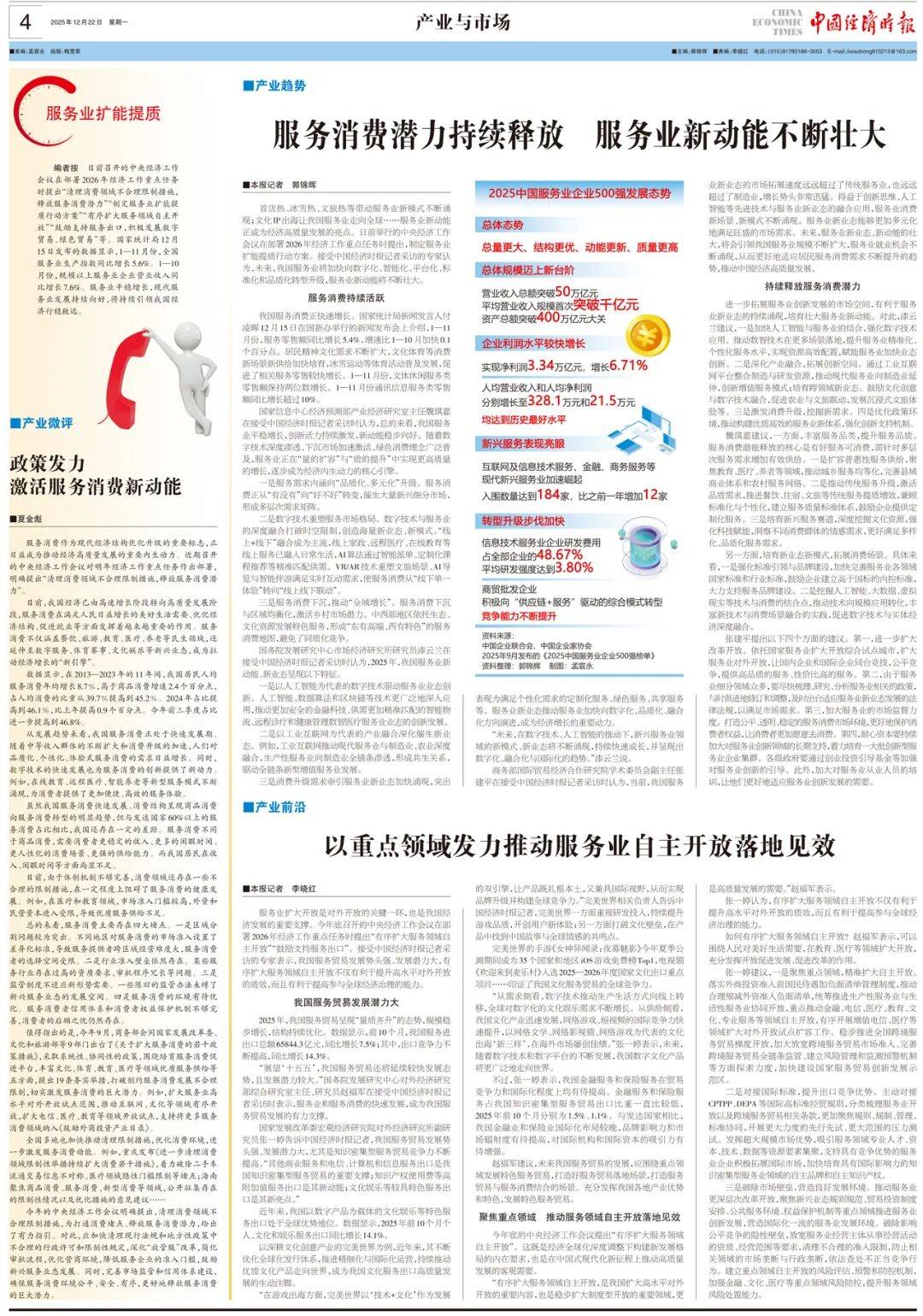
产业与市场丨政策发力 激活服务消费新动能
Sou Hu Cai Jing· 2025-12-22 07:26
Core Insights - The central economic work conference emphasized the need to "eliminate unreasonable restrictions in the consumption sector to unleash service consumption potential" and to "formulate an action plan for expanding and improving the service industry" [1][2][5] - The service industry is showing steady growth, with the national service production index increasing by 5.6% year-on-year from January to November, and revenue from large-scale service enterprises growing by 7.6% year-on-year from January to October [1][2] Group 1: Service Consumption Trends - Service consumption is becoming a significant internal driving force for high-quality economic development, covering areas such as dining, tourism, education, healthcare, and emerging sectors like digital services and cultural entertainment [2][3] - From 2013 to 2023, the average annual growth rate of per capita service consumption in China was 8.7%, surpassing the growth rate of goods consumption by 2.4 percentage points, with the share of service consumption in per capita consumption rising from 39.7% to 45.2% [2][3][4] - The share of service consumption is projected to increase to 46.1% in 2024, with a further rise to 46.8% in the first three quarters of this year [2][3] Group 2: Challenges in Service Consumption - There are four main bottlenecks in service consumption: regional segmentation, industry access barriers, outdated regulatory systems, and an inadequate consumer protection environment [4][5] - High market entry barriers in sectors like healthcare and education limit the supply of quality services, as foreign and private capital face restrictions [3][4] Group 3: Policy Initiatives - The government has introduced 19 practical measures to stimulate service consumption, including expanding high-level pilot programs for service industry openness and promoting orderly opening in sectors like telecommunications, healthcare, and education [4][5] - Local governments are also taking steps to eliminate restrictive measures and optimize the consumption environment, such as Chongqing's initiatives to address information asymmetry in the second-hand car market and hidden barriers in healthcare [5][8] Group 4: Future Outlook - The service industry is expected to accelerate its transformation towards digitalization, intelligence, platformization, standardization, and quality enhancement, with new service models emerging [8][9] - The integration of digital technology into service consumption is creating new market opportunities, with online services becoming mainstream and enhancing consumer experiences [9][10]
对外贸易法修订草案二审 增加规定推动数字证书、电子签名等国际互认
Zhong Guo Xin Wen Wang· 2025-12-22 03:19
Core Viewpoint - The draft amendment to the Foreign Trade Law emphasizes the promotion of digitalization in foreign trade, including international recognition of digital certificates and electronic signatures, to enhance trade facilitation [1] Group 1: Digitalization and Trade Facilitation - The draft includes provisions for state support in the digital development of foreign trade, aiming to improve the level of trade facilitation through international recognition of digital certificates and electronic signatures [1] - The amendment aims to clarify common service trade models, encouraging various modes of international service trade such as cross-border payments and overseas consumption [1] Group 2: High-Quality Development and Standards - The draft emphasizes the construction of product standards, certification, and labeling systems related to green trade, supporting high-quality development in foreign trade [1] - It includes provisions for the development of a talent pool for foreign trade, providing necessary support for high-quality trade development [1] Group 3: Fair Trade Practices - The draft reflects the central government's requirements for high-quality foreign trade development, promoting the construction of a strong trade nation and maintaining a fair and just international economic trade order [1] - It supports the enhancement of trade promotion platforms to improve functionality and service levels for foreign trade operators [1] Group 4: Penalty Regulations - The draft modifies penalty provisions for foreign trade operators, particularly for small and micro enterprises, by not setting a minimum fine amount, allowing authorities to apply penalties based on specific case circumstances [2]
12月22日投资早报|联创电子筹划控制权变更事项股票继续停牌,上峰水泥参股公司粤芯半导体创业板IPO获受理,今日两只新股申购
Xin Lang Cai Jing· 2025-12-22 00:35
Market Performance - On December 19, 2025, the A-share market saw all three major indices rise, with the Shanghai Composite Index closing at 3,890.45 points, up 0.36%, and the Shenzhen Component Index at 13,140.21 points, up 0.66% [1] - The Hong Kong stock market also experienced gains, with the Hang Seng Index increasing by 0.75% to 25,690.53 points, while the total trading volume reached 221.19 billion HKD [1] - In the U.S. stock market, all three major indices closed higher, with the Dow Jones Industrial Average rising by 0.38% to 48,134.89 points, and the S&P 500 Index increasing by 0.88% to 6,834.50 points [1] New Stock Offerings - Two new stocks are available for subscription today, with no new stocks listed [2] - Shaanxi Tourism, with a stock code of 603402, has an issue price of 80.44 CNY per share and a price-to-earnings ratio of 12.37 times, focusing on tourism performance and related services [4] - New Guangyi, with a stock code of 301687, has an issue price of 21.93 CNY per share and a price-to-earnings ratio of 28.59 times, specializing in high-performance special functional materials [4] Regulatory Developments - The National Development and Reform Commission, along with other agencies, released the "Internet Platform Pricing Behavior Rules" to enhance price regulation and protect consumer rights [5][6] - The rules prohibit platform operators from imposing unreasonable restrictions on pricing, including forced price reductions or mandatory price alignment across different sales channels [6] Business Sector Initiatives - The Ministry of Commerce held an expanded meeting emphasizing the importance of business work in 2026, which marks the beginning of the "14th Five-Year Plan" [7] - The meeting highlighted the need to boost consumption, expand the supply of quality goods and services, and promote trade innovation and investment integration [7] - There is a focus on enhancing the international trade environment, including the development of digital and green trade, and the promotion of the Belt and Road Initiative [7]



对外贸易法修订草案将二审 拟增加规定对外贸易工作应推进贸易强国建设
Zhong Guo Xin Wen Wang· 2025-12-19 06:30
Core Viewpoint - The draft amendment of the Foreign Trade Law is set for a second review, aiming to enhance regulations that promote the construction of a strong trading nation [1] Group 1: Key Modifications Proposed - The draft amendment will incorporate provisions to advance the construction of a strong trading nation, maintain a fair and just international economic trade order, and encourage various models of international service trade [1] - It will strengthen regulations related to foreign trade promotion, including the establishment of a cross-border financial service system, international recognition of digital certificates and electronic signatures, and the development of standards and certification systems related to green trade [1] - Legal responsibilities will be refined, with adjustments to penalty clauses to allow authorities to apply fines based on specific case circumstances without a minimum fine limit [1]
对外贸易法修订拟不限最低罚款数额
Di Yi Cai Jing· 2025-12-19 06:13
Core Viewpoint - The draft amendment to the Foreign Trade Law aims to enhance the legal framework supporting the development of foreign trade, incorporating new measures to adapt to recent changes in the trade environment and promote high-quality growth in foreign trade [1][2]. Group 1: Key Modifications in the Draft Amendment - The draft includes provisions for the state to promote the construction of a cross-border financial service system based on the needs of foreign trade development [1]. - It introduces measures for the state to facilitate international recognition of digital certificates and electronic signatures, thereby improving the level of trade facilitation [1]. - The draft emphasizes the need for the state to support the development of product standards, certification, and labeling systems related to green trade [1]. - It also includes provisions for enhancing the functions and service levels of trade promotion platforms [1]. - The draft supports the construction of a talent pool for foreign trade to provide necessary human resources for high-quality development [1]. Group 2: Legal Responsibility and Enforcement - The draft amendment adjusts relevant clauses regarding fines, removing the minimum fine limit to allow authorities to apply penalties based on specific case circumstances [1]. - It includes measures to counteract foreign individuals and organizations that threaten China's sovereignty, security, and development interests, allowing for restrictions on their foreign trade activities [3]. - The draft prohibits any individual or organization from providing support or assistance to evade countermeasures, with legal consequences for violations [3]. Group 3: Historical Context and Reform Initiatives - The current Foreign Trade Law has been in effect since 1994, with significant revisions in 2004, 2016, and 2022, reflecting ongoing reforms in the foreign trade sector [2]. - The new round of amendments aims to elevate successful reform initiatives, such as the negative list management system for cross-border service trade and the encouragement of digital trade, to a legal status to ensure effective implementation [2]. - The previous draft emphasized optimizing the foreign trade environment, enhancing intellectual property protection related to foreign trade, and establishing a trade adjustment assistance system to stabilize supply chains [2].