AGI

Search documents
X @Sam Altman
Sam Altman· 2025-10-01 13:36
AI Development & Strategy - The company primarily needs capital to build AI capable of scientific discovery, focusing research efforts on achieving Artificial General Intelligence (AGI) [1] - The company aims to showcase new technology and products to generate user engagement and revenue to offset computational costs [1] - The company acknowledges initial skepticism surrounding the necessity and purpose of technologies like ChatGPT in relation to AGI development [1] - The company recognizes the complexities involved in determining the optimal path for corporate development [1] Public Perception & Criticism - Critics highlight perceived discrepancies between the company's stated goals (e.g., needing $7 trillion and 10 GW to cure cancer) and its actual product releases (e.g., AI-generated "slop videos" marketed as personalized ads) [2]
Anthropic CEO: AGI Is Marketing
Alex Kantrowitz· 2025-09-30 16:58
Terminology Analysis - The company views terms like AGI (Artificial General Intelligence) and super intelligence as potentially meaningless and more akin to marketing terms [1][2] - The company publicly avoids using AGI and super intelligence, and is critical of their use [2] AI Development & Scaling - The company is bullish on the rapid improvement of AI capabilities, emphasizing the exponential progress in the field [3] - AI model improvement occurs every few months due to increased investment in compute, data, and new training models [3] - AI model training involves pre-training (feeding data from the internet) and a second stage involving reinforcement learning [4] - Both pre-training and reinforcement learning are scaling up together, with no apparent barriers to further scaling [5]


经验时代的 Scaling Law|AGIX PM Notes
海外独角兽· 2025-09-29 12:03
Core Insights - The AGIX index aims to capture the beta and alphas of the AGI era, which is expected to be a significant technological paradigm shift over the next 20 years, similar to the impact of the internet [2] - The article emphasizes the importance of learning from legendary investors like Warren Buffett and Ray Dalio to navigate the AGI revolution [2] Market Performance Summary - AGIX experienced a weekly decline of 3.62%, with a year-to-date return of 27.70% and an impressive return of 86.70% since 2024 [5] - In comparison, the S&P 500 decreased by 0.75% this week, with a year-to-date return of 12.96% and a return of 39.29% since 2024 [5] Sector Performance - The semiconductor and hardware sector saw a weekly decline of 1.03%, with an index weight of 23.67% [6] - The infrastructure sector declined by 1.74%, holding an index weight of 39.99% [6] - The application sector experienced a smaller decline of 0.86%, with an index weight of 31.27% [6] AI Developments - The article discusses the limitations of large language models (LLMs) in learning and adapting, suggesting that true learning involves experience and intuition, similar to human learning processes [10] - It highlights the potential of large video models (VLMs) to predict physical and causal relationships, which could enhance robotic learning and decision-making capabilities [12] - The emergence of a new scaling law related to experiential learning in AI suggests that opportunities in AI are expanding beyond digital tasks to interactive learning agents [13] Hedge Fund Activity - North American markets saw a significant momentum reversal, prompting hedge funds to reduce directional risks, leading to net selling in global equities [13] - The net leverage of U.S. long-short funds decreased from 59% to 53% following the sell-off, indicating a cautious approach among fund managers [14] - In Asia, particularly China, there was a notable reduction in long positions and an increase in short positions, especially in the technology sector [14] Corporate News - Oracle, Silver Lake, and Abu Dhabi's MGX are set to become major investors in TikTok's U.S. operations, controlling approximately 45% of its equity [15][16] - Meta's CEO announced that Instagram's monthly active users have reached 3 billion, significantly contributing to Meta's advertising revenue [16] - OpenAI, Oracle, and SoftBank plan to invest $500 billion in building five AI data centers as part of the Stargate project, aimed at enhancing AI infrastructure [17][18] - Boeing is collaborating with Palantir to implement AI solutions in its defense and aerospace sectors, focusing on data analysis standardization [19] ETF Insights - The article explains the concept of tracking error in ETFs, emphasizing its importance in evaluating the stability and reliability of an ETF's performance relative to its benchmark index [22] - It distinguishes between tracking difference and tracking error, highlighting that tracking error reflects the volatility of the return differences over time [22][23] - Factors influencing tracking error include fees, trading costs, and sampling errors, which can vary significantly across different markets and asset classes [24][25]



37岁1200亿,他登顶今年最年轻富豪
华尔街见闻· 2025-09-29 11:12
Core Viewpoint - Edwin Chen, a Chinese-American entrepreneur, is emerging as a new leader in the AI sector with his company Surge AI, which is currently raising $1 billion in its first round of financing, leading to a valuation of approximately $24 billion (about 171.2 billion RMB) [4][5][12]. Company Overview - Surge AI was founded by Edwin Chen in 2020 after he left his stable job at major tech companies. The company specializes in providing data annotation services for AI, achieving over $1 billion in annual revenue without external financing [7][14]. - Edwin Chen holds 75% of Surge AI's shares, resulting in a personal net worth of $18 billion (approximately 128.1 billion RMB), making him the youngest billionaire on the Forbes list this year [5][12]. Competitive Landscape - Surge AI's main competitor is Scale AI, which recently received a $15 billion investment from Meta, raising its valuation to over $29 billion. This has also created significant wealth for its founders [8][12]. - Data annotation companies like Surge AI and Scale AI are crucial in the AI ecosystem, as they provide the "clean" data necessary for model training, regardless of technological advancements [10][11]. Industry Insights - The AI industry is experiencing a wealth creation wave, with numerous startups achieving billion-dollar valuations. For instance, Perplexity, an AI search engine, recently secured $200 million in funding, reaching a valuation of $20 billion (approximately 142.5 billion RMB) [16]. - The stock market is also reflecting this trend, with companies like Nvidia and domestic AI chip leader Cambrian Technologies seeing their stock prices soar, with Cambrian's market value surpassing 600 billion RMB [17][18]. Future Outlook - Edwin Chen believes that the future of AI holds immense potential, stating that AI could achieve groundbreaking advancements, provided it is trained on high-quality data that reflects human expertise and values [15]. - The AI sector is expected to create more millionaires in the next five years than the internet did in its first 20 years, indicating a significant growth trajectory [19].

大佬连发警告,“人类只剩最后5年”
Hu Xiu· 2025-09-29 05:47
Core Insights - The emergence of super artificial intelligence (AGI) is increasingly seen as inevitable, with predictions that AI will surpass human intelligence across all dimensions by 2030 [3][4][5] - AI is expected to drastically reshape the job market, particularly affecting entry-level positions while benefiting experienced employees [11][13][15] Group 1: Impact on Employment - A recent Harvard study indicates that since 2023, companies utilizing generative AI have seen a significant decline in entry-level positions, averaging a 7.7% reduction, while mid to senior-level roles have remained stable [11][12] - The impact of AI is not uniform; entry-level jobs are more susceptible to AI disruption, leading to a "credential-biased technological change" where the demand for entry-level talent is redefined [10][14][16] - The trend shows that many traditional career paths starting from entry-level roles are being disrupted, potentially affecting long-term career development for newcomers [15] Group 2: AI Job Market Trends - In China, entry-level AI positions are also declining, with significant salary reductions reported in roles such as data development (-33%) and testing engineering (-27%) [19] - The global tech industry has seen substantial layoffs, with 89,964 tech employees laid off in 2025 alone, indicating a shift towards AI-driven operational models [21][23] - Major tech companies are actively restructuring their workforce to adapt to AI advancements, with layoffs often accompanied by increased investments in AI technologies [25][26] Group 3: Talent Acquisition Strategies - The demand for AI talent is surging, with a reported tenfold increase in AI job postings in 2025, and a significant rise in non-technical roles related to AI [31][32] - Companies are offering competitive salaries to attract top AI talent, with 42.66% of new graduate positions in AI offering monthly salaries between 50,000 to 80,000 yuan [33] - Major firms are implementing specialized recruitment programs to secure top-tier AI talent, reflecting a fierce competition for skilled professionals in the AI sector [34][36][40] Group 4: Competitive Landscape - The competition for AI talent has intensified, with companies like Meta and Microsoft engaging in aggressive recruitment strategies, including multi-million dollar salary packages [39][41][46] - The focus has shifted from accumulating computational power to securing intellectual resources, as top talent is crucial for technological breakthroughs and market positioning [46][47]

Flash Attention作者最新播客:英伟达GPU统治三年内将终结
量子位· 2025-09-29 04:57
Group 1 - The core argument is that Nvidia's dominance in the GPU market will face increasing competition within the next 2-3 years as specialized chips for different workloads emerge, leading to a more diversified ecosystem [6][9][23] - Tri Dao emphasizes that the architecture for AI models, particularly the Transformer, is stabilizing, but there are still ongoing changes and challenges in chip design and workload adaptation [11][12][21] - The future of AI workloads will include three main types: traditional chatbots, ultra-low latency scenarios, and large-scale batch processing, which will require tailored optimizations from hardware vendors [24][96] Group 2 - The cost of inference has decreased by approximately 100 times since the launch of ChatGPT, driven by improvements in model efficiency and inference optimization techniques [73][75][90] - Techniques such as model quantization and collaborative design between model architecture and hardware have significantly contributed to this cost reduction [82][84][88] - There is still an estimated potential for a further 10-fold improvement in inference optimization, particularly through specialized hardware and model advancements [90][93][95] Group 3 - The AI hardware landscape is expected to diversify as companies like Cerebras, Grok, and SambaNova introduce solutions that emphasize low-latency inference and high throughput for various applications [23][24][96] - The emergence of specialized AI inference providers will lead to different trade-offs, with some focusing on broad coverage while others aim for excellence in specific scenarios [96][97] - The evolution of AI workloads will continue to drive demand for innovative solutions, particularly in real-time video generation and agentic applications that require seamless integration with human tools [117][115][120]


OpenAI:人类只剩最后5年
Hu Xiu· 2025-09-28 23:36
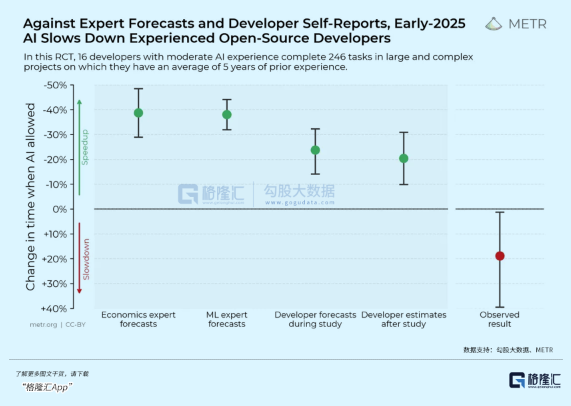
Core Insights - The article discusses the current limitations and future potential of AI, particularly in the context of its ability to surpass human intelligence and efficiency in various tasks [1][4][10]. Group 1: AI Capabilities and Predictions - By 2030, AI models like GPT-8 are expected to provide comprehensive answers to complex problems, including quantum gravity, and articulate their thought processes [2][3]. - It is predicted that 30% to 40% of tasks in today's economic activities will be performed by AI [4]. - A report from the METR think tank indicates that the capabilities of large language models double approximately every seven months, outpacing Moore's Law [8]. Group 2: Current AI Performance and Efficiency - An experiment by METR revealed that while AI tools can predict tasks 40% faster, they actually slow down the overall programming process by 19% compared to human-only efforts [13][14]. - The concept of "capability-reliability gap" explains that current AI models can perform complex tasks but fail to meet the quality standards required by businesses [19][20]. - In programming tasks, AI-generated code often contains errors, requiring human programmers to spend additional time correcting and rewriting, leading to a situation where humans act as "babysitters" for AI [22][23]. Group 3: AI Industry Landscape - As of April 2025, there are over 4.243 million AI-related companies in existence in China, with approximately 286,000 new registrations expected that year [28][29]. - Despite the proliferation of AI companies, very few have achieved profitability, with the industry characterized by high investment and low returns [31][32]. - Major tech companies like Microsoft, Meta, Google, and Amazon are projected to invest $300 billion in AI projects in 2024, with global generative AI investment expected to grow over 70% from 2023 [33][34]. Group 4: Challenges and Market Realities - Many AI startups are struggling financially, with numerous companies facing bankruptcy or operational shutdowns due to cash flow issues [40][41][46]. - The article highlights that while the AI market is booming, the reality is that 90% of participants may fail to survive, indicating a significant disparity between hype and actual performance [44][45]. - The current state of AI tools is not sufficient to replace human workers effectively, and many companies are misled into thinking that basic investments in technology equate to digital transformation [90][91].
撞墙的不是Scaling Laws,是AGI。
自动驾驶之心· 2025-09-28 23:33
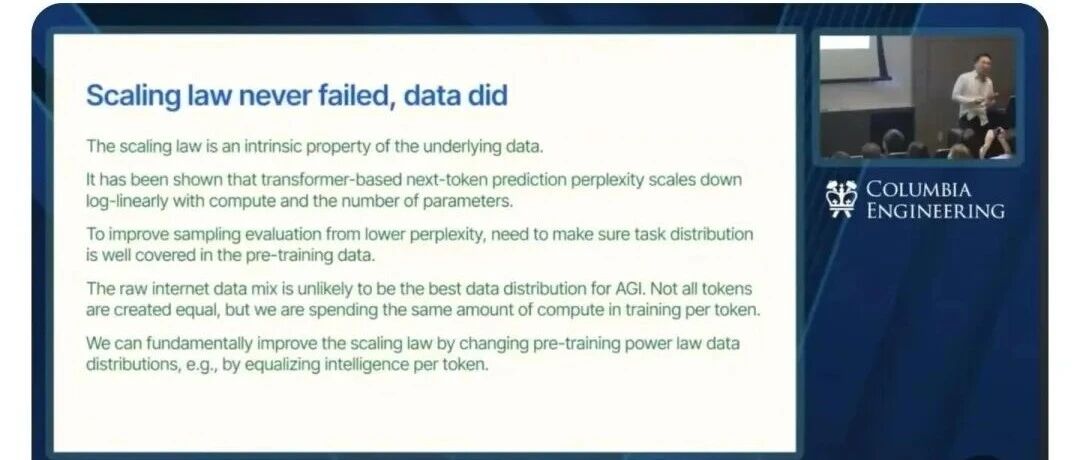
Core Viewpoint - The article posits that scaling laws do not necessarily lead to AGI (Artificial General Intelligence) and may even diverge from it, suggesting that the underlying data structure is a critical factor in the effectiveness of AI models [1]. Group 1: Data and Scaling Laws - The scaling laws are described as an intrinsic property of the underlying data, indicating that the performance of AI models is heavily reliant on the quality and distribution of the training data [14]. - It is argued that the raw internet data mix is unlikely to provide the optimal data distribution for achieving AGI, as not all tokens are equally valuable, yet the same computational resources are allocated per token during training [15]. - The article emphasizes that the internet data, while abundant, is actually sparse in terms of useful contributions, leading to a situation where AI models often only achieve superficial improvements rather than addressing core issues [8]. Group 2: Model Development and Specialization - GPT-4 is noted to have largely exhausted the available internet data, resulting in a form of intelligence that is primarily based on language expression rather than specialized knowledge in specific fields [9]. - The introduction of synthetic data by Anthropic in models like Claude Opus 3 has led to improved capabilities in coding, indicating a shift towards more specialized training data [10]. - The trend continues with GPT-5, which is characterized by a smaller model size but greater specialization, leading to a decline in general conversational abilities that users have come to expect [12]. Group 3: Economic Considerations and Industry Trends - Due to cost pressures, AI companies are likely to move away from general-purpose models and focus on high-value areas such as coding and search, which are projected to have significant market valuations [7][12]. - The article raises concerns about the sustainability of a single language model's path to AGI, suggesting that the reliance on a "you feed me" deep learning paradigm limits the broader impact of AI on a global scale [12].