拨备覆盖率

Search documents
12家A股银行上半年业绩快报出炉:净利增幅均超10%
Xin Hua Wang· 2025-08-12 06:19
A股上市银行今年上半年经营情况如何? 据记者初步统计,截至今年8月初,已有12家A股上市银行披露业绩快报(未经审计),披露主体目前 均为城商行和农商行。从已披露的数据来看,银行业绩表现亮眼,归母净利润均较去年同期实现两位数 增长,且有多家银行同比增长超30%。 光大银行金融市场部宏观研究员周茂华表示,介于二季度遭遇了散发疫情的冲击,银行如果有两位数的 利润增长,则表明银行的经营和盈利性相当有韧性。 对于银行下半年经营情况,周茂华表示,虽然二季度的散发疫情波及面比较广,但对银行的影响整体可 控,加之上半年出台的政策,其效果也会在下半年逐渐显现,因此对银行下半年的经营"整体保持乐 观"。 营收、净利润齐增长 据记者统计,已披露中期快报的银行营业收入和归母净利润均实现双增长。城商行阵营中的江苏银行、 南京银行、杭州银行营收超百亿元,分别为351.07亿元、235.32亿元、172.95亿元,位居前三位。江苏 银行、南京银行的净利润超百亿元,分别为133.8亿元、101.5亿元,同比增长31.81亿元、16.96亿元。 总体来看,12家银行净利润同比增幅均超10%,其中张家港行、苏州银行、江阴银行等6家银行同比增 速 ...





上市银行上半年资产质量持续向好
Xin Hua Wang· 2025-08-12 06:19
近期,A股上市银行陆续披露了2022年半年报。数据显示,在经营业绩取得超预期增长的情况下, 不少上市银行不仅资产质量得到进一步改善,而且风险抵补能力持续增强。 以南京银行为例,上半年该行采取了集中力量攻坚重点大户风险资产、聚力清收分类施策推进不良 处置、持续加大核销力度、按照市场原则开展债权转让并合理接收择机处置抵债资产等方式,处置化解 不良贷款。6月末,南京银行逾期贷款占比1.18%,较年初下降0.08个百分点。 除了持续加大不良资产清收处置力度,前述中小银行还加强了对大额资产的管控力度。例如,江阴 银行披露,上半年,该行从严控制大额贷款增量,每月监测大额贷款占比,逐步落实压降计划,民营大 额贷款强担保率较年初稳步提升。再如,南京银行对于存量大额问题资产,计提了充足的减值准备,并 积极推进风险处置化解。 资产质量的结构存在差异 除了浦发银行、平安银行、齐鲁银行、紫金银行之外,杭州银行、常熟银行、张家港行、南京银行 等十余家银行不良贷款率均压降至1%以下。 其中,截至二季度末,杭州银行的不良贷款率最低,仅为0.79%,较上年末下降0.07个百分点;江 阴银行不良贷款率降幅最大,由上年末的1.32%降至0.98 ...
经营区域分散,不良上升,息差下降,厦门国际银行需要一场“改革”
数说者· 2025-08-10 23:30
Core Viewpoint - Xiamen International Bank, established in 1985, transitioned from a Sino-foreign joint venture to a city commercial bank in 2013, reflecting its local state-owned nature despite its initial foreign investment [2][29]. Shareholding Structure - The top ten shareholders of Xiamen International Bank as of the end of 2024 include: - Fujian Provincial Investment Co., Ltd. (11.82%) - Minxin Group Co., Ltd. (8.69%) - Zhuhai Xianchuang Investment Management Co., Ltd. (4.96%) - Industrial and Commercial Bank of China (4.25%) - Fujian Investment Enterprise Group Co., Ltd. (4.12%) - Xiamen Guomao Holding Group Co., Ltd. (3.85%) - Xiamen Jianfa Group Co., Ltd. (3.83%) - Fujian Development Expressway Co., Ltd. (3.16%) - Suzhou Sugaoxin Technology Industry Development Co., Ltd. (2.99%) - Huali Family Co., Ltd. (2.87%) [3]. Business Operations - Xiamen International Bank operates 12 branches in mainland China and holds controlling stakes in two overseas banks: Macau International Bank and Chiyou Bank, forming a strategic presence in both mainland and Hong Kong/Macau markets [2][4]. Financial Performance - As of the end of 2024, Xiamen International Bank's consolidated total assets reached 1.14 trillion yuan, with a year-on-year growth rate of only 1.84%, marking a significant slowdown [6]. - The bank's operating income in 2023 was 125.13 billion yuan, a decrease of 26.95% year-on-year, and the net profit dropped by 81.39% to 8.79 billion yuan [10][14]. Profitability and Income Sources - The net interest margin for Xiamen International Bank fell below 1% to 0.90% in 2024, indicating a heavy reliance on investment income rather than traditional interest income [15][20]. - In 2024, the interest income accounted for only 42% of total operating income, significantly lower than the investment income [17]. Asset Quality and Risk Management - The non-performing loan (NPL) ratio increased to 2.12% by the end of 2024, with a declining provision coverage ratio of 105.47%, approaching regulatory danger levels [21][24]. - The overdue loan ratio was reported at 3.29%, and the attention loan ratio at 4.99%, indicating rising asset quality concerns [23]. Regional Diversification - The bank's loan balance shows that only 31.27% of loans are concentrated in Fujian province, which is low for a city commercial bank primarily serving a local market [25][26]. - The high cost-to-income ratio of 46.71% in 2023 reflects inefficiencies likely due to its dispersed operational strategy [29].


长安银行VS西安银行:陕西两大城商行的PK
数说者· 2025-08-06 23:32
Core Viewpoint - The article compares two city commercial banks in Shaanxi Province, Chang'an Bank and Xi'an Bank, highlighting their differences in ownership structure, financial performance, and operational focus [2][3][5]. Ownership and Structure - Chang'an Bank was established in 2009 through the merger of several city commercial banks and is primarily state-owned, with over 50% of shares held by provincial state-owned enterprises [2]. - Xi'an Bank was founded in 1997 and has a more diversified ownership structure, with significant foreign investment from the Canadian Imperial Bank of Commerce and local state-owned enterprises [4][5]. Capital Market Presence - Chang'an Bank has not yet listed on any stock exchange, while Xi'an Bank went public in 2019 on the Shanghai Stock Exchange [5]. Operational Scope - Chang'an Bank operates across all 10 cities in Shaanxi Province with a total of 260 branches, while Xi'an Bank also covers the entire province but has a more concentrated revenue base from Xi'an city, accounting for 97.90% of its income [5][6]. Financial Performance - As of the end of 2024, Chang'an Bank reported total assets of 542.29 billion yuan and net profit of 2.176 billion yuan, while Xi'an Bank had total assets of 480.37 billion yuan and net profit of 2.559 billion yuan [7][8]. - Chang'an Bank's revenue heavily relies on net interest income, which constituted 95.30% of its total revenue, compared to Xi'an Bank's 67.44% [15][20]. Asset Quality - Both banks have faced challenges with asset quality, with Chang'an Bank's non-performing loan (NPL) ratio at 1.85% and Xi'an Bank's at 1.72% as of 2024 [23][30]. - Xi'an Bank has a higher provision coverage ratio of 184.06%, indicating better asset quality management compared to Chang'an Bank's 173.44% [7][30]. Employee Compensation - Chang'an Bank's employee costs are higher, with total expenditures of 1.924 billion yuan and an average salary of approximately 380,000 yuan per employee, compared to Xi'an Bank's 1.126 billion yuan and an average salary of about 330,000 yuan [31]. Long-term Trends - Over the past decade, Chang'an Bank's total assets have consistently surpassed those of Xi'an Bank since 2019, indicating a stronger growth trajectory [9]. - Despite fluctuations, Xi'an Bank's net profit has historically been higher, but the gap is narrowing as Chang'an Bank's profitability stabilizes [13][33].
远东宏信(03360):2025年中期业绩点评:发力普惠,追寻更好风险收益比
NORTHEAST SECURITIES· 2025-08-03 11:42
Investment Rating - The report maintains a "Buy" rating for the company [4][6]. Core Views - The company reported a 3.9% year-on-year decline in revenue for the first half of 2025, totaling 17.336 billion yuan, while net profit attributable to shareholders increased by 3.8% to 2.164 billion yuan [1]. - The financial and consulting business remains a key revenue driver, with a revenue increase of 2.1% year-on-year, while equipment and industrial operations saw declines of 10.7% and 15.5%, respectively [1][17]. - The company has focused on the development of inclusive finance, achieving a 28.7% growth in the asset scale of this business, with revenue soaring by 124.1% year-on-year [3][38]. Summary by Sections Financial Performance - In the first half of 2025, the average return on equity was 8.66%, an increase of 0.17 percentage points year-on-year [1]. - The company’s interest-earning assets stood at 266.626 billion yuan, reflecting a 2.3% increase from the end of the previous year [2]. - The average yield on interest-earning assets rose to 8.08%, while the cost of interest-bearing liabilities decreased to 4.02%, leading to a net interest margin of 4.51% [2][25]. Business Segments - The financial and consulting segment generated 110.90 billion yuan in revenue, accounting for 64.0% of total revenue, with a gross margin of 57.5% [1][19]. - The inclusive finance business achieved a revenue of 14.51 billion yuan, significantly contributing to overall growth [3][38]. Asset Quality - The company reported a non-performing loan ratio of 1.05% and a watchlist ratio of 5.51%, both showing a decline from the previous year [3][36]. - The provision coverage ratio remained stable at 227.33%, indicating solid asset quality [3]. Future Outlook - The company is expected to maintain a high cash dividend payout ratio, with projections for net profit attributable to shareholders of 4.01 billion yuan, 4.23 billion yuan, and 4.48 billion yuan for 2025, 2026, and 2027, respectively [4][5].
上市银行财务总监盘点:招商银行彭佳文年薪最高为276万元个人薪酬增加公司营收下滑
Xin Lang Cai Jing· 2025-07-31 04:34
招商银行财务总监彭家文2024年薪酬增加,但公司营收却同比下降。2024年,招商银行营收为3374.88亿元,同比下降0.48%。2024年招商银行归母净利润1,483.91亿元,同比增长1.22% 值得关注的是,招商银行不良贷款余额增加40亿元。截至2024年12月31日,招商银行的不良贷款余额约为656.10亿元,较2023年末的615.79亿元增加了40.31亿元,同比增长6.55%。不过 尽管不良贷款余额增加,但招商银行信用减值损失却没有增加。2024年公司信用减值损失399.76亿元,同比减少13亿元,降幅3.15%。 2021年至2024年,招商银行的拨备覆盖率分别为483.87%、450.79%、437.70%、411.98%,连续三年出现下降,这成为公司利润"调节器"。 拨备覆盖率三连降背后,是银行业近些年的核心问题——净息差持续收窄。招行2024年净息差1.86%,比2023年下降17个BP。 专题:专题|2024年度A股CFO数据报告:美的集团钟铮年薪946万,比亚迪周亚琳896万 作为上市公司核心管理层关键成员,财务总监CFO的地位与作用至关重要。新浪财经《2024年度A股CFO数据报告 ...

上市银行财务总监盘点:招商银行彭佳文年薪最高为276万元 个人薪酬增加公司营收下滑
Xin Lang Zheng Quan· 2025-07-31 02:33
专题:专题|2024年度A股CFO数据报告:美的集团钟铮年薪946万,比亚迪周亚琳896万 作为上市公司核心管理层关键成员,财务总监CFO的地位与作用至关重要。新浪财经《2024年度A股 CFO数据报告》显示,2024年A股上市公司财务总监CFO群体薪酬规模合计达42.70亿元,平均年薪为 81.48万元。 分行业来看,银行业共有42家A股上市公司(申万一级行业分类)。根据公开信息,只有11家银行公布 了财务总监的完整信息,这11家银行分别是招商银行、宁波银行、杭州银行、华夏银行、瑞丰银行、苏 州银行、张家港行、江阴银行、南京银行、华夏银行、中信银行。 11位银行财务总监中,年龄最大的是宁波银行的罗维开,今年60岁;年龄最小的是张家港行的朱宇峰, 今年48岁。 尽管不良贷款余额增加,但招商银行信用减值损失却没有增加。2024年公司信用减值损失399.76亿元, 同比减少13亿元,降幅3.15%。 2021年至2024年,招商银行的拨备覆盖率分别为483.87%、450.79%、437.70%、411.98%,连续三年出 现下降,这成为公司利润"调节器"。 拨备覆盖率三连降背后,是银行业近些年的核心问题——净息 ...
常熟银行(601128):2025 年半年度业绩快报点评:规模降速夯实发展根基,业绩韧性较强
Guoxin Securities· 2025-07-22 05:15
Investment Rating - The investment rating for the company is "Outperform the Market" [5] Core Views - The company reported a strong performance in the first half of 2025, with revenue of 6.06 billion yuan, a year-on-year increase of 10.1%, and a net profit of 1.97 billion yuan, up 13.5% year-on-year, indicating stable growth [1] - The company is actively reducing the pace of credit expansion to solidify its foundation for smaller-scale operations, as retail credit demand remains weak [1][2] - The company has managed to maintain a stable non-performing loan ratio of 0.76% and a provision coverage ratio of 490%, which is better than its peers [2] Summary by Sections Financial Performance - In the first half of 2025, the company achieved a revenue of 6.06 billion yuan, a 10.1% increase year-on-year, and a net profit of 1.97 billion yuan, reflecting a 13.5% growth [1] - The total assets reached approximately 401.3 billion yuan, with total loans amounting to 251.5 billion yuan, marking a growth of 9.5% and 4.4% respectively compared to the beginning of the year [1] Deposit Management - The company’s deposit balance stood at 310.8 billion yuan, growing by 8.5% year-on-year, which is lower than the 14.0% growth seen in the same period last year [2] - The company is focusing on reducing high-cost long-term deposits and encouraging clients to shorten deposit terms to balance its asset-liability structure and lower deposit costs [2] Profit Forecast and Valuation - The forecast for net profit for 2025-2027 is set at 4.41 billion yuan, 5.21 billion yuan, and 6.17 billion yuan respectively, with year-on-year growth rates of 15.7%, 18.1%, and 18.4% [3] - The current stock price corresponds to a price-to-book (PB) ratio of 0.75x for 2025, 0.66x for 2026, and 0.58x for 2027, indicating a favorable valuation [3] Market Position - The company maintains a competitive edge in the small and micro-enterprise lending sector, with a comprehensive network in Jiangsu and opportunities for expansion into other provinces through village banks [3]
北京农商行总行组织架构及2024年经营情况分析
数说者· 2025-06-25 11:59
Core Viewpoint - The article analyzes the development history and operational status of Beijing Rural Commercial Bank, questioning its growth potential in a highly urbanized environment where the primary industry accounts for only 0.2% of the economy in Beijing [1]. Group 1: Development History and Organizational Structure - Beijing Rural Commercial Bank originated from 14 district and county cooperatives and the Beijing Rural Credit Cooperative, established in 1951 [2]. - The bank was restructured into a joint-stock company in 2005, with a total of 27,796 shareholders as of March 2025, including 280 legal entity shareholders (77.35% ownership) and 27,516 individual shareholders (22.65% ownership) [3]. - The largest shareholder is Beijing Financial Holdings Group, holding 9.9996% of the shares, with several state-owned enterprises among the top ten shareholders [3]. - As of the end of 2024, the bank had 9,447 employees, all located in Beijing, and its management structure includes 26 departments [4]. Group 2: Operational Status - As of the end of 2024, the total assets of Beijing Rural Commercial Bank reached 1.27 trillion yuan, reflecting a year-on-year growth of 2.10%, indicating a slowdown in growth [7]. - The bank's operating income for 2024 was 18.09% higher than the previous year, totaling 18.063 billion yuan, but still below the peak of 19.530 billion yuan in 2018 and 18.839 billion yuan in 2019 [9]. - The significant increase in operating income was primarily due to a 79.40% rise in investment income, which grew by 17.77%, while net interest income only increased by 0.37 billion yuan [9]. - The net profit attributable to shareholders for 2024 was 7.973 billion yuan, a modest increase of 0.71%, which is disproportionate to the high growth in operating income, largely due to a substantial increase in impairment losses [12]. - The bank's net interest margin continued to decline, reaching 1.00% in 2024, down from 1.05% in 2023, indicating a challenging lending environment [14]. - As of March 2025, total assets increased to 1.31 trillion yuan, but operating income for the first quarter fell by 12.63% year-on-year [15]. - The bank's financial investments amounted to 491.267 billion yuan, accounting for 38.83% of total assets, while loans were only 480.259 billion yuan, representing 37.96% of total assets, highlighting a low loan-to-investment ratio [20]. - The bank maintained a good asset quality with a non-performing loan ratio of 0.96% at the end of 2024 and a high provision coverage ratio of 322.71% [21].
聚焦10家A股农商行一季报:沪农商行营收降超7%,紫金银行净息差仅1.23%
Xin Lang Cai Jing· 2025-05-23 00:34
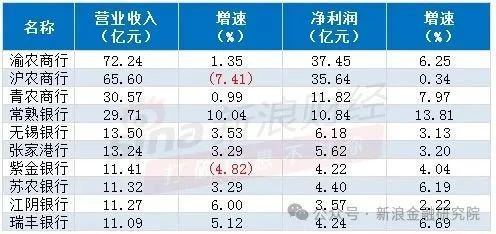
Core Viewpoint - The A-share listed rural commercial banks demonstrated strong resilience in Q1 2025, with all 10 banks achieving positive net profit growth, highlighting their robust financial performance despite market pressures [1][5][6]. Financial Performance - All 10 A-share listed rural commercial banks reported positive net profit growth in Q1 2025, with Changshu Bank leading at a 13.81% year-on-year increase [1][7]. - Eight banks experienced positive revenue growth, while two banks, Shanghai Rural Commercial Bank and Zijin Bank, reported declines in revenue [1][5][6]. - Revenue figures for major banks include: - Chongqing Rural Commercial Bank: 72.24 billion yuan, up 1.35% - Shanghai Rural Commercial Bank: 65.60 billion yuan, down 7.41% - Qingnong Bank: 30.57 billion yuan, up 0.99% - Changshu Bank: 29.71 billion yuan, up 10.04% [3][5][6]. Asset Quality - As of the end of March, seven banks had non-performing loan (NPL) ratios below 1%, with Changshu Bank, Wuxi Bank, and Jiangyin Bank all below 0.9% [1][15]. - Qingnong Bank had the highest NPL ratio at 1.77%, despite a slight decrease from the previous year [1][15]. Asset Scale - Chongqing Rural Commercial Bank and Shanghai Rural Commercial Bank both exceeded 1.5 trillion yuan in total assets, with Chongqing leading at 1.61 trillion yuan, a 6.3% increase [9][11]. - Qingnong Bank ranked third in total assets at 511.58 billion yuan, while Changshu Bank followed closely with 389.01 billion yuan [11][12]. Interest Margin - The net interest margin for several banks has narrowed, with Zijin Bank reporting the lowest at 1.23%, below the industry average of 1.52% [4][7].