Cloud Computing

Search documents
Microsoft tops Q1 expectations as cloud shines but stock slides
Yahoo Finance· 2025-10-28 15:19
Core Insights - Microsoft reported strong first quarter earnings, exceeding analysts' expectations with commercial cloud revenue of $49.1 billion, a 26% year-over-year increase [1][3] - The company's capital expenditures rose significantly by 74% year-over-year to $34.9 billion, with half attributed to GPUs and CPUs for Azure [2] - Microsoft experienced a stock decline of over 2% following the earnings report, despite reporting earnings per share (EPS) of $3.72 on revenue of $77.7 billion, surpassing analyst expectations [3][4] Financial Performance - The earnings per share (EPS) for the quarter was $3.72, compared to an anticipated EPS of $3.68, with revenue reported at $77.7 billion against an expected $75.5 billion [3] - In the same quarter last year, Microsoft reported an EPS of $3.30 and revenue of $65.6 billion [4] - Intelligent Cloud revenue, which includes Azure sales, reached $30.9 billion, exceeding Wall Street's expectation of $30.2 billion [4] Strategic Developments - Microsoft and OpenAI announced a revamped deal allowing OpenAI to restructure into a for-profit public benefit corporation, with Microsoft holding a 27% stake valued at approximately $135 billion [5] - Microsoft has invested billions in OpenAI, which has enhanced its software capabilities through Microsoft's Azure platform, contributing to revenue growth [6] - The new agreement allows OpenAI to utilize other cloud providers while committing to spend $250 billion on Azure usage [8] Product and Service Expansion - Microsoft is expanding its AI offerings, including the introduction of Copilot for PCs and updates to Windows 11 that enable voice interaction with the Copilot AI chatbot [8] - Copilot is also being integrated into Xbox gaming applications, indicating a broader strategy to enhance consumer engagement through AI [8]

Microsoft to report Q1 earnings following new OpenAI deal
Yahoo Finance· 2025-10-28 15:19
Microsoft (MSFT) is scheduled to report its first quarter earnings after the bell on Wednesday, offering Wall Street its latest look at the company's AI and cloud growth. The results follow news that Microsoft and OpenAI (OPAI.PVT) announced the terms of their revamped deal that allows the ChatGPT developer to move forward with plans to transform the corporate structure of its for-profit arm into a public benefit corporation controlled by its nonprofit side. Under the new agreement Microsoft will hold 27 ...
Is AMD Stock a Buy at New Record Highs?
Yahoo Finance· 2025-10-28 15:10
Core Insights - AMD stock has reached all-time highs recently, with a significant increase of 64% in just one month, indicating strong market performance and investor interest [1][3] - The company has a market capitalization of $410 billion and is recognized for its production of GPUs and CPUs, which are essential in computing [2] - AMD's stock has outperformed the Nasdaq Composite index, which has only gained 23% year-to-date, while AMD has surged by 117% [3] Financial Performance - AMD reported second-quarter adjusted earnings per share of $0.48, slightly missing analysts' expectations, but revenue of $7.69 billion exceeded forecasts and represented a 32% year-over-year increase [7] Market Position - AMD is actively increasing its market share in the desktop computer processing sector, currently holding 32.2% of the market, which has grown by over 9% year-over-year, while Intel maintains a 67% share [4] Strategic Partnerships - A significant factor in AMD's recent stock performance is its agreement with OpenAI to supply up to 6 gigawatts of data center capacity using AMD Instinct GPUs, which also allows OpenAI to acquire a 10% stake in AMD [5][6]

Qualcomm's stock pop is warranted, says Constellation Research's Ray Wang
Youtube· 2025-10-28 13:55
Core Insights - The current focus in the tech sector revolves around AI revenue streams, digital advertising growth, and energy consumption efficiency [2][3][10] AI Revenue Streams - There is ongoing debate about whether the tech giants are in an AI bubble or if there is sustainable growth, with indications that AI revenue streams are continuing to develop [2] - Six out of the seven major tech companies are investing in Nvidia's technology, which is driving AI revenue growth [2] Digital Advertising - The growth of digital advertising remains a significant area of interest, with positive indicators suggesting continued expansion in this sector [2][10] - Meta is leveraging AI to enhance digital ad efficiency and revenue operations, positioning itself as a leader in AI integration among the major tech companies [10] Energy Consumption and Efficiency - Energy consumption and efficiency are critical trends, with companies like Qualcomm focusing on reducing energy use while enhancing chip performance [3][5] - There is a competitive rush among vendors to find alternatives to Nvidia's GPUs, emphasizing the importance of energy efficiency in chip design [5] Cloud Market Competition - Major players like Microsoft, Amazon, and Google are in a race for cloud market share, with AI capabilities being a key factor in their competitive strategies [6][8] - The intertwining of AI and cloud consumption is expected to drive significant growth in both areas, with Oracle and other companies also contributing to this trend [8][9]



Commvault(CVLT) - 2026 Q2 - Earnings Call Transcript
2025-10-28 13:32
Financial Data and Key Metrics Changes - Commvault achieved a total revenue growth of 18% to $276 million, with subscription ARR increasing by 30% to $894 million [4][15] - Total ARR grew by 22% to exceed $1 billion, reaching this milestone two quarters earlier than the original target [4][14] - SaaS ARR rose 56% to $336 million, also surpassing the initial target two quarters ahead of schedule [15][20] Business Line Data and Key Metrics Changes - Subscription ARR now constitutes 86% of total ARR, up from 81% a year ago, indicating a strong shift towards subscription-based revenue [15] - Identity and data security-focused offerings contributed nearly 40% of net new ARR, showcasing strong momentum in this segment [7][16] - Active Directory usage tripled year over year, reflecting increased adoption of data and identity recovery solutions [16] Market Data and Key Metrics Changes - The number of SaaS customers grew to nearly 9,000, representing a 40% year-over-year increase [9] - Commvault moved and protects approximately eight exabytes of customer data in the cloud, with a CAGR of over 40% over the past five years [8] - Net dollar retention remained healthy at 125%, indicating strong customer loyalty and upsell opportunities [10] Company Strategy and Development Direction - Commvault's growth is driven by strong demand for its Cloud Cyber Resilience platform, the ongoing shift to the cloud, and a commitment to innovation [5][10] - The company is focusing on integrating identity security with data protection to enhance cyber resilience [38] - Recent acquisition of Satori Cyber aims to bolster capabilities in monitoring and protecting large language models and structured data [11] Management's Comments on Operating Environment and Future Outlook - Management expressed confidence in continued market demand, driven by the need for enhanced cyber resilience amid rising cyber threats [36][23] - The company anticipates a total ARR growth of 18% to 19% for fiscal 2026, with subscription ARR expected to increase by 24% to 25% [21][22] - Management highlighted the importance of innovation and customer-centric strategies to maintain competitive advantage in a rapidly evolving market [47] Other Important Information - Commvault's fiscal Q2 gross margins were reported at 80.5%, reflecting the impact of the SaaS business mix [18] - The company raised $900 million in convertible senior notes to optimize its balance sheet and enhance capital allocation flexibility [19] - Free cash flow grew 37% year over year to $74 million, supported by strong cash collections and deferred revenue from SaaS contracts [19] Q&A Session Summary Question: Can you elaborate on the shift in term duration? - Management noted that customers are opting for shorter contract durations to maintain flexibility as they transition to the cloud, which has impacted average deal size [26] Question: How does Commvault view the competitive landscape? - Management believes that while the market is competitive, Commvault is gaining share due to its innovative solutions and strong growth in both SaaS and software segments [31][33] Question: Is the backup modernization cycle winding down? - Management disagreed, stating that the frequency and scale of cyber attacks continue to drive demand for modernization and resilience solutions [36] Question: What are the drivers of the term subscription business? - On-premise data growth remains a significant driver, alongside the increasing integration of identity and data security offerings [52] Question: Are you seeing increased cross-sell between term and SaaS customers? - Management confirmed that the percentage of SaaS customers also using term products is gradually increasing, reflecting a positive trend in cross-selling [55]

Commvault(CVLT) - 2026 Q2 - Earnings Call Transcript
2025-10-28 13:30
Financial Data and Key Metrics Changes - Commvault achieved a record $47 million in net new ARR, with subscription ARR rising 30% to $894 million and total revenue growing 18% to $276 million [3][12] - Total ARR grew 22%, reaching $1 billion two quarters earlier than the original target [3][12] - SaaS ARR grew 56% to $336 million, also exceeding the original target two quarters ahead of schedule [12][13] - Fiscal Q2 gross margins were 80.5%, reflecting the shift towards SaaS and the integration costs from Satori [17][66] Business Line Data and Key Metrics Changes - Subscription ARR now constitutes 86% of total ARR, up from 81% a year ago [13] - Strong double-digit growth was observed in identity and data security offerings, which represented nearly 40% of net new ARR [5][15] - Active Directory usage tripled year over year, indicating strong demand for identity protection services [15][46] Market Data and Key Metrics Changes - Commvault protects approximately eight exabytes of customer data in the cloud, with a CAGR of over 40% over the past five years [7] - The number of SaaS customers grew to nearly 9,000, representing a 40% increase year over year [8] - Net dollar retention remained healthy at 125%, indicating strong adoption of SaaS offerings from existing customers [9][15] Company Strategy and Development Direction - The company focuses on three key growth drivers: demand for the Commvault Cloud Cyber Resilience platform, the shift to the cloud, and ongoing innovation [4][10] - Commvault aims to address evolving resilience requirements as enterprises increasingly adopt AI technologies [10] - The acquisition of Satori Cyber is expected to enhance the company's capabilities in monitoring and protecting large language models [10] Management's Comments on Operating Environment and Future Outlook - Management expressed confidence in continued strong market demand, driven by innovation and growth-focused investments [21] - The competitive landscape remains challenging, but Commvault is positioned to take market share through its innovative platform [28][39] - The company anticipates a total revenue range of $1.161 to $1.165 billion for fiscal year 2026, reflecting a 17% increase at the midpoint [20] Other Important Information - Commvault's capital allocation strategy includes share buybacks, M&A, and organic investments [72] - The company repurchased $131 million of stock during the quarter, with a total of $146 million year to date [18][72] Q&A Session Summary Question: Can you elaborate on the shift in term duration? - Management noted that customers are opting for shorter contract durations to maintain flexibility as they transition to the cloud, which has impacted average deal size [24][62] Question: How does Commvault view the competitive landscape? - Management indicated that while the landscape is competitive, Commvault continues to take market share, particularly in the SaaS segment, which is growing at a faster rate than the overall market [28][30] Question: Are there signs of a slowdown in backup modernization? - Management disagreed, stating that the demand for cyber resilience remains strong due to ongoing cyber threats and the need for innovative solutions [31] Question: What are the drivers of the term subscription business? - Management highlighted that on-premise data growth continues to be a significant driver, alongside the increasing importance of identity and data security [43][46] Question: Is there increased cross-sell between term and SaaS customers? - Management confirmed that the percentage of SaaS customers also using term services is gradually increasing, reflecting a positive trend in cross-selling [47][48]
Celestica (NYSE:CLS) 2025 Earnings Call Presentation
2025-10-28 12:00
Financial Performance & Outlook - Celestica's 2025E revenue is projected to be $12.2 billion, with a 7.4% non-GAAP adjusted operating margin[21] - The company anticipates a 31% revenue growth in 2026, reaching $16.0 billion, and a non-GAAP operating margin of 7.8%, a 40 bps increase[150] - Non-GAAP adjusted EPS is expected to grow by 39% to $8.20 in 2026[150] - Celestica forecasts non-GAAP free cash flow of $500 million in 2026, an 18% increase from $425 million in 2025E[150] Segment Performance - Connectivity & Cloud Solutions (CCS) is expected to generate $9.0 billion in revenue in 2025E, a 39% year-over-year increase, with a segment margin of 8.2%, up 80 bps year-over-year[44] - Advanced Technology Solutions (ATS) is projected to reach $3.2 billion in revenue in 2025E, a 1% year-over-year increase, with a segment margin of 5.3%, up 70 bps year-over-year[117] Market & Technology - Data center IT capex is expected to surpass $1 trillion by 2028, driven by AI and cloud investments[63] - The High Bandwidth Ethernet Switch TAM is projected to reach approximately $50 billion by 2029, with a 30% CAGR[78, 79] Strategic Focus - Celestica is focused on accelerating market advancements through technology leadership and best-in-class operational execution[39]

Low-code Development Platform Market to Reach USD 67.12 Billion by 2030 with Key Trends in Cloud and AI Adoption
Medium· 2025-10-28 11:47
Market Overview - The Low-code Development Platform Market is projected to grow from USD 26.30 billion in 2025 to USD 67.12 billion by 2030, with a CAGR of 20.61% during the forecast period [1] - Growth is driven by the demand for rapid application development, modernization of legacy systems, and increased adoption across various industries [1] Key Trends - **Cloud-First Deployment Models**: The shift towards cloud-first deployment models is enhancing flexibility and scalability, with cloud platforms becoming a significant part of low-code adoption due to reduced infrastructure costs and support for remote work [3] - **Integration of Artificial Intelligence**: AI integration in low-code platforms is streamlining development processes, enabling automation of repetitive tasks and empowering citizen developers, thus accelerating delivery timelines [4] - **Regulatory Compliance**: Compliance and regulatory demands are influencing low-code adoption, particularly in industries like BFSI and healthcare, where strong audit trails and adherence to data regulations are required [5][6] - **Modernization of Legacy Systems**: Enterprises are replacing outdated systems with low-code solutions to reduce maintenance costs and improve operational agility, highlighting the role of low-code platforms in maintaining competitive advantage [7] Market Segmentation - The market is segmented by component (platform and services), application type (web-based, mobile-based, desktop/server-based, API-centric & micro-services), deployment mode (cloud and on-premise), organization size (SMEs and large enterprises), and industry verticals including BFSI, healthcare, and IT [10] Key Players - Major players in the market include Salesforce.com Inc., Microsoft Corporation, Appian Corporation, Oracle Corporation, and OutSystems Inc., each offering unique low-code solutions tailored to various business needs [10][13] Conclusion - The Low-code Development Platform industry is experiencing robust growth as organizations seek faster and cost-effective software development options, with trends such as cloud-first models and AI-driven tools shaping the market [11][12]


Taiwan's Foxconn To Invest Up To $1.4 Billion In AI Data Center Equipment
Forbes· 2025-10-28 10:20
Core Insights - Foxconn plans to invest up to NT$42 billion ($1.4 billion) in AI data center equipment from December 2025 to December 2026 to enhance its cloud computing services and develop smart platforms [1][2] Group 1: Investment and Expansion - The investment will be funded through Foxconn's own resources and aims to expand its cloud compute service platform [2] - This announcement follows Foxconn's earlier plan to build a 100-megawatt AI data center in collaboration with Nvidia in Taiwan [3] Group 2: Revenue Diversification - Foxconn has successfully diversified its revenue streams, with AI server production surpassing smart consumer electronics for the first time in Q2 [4] - The AI server segment contributed 41% to Foxconn's NT$1.8 trillion revenue in the three months ended June, while smart consumer electronics accounted for 35% [4] - The company claims to hold over 40% of the global AI server market [4] Group 3: Strategic Partnerships - In August, Foxconn sold an EV factory in Ohio to SoftBank to focus on AI server manufacturing, while continuing operations at the plant [5] - The Ohio facility will produce equipment for the $500 billion AI data center venture supported by SoftBank, OpenAI, Oracle, and Abu Dhabi's MGX [5]


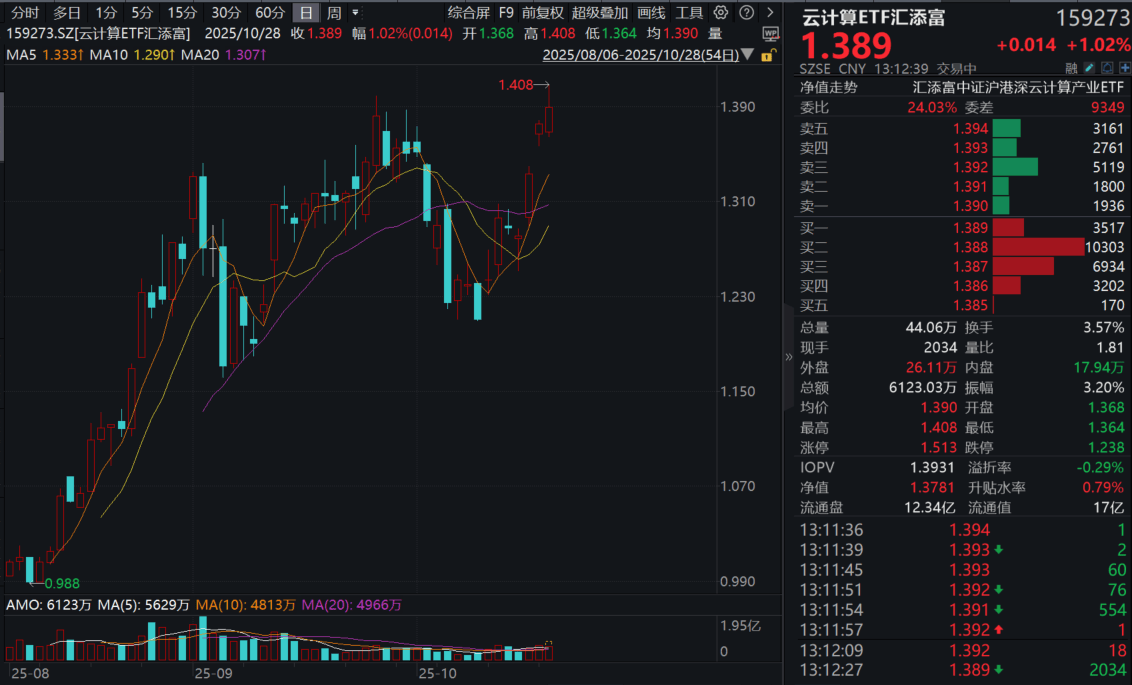
高通推出人工智能芯片,算力热点事件频出!云计算ETF汇添富(159273)盘中涨超1%!机构:光模块需求可见度再提升!
Sou Hu Cai Jing· 2025-10-28 06:02
Group 1 - The Shanghai Composite Index successfully broke through the 4000-point mark, with the computing power sector continuing its strong performance [1] - The Huatai-PineBridge Cloud Computing ETF (159273) rose over 1%, with a trading volume exceeding 70 million yuan, and its latest scale reached 1.7 billion yuan as of October 27, leading its peers [1] - Qualcomm announced the launch of two AI chips for data centers, AI200 and AI250, expected to be commercially available in 2026 and 2027, respectively, causing its stock price to surge over 20% [1] Group 2 - Kingsoft Office reported a third-quarter revenue of 1.521 billion yuan, a year-on-year increase of 25.33%, and a net profit of 431 million yuan, up 35.42% [2] - The three main business segments of Kingsoft Office all experienced growth, with WPS 365 revenue increasing by 71.61% [2] - As of 13:38, the component stocks of the Huatai-PineBridge Cloud Computing ETF showed mixed performance, with Kingsoft Office rising over 6% due to positive earnings [2] Group 3 - The demand for optical modules is expected to increase, with projections for 2025-2027 indicating a demand of 50 million, 75 million, and 100 million units, respectively [4] - The demand for 1.6T optical modules has been revised upwards, with total industry demand expected to rise from 1 million to 2 million units due to the rapid growth in AI training and inference network bandwidth [4] Group 4 - The domestic AI industry is rapidly developing, with cloud service providers like Alibaba Cloud gaining competitive advantages over traditional internet cycles [6] - The focus is on the domestic chip industry, which is expected to benefit significantly from supply chain security considerations, with recommendations to pay attention to the entire domestic chip supply chain [6] - The Huatai-PineBridge Cloud Computing ETF (159273) covers a wide range of sectors, including hardware, cloud computing services, IT services, and application software, with a hardware-software ratio of 6:4 [6]