
公募基金销售新规

Search documents
公募销售新规对不同公募产品的影响——《公开募集证券投资基金销售费用管理规定》点评
申万宏源金工· 2026-01-07 08:01
Core Viewpoint - The new regulations for public fund sales, effective from January 1, 2026, aim to reduce investment costs for investors and standardize the sales market for public funds, thereby protecting investors' rights [1] Group 1: Impact on Different Public Fund Products - The new regulations categorize sales fees into four types based on product type, holder type, and sales channel, leading to a significant reduction in subscription fees for various fund types [2] - Subscription fee rates have been notably decreased, with the maximum rate for actively managed equity funds set at 0.8%, mixed funds at 0.5%, and bond/index funds at 0.3% [2][7] - Redemption fees are standardized across all shares, with specific exemptions for personal investors holding bond funds for over 7 days, which may increase costs for short-term strategies [3] - Sales service fees are capped at 0.4% for equity and mixed funds, 0.2% for bond and index funds, and 0.15% for money market funds, with no fees for funds held over one year [4][11] Group 2: Detailed Changes in Sales Fees - Subscription fees have been significantly reduced from previous regulations, with maximum rates now clearly defined for different fund types [7][8] - Redemption fee structures have been simplified to encourage long-term holding, with all fees now counted towards fund assets [9][10] - Sales service fees are now clearly defined and lower than previous maximums, promoting long-term investment [11][12] - Customer maintenance fees are differentiated based on investor type, with lower rates for institutional investors in non-equity funds [13][14] Group 3: Impact on Bond Funds - The new regulations provide more flexibility for redemption fees, particularly benefiting personal investors and potentially challenging institutional pure bond funds [15] - The majority of bond fund holders are institutions, with 82.97% of the market share, indicating a significant impact on institutional strategies [16] - The focus of institutional investors may shift towards bond ETFs and money market funds for liquidity management, while seeking stable returns from long-term bond funds [22][24]


年内新增超5500亿元 债券ETF规模创历史新高
Xin Lang Cai Jing· 2025-12-22 20:23
Core Insights - The bond ETF market has experienced significant growth in 2023, with a total scale of 731.29 billion yuan as of December 18, marking an increase of 557.26 billion yuan from the beginning of the year, representing a growth rate of 320.20% [1][2] - The net inflow of funds into bond ETFs reached 455.91 billion yuan, a substantial increase of 455.33% compared to the previous year's total net inflow of 82.10 billion yuan [1][3] Group 1: Market Growth - The total market size of ETFs has grown from 354.06 billion yuan at the beginning of 2018 to 5.79 trillion yuan, with an increase of 2.06 trillion yuan in 2023 alone [2] - Bond ETFs have consistently surpassed key thresholds throughout the year, crossing the 1 trillion yuan mark in May, 2 trillion in February, 3 trillion in June, and reaching 7 trillion in October [2][3] Group 2: Contribution of Sci-Tech Bond ETFs - Sci-Tech bond ETFs have contributed nearly half of the market growth for bond ETFs, with a total scale of 273.75 billion yuan as of December 18, raising 69.77 billion yuan from two rounds of issuance [4] - The rapid growth of Sci-Tech bond ETFs is attributed to their combination of technology attributes, high credit ratings, and standardized management, appealing to investors seeking alignment with national strategies [4] Group 3: Investor Behavior and Future Outlook - Institutional investors dominate the bond ETF market, with over 90% holdings in 41 out of 53 bond ETF products, indicating strong institutional interest [5] - New regulations proposed by the China Securities Regulatory Commission (CSRC) may lead to a significant shift of funds from traditional bond funds to bond ETFs, with potential migration estimated at 154.01 billion yuan from wealth management products and 118.15 billion yuan from bank proprietary trading [6]
公募基金销售将迎新规 考核体系面临深度重构
Zheng Quan Shi Bao· 2025-12-14 18:34
Core Viewpoint - The recent draft of the "Regulations on the Sales Behavior of Publicly Raised Securities Investment Funds" aims to standardize fund sales practices, addressing issues such as the excessive focus on sales scale and unregulated live streaming activities in the industry [1] Group 1: Sales Behavior Regulations - The draft emphasizes that performance evaluation metrics for fund sales should increase the weight of equity fund retention and investor profit and loss situations, moving away from prioritizing sales revenue and scale [1][7] - Fund managers and sales institutions are required to objectively and comprehensively present fund performance, ensuring that past performance does not imply future returns, and must not promise future profits in any form [2][3] Group 2: Marketing and Promotion Guidelines - Fund managers and sales institutions must avoid misleading promotional language and cannot advertise fund size or growth, focusing instead on the investment team's capabilities and the fund's utility [3] - The new regulations prohibit the use of terms that may downplay risks, such as "positive returns" or "positive return probability," ensuring that risk indicators are clearly communicated alongside performance data [2][3] Group 3: Live Streaming Regulations - The draft mandates that fund managers and sales institutions must implement appropriate risk control measures when conducting live streaming, ensuring compliance and risk management capabilities are aligned with the nature of the live business [4][5] - Only qualified personnel can present fund-related content during live streams, and all promotional materials must be retained for a minimum of 20 years [5][6] Group 4: Performance Evaluation Mechanism - The revised performance evaluation mechanism for fund sales must align with operational performance, financial status, and compliance, discouraging short-term sales behaviors that could lead to risks [7][8] - The focus on equity fund retention and investor profit and loss in the evaluation criteria aims to shift the emphasis from merely selling products to ensuring customer profitability, thereby enhancing advisory service capabilities [8]
债市小幅回暖,银行一项指标成后续机构关注焦点
Xin Lang Cai Jing· 2025-12-10 13:43
Core Viewpoint - The bond market has shown signs of recovery after a period of decline, with most bond yields experiencing slight decreases, indicating a potential stabilization in market sentiment [1][3][9]. Group 1: Market Performance - As of December 10, most bond varieties have shown an upward trend after several days of decline, with yields on government bonds from one year to ultra-long term decreasing by less than 1 basis point [1][9]. - The 30-year government bond yield had previously increased by 4 basis points on December 4, and the price of the 30-year government bond futures hit a yearly low of 111.69 yuan on December 8 [1][9]. - The 10-year government bond yield fluctuated around 1.84% after rising from 1.82% on December 1 to a peak of 1.86% on December 4 [1][9]. Group 2: Institutional Behavior - Market participants noted that the fluctuations in the 30-year government bond were primarily driven by differing behaviors among institutions and trading sentiment rather than fundamental changes [2][10]. - Traditional buyers such as banks and insurance companies have shown reduced buying power recently, contributing to the market's cooling [2][10]. - The anticipated implementation of new regulations for public funds has created uncertainty, affecting institutional behavior and leading to a decrease in demand for short-term bonds [2][10]. Group 3: Regulatory Impact - The new public fund sales regulations are expected to increase short-term redemption fees, which may negatively impact the liquidity management of institutions that typically use short-term bond funds [2][10]. - Concerns about the timing of the new regulations and their impact on market dynamics remain a significant focus for investors [11]. Group 4: ΔEVE Indicator - The ΔEVE indicator, which measures the economic value fluctuations of banks due to interest rate changes, is approaching regulatory limits for major banks, prompting them to adjust their bond holdings [12][13]. - As of the end of 2024, major state-owned banks have ΔEVE ratios exceeding 14%, nearing the 15% regulatory threshold [13]. - The ongoing issuance of long-term local government bonds is expected to maintain pressure on banks' ΔEVE ratios, influencing their investment strategies [12][13].
债市连续调整 原因是什么?
Zhong Guo Zheng Quan Bao· 2025-12-04 12:10
Group 1 - The bond market experienced a significant decline on December 4, with all government bond futures showing negative performance, particularly the 30-year bond futures hitting a new low since November 23, 2024 [1][3] - As of the close on December 4, the main contracts for various maturities of government bonds fell, with the 30-year bond futures down by 1.04% to 112.45, and the 10-year bond futures down by 0.35% to 107.67 [3][4] - The yields on active government bonds also increased, with the 30-year bond yield rising by 1.9 basis points to 2.26%, and the 10-year bond yield up by 1.3 basis points to 1.85% [4] Group 2 - The overall trend in the bond market has been weak since December, with cumulative declines in the main contracts for various maturities, including a 1.78% drop for the 30-year bonds [5] - Multiple factors are influencing the bond market's performance, including tightening liquidity and changing expectations regarding monetary policy, as evidenced by the People's Bank of China's recent operations [7][8] - Market sentiment remains cautious, with expectations of limited positive reactions to favorable fundamentals due to the uncertainty surrounding new public fund sales regulations [10]

债市连续调整,原因是什么?
Zhong Guo Zheng Quan Bao - Zhong Zheng Wang· 2025-12-04 11:57
Core Viewpoint - The bond market experienced a significant decline on December 4, with all government bond futures showing negative performance, particularly the 30-year bond futures reaching a new low since November 23, 2024 [1][2]. Group 1: Market Performance - As of the close on December 4, the main contracts for government bond futures across all maturities fell, with the 30-year bond futures down by 1.04% to 112.45 yuan, hitting a low of 112.24 yuan during the day [2][3]. - The 10-year bond futures decreased by 0.35% to 107.67 yuan, while the 5-year and 2-year bond futures fell by 0.24% and 0.05%, respectively [2][3]. - In the cash market, the yield on the 30-year bond rose by 1.9 basis points to 2.26%, and the 10-year bond yield increased by 1.3 basis points to 1.85% [4]. Group 2: Influencing Factors - The overall weakness in the bond market since December is attributed to multiple factors, including domestic trading conditions, liquidity tightening, and changes in monetary policy expectations [5]. - The People's Bank of China conducted a 180.8 billion yuan reverse repo operation, leading to a net withdrawal of 175.6 billion yuan on December 4, which influenced market dynamics [5]. - Analysts noted that the decline in bond prices is partly due to market expectations regarding the scale of government bond transactions and the central bank's operations [5]. Group 3: Market Sentiment - Market sentiment remains cautious, with expectations for year-end allocation trading dependent on the implementation of new public fund sales regulations [7]. - If public funds cannot participate in driving year-end allocations, the sentiment in the bond market may remain weak, with resistance to yield declines [7]. - Analysts suggest that the liquidity of ultra-long bonds may stabilize as year-end pressures on banks ease, potentially leading to a recovery in demand for long-duration bonds [7].
债市继续承压 万科事件如何扰动长债利率?
Di Yi Cai Jing· 2025-11-27 12:17
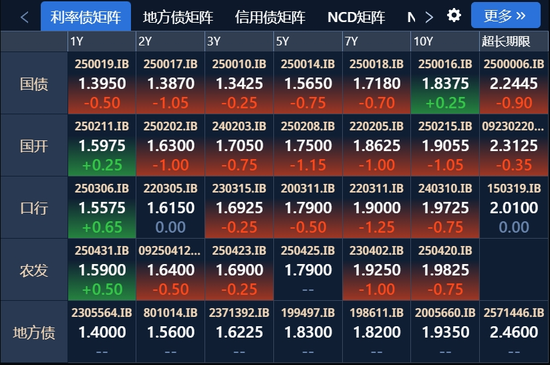
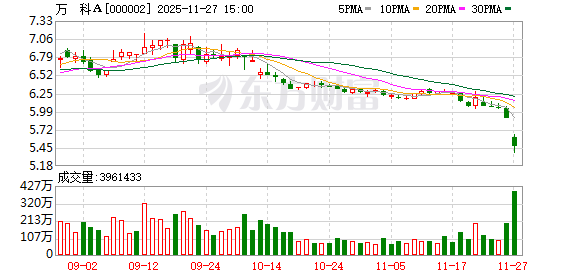
Group 1 - The domestic bond market is under pressure, with long-term bond yields rising, particularly the 10-year government bond yield approaching 1.84% [2][3] - Concerns about the redemption of "fixed income +" funds and the implementation of new public fund sales regulations are contributing to market anxiety [2][4] - The recent debt extension issues faced by Vanke have negatively impacted market sentiment, primarily affecting credit bonds but also influencing interest rate bonds due to redemption pressures [2][5] Group 2 - Analysts suggest that the bond market's incremental positive factors are limited, and the direction of monetary policy remains unclear, leading to weak overall market sentiment [4][6] - The People's Bank of China (PBOC) has been conducting net withdrawals in the open market, but overall liquidity remains ample, with a recent net injection of 564 billion yuan [4][5] - Expectations for interest rate cuts are diminishing, with analysts indicating that if the Federal Reserve cuts rates in December, it could provide more room for domestic rate cuts [6][7] Group 3 - The adjustment of banks' deposit structures, particularly the removal of 5-year fixed deposit products, may signal a shortening of the duration of bank liabilities, impacting their bond holding behavior [7][8] - The PBOC's emphasis on maintaining reasonable interest rate relationships is seen as a key reference for the trend of long-term bond yields [8]

节后股债开门红 债市“钝刀割肉”配置难度还在增加
Di Yi Cai Jing· 2025-10-09 13:53
Core Viewpoint - The bond market is experiencing a tug-of-war between bullish and bearish forces, with increased difficulty in investment compared to last year, influenced by various factors including policy changes and market dynamics [1][4][7]. Group 1: Market Performance - On October 9, the first trading day after the National Day holiday, both the stock and bond markets saw gains, with government bond futures rising across the board [2][3]. - Major interest rate bonds in the interbank market saw a general decline in yields, with the 10-year government bond yield dropping by 0.6 basis points to 1.777% [2][3]. - The bond market has shown a wide fluctuation in yields this year, with the 10-year bond yield fluctuating nearly 15 basis points since its issuance [3][8]. Group 2: Investment Challenges - The investment returns from banks have significantly weakened year-on-year, impacting their profitability [1][7]. - The introduction of new public fund sales regulations and the resumption of value-added tax on bond interest income are causing institutions to adjust their strategies [7][9]. - The bond market's "dull knife cutting meat" trend has led to increased pressure on investors, with many institutions facing challenges in navigating the current market environment [8][9]. Group 3: Future Outlook - Analysts express cautious optimism for the bond market, noting that while trading enthusiasm may slightly recover, overall trading space remains limited [1][6]. - The market is closely monitoring the impact of the "15th Five-Year Plan" and the implementation of new public fund sales regulations [1][6]. - There is a consensus that even if the fundamental data remains poor in the fourth quarter, the continued loose monetary policy may not significantly lower bond yields [5][6].