一级买二级

Search documents
六大关键词回顾2025年一级市场:美元基金复苏、港股IPO火热 人工智能与半导体双线并进
Xin Lang Cai Jing· 2026-01-09 05:57
Group 1 - In 2025, the primary market is evolving amidst significant changes, driven by disruptive technologies led by artificial intelligence and reshaped capital flows due to geopolitical factors [1][50] - Global venture capital activity remained stable with 22,500 investment events and a total disclosed investment of approximately $348.1 billion, marking a 44.8% increase compared to 2024 [50] - The IPO and M&A markets rebounded strongly, with 1,372 companies successfully listing and raising approximately $170.6 billion, the best performance since 2022 [2][50] Group 2 - In China, the narrative differs, with government policies aimed at improving the efficiency of fiscal funds and supporting strategic sectors like AI and aerospace [51] - The establishment of a national venture capital fund with a registered scale exceeding 120 billion yuan aims to support seed and early-stage projects [51] - The banking sector's financial asset investment companies (AIC) have made significant progress, with 99 new funds established and a total scale of 198 billion yuan [3][51] Group 3 - The fundraising environment has shifted from quantity expansion to quality improvement, with a slight decrease in the number of private equity and venture capital managers [5][53] - The total scale of private equity funds reached 11.18 trillion yuan, showing a modest increase of 2.3% year-on-year [53] - Notably, the fundraising situation for dollar funds has improved, with several funds successfully closing significant amounts [7][55] Group 4 - Artificial intelligence remains the dominant investment theme in 2025, with 788 AI companies receiving 1,015 investments totaling 65.6 billion yuan, a significant increase from 2024 [18][60] - The robotics sector, particularly embodied intelligence, saw substantial growth, with 530 investments totaling 34.5 billion yuan, reflecting a 116.3% increase in investment events [19][60] - The competition in the foundational model space has stabilized, with a noticeable decline in investment activity as resources concentrate among leading firms [20][60] Group 5 - The trend of early-stage investments continues, with A-round investments being the most frequent, comprising 34.5% of total investment events [25][26] - Seed and angel round investments have seen significant increases, with seed round investments growing by 59.5% in number and 179.4% in amount compared to 2024 [27][25] - Noteworthy large investment events include significant funding rounds for various companies across sectors, indicating a robust interest in early-stage ventures [26][27] Group 6 - The Yangtze River Delta region remains the most active investment area, accounting for nearly 50% of total investment events in China [31][30] - Jiangsu province alone had 1,256 investment events, representing 19.8% of the national total, with significant investments in advanced manufacturing and AI [33][30] - Beijing reported the highest disclosed investment amount at 95.9 billion yuan, highlighting its prominence in the investment landscape [36][30] Group 7 - The M&A market in China is characterized by a trend of private equity firms acquiring foreign brands, with notable transactions involving major global companies [38][39] - Investment institutions are increasingly engaging in mergers and acquisitions of listed companies, marking a shift towards deeper involvement in operational aspects [39][40] - The trend indicates a growing preference for controlling stakes in companies to enhance operational synergies and market positioning [40][39] Group 8 - The Hong Kong stock market has regained its position as a leading venue for IPOs, with 247 Chinese companies listed in 2025, a 26.7% increase year-on-year [44][43] - The total fundraising amount for Chinese companies in Hong Kong reached approximately 326.6 billion yuan, reflecting a significant recovery in the IPO market [44][43] - The A-share market also saw a notable increase in listings and fundraising, with 116 companies raising around 128.7 billion yuan [45][43]

又要诞生一个「上纬新材」?
36氪· 2025-12-23 10:13
Core Viewpoint - The article discusses the acquisition of Shengtong Energy by Qiteng Robotics for over 1.6 billion yuan, highlighting the trend of robotics companies acquiring traditional listed firms to leverage capital markets for growth and innovation [3][4]. Group 1: Transaction Details - Qiteng Robotics and its affiliates plan to invest over 1.6 billion yuan in Shengtong Energy through a combination of share transfer and tender offer, resulting in Qiteng becoming the controlling shareholder [3][4]. - Shengtong Energy reported a revenue of 4.513 billion yuan for the first three quarters of 2025, a year-on-year increase of 21.34%, and a net profit of 44.39 million yuan, up 83.58% [3]. - The acquisition involves two steps: first, a direct purchase of 29.99% of shares at 13.28 yuan per share, totaling approximately 1.124 billion yuan; second, a tender offer for an additional 15% of shares [9][11]. Group 2: Company Profiles - Shengtong Energy is a stable traditional business focused on LNG operations and related investments, while Qiteng Robotics specializes in high-risk scenario robotics, achieving a revenue of 954 million yuan and a net profit of 123 million yuan in 2024 [3][4]. - Qiteng Robotics, founded in 2010, has evolved into a leader in the special robotics sector, with products used in industries such as oil and gas, and has established partnerships with major companies like Sinopec and PetroChina [13][14]. Group 3: Market Implications - The acquisition reflects a growing trend where robotics companies seek to gain control of traditional industries through listed platforms, avoiding lengthy IPO processes and facilitating rapid market entry [11][16]. - The successful completion of this transaction could make Qiteng's founder, Zhu Dong, the youngest actual controller of a listed company in Chongqing [4].

又要诞生一个“上纬新材”?
Sou Hu Cai Jing· 2025-12-15 07:37
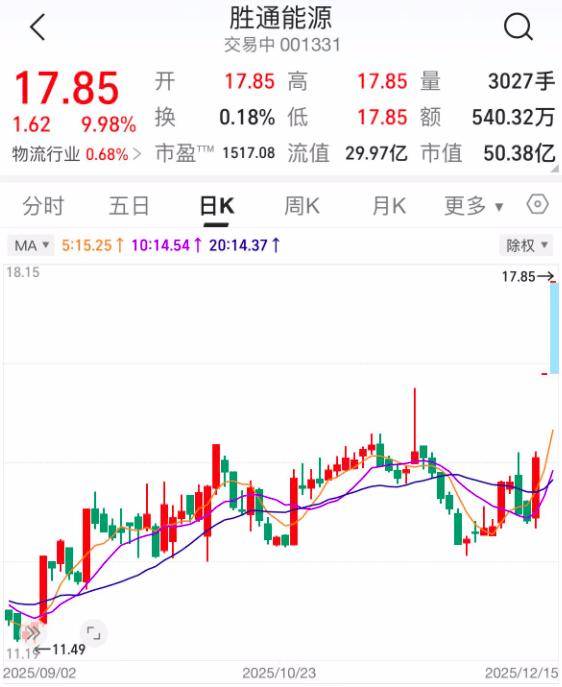
Core Viewpoint - The recent acquisition of Shengtong Energy by Qiteng Robotics highlights a growing trend in the capital market where companies in high-tech sectors are acquiring traditional businesses to leverage their platforms for market expansion and technological implementation [1][2]. Group 1: Transaction Details - Qiteng Robotics and its affiliates plan to invest over 1.6 billion yuan to acquire Shengtong Energy through a combination of share transfer and tender offer [1]. - After the transaction, Qiteng Robotics will become the controlling shareholder of Shengtong Energy, with Zhu Dong as the actual controller [1][4]. - The initial step involves Qiteng Robotics purchasing 29.99% of Shengtong Energy's shares at 13.28 yuan per share, totaling approximately 1.124 billion yuan, which avoids triggering a mandatory tender offer [5][6]. Group 2: Company Profiles - Shengtong Energy is a stable traditional business primarily engaged in LNG operations, achieving a revenue of 4.513 billion yuan in the first three quarters of 2025, a year-on-year increase of 21.34%, and a net profit of 44.39 million yuan, up 83.58% [1]. - Qiteng Robotics specializes in high-risk scenario robotics, reporting a revenue of 954 million yuan and a net profit of 123 million yuan in 2024, with a net profit margin of 12.9% [1][2]. Group 3: Market Reaction and Future Prospects - Following the announcement, Shengtong Energy's stock price hit the daily limit, closing at 17.85 yuan per share, with a total market capitalization of 5.038 billion yuan, reflecting a doubling of its stock price within the year [2]. - The acquisition is expected to create synergies between Qiteng Robotics and Shengtong Energy, particularly in the LNG sector and industrial customer base, facilitating technology deployment and market expansion [2][6].

又要诞生一个“上纬新材”?
投中网· 2025-12-15 07:06
Group 1 - The core viewpoint of the article is that the acquisition of a listed company by a robotics firm, Qiteng Robotics, represents a growing trend in the capital market where private companies seek to gain control of public companies to facilitate their growth and market expansion [2][3][4]. - Qiteng Robotics plans to invest over 1.6 billion yuan to acquire a controlling stake in Shengtong Energy, which is primarily engaged in LNG (liquefied natural gas) business [3][4]. - After the acquisition, Qiteng Robotics will become the controlling shareholder of Shengtong Energy, with Zhu Dong as the actual controller, marking a significant milestone as he will be the youngest actual controller of a listed company in Chongqing [4]. Group 2 - Shengtong Energy reported a revenue of 4.513 billion yuan for the first three quarters of 2025, representing a year-on-year growth of 21.34%, and a net profit of 44.39 million yuan, up 83.58% year-on-year [3]. - Qiteng Robotics achieved a revenue of 954 million yuan in 2024, with a net profit of 123 million yuan and a net profit margin of 12.9% [3]. - The acquisition process involves two main steps: first, Qiteng Robotics will purchase 29.99% of Shengtong Energy's shares through a direct transfer, and then it will initiate a tender offer to acquire an additional 15% of shares [9][10]. Group 3 - The synergy between Qiteng Robotics and Shengtong Energy lies in their shared focus on LNG scenarios and industrial customer bases, which could enhance technology implementation and market expansion through the listed company platform [4]. - The acquisition strategy mirrors previous transactions in the market, such as Zhiyuan Robotics' acquisition of a controlling stake in another company, utilizing a similar approach of share transfer followed by a tender offer [10]. - Qiteng Robotics has established itself as a leader in the special robotics sector, with a history dating back to 2010, and has developed a range of products for high-risk environments, including firefighting and inspection robots [12][13]. Group 4 - The company has received significant investments from various institutions, indicating strong market confidence and a solid growth trajectory [13][15]. - Qiteng Robotics is actively pursuing partnerships and collaborations to enhance its production capabilities and market reach, as evidenced by recent agreements to establish joint ventures and production bases [15]. - The article highlights the competitive landscape in the robotics sector, noting that few players participate in bidding for state-owned enterprises due to high standards and technical requirements [13].