世界一流强港建设

Search documents
通江达海再启航
Xin Lang Cai Jing· 2026-01-19 17:08
Core Insights - The article highlights the significant growth and development of the Quzhou port and its water transport services, showcasing impressive increases in cargo throughput and container handling. Group 1: Port Performance - From January to December 2025, Quzhou's total water transport turnover reached 1.9 billion ton-kilometers, marking an 18.1% year-on-year increase, ranking second in the province [1] - The container throughput at Quzhou port reached 25,800 TEUs, a remarkable 107% increase year-on-year, also ranking second in the province [1] - The total cargo throughput at the port amounted to 10.57 million tons, reflecting a 19.4% year-on-year growth, ranking third in the province [1] Group 2: Operational Efficiency - The Quzhou port's operational efficiency has improved significantly, with the container throughput surpassing 20,000 TEUs in 2025, which is four times that of the previous year [2] - The port has transitioned from a simple loading and unloading facility to a comprehensive service provider, enhancing its operational model with a "front port and back warehouse" approach [3] - Companies are experiencing reduced transportation costs, with savings of nearly 20,000 yuan per trip by utilizing water transport instead of rail [3]
宁波诞生首家“百万载重吨级”航运企业
Xin Lang Cai Jing· 2025-12-26 09:18
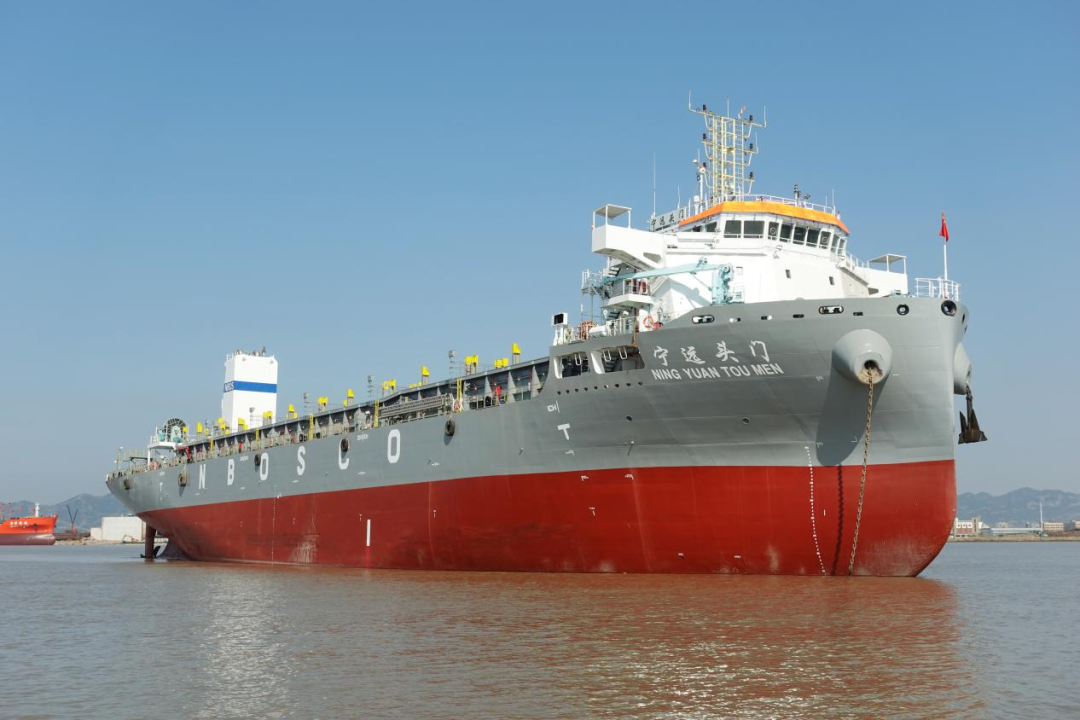
Group 1 - Ningbo Ocean Transport Co., Ltd. has achieved a historic milestone by surpassing 1 million deadweight tons in self-owned shipping capacity, becoming the first shipping company in Ningbo to enter the "million deadweight ton club" [1] - The company has a total fleet size of 113 vessels, with a total capacity exceeding 1.8 million deadweight tons and a container capacity of over 100,000 standard containers, ranking first in Zhejiang province and third among mainland Chinese shipping companies [3] - The fleet's growth supports the expansion of its route network, which now includes 42 operating routes and connects 51 major ports along China's south and north coasts and the Yangtze River, as well as regions such as Japan, South Korea, Southeast Asia, and the Middle East [3] Group 2 - From January to November 2025, Ningbo Ocean's container transport volume, cargo transport volume, and freight turnover all experienced over 14% year-on-year growth, indicating strong development momentum [5] - The rapid development of the company reflects China's efforts to build world-class ports and strengthen the modern shipping service industry, providing solid maritime capacity support for the new development pattern [5]


首破“4000万箱”! 宁波港持续锻造“硬核”力量
Zheng Quan Shi Bao Wang· 2025-12-02 07:28
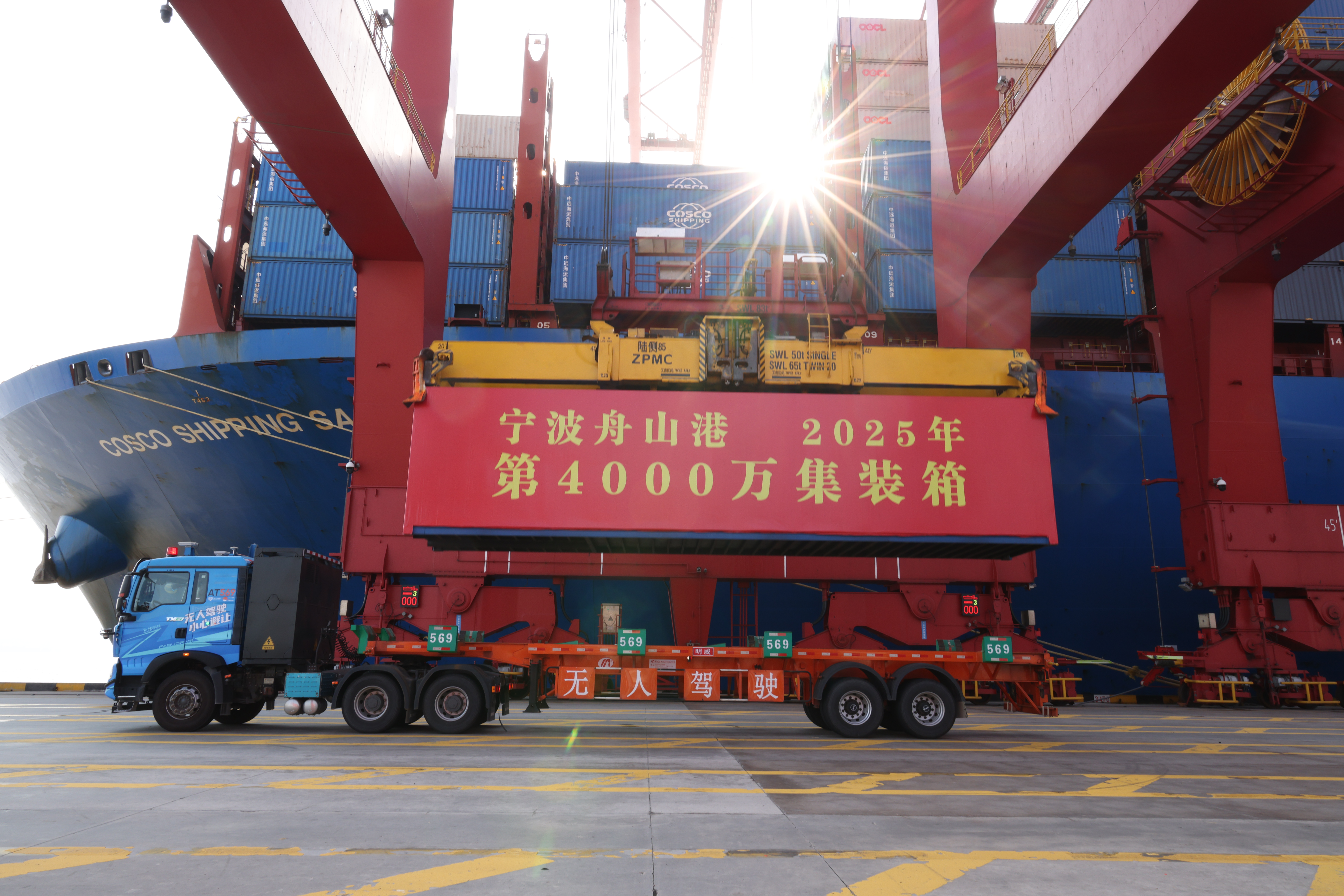
Core Viewpoint - Ningbo Port has achieved a historic milestone by surpassing an annual container throughput of 40 million standard containers, becoming the third port globally to join the "40 million club" after Shanghai and Singapore [1][5]. Group 1: Container Throughput Growth - The growth from 30 million to 40 million standard containers took only four years, compared to six years from 20 million to 30 million and seven years from 10 million to 20 million [5]. - Container throughput is considered a "barometer" of economic vitality, reflecting the port's significant role in the economy [5]. Group 2: Strategic Initiatives - The Zhejiang provincial government has launched the "World-Class Strong Port Construction Project (2023-2027)" to enhance the port's core competitiveness and support capabilities through ten key projects and ten reform initiatives [5]. - Ningbo Port has improved its overall layout by integrating "hub + channel + network" strategies, focusing on major engineering projects and logistics systems to support container volume growth [5]. Group 3: New Shipping Routes - The continuous opening of new shipping routes has been a key driver for the port's container volume increase, with over 300 container routes connecting more than 600 ports in over 200 countries and regions [6]. - The port's connectivity index ranks second globally, with the recent launch of the "China-Europe Arctic Express," which shortens shipping times to major European ports by at least six days [6]. Group 4: Economic Impact - The surge in container volume is attributed to the rapid development of emerging industries in China, particularly in the Yangtze River Delta region, making China the largest exporter of new energy vehicles, lithium batteries, and photovoltaic products [6]. - The transformation of China's foreign trade structure is evident, with a shift from traditional products like clothing and home appliances to new products such as new energy vehicles and lithium batteries [6].

宁波舟山港年吞吐量首破4000万标箱
Ren Min Ri Bao· 2025-12-02 02:09
Core Insights - Ningbo-Zhoushan Port has achieved a historic milestone by surpassing an annual container throughput of 40 million TEUs for the first time, marking a significant support for China's manufacturing exports [1] - The port's growth trajectory demonstrates a remarkable acceleration, with the time taken to increase throughput from 30 million to 40 million TEUs being only 4 years, compared to 6 years for the previous increments [1] - This achievement positions Ningbo-Zhoushan Port as the fastest-growing and largest port in terms of throughput increase among the top five global ports over the past decade [1] Industry Development - The milestone reflects the solid steps taken by Zhejiang province in advancing the construction of a world-class strong port [1] - It also serves as a vivid representation of the resilience of China's foreign trade [1]
从最快“中欧航线”看宁波舟山港开放加速度
Zhong Guo Xin Wen Wang· 2025-10-14 11:19
Core Points - The "China-Europe Arctic Express" is the world's first container shipping route specifically designed for cross-border e-commerce and high-value goods, successfully launched from Ningbo-Zhoushan Port [1][2] - This route significantly shortens shipping time to Europe, with a planned duration of 18 days, reducing carbon emissions by approximately 50% compared to traditional routes [2] Group 1: Route and Efficiency - The "China-Europe Arctic Express" marks a significant milestone in global shipping history, enhancing the connectivity of Ningbo-Zhoushan Port with major international shipping lanes [1][2] - The route's opening is expected to optimize global supply chains and promote economic cooperation along the route, serving as a strategic value addition [2] - The shipping time of the new route is about 20 days shorter than traditional routes, despite a slight delay due to adverse weather conditions during its inaugural journey [2] Group 2: Port Development and Connectivity - Ningbo-Zhoushan Port has expanded its international container shipping routes to over 256, including 24 fast shipping lines, covering more than 600 ports in over 200 countries [4] - The port has implemented a "sea-rail combined transport" model, allowing for direct loading of goods onto ships without the need for storage or reloading, enhancing operational efficiency [4] Group 3: Economic Impact and Service Improvement - The "Zhejiang e-Port" initiative has improved logistics efficiency, reducing transportation costs by an average of 10% and decreasing container transfer times by 2 days [6] - The port's container throughput has surpassed 30 million TEUs this year, setting a new historical record [6] - Ningbo-Zhoushan Port's ranking in the global shipping center index has improved, reflecting ongoing enhancements in the port's operational environment [8] Group 4: Future Plans and Strategic Goals - Zhejiang Province aims to create a port environment characterized by optimal service, minimal costs, and maximum efficiency, focusing on infrastructure, international route development, and logistics network expansion [9]
董家口港区嬗变记
Da Zhong Ri Bao· 2025-09-22 10:13
Core Viewpoint - The completion of the second 400,000-ton ore terminal at Dongjiakou Port marks a significant enhancement in the port's capacity and supports the development of Qingdao Port as a world-class strong port, contributing to the high-quality economic development of the region [1][2][3]. Infrastructure Development - The new 400,000-ton ore terminal is a milestone for Dongjiakou Port, reinforcing its status as a key hub for iron ore unloading in northern China and enhancing Qingdao Port's capabilities [2][3]. - The overall planning for Qingdao Port aims to establish it as a world-class shipping and logistics hub by 2035, with Dongjiakou Port playing a crucial role due to its natural advantages and infrastructure [1][3]. Energy Hub Functionality - Dongjiakou Port has become a vital energy hub in China, particularly for oil and LNG, with significant developments in oil terminal construction and storage capacity [4][5]. - The port's oil terminal has a designed annual throughput capacity of over 60 million tons, and it features the largest oil storage capacity among coastal ports in China, supporting national strategic reserves [5]. Port-Industry Integration - The integration of port and industry is accelerating, with Dongjiakou Port attracting leading enterprises and developing four major industrial clusters, enhancing its economic growth potential [6][7]. - A significant investment project, the Louis Dreyfus Food Technology Industrial Center, is underway, which will strengthen the food supply chain in the region and exemplify the port-industry integration model [6]. Future Development - Dongjiakou Port is positioned to continue enhancing its comprehensive strength and international competitiveness, contributing to China's maritime power strategy and regional economic development [7].