
港口集装箱运输服务

Search documents
港口行业2026年度信用风险展望(2026年2月):吞吐量增速放缓,基建与内需托底行业基本面
Lian He Zi Xin· 2026-02-06 09:26
Investment Rating - The report indicates a stable outlook for the port industry, with a focus on infrastructure and domestic demand supporting the industry fundamentals [7][8]. Core Insights - The growth rate of cargo and container throughput in Chinese ports is slowing down, influenced by GDP and import-export growth deceleration. Coastal ports dominate in terms of throughput, with significant differentiation in growth rates among major ports [8][9]. - Since 2018, investment in inland waterway transportation has consistently exceeded that of coastal ports, leading to structural overcapacity in coastal ports. However, there remains a demand for terminal upgrades, optimization of port layouts, and channel construction, with a clear trend towards larger and more specialized port berths [8][9]. - The overall revenue of sampled port enterprises is steadily increasing, with strong operational cash flow capabilities. Future capital expenditures are expected to remain substantial due to increased financing driven by port-related project investments [8][9]. - The report anticipates that global economic growth will remain low, with uncertainties surrounding trade policies potentially impacting China's foreign trade. However, domestic demand is expected to expand, providing some support for port throughput [8][9]. Industry Overview Macroeconomic Environment - In 2025, China's economy is projected to stabilize, with domestic demand expected to support cargo throughput at ports. The economic policies are characterized by a multi-dimensional collaborative approach, focusing on stabilizing growth and enhancing domestic consumption [9][10]. - The port industry is highly sensitive to macroeconomic cycles, with the performance of cargo and container throughput closely linked to economic conditions and foreign trade developments [10][11]. Industry Policies and Regulatory Environment - The government has introduced various policies to guide the development of smart, green, safe, and efficient ports, aiming to enhance the competitive capabilities of ports through a market-oriented pricing system [11][12]. - Recent policies emphasize the integration of rail-water transport and the construction of a modern comprehensive transportation system, with significant investments expected in port infrastructure [11][12]. Industry Operating Conditions - The throughput growth of Chinese ports has shown signs of slowing down, with a notable differentiation in growth rates among major coastal ports. In 2024, the total cargo throughput reached 1,759.5 million tons, growing by 3.7% [16][20]. - Container throughput growth has also slowed, with a total of 33.2 million TEUs in 2024, reflecting a 7.0% increase [17][20]. Financial Performance - Sampled port enterprises have shown steady revenue growth, with total revenue reaching 643.36 billion yuan in the first nine months of 2025, maintaining a stable operational performance [34][36]. - The cash flow from operating activities has been strong, with a cash income ratio exceeding 100%, indicating that cash flow can meet capital expenditure needs [36][39]. Debt Levels - The total debt of sampled port enterprises has increased, with a total debt of 1,162.86 billion yuan by September 2025, primarily for new terminal construction and upgrades [41][43]. - The short-term debt ratio is moderate, with a significant portion of financing coming from bank loans and bond issuances [41][43]. Debt Repayment Capacity - Most sampled port enterprises face manageable short-term repayment pressures, with strong long-term repayment capabilities. However, some enterprises have heavier debt burdens and historical personnel liabilities that require attention [44][45]. Bond Market Performance - The report notes a decrease in bond issuance rates for port enterprises, with a total of 180 bonds issued in 2025, reflecting a 7.57% increase in issuance scale [48][49].





中国港口行业展望
Zhong Cheng Xin Guo Ji· 2026-02-04 02:11
Investment Rating - The report maintains a stable outlook for the Chinese port industry, reflecting a robust credit status for the next 12 to 18 months [7]. Core Insights - Since 2025, the container throughput has seen significant growth due to multiple waves of export surges, increased demand from emerging markets, and a rise in high-value product exports. Domestic transportation and bulk commodity imports have also contributed to a favorable increase in total cargo throughput, surpassing the growth rate of the previous year [6][41]. - The competitive landscape among major ports remains largely unchanged, with hub ports strengthening their scale advantages and some southern ports experiencing robust growth [7]. - Despite a weak global economic and trade growth outlook, China's enhanced industrial chain competitiveness and diversified trade layout provide resilience for foreign trade. Domestic fiscal and monetary policies are expected to support internal trade and import transportation demand, stabilizing port throughput [24][41]. Industry Fundamentals - Container throughput in China increased by 6.6% year-on-year to 325 million TEU from January to November 2025, with foreign trade containers growing by 9.5% [9]. - Total cargo throughput for the same period rose by 4.41% to 1.675 billion tons, with foreign trade cargo throughput increasing by 4.12% to 516.1 million tons [9]. - The investment in water transport construction remains high, although equity investment has peaked, with ongoing internal integration and overseas investment needs [6][41]. Financial Performance - Port enterprises have maintained a good profit realization capability, with a slight increase in financial leverage but strong debt repayment ability. Future cargo throughput growth is expected to support profitability, while construction efforts are anticipated to slow down [32][41]. - From January to September 2025, the average operating revenue of 14 sample enterprises grew by only 2.44% year-on-year, influenced by changes in revenue recognition and a contraction in non-port business scale [33]. - The average net cash flow from operating activities increased by 0.49%, indicating a stable cash generation capability [35]. Conclusion - The report concludes that despite global economic challenges and uncertainties in the foreign trade environment, China's port industry is expected to achieve low-speed growth in cargo and container throughput, with a stable credit level anticipated [41].
1月份突破8000标箱 淮滨中心港单月集装箱吞吐量刷新纪录
He Nan Ri Bao· 2026-02-01 23:31
Core Insights - The Huai Bin Center Port achieved a record container throughput of 8,740 TEUs in January 2026, following a previous milestone of over 7,000 TEUs in December 2025, marking the highest monthly performance since its opening [1] - The success is attributed to the support from provincial and municipal levels for inland shipping, enhancing the port's route network and operational quality [1] - A new policy from the Henan Provincial Highway Management Center will reduce toll costs for hydrogen fuel cell trucks and electric trucks, significantly lowering transportation costs for port logistics and enhancing market competitiveness [1] Group 1 - The Huai Bin Center Port has adopted a green development philosophy, focusing on infrastructure upgrades, innovative transport modes, and ecological protection, successfully establishing a near-zero carbon port [2] - The port has launched 10 container shipping routes and opened a new energy transport line for imported iron ore, creating a low-carbon "public-water transport" corridor [2] - The port's operational efficiency has improved through scientific scheduling and resource optimization, achieving a high operational model where vessels can unload immediately upon arrival [2] Group 2 - The city of Xinyang is seizing the opportunity for high-quality development of inland shipping, expanding the "Central Plains Out to Sea" corridor, and promoting the development of the port economy [3]
连跌十年的中国大港,还能止住颓势吗?
Xin Lang Cai Jing· 2026-01-24 03:13
Core Viewpoint - The outlook for Hong Kong's port in 2025 is not optimistic, with a projected container throughput of 12.91 million TEU, representing a year-on-year decline of 5.7% [1][5]. Group 1: Container Throughput Trends - Hong Kong's container throughput has been declining for nearly a decade, with a significant drop of 13.7% in 2023 [1][5]. - In contrast, Guangzhou Port's foreign trade container volume reached 14 million TEU in 2023, marking the first time it has surpassed Hong Kong [1][5]. Group 2: Comparative Analysis of Major Ports - In 2015, the foreign trade container volumes for Shenzhen, Hong Kong, and Guangzhou were 23.09 million TEU, 20.07 million TEU, and 5.76 million TEU, respectively, with a combined total of 48.92 million TEU [2][6]. - By 2025, the projected volumes are 33.12 million TEU for Shenzhen, 12.90 million TEU for Hong Kong, and 14 million TEU for Guangzhou, leading to a total of 60 million TEU [2][6]. - The new foreign trade container volume ratios for the three ports will be 55:22:23, indicating Shenzhen's significant lead and Guangzhou's recovery [3][7]. Group 3: Factors Contributing to Decline - Hong Kong currently operates 168 weekly shipping routes, but the number of routes for Europe and North America is limited to 3 and 7, respectively, which is significantly lower than Shenzhen's daily operations [4][8]. - Higher handling fees in Hong Kong compared to mainland ports have led to a decrease in cargo that previously required transshipment through Hong Kong, as goods can now be directly loaded in Shenzhen and Nansha [4][9]. - The removal of Hong Kong from the direct shipping list by the Twin Star Alliance and other factors contribute to the ongoing decline in throughput [4][9].

天路百万吨 水路百万级 陆路万里长 经济通道如何向通道经济进阶?——枢纽与支点·大中原融入大市场①
He Nan Ri Bao· 2026-01-12 23:22
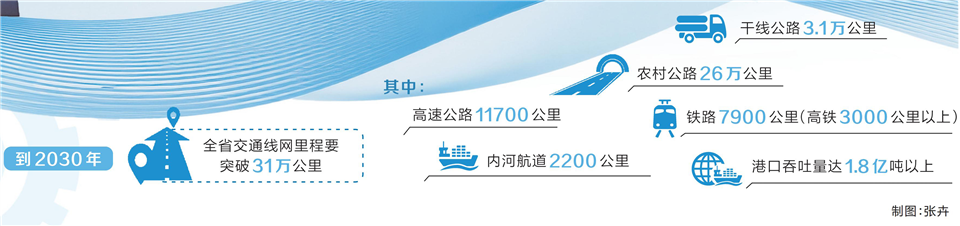
Core Insights - The article highlights the significant advancements in transportation infrastructure in Henan province, marking its transition from a geographical center to a strategic hub for national and international market circulation [2][3][14] - Key achievements include the Zhengzhou Airport surpassing 1 million tons in annual cargo throughput, the opening of the first dedicated container terminal in Zhoukou, and the completion of 17 highway projects, bringing the total highway mileage in the province to over 10,000 kilometers [2][4][12] Transportation Infrastructure Developments - Zhengzhou Airport has officially joined the "million-ton club" for air cargo, enhancing its status as a global logistics hub [2][6] - Zhoukou's new container terminal is expected to significantly reduce transportation costs, with water transport costing only one-fifth of road transport [3][9] - The completion of 17 highway projects has enabled over 90% of counties in Henan to access dual highways, facilitating regional integration and reducing operational costs [4][12] Economic Transformation - The developments in transportation are part of a broader strategy to transform Henan's economic model from a "transportation corridor" to a "hub economy," focusing on value creation and resource allocation [16][17] - The integration of water, land, and air transport is seen as a critical step in enhancing the province's economic resilience and competitiveness [3][14] Future Outlook - The province aims to further enhance its transportation network, targeting over 31,000 kilometers of road by 2030, with specific goals for highway, rural road, and inland waterway expansions [12][14] - The strategic focus includes strengthening the Zhengzhou International Comprehensive Transportation Hub and expanding the "Air Silk Road" to enhance global connectivity [12][13][14]

【原创】港口:市值涨少跌多 期待穿越周期
Xin Lang Cai Jing· 2026-01-12 12:28
Core Viewpoint - The port sector is expected to experience a rally after crossing the cycle, driven by the strengthening of reform policies in the "14th Five-Year Plan" and the continuation of sector rotation and active themes in 2026 [1][11]. Industry Overview - The port industry is highly sensitive to macroeconomic cycles, exhibiting strong economic cyclicality, with high overall entry barriers. Future regional cooperation and collaborative development will be key themes for industry growth [2][12]. - In 2025, the port sector's operating revenue is projected to grow steadily, with slight fluctuations in profitability, indicating overall stable operations [2][12]. Port Production Performance - In the first 11 months of 2025, the national port cargo throughput reached 16.75 billion tons, a year-on-year increase of 4.4%. Coastal ports accounted for 10.65 billion tons (3.7% growth), while inland ports handled 6.1 billion tons (5.7% growth) [4][14]. - The national port container throughput for the same period was 32 million TEUs, up 6.6% year-on-year, with coastal ports handling 29 million TEUs (6.9% growth) and inland ports 3.884 million TEUs (4.9% growth) [4][14]. Market Capitalization Trends - The port sector index rose to 1420.75 points in 2025, a 7.09% increase year-on-year, although the overall performance was weaker than the market average [6][16]. - Shanghai Port Group had a market capitalization of 126.178 billion yuan, ranking third in the 2025 China Port and Shipping Company Market Capitalization Rankings, despite a year-on-year decline of 11.44% [6][16]. - Ningbo Port's market capitalization was 70.618 billion yuan, down 5.71%, while it is expected to achieve a cargo throughput of 1.216 billion tons, a 7.21% increase year-on-year [6][16]. Notable Company Performances - China Merchants Port had a market capitalization of 63.558 billion yuan in 2025, up 9.39%, maintaining its position in the top ten [8][18]. - COSCO Shipping Ports reported a market capitalization of 20.029 billion yuan, a 25.01% increase, with a total throughput of 11.3 million TEUs, up 5.6% [8][18]. - Qingdao Port achieved a cargo throughput of 546 million tons, a 2.41% increase, and a container throughput of 25.84 million TEUs, a 7.11% increase, despite a market capitalization decline of 6.75% [10][20].

“千万”大港上新 谁是年度最强“黑马”?
Mei Ri Jing Ji Xin Wen· 2025-12-30 15:52
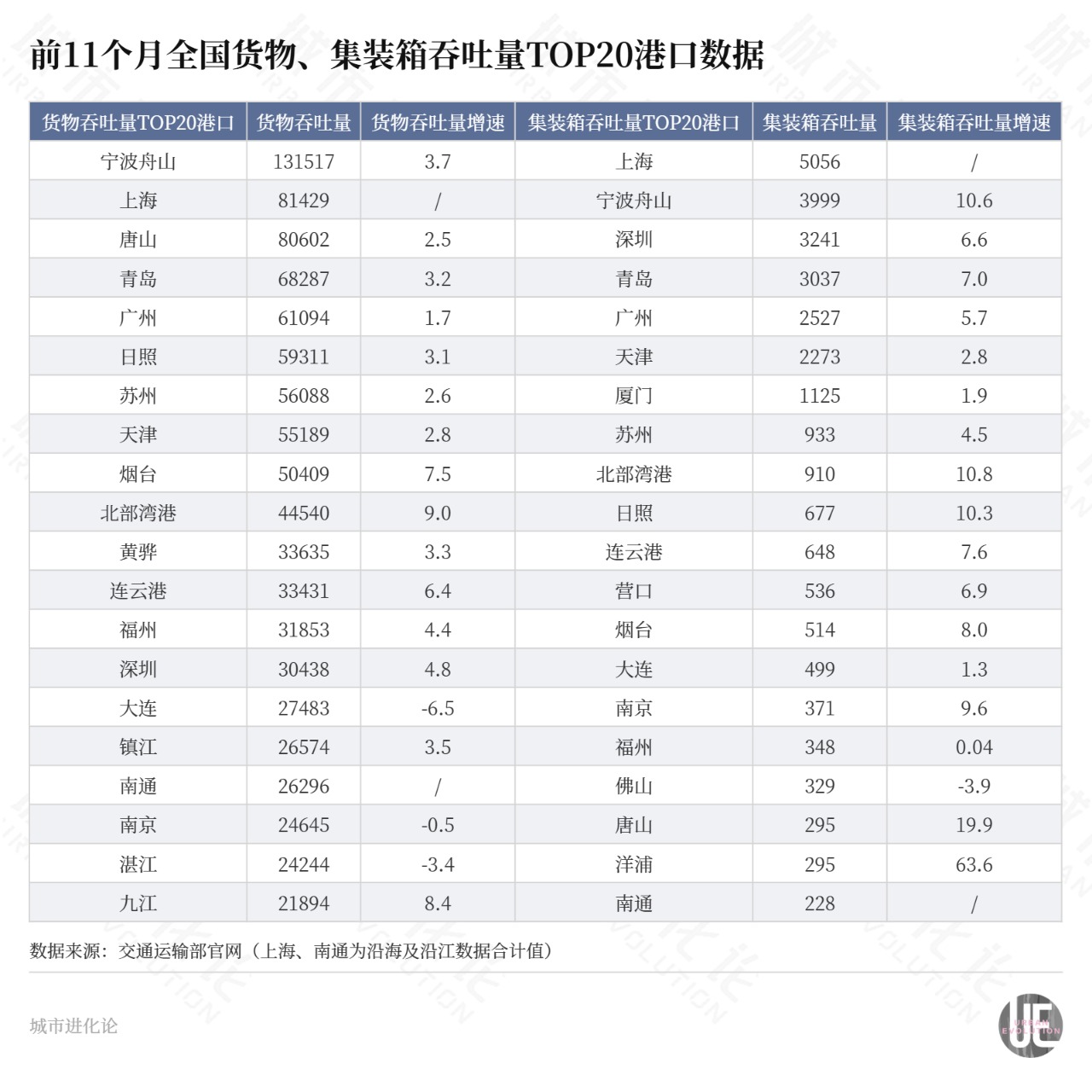
Core Insights - The article highlights significant milestones in China's port development, with notable achievements in container throughput and cargo handling, indicating robust growth in the sector [1][4][9]. Port Performance - Guangxi Beibu Gulf Port's container throughput surpassed 10 million TEUs, marking its entry into the million TEU club [1]. - Ningbo-Zhoushan Port's annual container throughput exceeded 40 million TEUs, making it the second-largest port in China and the third-largest globally [1]. - From January to November, national port cargo throughput reached 1.675 billion tons, and container throughput reached 32 million TEUs, with year-on-year growth of 4.4% and 6.6% respectively [1]. Leading Ports - The top ten ports, including Ningbo-Zhoushan, Shanghai, Tangshan, and Qingdao, contributed to 40% of the national total cargo throughput [1]. - Shanghai Port surpassed Tangshan Port with a cargo throughput of 814.29 million tons, becoming the second-largest port in China [7]. - Beibu Gulf Port led the growth in container throughput among the top ports, achieving a 9% increase [7][14]. Container Throughput Growth - Shanghai Port's container throughput reached 50.56 million TEUs, with expectations to exceed 55 million TEUs for the year, maintaining its position as the world's largest port for 16 consecutive years [9][13]. - Ningbo-Zhoushan Port's container throughput grew by 10.6%, reaching 39.99 million TEUs, with projections to surpass 43 million TEUs by year-end [13][14]. - Yangpu Port in Hainan achieved a remarkable 63.6% increase in container throughput, reaching 2.95 million TEUs, positioning it as a rising international hub [14]. Infrastructure Developments - The establishment of the Pinglu Canal is anticipated to enhance connectivity for Beibu Gulf Port, facilitating cargo movement from the southwest region to the sea [8][21]. - The dual-channel structure at Ningbo-Zhoushan Port is expected to increase the capacity for ultra-large vessels by over 50%, further solidifying its status as a global logistics hub [4]. Competitive Landscape - The competition among ports is intensifying, with ports like Guangzhou and Suzhou making significant strides in throughput, indicating a dynamic market environment [7][15]. - The article emphasizes the potential of inland ports, with Suzhou, Nanjing, and Foshan entering the top 20 container ports, showcasing the growing importance of inland waterways [15][17].
全国前十吞吐量港口出炉
2 1 Shi Ji Jing Ji Bao Dao· 2025-12-12 01:28
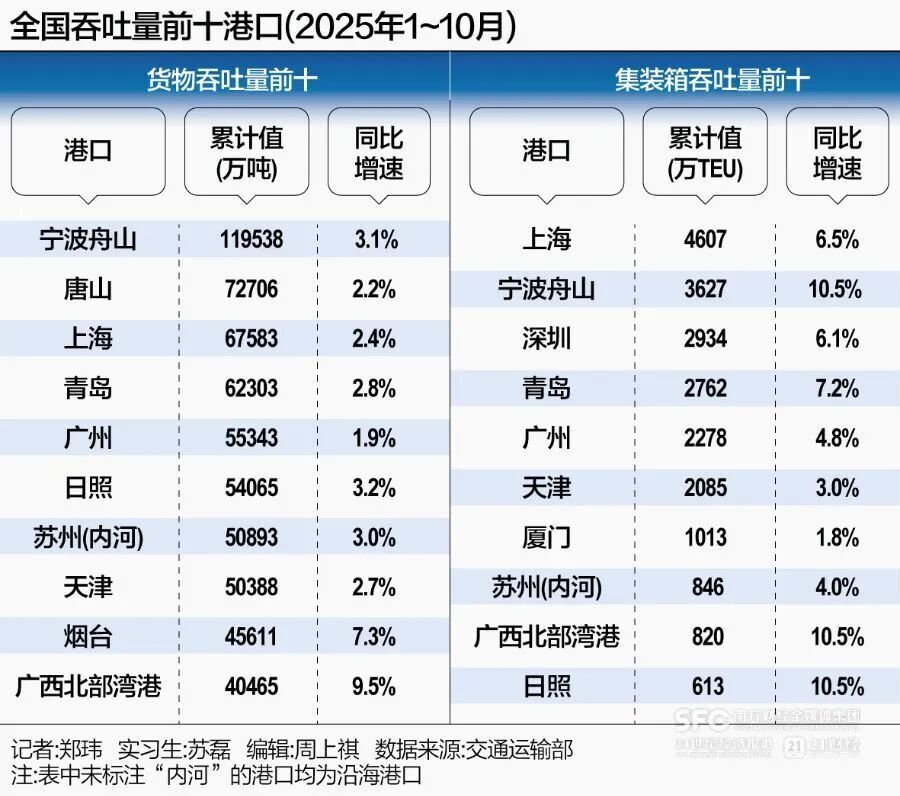
Core Insights - The article highlights significant growth in container throughput and cargo volume at major Chinese ports, indicating a robust performance in the shipping and logistics sector as the year-end approaches [1][8]. Group 1: Coastal Ports Performance - Shanghai Port's container throughput reached 50.56 million TEUs in the first 11 months of 2025, a year-on-year increase of 6.7%, breaking the 50 million TEU mark one month earlier than last year [1][8]. - Ningbo-Zhoushan Port also achieved a historic milestone, surpassing 40 million TEUs for the first time, becoming the third global port to reach this level [1][8]. - Shenzhen Port reported a container throughput of 32.41 million TEUs from January to November 2025, reflecting a growth of 6.57% [8]. Group 2: Inland Ports Growth - Several inland ports, including Suzhou, Wuxi, and Yunnan, demonstrated remarkable growth, with Wuxi Port's container throughput increasing by 107.0% and Yunnan Port by 223.6% year-on-year [2][9]. - The importance of inland shipping is being recognized, with provinces like Guangdong and Shandong incorporating inland waterway construction into their 14th Five-Year Plans [2][15]. Group 3: National Port Statistics - Nationally, cargo throughput at ports reached 1.51 billion tons from January to October 2025, marking a 4.3% year-on-year increase, while container throughput grew by 6.4% to 29.42 million TEUs [7][8]. - The top ten ports in terms of cargo throughput include Ningbo-Zhoushan, Tangshan, and Shanghai, with each exceeding 55 million tons [7][8]. Group 4: Future Developments - The upcoming 15th Five-Year Plan is expected to bring changes to port layouts and enhance the integration of coastal and inland ports, focusing on optimizing resources and improving infrastructure [11][15][16]. - Specific plans include the development of a modernized inland waterway network in provinces like Henan, aiming for a cargo throughput of over 100 million tons during the 15th Five-Year period [15][16].

大港季末冲刺:多地刷新吞吐量记录,“十五五”港口群布局迎变
2 1 Shi Ji Jing Ji Bao Dao· 2025-12-11 12:29
Core Insights - The article highlights the significant growth in container throughput and cargo handling at major ports in China, with Shanghai, Ningbo-Zhoushan, and Shenzhen leading the way in performance metrics [1][4][5]. Port Performance - Shanghai Port achieved a container throughput of 50.56 million TEUs in the first 11 months of 2025, marking a 6.7% year-on-year increase and breaking the 50 million TEU mark a month earlier than the previous year [1][5]. - Ningbo-Zhoushan Port also reported a record container throughput, surpassing 40 million TEUs for the first time, making it the third global port to reach this milestone [1][5]. - Shenzhen Port's container throughput reached 32.41 million TEUs, reflecting a growth of 6.57% year-on-year [5]. National Trends - Nationally, the total cargo throughput for ports reached 1.51 billion tons from January to October 2025, with a year-on-year growth of 4.3%, while container throughput increased by 6.4% to 29.42 million TEUs [4][6]. - Notably, 21 ports experienced double-digit growth in container throughput, with inland ports like Wuxi and Yunnan showing remarkable increases of 107.0% and 223.6%, respectively [6][11]. Future Developments - The "14th Five-Year Plan" is set to conclude, with provinces like Guangdong, Shandong, and Henan planning to enhance inland waterway construction as part of their "15th Five-Year Plan" [7][11]. - The Guangdong provincial government aims to strengthen the integration of port resources and enhance the international hub status of Guangzhou and Shenzhen ports [7][10]. - The article indicates that the next five years will see a reconfiguration of port group layouts in response to evolving trade dynamics and national market integration [12].
宁波舟山港年集装箱吞吐量首破4000万大关
Jing Ji Guan Cha Wang· 2025-12-02 08:13
Core Insights - Ningbo-Zhoushan Port has achieved an annual container throughput of over 40 million TEUs for the first time, making it the second port in China and the third in the world to reach this milestone [1] Industry Summary - Container throughput is a critical indicator of port transportation capacity and international trade levels [1] - The annual container throughput at Ningbo-Zhoushan Port has shown significant growth, increasing from 30 million TEUs to 40 million TEUs in just four years [1] - Ningbo-Zhoushan Port is the fastest-growing and largest port in terms of annual container throughput increase among the top five global ports over the past decade [1]