
中国特色社会主义文化

Search documents
理论1点点 |中国式现代化行稳致远的根本所在
Xin Lang Cai Jing· 2026-01-10 23:42
Core Viewpoint - The essence of Chinese-style modernization lies in the leadership of the Communist Party of China, which has enabled a progressive and impactful development on a global scale [1] Group 1 - Chinese-style modernization is a continuous process that advances through the historical journey of the great rejuvenation of the Chinese nation under the leadership of the Communist Party [1] - The successful exploration of the socialist path with Chinese characteristics has provided the correct direction for modernization [1] - The theoretical guidance and action plans for modernization are derived from the ongoing development of Marxism in the context of China [1] Group 2 - The driving force and strong institutional guarantees for modernization come from the Party's efforts in revolution, construction, and reform [1] - The rich cultural nourishment and strong spiritual power for modernization are rooted in the red culture and the continuously evolving socialist culture [1] - The comprehensive leadership of the Party is crucial for maintaining the vitality and robust life force of Chinese-style modernization [1]
深耕中华文明基因 谱写文化建设新篇章
Xin Lang Cai Jing· 2025-12-26 22:03
Group 1 - The article emphasizes the importance of culture as the soul of a nation and a crucial force for survival and development [1] - It highlights the ongoing task of promoting cultural prosperity and building a strong cultural nation as a long-term and complex endeavor [1] - The article presents expert research findings focusing on various aspects such as strengthening cultural subjects through "two combinations" and leveraging cultural heritage to support urban development [1] Group 2 - The article discusses the role of youth vitality in shouldering historical responsibilities and the pursuit of common prosperity in spiritual life as a practice of the "people first" concept [1] - It aims to provide support and reference for accumulating strong internal motivation for the development of socialist culture with Chinese characteristics [1]
五百年婺剧“出海记”
Xin Hua She· 2025-12-20 13:48
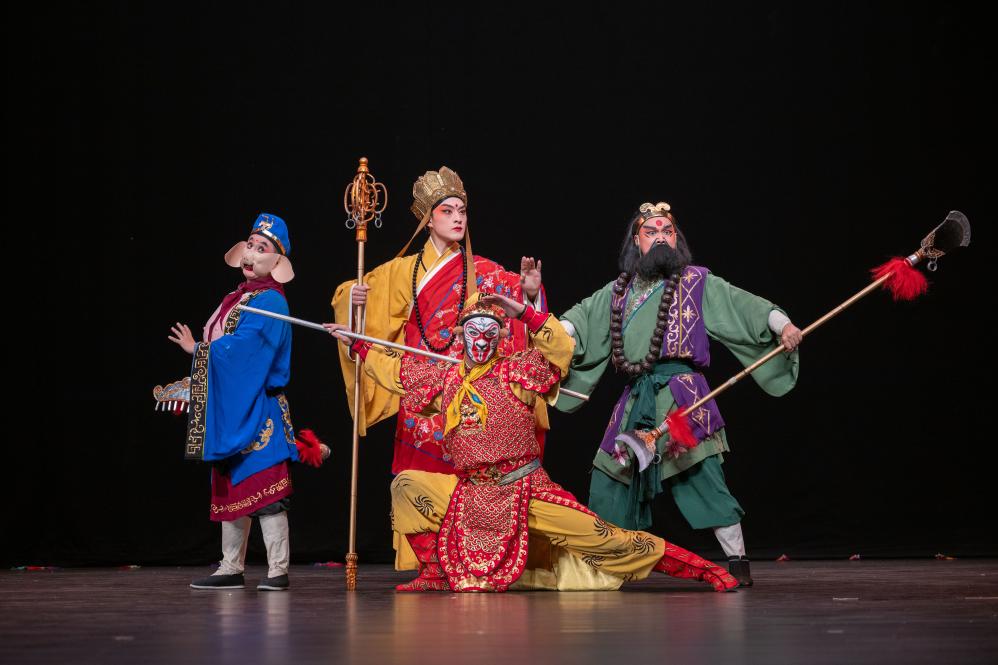
Core Viewpoint - The Zhejiang Wuju Art Research Institute is successfully promoting the traditional Chinese opera Wuju on the international stage, with plans for extensive overseas performances in 2026, indicating a growing global presence and appreciation for this art form [1][2]. Group 1: International Expansion - Wuju has performed in 73 countries and regions, reaching over 5 million overseas audiences since its first performance in Japan in 1993 [1]. - The upcoming performances in February 2026 will include tours in Europe (UK, Ireland, Netherlands) and Asia (Myanmar, Bhutan, Nepal) [1]. Group 2: Artistic Appeal - The unique charm of Wuju lies in its "literary and martial" performance style, which makes it accessible to international audiences by externalizing characters' inner emotions through physical actions [1]. - The themes in Wuju, such as love, sacrifice, loyalty, and misunderstanding, resonate universally, creating a bridge across cultural divides [2]. Group 3: Innovation and Modernization - The Zhejiang Wuju Art Research Institute is implementing modern creative practices and international expressions, such as incorporating techniques from other Chinese operas and engaging with local cultures during performances [2]. - The use of technology, like drones for stage effects, and local music for audience interaction has enhanced the appeal of Wuju performances [2]. Group 4: Training and Talent Development - The success of Wuju is supported by rigorous training and frequent performances, emphasizing the importance of talent cultivation within the troupe [3]. - The adaptability of the performers, demonstrated during a challenging South American tour, showcases their dedication and versatility [3]. Group 5: Cultural Mission - The leadership of the Zhejiang Wuju Art Research Institute expresses confidence in expanding the global recognition and influence of Wuju, aligning with the broader mission of promoting Chinese culture internationally [3].
四中全会精神在基层丨五百年婺剧“出海记”
Xin Hua Wang· 2025-12-20 08:44
Core Viewpoint - The Zhejiang Wuju Art Research Institute is successfully promoting the traditional Chinese opera Wuju on the international stage, with performances scheduled across multiple countries, showcasing its unique charm and universal themes [1][3][4]. Group 1: International Expansion - The Wuju troupe plans to perform in Europe (UK, Ireland, Netherlands) and Asia (Myanmar, Bhutan, Nepal) in February 2026, with additional performances in Canada [3]. - Since its first performance in Japan in 1993, Wuju has reached 73 countries and regions, entertaining over 5 million overseas audiences [3][4]. Group 2: Artistic Appeal - Wuju's unique performance style, which externalizes characters' inner emotions through physical actions, lowers the understanding barrier for international audiences [3]. - The themes in Wuju plays, such as love and sacrifice in "The Legend of the White Snake" and loyalty and misunderstanding in "The Monkey King," resonate universally, bridging cultural gaps [4]. Group 3: Innovation and Modernization - The Zhejiang Wuju Art Research Institute is implementing modern adaptations and international expressions, such as incorporating Sichuan opera's face-changing techniques and engaging with local music during performances [5]. - A strong training regimen for young actors is emphasized to ensure high-quality performances, with a focus on rigorous practice and frequent shows [5][8]. Group 4: Cultural Mission - The institute's leadership expresses confidence in expanding Wuju's global presence, aligning with China's cultural export goals and the broader mission of promoting Chinese culture internationally [8].

增强新时代中国特色社会主义文化的思想引领力
Jing Ji Ri Bao· 2025-08-13 22:12
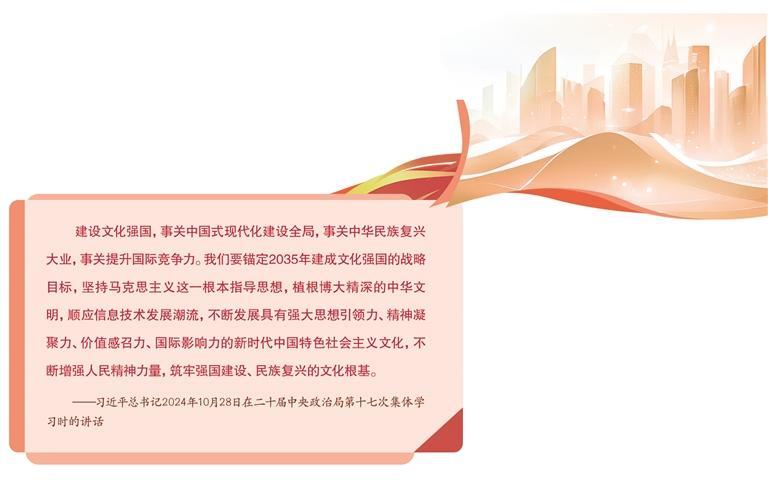
Group 1 - The core idea emphasizes the importance of cultural prosperity and building a strong cultural nation, as highlighted by Xi Jinping's remarks on the development of a new era of socialist culture with strong ideological leadership, spiritual cohesion, value appeal, and international influence [2][4][9] - The concept of ideological leadership is identified as the core competitiveness of culture, with the assertion that thought is the soul of culture and serves as its carrier, reflecting specific ideological systems that determine the nature of culture [3][4] - The historical context shows that the development of Chinese culture has been influenced by world history, with a focus on enhancing the ideological leadership of socialism with Chinese characteristics to compete in the global cultural arena [4][6] Group 2 - The Communist Party of China has continuously advanced the sinicization and modernization of Marxism, establishing a solid ideological foundation for the development of a scientific and popular socialist culture [6][8] - The Party's historical journey reflects its commitment to cultural renewal and advancement, with significant milestones in cultural policy development across different historical periods [7][8] - The strategic deployment of cultural construction has evolved, with recent Party congresses emphasizing the importance of cultural confidence and the promotion of socialist culture [8][9] Group 3 - The principle of "two combinations" is essential for promoting theoretical innovation and cultural prosperity, highlighting the integration of Marxism with Chinese realities and traditional culture [9][10] - The enhancement of cultural ideological leadership is linked to the Party's commitment to using innovative theoretical achievements to educate and unify the populace [11][12] - The interaction between ideological content and cultural carriers is crucial for strengthening the cultural foundation necessary for national rejuvenation [12]
文化主体性是文化自信的根本依托
Jing Ji Ri Bao· 2025-04-02 00:59
Group 1 - Cultural subjectivity refers to the conscious awareness, autonomous stance, and independent creativity of specific countries and nations in their cultural development process, serving as a source of cultural confidence [1][4] - Cultural confidence is closely related to cultural cognition, which provides the ideological basis for the generation of cultural confidence [2][3] - The unique value generated by cultural subjectivity provides a spiritual foundation for cultural confidence, emphasizing the importance of cultural sovereignty [6][9] Group 2 - The establishment of cultural development goals and the selection of cultural development paths are essential for achieving cultural confidence and avoiding dependency on external influences [10][12] - Cultural development must align with economic and social development goals while maintaining relative independence, reflecting the intrinsic requirements of cultural subjectivity [7][8] - The realization of cultural development goals relies on the independent selection of cultural development paths, which should be tailored to the unique historical and cultural contexts of each nation [9][10] Group 3 - Cultural confidence is built on the foundation of cultural creation, which is essential for the development of a socialist cultural power [11][12] - The process of cultural construction led by the Communist Party is both a process of cultural creation and the establishment of cultural subjectivity [11][12] - The formation of a new form of human civilization is linked to the independent creation of culture, which enhances cultural confidence and international competitiveness [12][13]