中国经济新旧动能转换

Search documents
中欧基金:2026第一场对话,我们决定用「价值投资」开场
Xin Lang Cai Jing· 2025-12-31 09:14
Group 1 - The core discussion revolves around the perceived "temperature difference" between the secondary market and the economy, emphasizing the importance of understanding macroeconomic transitions in China [1][3][6] - The conversation highlights the ongoing transformation of China's economic drivers and the time required for risk digestion [3][7] - The dialogue stresses that long-term macro assumptions play a subjective role in trading decisions, advocating for a strategic approach of "surviving first" rather than seeking short-term victories [1][3][7] Group 2 - The importance of macro perspectives is underscored, particularly regarding inflation, interest rate turning points, and global distribution issues [3][7] - It is noted that the U.S. and China cannot sustain negative or low nominal interest rates in the long term [3][7] - The discussion includes two explanatory paths for the current global inflation and highlights the cognitive differences among overseas investors regarding the risks associated with U.S. dollar credit [3][7] Group 3 - The conversation reflects on the performance as a manifestation of understanding complex systems, with insights into the speaker's background and investment philosophy [3][7] - The speaker emphasizes the importance of staying within one's circle of competence and acknowledges areas of lesser understanding [3][7] - A retrospective analysis is provided on missed opportunities, such as in the electric vehicle sector [3][7] Group 4 - The dialogue dissects value investing, noting that value investors often operate outside the mainstream [3][7] - It is clarified that the approach is not about contrarianism for its own sake, but rather about mathematical evaluations of cost-effectiveness [3][7] - Different industries and stages require tailored valuation models, and the speaker expresses a strong aversion to losing previously gained profits [3][7] Group 5 - The team's principles are highlighted, emphasizing sincerity, equality, and the integration of knowledge and action [3][7] - The most important team tenet is identified as "knowledge in action," advocating for thoughtful changes rather than hasty trading decisions [3][7] - A preference for "win-win" values is articulated, reflecting a collaborative investment philosophy [3][7]
华泰证券张继强: 经济新旧动能转换步入右侧阶段 产业升级、科技进步的“势”已形成
Zhong Guo Zheng Quan Bao· 2025-11-01 00:17
Core Viewpoint - The transformation of China's economy is entering a new stage, with a shift from old to new economic drivers, which is positively impacting the capital market ecosystem [1][2][7]. Economic Transformation - The transition from old to new economic drivers is seen as a trend, with the old economy's clearance benefiting the bond market and the rise of the new economy favoring the stock market [2]. - The "14th Five-Year Plan" is expected to provide a foundation for long-term development, with nominal GDP growth likely to improve, leading to slight profit growth expectations [2][6]. Liquidity and Investment Trends - The Federal Reserve is expected to cut interest rates twice this year and potentially three more times next year, contributing to a globally loose liquidity environment [2][6]. - There is increasing interest from foreign investors in Chinese assets, while domestic demand for reallocation of funds from maturing deposits and wealth management products is strong, favoring various equity assets [2][6]. Market Strategy and Asset Allocation - A diversified portfolio including technology stocks, resource stocks, gold, and short-term bonds is recommended for risk diversification [3]. - The "anti-involution" theme is prevalent in the market, promoting supply-demand balance and improving the business environment, although the complexity of current supply-demand imbalances is acknowledged [4]. Market Style and Sector Focus - The market is expected to shift from small-cap and dividend stocks in the first half of the year to large-cap growth stocks in the second half, with technology and resource stocks remaining focal points [5]. - The Hong Kong stock market is more sensitive to geopolitical issues, but long-term benefits from liquidity easing due to Fed rate cuts are anticipated [5]. Long-term Market Outlook - The long-term positive outlook for the Chinese capital market is supported by the transition to new economic drivers, increased long-term capital inflows, and the introduction of stabilizing funds to reduce irrational market volatility [6][7].

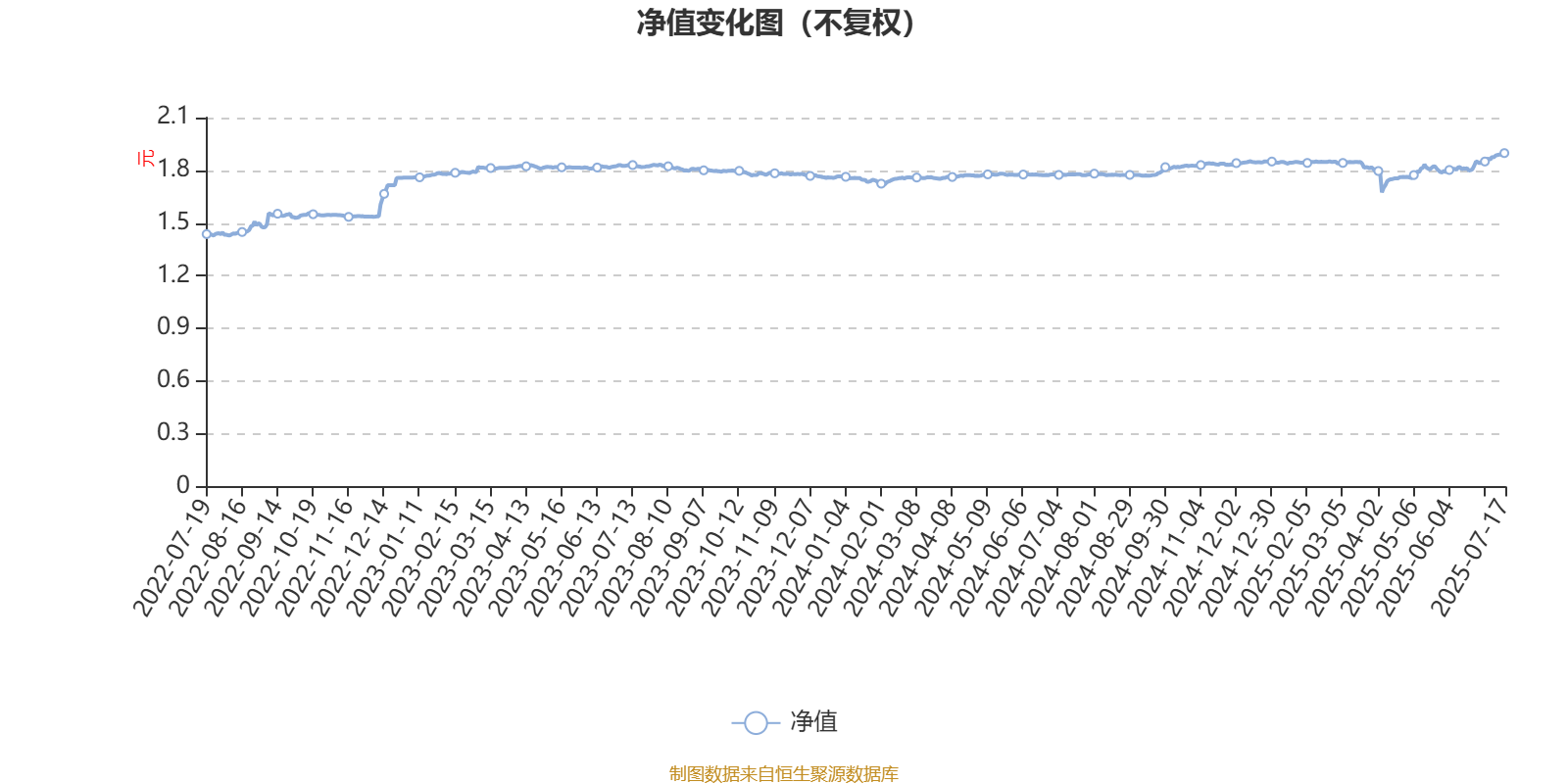
融通新机遇灵活配置混合:2025年第二季度利润470.02万元 净值增长率2.73%
Sou Hu Cai Jing· 2025-07-18 02:20
Core Viewpoint - The report highlights the performance and strategy of the AI Fund, indicating a positive outlook on China's economic transformation and the fund's investment approach focusing on high positions and diversification in sectors like AI, new energy, and military industry [3][4]. Fund Performance - As of the second quarter of 2025, the fund reported a profit of 4.7002 million yuan, with a weighted average profit per share of 0.05 yuan [3]. - The fund's net asset value (NAV) growth rate for the second quarter was 2.73%, and the fund size reached 159 million yuan [3][13]. - The fund's one-year NAV growth rate was 6.87%, ranking it 44 out of 142 comparable funds [4]. Investment Strategy - The fund management believes that the transformation of China's economy is accelerating, despite challenges in traditional sectors like real estate [3]. - The investment strategy involves maintaining a high position and a highly diversified portfolio, primarily focusing on the overall economic development prospects of China [3]. Performance Metrics - The fund's three-year Sharpe ratio was 0.8549, ranking 13 out of 142 comparable funds [7]. - The maximum drawdown over the past three years was 9.56%, with the highest quarterly drawdown occurring in Q2 2025 at 6.84% [9]. - The average stock position over the past three years was 25.55%, significantly higher than the industry average of 18.3% [12]. Top Holdings - As of the end of Q2 2025, the fund's top ten holdings included Kweichow Moutai, CATL, Ping An Insurance, China Merchants Bank, Industrial Bank, Yangtze Power, Midea Group, Industrial and Commercial Bank of China, BYD, and Zijin Mining [16].