中文教育

Search documents
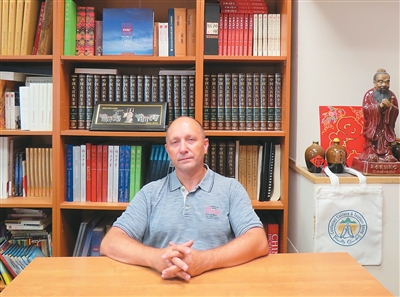
不研读孔子,就无法理解中国文化(孔院之光)
Ren Min Ri Bao Hai Wai Ban· 2026-02-05 22:46
Core Viewpoint - The article highlights the significant contributions of Professor Luis Antonio Paulino in promoting Chinese language education and cultural exchange between Brazil and China through the establishment and development of the Confucius Institute at São Paulo State University. Group 1: Background and Achievements - Professor Paulino is the director of the Confucius Institute at São Paulo State University and has held various advisory roles in the Brazilian government, contributing to cultural and educational exchanges between Brazil and China [4]. - He founded Brazil's first Confucius Institute in 2008, which has since expanded to 19 teaching sites across three states, registering over 41,000 students [8]. Group 2: Educational Initiatives - The Confucius Institute offers a diverse curriculum, including basic Chinese language courses and cultural classes, utilizing a "face-to-face + online" teaching model [8]. - The institute has translated key educational materials into Brazilian Portuguese, addressing local language differences and enhancing the quality of Chinese language education in Brazil [8]. Group 3: Cultural Exchange and Community Engagement - The institute organizes various cultural events, such as film festivals and traditional celebrations, to immerse students in Chinese culture and foster a deeper understanding of contemporary Chinese society [9][10]. - It has facilitated over 1,000 job placements through recruitment fairs, connecting students with Chinese companies operating in Brazil, thereby enhancing career opportunities for graduates [10]. Group 4: Future Plans and Vision - In 2025, Paulino plans to establish the Brazilian Confucius Institute Alliance to enhance collaboration among the institutes and promote Chinese culture across Brazil [11]. - The institute aims to continue developing educational resources tailored for Brazilian students and strengthen the strategic partnership between Brazil and China in the next 50 years [11][12].

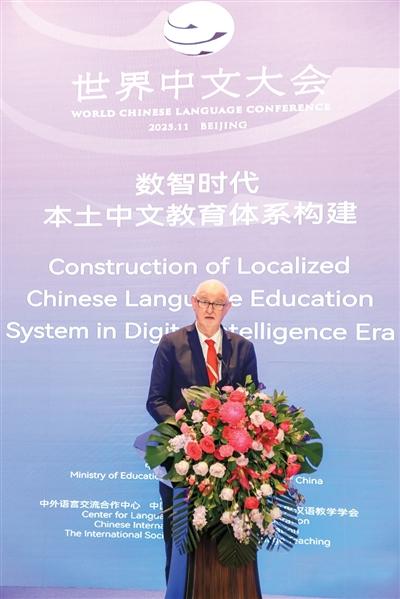
“每一堂中文课都是一次文化之旅”——访泰国教育部前部长素察
Xin Lang Cai Jing· 2026-02-01 03:56
Core Viewpoint - The development of Chinese education in Thailand is thriving, serving as a lasting impetus for deepening friendly relations between Thailand and China [1] Group 1: Chinese Education Development - The former Thai Minister of Education, Suchart, emphasized the importance of Chinese education as a bridge for youth exchange and mutual understanding between the two countries [1] - During his tenure, Suchart promoted the expansion of Chinese education across all educational stages in Thailand, resulting in over 20,000 Chinese teacher volunteers and providing Chinese learning opportunities for approximately 4 million students [2] - Suchart believes that learning Chinese not only facilitates cultural exchange but also lays the foundation for cooperation between Thailand and China [2] Group 2: Personal Experience and Cultural Exchange - Suchart has personally engaged in learning Chinese, attending classes at the Confucius Institute at Chulalongkorn University, and has developed a deep interest in Chinese culture through various activities [1] - He highlights that learning Chinese is a pathway to understanding Chinese culture and history, citing his engagement with Chinese literature and media [1] - Suchart noted that many Thai youths believe that mastering Chinese enhances their ability to connect with Chinese clients, reflecting the growing influence of China [2]
“每一堂中文课都是一次文化之旅”
Ren Min Ri Bao· 2026-02-01 01:54
Core Insights - Chinese education is thriving in Thailand, serving as a vital bridge for deepening friendly relations between Thailand and China [1][2] - The promotion of Chinese language education is seen as essential for cultural exchange and cooperation between the two countries [2] Group 1: Development of Chinese Education - The former Thai Minister of Education, Suchart, emphasized the importance of Chinese education during his tenure, leading to the expansion of Chinese language programs across all educational levels in Thailand [2] - Over 20,000 Chinese teacher volunteers have been received in Thailand, providing Chinese learning opportunities to approximately 4 million students in thousands of schools [2] Group 2: Cultural Exchange and Personal Experience - Suchart views learning Chinese as a pathway to understanding Chinese culture and history, enhancing cultural exchanges between Thailand and China [1][2] - He actively engages in learning activities related to Chinese culture, such as calligraphy and traditional literature, indicating a personal commitment to cultural immersion [1]
菲律宾红溪礼示大学孔子学院庆祝建院十五周年
Xin Lang Cai Jing· 2026-01-19 23:20
Core Viewpoint - The 15th anniversary celebration of the Confucius Institute at Holy Angel University in the Philippines highlights its significant contributions to Chinese language education and cultural exchange between China and the Philippines over the past 15 years [1] Group 1: Event Overview - The anniversary celebration and the 12th National Chinese Teaching Conference took place in Angeles City, Pampanga, Philippines, attended by over 300 participants from 11 Confucius Institutes across 8 countries [1] - The event featured representatives from various educational institutions, including local Chinese teachers and community representatives, emphasizing the collaborative nature of the celebration [1] Group 2: Institutional Collaboration - The Confucius Institute at Holy Angel University was established in 2010 through a partnership between Fujian Normal University and Holy Angel University, showcasing a long-term collaboration in promoting Chinese education [1] - The presidents of both universities delivered speeches reflecting on their successful partnership and the achievements of the Confucius Institute in enhancing the local Chinese education system [1] Group 3: Achievements and Impact - The event showcased the fruitful outcomes of the Confucius Institute's efforts in serving the community and advancing Chinese language education in the Philippines [1] - It provided a high-level dialogue platform for Chinese education and regional exchanges, further solidifying the role of the Confucius Institute in cultural diplomacy [1]
泰国教育部民教委与泰国华文教师公会签约推动中文教育
Xin Lang Cai Jing· 2026-01-19 16:10
Group 1 - The Thai Ministry of Education and the Thai Chinese Teachers Association signed a memorandum to promote cooperation in Chinese education [1] - The memorandum aims to institutionalize cooperation mechanisms to standardize the development of Chinese education in private schools in Thailand [1] - Key initiatives include supporting the construction of Chinese curricula, innovating teaching models, enhancing training for Thai Chinese teachers, and expanding channels for students to learn Chinese and Chinese culture [1] Group 2 - The Thai Chinese Teachers Association, established in 1979, has been dedicated to the development of Chinese education in Thailand [2] - Recent efforts by the association include the formulation of a five-year development plan, improving local teachers' Chinese proficiency, increasing Chinese course hours, and establishing a Thai version of the teacher qualification examination system [2] - These initiatives provide institutional support for the sustainable and high-quality development of Chinese education in Thailand [2]
菲律宾红溪礼示大学孔子学院成立十五周年庆典举行
Xin Lang Cai Jing· 2026-01-17 03:19
Core Viewpoint - The 15th anniversary celebration of the Confucius Institute at Holy Angel University in the Philippines highlights its significant achievements in promoting Chinese language education and cultural exchange between China and the Philippines [2][5]. Group 1: Event Overview - The celebration and the 12th National Chinese Teaching Conference were held on January 15 in Angeles City, attended by over 300 representatives from various countries and educational institutions [2][7]. - Former Philippine President Gloria Arroyo emphasized the institute's success in making Chinese the most widely implemented foreign language program in public high schools in the Philippines [2]. Group 2: Institutional Collaboration - The Confucius Institute was established in January 2010 through a collaboration between Fujian Normal University and Holy Angel University, marking a long-term partnership aimed at enhancing Chinese education in the Philippines [5]. - The presidents of both universities reflected on their cooperation and acknowledged the significant contributions of the institute to the development of local Chinese language education and cultural exchanges [5]. Group 3: Future Aspirations - The Chinese Ambassador to the Philippines expressed hopes for continued cooperation and the importance of learning Chinese to open more opportunities for students [5]. - The newly renovated teaching and office spaces at the Confucius Institute are expected to improve educational conditions and support the professional development of teachers [5][7]. Group 4: Conference Discussions - The 12th National Chinese Teaching Conference featured discussions on curriculum development, teaching innovation, and localization, with participation from Confucius Institute directors and local educators [7].
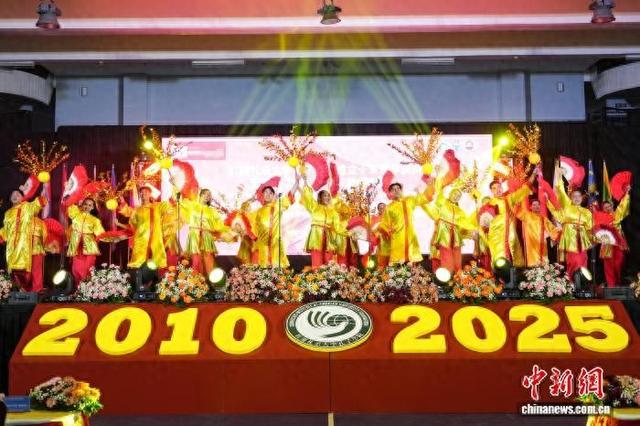
佛得角大学孔子学院举行成立十周年纪念活动
Xin Hua She· 2025-12-18 08:01
Core Viewpoint - The 10th anniversary of the Confucius Institute at Cape Verde University highlights its significant contributions to Chinese language education and cultural exchange between China and Cape Verde [1][2]. Group 1: Event Overview - The anniversary event, themed "Picking Light · Towards the Future," featured cultural performances such as lion dance, dance, and Tai Chi fan, attracting participation from students and the local community [2]. - The event was attended by dignitaries including the president of Guangdong University of Foreign Studies and the Chinese ambassador to Cape Verde, who acknowledged the institute's role in promoting Chinese education and cultural understanding [2]. Group 2: Achievements and Future Plans - Over the past decade, the Confucius Institute has trained nearly 11,000 Chinese language learners and has integrated Chinese language teaching into the national education system of Cape Verde [2]. - The institute's directors expressed intentions to use the anniversary as a new starting point to deepen Chinese education and cultural exchanges, contributing positively to Sino-Cape Verdean cooperation [2].
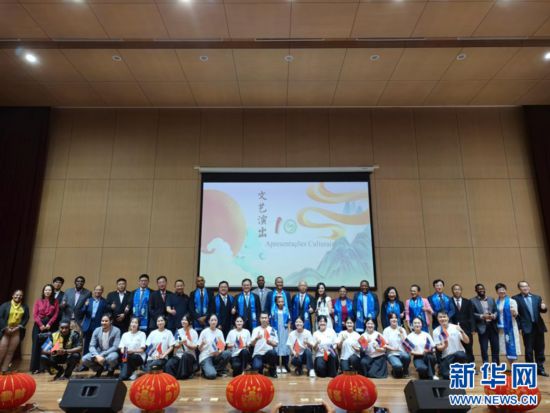
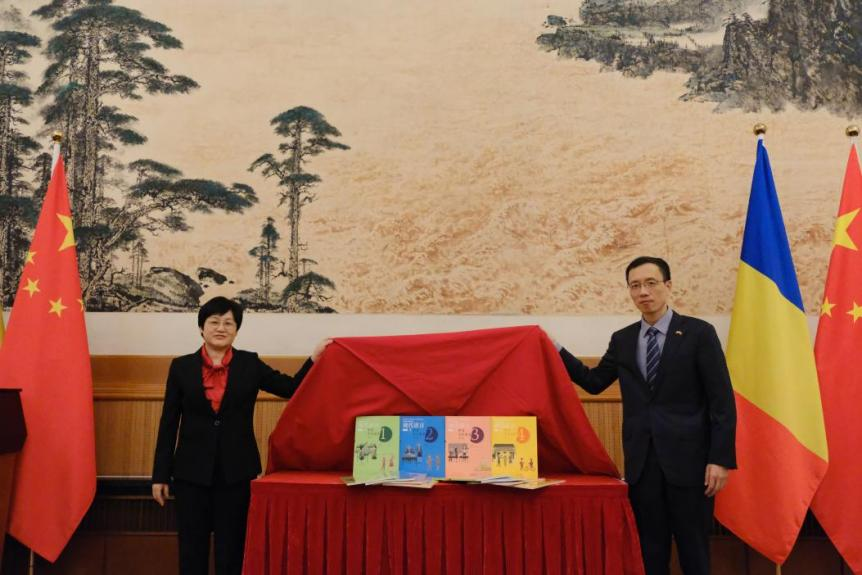
《现代语言2中文》(罗马尼亚语版)新书发布会在罗马尼亚成功举办
人民网-国际频道 原创稿· 2025-12-14 03:08
Core Viewpoint - The publication of the Romanian version of "Modern Language 2 Chinese" marks a significant advancement in Chinese language education in Romania, providing a localized and systematic approach to teaching Chinese to Romanian high school students [2][3]. Group 1: Publication Details - The Romanian version of "Modern Language 2 Chinese" is developed by the Higher Education Press in collaboration with a Sino-Romanian expert team, tailored for the Romanian basic education stage [2]. - The textbook aligns with the Romanian Ministry of Education's Chinese teaching guidelines and incorporates the International Chinese Education Chinese Proficiency Level Standards from the Chinese Ministry of Education [2]. - The publication includes student books, exercise books, and multimedia learning resources, offering a comprehensive learning solution for Romanian students [2]. Group 2: Significance and Support - The Chinese Ambassador to Romania, Chen Feng, emphasized the importance of language and cultural exchange in enhancing bilateral relations and expressed hope that more Romanian students will engage with the Chinese language through this textbook [2][3]. - The Director of Teacher Training at the Bucharest University, Ovidiu Panisvara, praised the dedication of the Sino-Romanian teaching team and highlighted the textbook as a significant achievement in the development of the Confucius Institute at Bucharest University [2]. Group 3: Educational Impact - The Vice President of the Higher Education Press, Zhang Jing, stated that the textbook serves as an important window for the younger generation in Romania to understand Chinese language and culture [3]. - The publication fills a gap in Chinese language teaching materials for the Romanian basic education stage, marking a new milestone in local Chinese education [3].
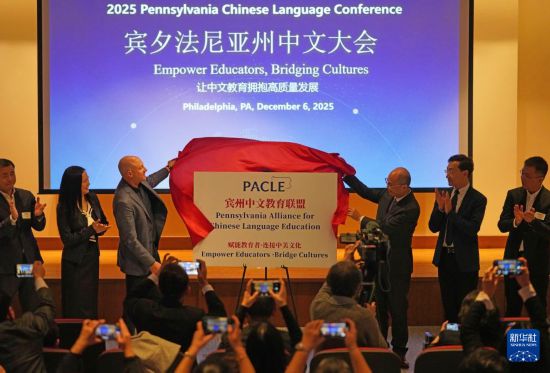
通讯丨“让中文学习不再是一段孤独的旅程”——记美国宾州首届中文大会
Xin Hua She· 2025-12-08 03:21
Core Viewpoint - The first Chinese conference in Pennsylvania aims to unify and enhance Chinese language education, creating a collaborative ecosystem among various stakeholders in the education sector [3][5]. Group 1: Establishment of the Pennsylvania Chinese Education Alliance - The Pennsylvania Chinese Education Alliance was officially launched during the conference, with the goal of gathering resources and support for Chinese language education [3]. - The founding chair, Yu Juan, emphasized three main missions for the alliance: establishing a systematic foundation, empowering educators, and building an ecological chain for Chinese education [5]. Group 2: Collaboration and Community Engagement - The conference highlighted the importance of collaboration among universities, community programs, and cultural institutions to create a cooperative educational ecosystem [7]. - Participants included educators from both the U.S. and China, who shared experiences and discussed challenges in implementing Chinese language teaching [5][7]. Group 3: Student Involvement and Perspectives - Student representatives from local universities shared their experiences from a recent trip to China, emphasizing the value of learning Chinese and engaging with Chinese peers [9]. - A graduate student from the University of Pennsylvania, who has studied Chinese for nine years, encouraged American students to visit China, stating that such experiences deepen understanding and correct misconceptions [9].
中文见证中华文明连续性(孔院之光)
Ren Min Ri Bao Hai Wai Ban· 2025-10-16 23:02
Core Viewpoint - Taras Ivchenko, also known as Yi Fucheng, is a prominent Russian sinologist and the director of the Oriental Studies Department at the Russian State University for the Humanities, who has significantly contributed to Chinese language education and cultural exchange between Russia and China [1]. Group 1: Academic Background and Achievements - Yi Fucheng has a strong academic background, having studied ancient Chinese at Peking University under renowned linguist Guo Xiliang, which has greatly influenced his research and teaching [3]. - He has received multiple awards for his contributions to Chinese language and culture, including the "China Language and Culture Popularization Award" in 2010 and the "Friendship Ambassador Award" in 2023 [1][2]. Group 2: Teaching and Curriculum Development - Yi Fucheng teaches various courses at the Confucius Institute, focusing on language theory, Chinese morphology, and rhetoric, and emphasizes the importance of ancient Chinese literature in understanding modern Chinese [5][6]. - He has led the development of localized Chinese teaching materials, which have been well-received by Russian educators and learners, reflecting a significant increase in student enrollment from 40 to 869 over the years [7][8]. Group 3: Cultural Exchange and Community Engagement - The Confucius Institute under Yi Fucheng's leadership not only offers language courses but also a wide range of Chinese cultural programs, including calligraphy, painting, and tea art, fostering a deeper understanding of Chinese culture among Russian students [7][9]. - Yi Fucheng promotes lifelong learning and cultural exploration by encouraging students to engage with both classical philosophical texts and contemporary Chinese political discourse, enhancing their understanding of Chinese cultural continuity [8][9]. Group 4: Future Vision and Impact - Yi Fucheng envisions the Confucius Institute evolving into a comprehensive research institution that not only teaches Chinese but also engages in curriculum development, academic research, and cultural seminars, thereby expanding its influence [9]. - Over 10,000 students have participated in programs at the Confucius Institute, with many pursuing further studies or careers related to China, demonstrating the institute's significant role in fostering Sino-Russian relations [9].