
中日四个政治文件精神

Search documents
社评:套上马甲也无法改变高市涉台言论的非法性
Xin Lang Cai Jing· 2026-01-28 16:48
Group 1 - Japanese Prime Minister Kishi Sanae's recent comments on Taiwan suggest potential US-Japan joint action in the event of a crisis, indicating a provocative stance towards Taiwan and a challenge to post-war international order [1][2] - The comments reflect a strategy to bind the US-Japan alliance under the guise of fulfilling alliance obligations, while fundamentally seeking justification for Japan's military intervention in Taiwan [2][3] - The remarks have led to significant backlash, with a reported 45% decrease in Chinese tourists visiting Japan by December 2025, and a 40% drop in sales of duty-free goods, indicating direct economic impacts on Japan's tourism and manufacturing sectors [2] Group 2 - To navigate the current situation, Japan must return to a correct stance on Taiwan, ceasing to manipulate the issue for domestic political gain, which reflects a misguided historical perspective [3][4] - Japan's reliance on the US as a shield against criticism is flawed, as the legal framework of the US-Japan alliance cannot override the principles of national sovereignty outlined in the UN Charter [3][4] - Japan's interpretation of collective self-defense in relation to Taiwan represents a significant deviation from its pacifist constitution and could lead to severe consequences if provocations continue [4]
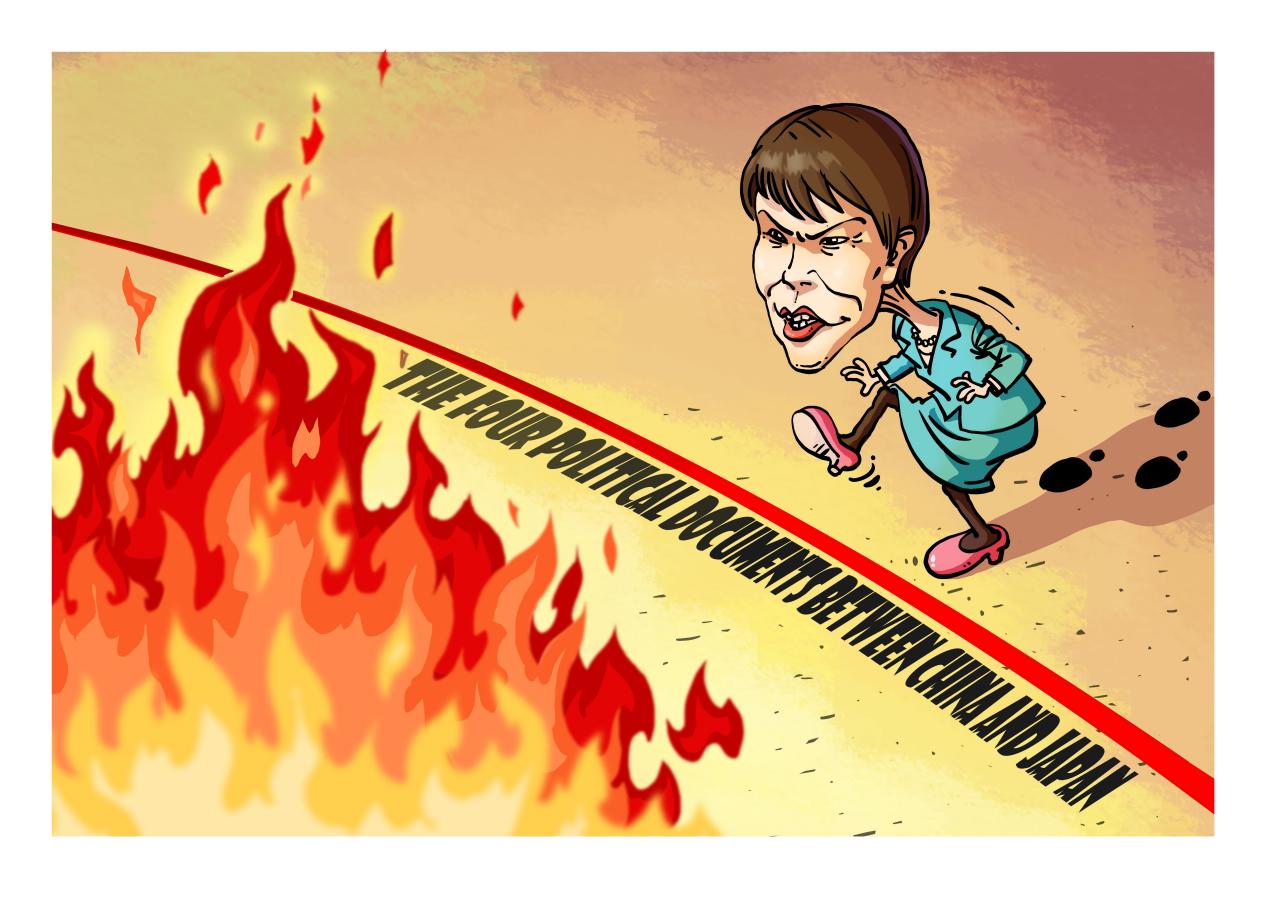
漫评:“越界”
人民网-国际频道 原创稿· 2025-12-08 08:00
Group 1 - The core viewpoint of the article highlights the recent controversial statements made by Japanese Prime Minister Sanae Takaichi regarding Taiwan, which contradict the One China principle and the spirit of the four political documents between China and Japan [3] - Takaichi's assertion that Japan's stance on the Taiwan issue remains unchanged since the 1972 Japan-China Joint Communiqué is seen as an evasion and a manipulation of language, failing to address China's repeated inquiries and criticisms from both domestic and international communities [3] - The article emphasizes that the Taiwan issue is a core interest of China and represents an inviolable red line and bottom line that should not be crossed [3]

外交部:高市早苗突出非法无效的“旧金山合约”是错上加错
Xin Hua She· 2025-11-27 08:20
Core Viewpoint - The Chinese Foreign Ministry criticizes Japanese Prime Minister Fumio Kishida for emphasizing the "San Francisco Peace Treaty," which is deemed illegal and invalid, while neglecting the "Cairo Declaration" and "Potsdam Proclamation," which have established international legal standing and are highlighted in bilateral agreements [1] Group 1 - The Chinese government asserts that Kishida's remarks undermine the political foundation of Sino-Japanese relations as established in four key political documents [1] - The statement indicates that Kishida's actions reflect a lack of remorse and a continued challenge to the post-war international order and basic principles of international law [1] - The Chinese side calls for the international community to remain vigilant against such provocations and urges Japan to reflect on its statements and fulfill its commitments to China [1]
日方所谓“一贯立场”的具体内容到底是什么?
Ren Min Ri Bao· 2025-11-24 22:31
Core Viewpoint - The Chinese government emphasizes the importance of Japan adhering to the "One China" principle and the commitments made in the four political documents between China and Japan, particularly regarding Taiwan's status [1][2]. Group 1: China's Position on Japan's Statements - The Chinese government criticizes Japan for reiterating its stance on Taiwan without providing specific details, suggesting that such reiteration is meaningless if it does not reflect concrete actions [1]. - The spokesperson urges Japan to take China's serious demands seriously and to reflect on its actions, emphasizing the need for Japan to align its statements with its commitments to China [2]. Group 2: Historical Context and Commitments - The Chinese government highlights the historical commitments made in the 1972 Sino-Japanese Joint Statement, which recognizes the People's Republic of China as the sole legitimate government of China and asserts that Taiwan is an inseparable part of China [2]. - The spokesperson questions why Japan cannot accurately restate its commitments regarding the "One China" principle and urges Japan to avoid double standards in its approach to China [2].
毒化中日关系必将自食恶果(钟声)
Ren Min Ri Bao· 2025-11-18 22:51
Core Viewpoint - The statements made by Japanese Prime Minister Sanae Takaichi regarding potential military intervention in the Taiwan Strait represent a serious violation of China's sovereignty and the political foundation of Sino-Japanese relations, causing significant harm to the feelings of the Chinese people [1][3][4] Summary by Sections Sino-Japanese Relations - The Taiwan issue is fundamental to the mutual trust between China and Japan, as established in the 1972 Sino-Japanese Joint Statement, which recognizes Taiwan as an inseparable part of China [2] - The four political documents between China and Japan reaffirm the commitment to the principles outlined in the Joint Statement regarding Taiwan, which are legally binding and must be adhered to by any Japanese government [2] Political Responsibility - As a national leader, Takaichi should demonstrate political responsibility and work towards the healthy development of Sino-Japanese relations, rather than making provocative statements that threaten regional stability [3] - Takaichi's remarks about Taiwan being a potential "survival crisis" for Japan are seen as a deliberate provocation that undermines the peace in the Taiwan Strait [3] Domestic Reactions in Japan - Takaichi's actions have faced widespread criticism from various sectors in Japan, with notable figures and media outlets condemning her statements as reckless and harmful to bilateral relations [4] - There is a growing sentiment among the Japanese public urging Takaichi to retract her statements, reflecting a desire for responsible diplomacy [4]
中方要求日方给出“明确交代”,外交部:日方必须立即收回错误言论,深刻反省,改弦更张
Huan Qiu Shi Bao· 2025-11-18 22:44
Group 1 - Japan's Prime Minister Kishi Sanae's controversial remarks regarding Taiwan have led to strong protests from China, resulting in economic and tourism repercussions for Japan [1][2][5] - Approximately 491,000 flight tickets to Japan have been canceled by Chinese airlines, representing 32% of total bookings, with a significant impact on Japan's tourism industry [4][5] - The reduction in Chinese tourists could lead to a 0.2 percentage point decrease in Japan's GDP growth if the number of visitors is halved, exacerbating the already fragile state of Japan's economy [5][6] Group 2 - The Japanese government is facing criticism from within, with calls for Prime Minister Kishi to reconsider her statements and actions that have escalated tensions with China [6][8] - There are concerns that Kishi may visit the Yasukuni Shrine, which could further strain Japan-China relations and provoke international backlash [7][8] - The ongoing diplomatic tensions have narrowed communication channels between Japan and China, complicating efforts to resolve the situation [3][8]
高市早苗被喊“下台”
证券时报· 2025-11-16 04:19
Core Viewpoint - The article discusses the public protests in Japan against Prime Minister Sanna Takashi's controversial remarks regarding China and Taiwan, highlighting the growing domestic and international tensions resulting from her statements [1][3]. Group 1: Public Response - Hundreds of Japanese citizens gathered in front of the Prime Minister's residence in Tokyo to protest against Sanna Takashi's remarks, demanding her resignation [1]. - Protesters chanted slogans such as "Withdraw the statement, apologize quickly" and "Those who cannot handle diplomacy do not deserve to be Prime Minister" [3]. Group 2: Political Reactions - Several Japanese lawmakers have called for Takashi to retract her statements regarding Taiwan, arguing that they exacerbate tensions between Japan and China [4]. - Notable former Prime Ministers, including Yoshihiko Noda and Yukio Hatoyama, have issued warnings regarding Takashi's provocative comments [3]. Group 3: Legal and Political Implications - During a parliamentary session, Takashi stated that military intervention in Taiwan could constitute a "survival crisis situation," which would allow Japan to exercise collective self-defense even without a direct attack [5]. - Despite the backlash, Takashi maintained that her comments align with the government's longstanding position and showed no intention of retracting them [5].

日媒:冲绳民众在日本国会举行抗议集会,反对政府以预备所谓“台湾有事”为由加强军备
Huan Qiu Wang· 2025-11-14 10:48
Core Viewpoint - The protests in Okinawa against the Japanese government's military buildup in response to potential Taiwan-related conflicts highlight local concerns about becoming a frontline in future conflicts [1][2]. Group 1: Public Sentiment and Protests - Okinawa residents held a protest in the Japanese parliament, questioning the government's military strategy and expressing fears of repeating the traumatic experiences of World War II [1]. - Protesters emphasized the proximity of U.S. military and Japanese Self-Defense Forces facilities to civilian areas, raising concerns about the potential for these locations to become targets in a conflict [1]. Group 2: Political Statements and Reactions - Japanese Prime Minister Sanae Takaichi's remarks regarding the potential for military intervention in Taiwan have been labeled as dangerous by local officials, urging for thorough political discussions before escalating military preparations [1]. - The Chinese Foreign Ministry condemned Takaichi's statements as provocative and a violation of the One China principle, demanding Japan retract its comments or face consequences [2].
外交部:如日方胆敢武力介入台海局势,中方必将迎头痛击
财联社· 2025-11-13 08:19
Core Viewpoint - The article discusses the strong opposition from China regarding Japanese Prime Minister Fumio Kishida's remarks about potential military intervention in Taiwan, emphasizing that such statements violate China's sovereignty and the One China principle [1][2][3]. Group 1: China's Response to Japan's Statements - China firmly opposes Japan's remarks and demands immediate correction, stating that any consequences will be borne by Japan if it does not retract its statements [2]. - The article highlights the historical context of Japan's colonial rule over Taiwan and its past militaristic actions, questioning the intentions behind Kishida's comments [2]. - China asserts that the Taiwan issue is a domestic matter and warns Japan against interfering, labeling any military intervention as an act of aggression [3]. Group 2: Historical Context and Implications - The article references the 80th anniversary of the victory in the Chinese People's War of Resistance against Japanese Aggression, linking it to Japan's historical actions and questioning its current political motives [2]. - It raises concerns about Japan potentially repeating its militaristic past and disrupting the post-war international order [2]. - The article emphasizes the need for Japan to reflect on its historical responsibilities and cease provocative actions regarding Taiwan [3].

高市早苗高调炒作会面中国台湾当局人员,外交部:性质和影响恶劣
Guan Cha Zhe Wang· 2025-11-01 14:38
Core Viewpoint - The Chinese Foreign Ministry strongly opposes Japanese Prime Minister's actions during the APEC meeting, which are seen as a violation of the One China principle and detrimental to China-Japan relations [1] Group 1: Japan's Actions - Japanese Prime Minister Suga Yoshihide's meetings with Taiwan officials during the APEC conference are viewed as a serious breach of the One China principle and international relations norms [1] - The high-profile promotion of these meetings on social media is interpreted as sending a dangerous signal to pro-independence forces in Taiwan [1] Group 2: China's Response - China has lodged a formal protest and strong objections to Japan regarding these actions [1] - The Taiwan issue is emphasized as a core interest for China, affecting the political foundation of China-Japan relations [1] Group 3: Historical Context - The year marks the 80th anniversary of the victory in the Anti-Japanese War and the recovery of Taiwan, highlighting Japan's historical responsibilities regarding Taiwan [1] - China urges Japan to adhere to the spirit of the four political documents between China and Japan and to reflect on its actions to mitigate negative impacts [1]