中美半导体博弈

Search documents
18个月后再加税!美国对华芯片施压,不到24小时,中方强硬表态
Sou Hu Cai Jing· 2025-12-26 11:22
Core Viewpoint - The Trump administration's decision to impose tariffs on Chinese semiconductor imports, effective June 2027, reflects a strategic maneuver in the semiconductor industry, allowing for an 18-month buffer period for negotiations and adjustments [1][20]. Group 1: U.S. Semiconductor Strategy - The U.S. is targeting mature process chips (28nm and above), which are essential for various industrial applications, from household appliances to automotive technologies [5]. - The U.S. faces a dilemma as it has also invested hundreds of billions in domestic semiconductor production, while predicting a surplus of over 30% in global mature process capacity by 2030 [7]. - Immediate tariffs could further undermine market confidence, risking the viability of new U.S. semiconductor facilities [8]. Group 2: Supply Chain Dependencies - The U.S. heavily relies on China for critical raw materials like gallium and germanium, which are essential for semiconductor manufacturing [10]. - Restrictions on rare earth exports from China have already impacted U.S. defense contractors, highlighting the interdependence of the two nations in the semiconductor supply chain [12]. Group 3: Bilateral Negotiation Dynamics - The delay in imposing tariffs serves as a bargaining chip for the U.S. to negotiate reductions in Chinese semiconductor subsidies and relaxations in rare earth export controls [20]. - Simultaneously, China aims to leverage this situation to seek eased restrictions on advanced semiconductor exports to the U.S. and halt unwarranted sanctions against its tech firms [20]. Group 4: Potential Market Impact - A complete breakdown in negotiations could lead to a significant increase in global chip prices, estimated to rise by 35% to 65%, resulting in substantial additional costs for U.S. consumers [22].



美国一份报告欲彻底封杀中国芯片?祭出史上最严稀土管制措施应对
Sou Hu Cai Jing· 2025-10-10 04:41
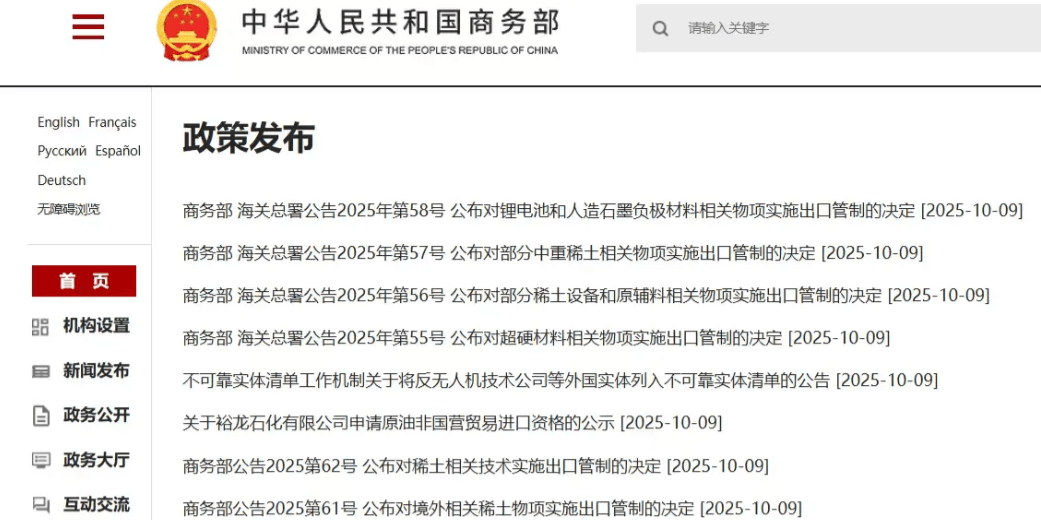
Core Viewpoint - The recent export control announcements by the Ministry of Commerce and the General Administration of Customs of China focus on rare earths, lithium batteries, and graphite materials, which have significant implications for global supply chains and industries [1][2]. Group 1: Export Control Measures - The announcements include multiple export control decisions on rare earths and related materials, marking the strictest measures to date [2]. - The measures aim to close loopholes in rare earth transshipment and smuggling, and are closely related to the recent systematic suppression of China's semiconductor industry by the U.S. [2][6]. Group 2: U.S. Semiconductor Restrictions - The U.S. has escalated its restrictions on China's semiconductor industry, with new rules affecting foreign subsidiaries of companies with over 50% U.S. ownership [3]. - A report from the U.S. House of Representatives highlights that China imported semiconductor manufacturing equipment worth $38 billion from U.S. and allied companies last year, indicating the strategic importance of these imports for Chinese firms like SMIC and Yangtze Memory Technologies [4]. Group 3: Strategic Importance of Rare Earths - Rare earths are critical raw materials for semiconductor production, and tightening their export could severely impact U.S. sectors reliant on high-performance chips, including AI and military applications [6][8]. - The strategy of using rare earth exports as leverage against U.S. semiconductor restrictions has previously yielded positive results for China, demonstrating the strategic value of these resources in the U.S.-China rivalry [6][8]. Group 4: Long-term Solutions - While immediate responses to U.S. restrictions are necessary, the long-term solution lies in accelerating domestic production capabilities for semiconductor equipment [8][10]. - Achieving self-sufficiency in the semiconductor supply chain is essential for China to mitigate the impact of unilateral sanctions and maintain competitive parity with the U.S. [10].