
中美货币政策

Search documents
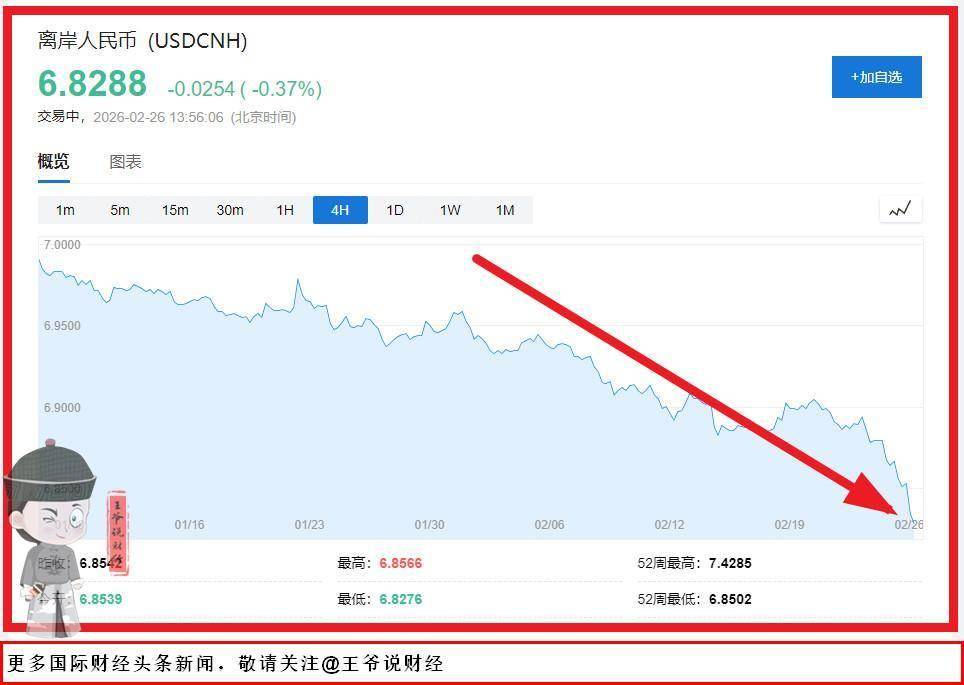
人民币突然暴涨:直接升破6.83关口!原因为何?这波升值能持续多久?美元霸权真的要凉凉吗?
Sou Hu Cai Jing· 2026-02-26 08:49
Core Viewpoint - The recent surge in the Renminbi (RMB) against the US dollar, breaking the 6.83 mark, is attributed to a combination of factors including shifts in monetary policy, economic recovery in China, and a global trend towards de-dollarization [1][20]. Group 1: RMB Exchange Rate Movement - On February 26, 2026, both onshore and offshore RMB broke the critical 6.83 level against the US dollar, with offshore RMB reaching a high of 6.83875, marking a three-year peak [1]. - In just three trading days, the RMB appreciated nearly 1%, with a cumulative increase of over 2.4% since the beginning of the year [3]. Group 2: Reasons for RMB Strength - The first core reason for the RMB's strength is the historical shift in US monetary policy, with expectations of at least two interest rate cuts by the Federal Reserve in 2026, leading to a weakening dollar [9][10]. - The second reason is the continuous recovery of China's economic fundamentals, with key indicators such as PMI and consumer spending showing significant improvement, boosting confidence in RMB assets [12][13]. - The third reason is the accelerating trend of de-dollarization globally, with an increasing number of countries using RMB for cross-border trade settlements, which enhances the demand for RMB [14][15]. Group 3: Impact of RMB Appreciation - The appreciation of the RMB has tangible benefits for ordinary citizens, including lower costs for foreign travel, imported goods, and potentially reduced fuel costs due to lower import prices for crude oil [17]. - While there may be short-term pressures for exporters, a stable exchange rate is expected to benefit foreign trade in the long run [17]. Group 4: Future Outlook for RMB - In the short term, the RMB is expected to have further appreciation potential, supported by ongoing foreign capital inflows and a recovering domestic economy [18][21]. - However, it is noted that the RMB will not experience a one-sided surge, and fluctuations will remain the norm, with the central bank aiming to maintain stability in the exchange rate [21].

对当前中美债市交易逻辑和货币政策不同点的分析与展望
2025-05-07 15:20
Summary of Key Points from the Conference Call Industry or Company Involved - The analysis focuses on the monetary policies and economic conditions of the United States and China, particularly in relation to their bond markets and inflation dynamics. Core Insights and Arguments - **Divergent Monetary Policy Goals**: Both the US and China have aligned on the timing of monetary easing, but their objectives differ significantly. The US aims to reduce high inflation (with a core CPI reaching 6% in 2023), while China seeks to boost demand and escape negative CPI growth. The core CPI differential has narrowed to 2.3% but remains high, indicating a clear demand disparity [1][2][3]. - **Policy Focus**: The US Federal Reserve prioritizes inflation and employment, making decisions based on economic conditions. In contrast, the People's Bank of China (PBOC) pursues multiple goals, including stable growth, stable exchange rates, and risk prevention, emphasizing cross-cycle adjustments [1][4]. - **Market Expectations vs. Official Predictions**: Market expectations for the Federal Reserve to cut rates by 75 basis points starting in July are more optimistic than the Fed's own forecast of 50 basis points. The impact of tariffs on inflation is anticipated to manifest in the coming months, but the recession effects may take longer to materialize [1][5][8]. - **Inflation vs. Employment Conflict**: Fed Chair Powell indicated that in cases of conflict between inflation and employment targets, controlling inflation takes precedence. This suggests a current focus on the inflationary effects of tariffs rather than immediate recession risks [6][7]. - **Supply and Demand Issues**: The US faces supply shortages and aims to enhance domestic production through manufacturing return and tariff policies. Conversely, China is grappling with insufficient demand and is looking to stabilize expectations and increase consumer income to boost consumption [3][9]. - **Chinese Bond Market Outlook**: The Chinese bond market is expected to experience limited interest rate fluctuations in the short term, with no significant policy changes anticipated following the April Politburo meeting. The impact of US tariffs on Chinese exports is becoming evident, but economic data may not provide further clarity until later in the year [10][13]. - **Liquidity Environment**: The current liquidity environment is relatively tight compared to the previous year, which may hinder a smooth downward trend in bond yields. The market is characterized by high prices and limited debt relief for major banks [11]. - **Potential for Coordinated Rate Cuts**: There is little likelihood of coordinated rate cuts between the US and China in the near term, as the PBOC is not expected to lower rates ahead of the Fed's actions [12]. - **Future Predictions for Bond Markets**: The Chinese bond market is expected to show narrow fluctuations without significant adjustments, even if US-China negotiations progress positively. The pricing of government bonds is not entirely market-driven, which may lead to slower adjustments [13][14]. Other Important but Possibly Overlooked Content - **Economic Data Limitations**: The PMI data and other economic indicators may not fully reflect the underlying economic conditions due to their subjective nature, and significant changes may not be evident until later in the year [10]. - **Market Sentiment**: The current market sentiment is more influenced by confidence factors rather than actual data, indicating a potential disconnect between market expectations and economic realities [8].