
中国经济基本面

Search documents
人民币突然暴涨:直接升破6.83关口!原因为何?这波升值能持续多久?美元霸权真的要凉凉吗?
Sou Hu Cai Jing· 2026-02-26 08:49
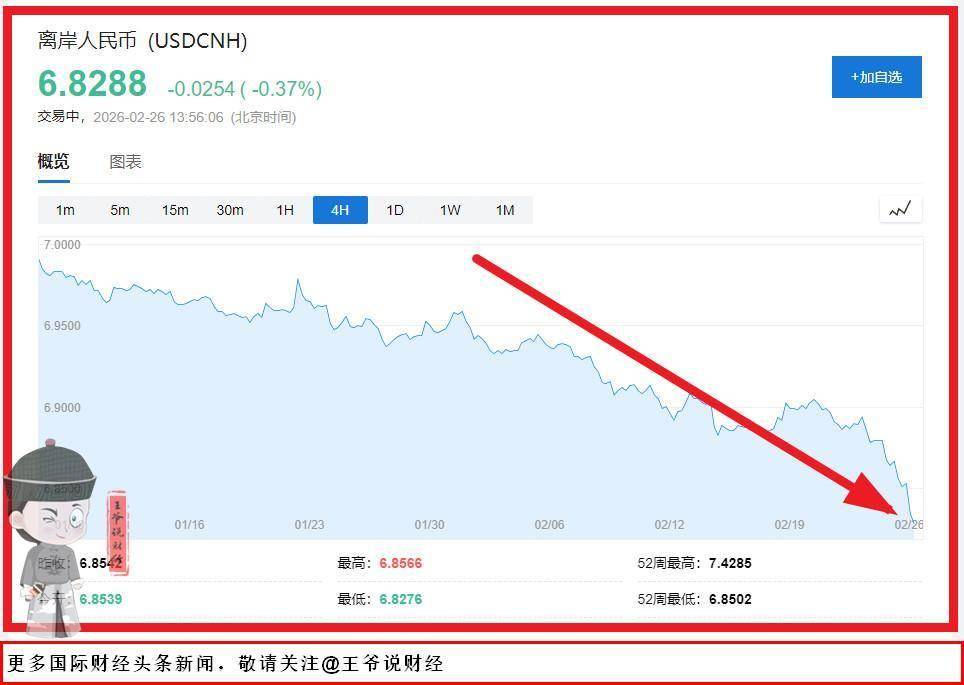
Core Viewpoint - The recent surge in the Renminbi (RMB) against the US dollar, breaking the 6.83 mark, is attributed to a combination of factors including shifts in monetary policy, economic recovery in China, and a global trend towards de-dollarization [1][20]. Group 1: RMB Exchange Rate Movement - On February 26, 2026, both onshore and offshore RMB broke the critical 6.83 level against the US dollar, with offshore RMB reaching a high of 6.83875, marking a three-year peak [1]. - In just three trading days, the RMB appreciated nearly 1%, with a cumulative increase of over 2.4% since the beginning of the year [3]. Group 2: Reasons for RMB Strength - The first core reason for the RMB's strength is the historical shift in US monetary policy, with expectations of at least two interest rate cuts by the Federal Reserve in 2026, leading to a weakening dollar [9][10]. - The second reason is the continuous recovery of China's economic fundamentals, with key indicators such as PMI and consumer spending showing significant improvement, boosting confidence in RMB assets [12][13]. - The third reason is the accelerating trend of de-dollarization globally, with an increasing number of countries using RMB for cross-border trade settlements, which enhances the demand for RMB [14][15]. Group 3: Impact of RMB Appreciation - The appreciation of the RMB has tangible benefits for ordinary citizens, including lower costs for foreign travel, imported goods, and potentially reduced fuel costs due to lower import prices for crude oil [17]. - While there may be short-term pressures for exporters, a stable exchange rate is expected to benefit foreign trade in the long run [17]. Group 4: Future Outlook for RMB - In the short term, the RMB is expected to have further appreciation potential, supported by ongoing foreign capital inflows and a recovering domestic economy [18][21]. - However, it is noted that the RMB will not experience a one-sided surge, and fluctuations will remain the norm, with the central bank aiming to maintain stability in the exchange rate [21].

人民币“破7”冷思考 2026年升值动能与回调压力并存
2 1 Shi Ji Jing Ji Bao Dao· 2026-01-05 00:34
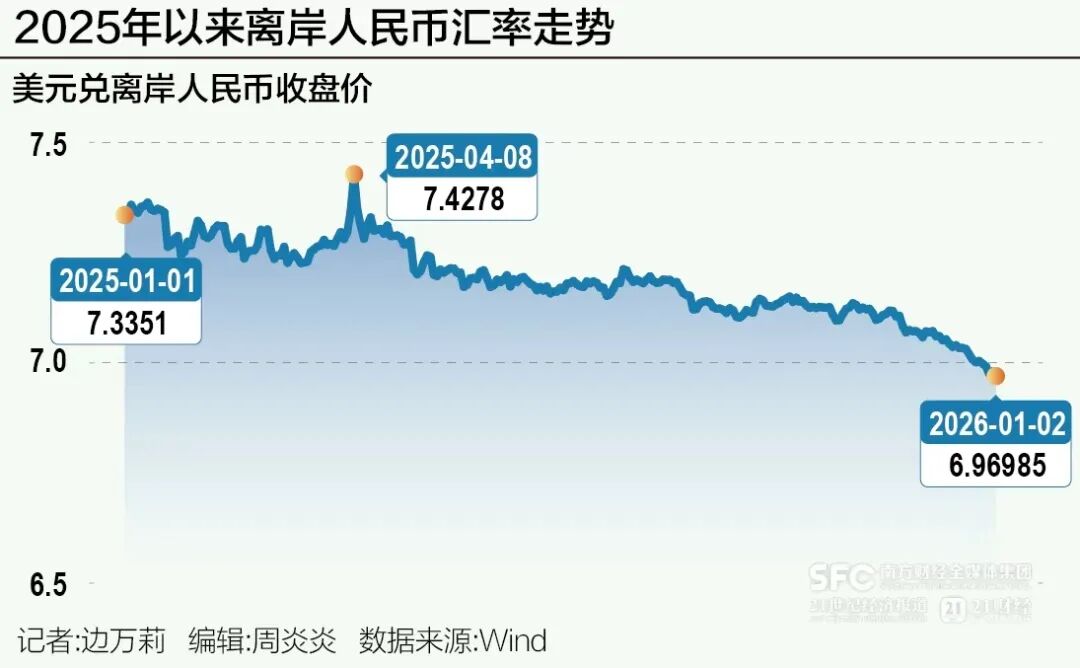
Core Viewpoint - The RMB/USD exchange rate is expected to experience both appreciation momentum and adjustment pressure in 2026, influenced by various economic factors and external uncertainties [1][8]. Group 1: Exchange Rate Trends - In 2025, the RMB/USD exchange rate exhibited a "weak first, strong later" trend, fluctuating between 7.30 and 7.35 until early April, before turning to an upward trend [1][2]. - By the end of 2025, both offshore and onshore RMB rates broke the psychological barrier of "7", reaching new highs since September 2024 and May 2023, respectively [1][3]. - The appreciation of the RMB is attributed to a weaker USD, stable Chinese economic fundamentals, and increased demand for currency settlement at year-end [1][2][3]. Group 2: Factors Influencing RMB Appreciation - The weakening of the USD is identified as a primary driver for the recent RMB appreciation, with the USD index dropping significantly after peaking above 100 in November [3][6]. - Seasonal factors also play a role, as historical trends show that the RMB tends to appreciate at the end of the year due to increased currency settlement needs from exporters [4][5]. - The strong performance of exports and the attractiveness of RMB-denominated assets have further supported the RMB's rise [6][8]. Group 3: Future Outlook - The People's Bank of China (PBOC) aims to maintain the RMB exchange rate at a reasonable and balanced level, emphasizing the prevention of excessive fluctuations [7][8]. - In 2026, the RMB is likely to experience a dual-directional fluctuation rather than a one-sided trend, with potential appreciation driven by favorable domestic and international conditions [1][8][9]. - Analysts predict that the RMB/USD exchange rate will likely remain within the range of 6.9 to 7.3, influenced by various economic factors and market dynamics [9].
人民币汇率破7背后
2 1 Shi Ji Jing Ji Bao Dao· 2026-01-04 14:56
Core Viewpoint - The RMB/USD exchange rate is expected to experience a "weak first, strong later" trend in 2025, with the rate fluctuating between 7.30 and 7.35 until early April, followed by a significant appreciation towards the end of the year, breaking the key psychological level of "7" [1][4][6]. Group 1: Factors Influencing RMB Appreciation - The recent appreciation of the RMB is attributed to multiple factors, including a weakening USD, a stable Chinese economic fundamental, and increased demand for currency settlement at year-end [1][6][8]. - The RMB's rise is supported by the resilience of exports and the attractiveness of RMB-denominated assets, which have contributed to the upward pressure on the currency [8][10]. - The correlation between the USD index and the RMB exchange rate indicates that a 3% depreciation in the USD typically corresponds to a 1% appreciation in the RMB, highlighting the impact of USD movements on RMB valuation [6][8]. Group 2: Seasonal and Market Dynamics - Seasonal factors also play a role in the RMB's appreciation, with historical trends showing stronger appreciation at the end of the year due to increased settlement needs from exporters [7][8]. - The end-of-year settlement demand from export enterprises has been identified as a significant driver for the RMB's rise, as companies accelerate currency conversion to avoid exchange losses [8][10]. - The market sentiment has shifted, with previously bearish views on the RMB reversing as Chinese assets become more attractive compared to US assets, leading to a reversal of previously held foreign capital [8][10]. Group 3: Outlook for 2026 - The People's Bank of China (PBOC) aims to maintain the RMB exchange rate at a reasonable and balanced level, emphasizing the prevention of excessive fluctuations and the need for a stable monetary policy [10][11]. - Factors that may support the RMB in 2026 include a potential weakening of the USD due to economic pressures and a rebound in the Chinese economy, which could sustain the RMB's appreciation momentum [11][12]. - The RMB is expected to maintain a dual-directional fluctuation pattern, with projections indicating a trading range between 6.9 and 7.3 against the USD throughout 2026 [12].
IMI锐评|如何理解人民币汇率的阶段性升值?
Sou Hu Cai Jing· 2025-12-30 06:49
Core Viewpoint - The offshore RMB/USD exchange rate has surpassed the 7.0 mark for the first time since September 2024, indicating a phase of strengthening for the RMB against the USD driven by multiple factors including adjustments in Federal Reserve policy, fluctuations in the USD index, and improvements in domestic policy expectations [1] Group 1: RMB Exchange Rate Trends - In 2025, the RMB exhibited a "first suppressed then rising" trend, with a significant depreciation in early months due to external pressures, followed by a recovery starting in May, leading to a 3.76% appreciation in the offshore RMB by the end of November [2] - The offshore RMB reached a high of 7.0 against the USD on December 25, marking a significant recovery from a low of 7.40 earlier in the year [2] Group 2: Drivers of RMB Appreciation - Four main factors driving the RMB's recent strength include: 1. Domestic economic resilience with a growth rate of 5.2% in the first three quarters, providing fundamental support for the exchange rate [4] 2. A shift in macroeconomic narrative towards positive developments in technology and innovation, leading to a revaluation of Chinese assets [4] 3. A weakening USD due to concerns over U.S. economic prospects and fiscal sustainability, which has supported the RMB [5] 4. Improved Sino-U.S. trade relations following negotiations that led to reduced tariffs and eased market tensions [4] Group 3: Internal Foundations for RMB Strength - The RMB's potential for moderate appreciation is supported by a favorable economic growth outlook, with expectations of GDP growth above 4% in the coming years, contrasting with the U.S. growth rate below 3% [8] - Rising household incomes and structural reforms aimed at achieving common prosperity are expected to enhance the RMB's real exchange rate [9] - A sustained current account surplus, driven by strong goods trade, is anticipated to provide ongoing support for RMB appreciation [10] Group 4: Policy Management of RMB Exchange Rate - The People's Bank of China (PBOC) aims to maintain stability in the RMB exchange rate, emphasizing the prevention of excessive fluctuations while allowing for a reasonable appreciation [11] - The PBOC's approach includes using counter-cyclical factors to stabilize the exchange rate amid external pressures, ensuring that the RMB remains within a reasonable range [7] Group 5: Future Outlook for RMB Exchange Rate - Factors favoring RMB appreciation include potential further interest rate cuts by the Federal Reserve, which could weaken the USD [13] - The ongoing stabilization of Sino-U.S. trade relations and the strengthening of the Chinese economy are expected to support the RMB's upward trajectory [14] - The RMB is projected to fluctuate between 6.8 and 7.2 against the USD in 2026, with a potential for slight appreciation due to favorable internal and external conditions [18][19]
2026年人民币走势预测与展望
Sou Hu Cai Jing· 2025-12-25 04:26
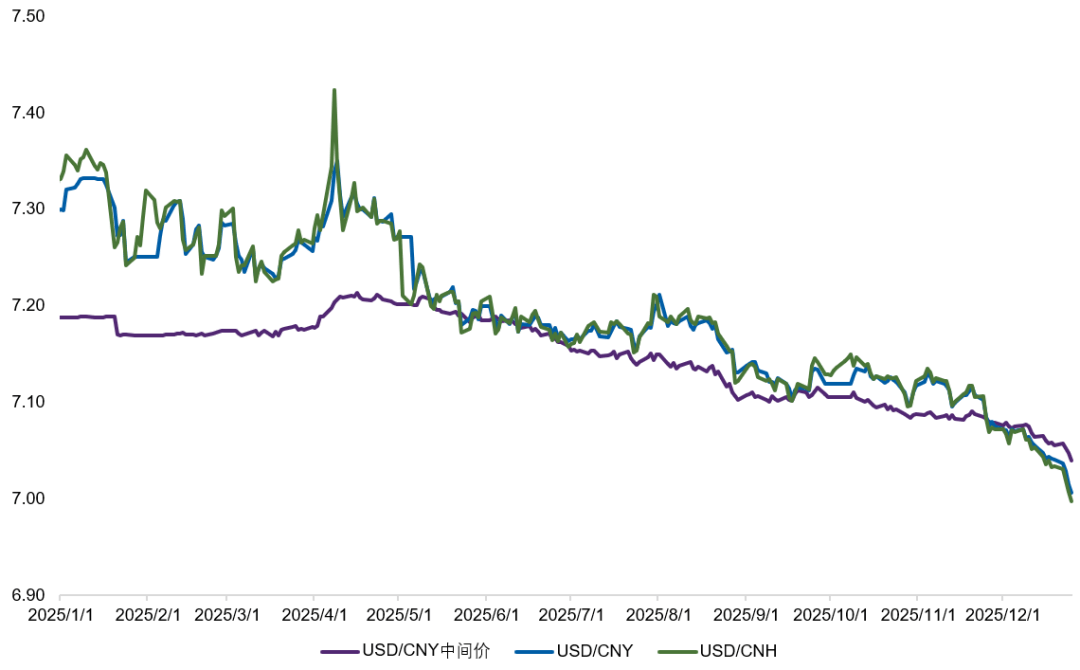
Core Viewpoint - In 2025, the RMB exchange rate exhibited a "weak first, strong later, and narrowing fluctuations" trajectory, with the offshore RMB successfully breaking the 7 key level by year-end, laying a strong foundation for 2026 [2][3] Summary by Sections 2025 Review - The RMB/USD exchange rate can be divided into three phases: a weak phase from early January to early April, a rapid appreciation phase from early April to early July, and a moderate appreciation phase from July to year-end. The year started with an exchange rate of 7.27, hitting a low of 7.42879 in April, a depreciation of over 2.18% [3] - From April to July, the RMB appreciated over 2.58%, rising from around 7.35 to 7.16 due to clearer Fed rate cuts and improved US-China trade negotiations [3] - By December 24, the offshore RMB surpassed 7.01, resulting in an overall appreciation of over 4% for the year, while the onshore RMB depreciated by 3.83% [3] Exchange Rate Characteristics - In 2025, the RMB showed a "strong against the USD, weak against a basket of currencies" characteristic, with the CFETS RMB index down 4.1% and the RMB depreciating against the euro by 8.5% and the Mexican peso by 10.5% [4] - The market structure improved, with a shift from a deficit of $39.243 billion in January to a surplus of $51.758 billion by September, indicating a positive cycle of expectations, capital inflow, and exchange rate appreciation [4] Core Driving Logic - The RMB's appreciation in 2025 was driven by both external and internal factors, with the Fed's monetary policy shift being the most critical variable. Since September 2025, the Fed has cut rates by 0.75 percentage points, contributing to a structural weakening of the USD [5] - Internally, China's economic resilience, capital inflows, and policy support formed a threefold force, with GDP growth exceeding expectations and a stable trade surplus providing a solid foundation for the RMB [6] Seasonal Factors - Seasonal factors, particularly pre-Spring Festival capital settlement behaviors, significantly contributed to the RMB's year-end appreciation, with December typically seeing the highest levels of bank settlement surplus [7] 2026 Outlook - The RMB is expected to maintain a "moderate appreciation" trend in 2026, with a predicted range of 6.7 to 7.2 against the USD. Various institutions forecast the year-end exchange rate to be between 6.7 and 7.0 [8][9] - Three potential scenarios for 2026 include a baseline scenario of gradual appreciation, an optimistic scenario with significant appreciation due to strong domestic recovery, and a pessimistic scenario where the RMB faces downward pressure due to economic challenges [9] Impact on Economy and Capital Markets - The anticipated RMB appreciation will lower import costs and improve corporate profitability, particularly benefiting industries reliant on imports [11] - Conversely, export-oriented companies may face profit pressures due to exchange rate fluctuations, necessitating effective risk management strategies [11] - The RMB's appreciation is expected to attract foreign capital, with historical data showing a positive correlation between exchange rate increases and foreign investment inflows [12] Policy Implications - The central bank's approach will balance "stabilizing the exchange rate" and "promoting openness," emphasizing market-driven exchange rate formation while supporting RMB internationalization [14] - The ongoing reforms and policy measures aim to enhance the RMB's global standing and stabilize its exchange rate, creating a favorable environment for high-quality economic development [14]
离岸人民币升破7关口!看好港股资产
Sou Hu Cai Jing· 2025-12-25 03:57
Core Viewpoint - The offshore RMB has surpassed the 7.0 mark against the USD for the first time since September 2024, indicating a strengthening of the Chinese currency [1] Group 1: Currency Performance - The onshore RMB reached a high of 7.0061 against the USD [1] - Historical trends show that during periods of RMB appreciation, Hong Kong assets such as the Hang Seng Index and Hang Seng Tech Index tend to perform well [1] Group 2: Economic Context - The current environment is characterized by a Federal Reserve interest rate cut cycle, which has weakened the USD and created a favorable external environment for RMB appreciation [1] - The resilience and attractiveness of the Chinese economy provide solid fundamental support for the RMB's rise [1] - The approaching year-end may lead to a release of settlement demand, further supporting the RMB's appreciation [1] Group 3: Related ETFs - Relevant ETFs include the Hang Seng Tech Index ETF (513180), which focuses on Chinese AI core assets [2] - The Hong Kong Stock Connect Technology ETF (159101) is noted for its high elasticity characteristics [2] - The Hang Seng ETF (159920) serves as a core broad-based investment in the Hong Kong market [2]
人民币悄然走强背后:三大市场推力与你的钱袋子
Sou Hu Cai Jing· 2025-12-21 11:42
Group 1 - The core point of the article is that the recent strengthening of the Chinese yuan is driven by solid economic fundamentals, changes in international trade dynamics, and the ongoing internationalization of the yuan [1][3][5] Group 2 - China's economic fundamentals provide a stabilizing effect for the yuan, with a complete industrial chain and a large domestic market supporting its strength [1] - The resilience of Chinese exports has increased foreign exchange earnings, leading to a favorable supply-demand relationship for the yuan [3] - The divergence in global monetary policy, particularly the Federal Reserve's aggressive rate hikes followed by signals of a slowdown, has eased the pressure on the yuan against the dollar [3] - The internationalization of the yuan is progressing, with more countries willing to use it for trade settlements and central banks incorporating it into their foreign exchange reserves, challenging the dominance of the dollar [5] - The strengthening of the yuan has mixed effects on ordinary people, benefiting imports and overseas spending while potentially pressuring export businesses [5] - Future expectations suggest that the yuan will likely experience two-way fluctuations, with a focus on stability rather than aggressive strengthening [7] - The strengthening of the yuan reflects market confidence in the long-term prospects of the Chinese economy, driven by productive factories and innovative enterprises [7]

内外部因素共振支撑人民币走强
2 1 Shi Ji Jing Ji Bao Dao· 2025-11-28 23:21
Core Viewpoint - The recent strengthening of the Renminbi (RMB) against the US dollar is primarily driven by market expectations of a Federal Reserve interest rate cut in December, with the RMB appreciating nearly 5% from its April low of 7.43 to around 7.07, marking a new high since October 14 of last year [1] Group 1: Currency Dynamics - The RMB's appreciation is significantly influenced by the market's rising expectations for a 25 basis point rate cut by the Federal Reserve, which has increased to approximately 80% since the dovish signals from the Fed on November 21 [1] - Despite fluctuations in the US dollar index due to the depreciation of the Japanese yen, the RMB has maintained a robust position, indicating a dual strength of both the dollar and the RMB [1] - The recent RMB appreciation is largely driven by market forces, reflecting a broader trend of strengthening against most currencies [1] Group 2: Economic Fundamentals - The foundation for the RMB's strength lies in China's resilient economic fundamentals, with exports continuing to grow despite US tariffs, and a GDP growth target of 5% appearing achievable [2] - China's significant position in the global supply chain and trade system provides a strong basis for its economic resilience amid trade tensions [2] - The recent policies aimed at curbing disorderly competition have stabilized key economic indicators, alleviating market concerns about persistent price declines and interest rate cuts, thereby boosting market confidence [2] Group 3: Internationalization of the RMB - The questioning of the US dollar's credibility due to high debt levels and protectionist tendencies has created opportunities for the internationalization of the RMB, with its global trading volume rising to $817 billion daily, accounting for 8.5% of global forex trading [3] - As of the end of October, the scale of offshore RMB loans by financial institutions reached approximately 2.5 trillion yuan, reflecting a 37.5% year-on-year increase, indicating accelerated international use of the RMB [3] Group 4: Future Outlook - Given the solid economic fundamentals of China and the overarching trend of RMB internationalization, the RMB is likely to continue its strong performance [4]
人民币汇率创年内新高,外资却在疯狂抄底中国?真相令人意外
Sou Hu Cai Jing· 2025-11-21 16:43
Core Insights - The recent appreciation of the Chinese yuan against the US dollar has surprised many, with the exchange rate reaching 7.0905, a one-year high, indicating a stronger yuan compared to earlier this year when it hovered around 7.3 [1][3] - Despite concerns about capital outflows, foreign investment in Chinese assets has shown resilience, with northbound capital in A-shares increasing by over 380 billion yuan this year, reaching a total market value of 2.58 trillion yuan by the end of Q3 [3][4] Currency Exchange Rate - The yuan's exchange rate has improved significantly from earlier in the year, with a notable rise from 7.3 to 7.0905, marking a strong performance [1][3] - The dollar index peaked at 109.24 earlier this year, a historically high level, raising concerns about the yuan's potential depreciation [1][3] Foreign Investment Trends - Foreign capital has not fled the Chinese market as previously speculated; instead, it has been accumulating Chinese assets during market fluctuations [4][5] - As of November 18, foreign investors held significant stakes in several A-shares, with some exceeding 24% ownership, indicating strong interest [4] Institutional Perspectives - International investment banks and funds have expressed improved outlooks on Chinese assets, citing valuation advantages and supportive policies as key reasons for their optimism [5][6] - Short-term capital movements do not reflect a loss of confidence in the Chinese market; rather, they are part of normal portfolio adjustments [5][6] Economic Fundamentals - The long-term trajectory of the yuan will depend on economic fundamentals, with China's economy showing resilience, particularly in emerging sectors like renewable energy and digital economy [6][8] - The current exchange rate mechanism is more market-oriented, allowing for healthier fluctuations, which is a positive sign for the currency's stability [8][9] Investment Opportunities - The stable yuan provides a favorable environment for investment, with ongoing foreign capital inflows indicating the attractiveness of Chinese assets [10][12] - A stable exchange rate is beneficial for trade, reducing currency risk for businesses, although it may impact price competitiveness for exporters [10][12]
毕盛资产王国辉:看好中国经济发展“MIT”优势
Zhong Guo Zheng Quan Bao· 2025-10-15 22:31
Core Viewpoint - The founder and chairman of Bison Asset, Wang Guohui, expressed a strong bullish outlook on the Chinese capital market, citing the "MIT" advantages of Manufacturing, Innovation, and Talent as key reasons for this optimism [1][2] Group 1: Manufacturing - China has established a robust manufacturing ecosystem over the past thirty years, which includes not only factories and machinery but also a comprehensive infrastructure of ports, airports, roads, and power plants [1] - The application of artificial intelligence in manufacturing by Chinese companies is expected to enhance this advantage in the coming decades [1] Group 2: Innovation - Historically, many Chinese companies have been reluctant to invest in innovation, preferring to utilize existing technologies for short-term returns [1] - The presence of a significant number of Chinese engineers in top U.S. tech companies indicates a strong potential for innovation, with companies like DeepSeek making breakthroughs in large language models [1] Group 3: Talent - The talent pool in China includes proactive and creative entrepreneurs, engineers, and industrial workers, which is a significant source of confidence in the country's future [2] - Visits to innovative companies, such as a biotechnology firm in Chengdu with founders educated in the U.S., reinforce the belief in China's potential for future development [2]