主要原材料购进价格指数

Search documents
1月份制造业PMI为49.3%
Ren Min Ri Bao Hai Wai Ban· 2026-02-02 01:48
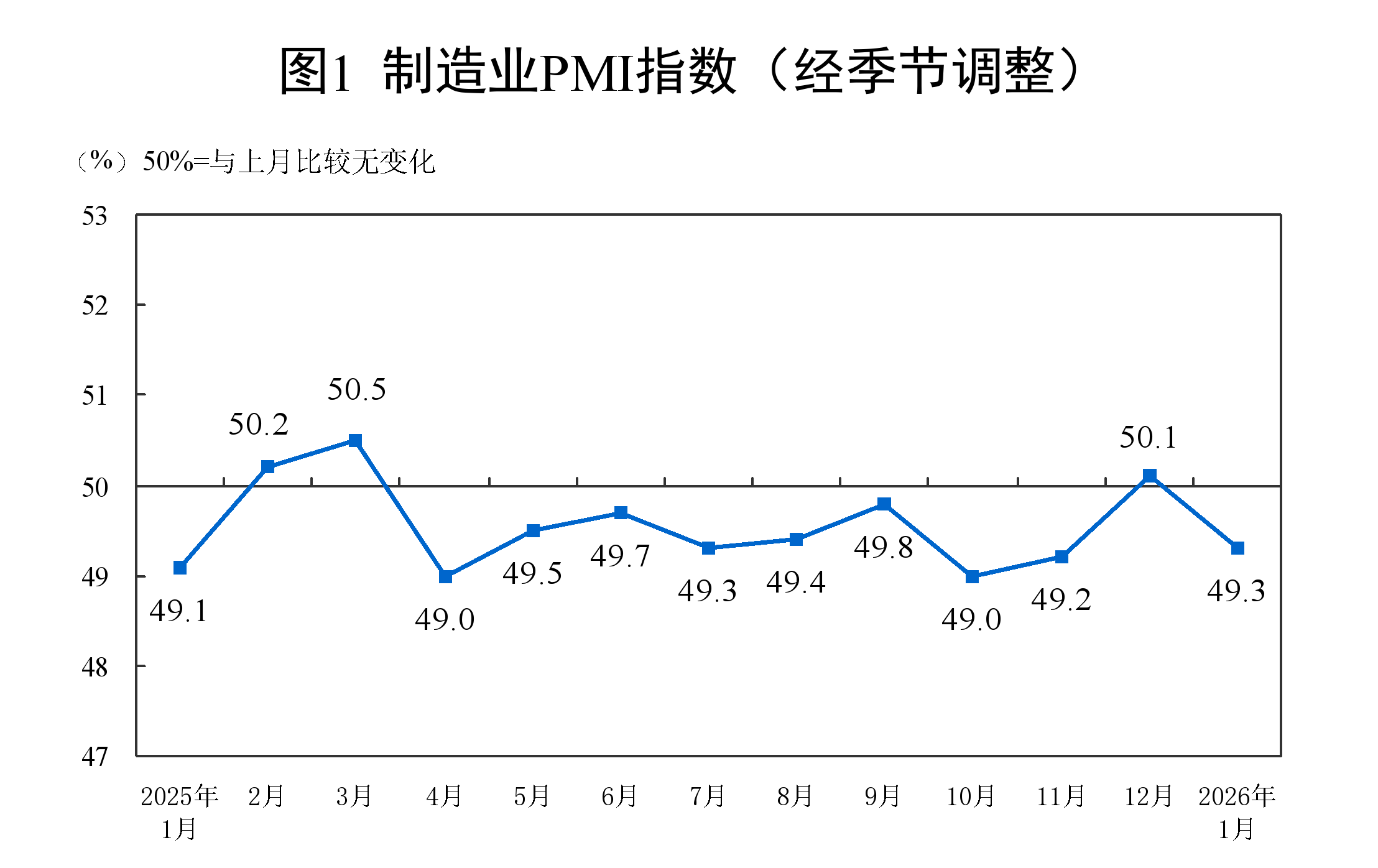
Group 1 - The manufacturing Purchasing Managers' Index (PMI) for January is 49.3%, a decrease of 0.8 percentage points from the previous month, indicating a decline in manufacturing activity due to seasonal factors and insufficient market demand [2] - The production index stands at 50.6%, indicating continued expansion in manufacturing production, while the new orders index is at 49.2%, reflecting a drop in market demand [2] - Certain industries such as agricultural processing and aerospace have production and new orders indices above 56.0%, indicating strong demand, while sectors like petroleum and automotive show indices below the critical point, suggesting a slowdown in market demand [2] Group 2 - The main raw materials purchasing price index and the factory price index are at 56.1% and 50.6%, respectively, both showing increases from the previous month, with the factory price index rising above the critical point for the first time in nearly 20 months [3] - Large enterprises maintain a PMI of 50.3%, indicating continued expansion, while medium and small enterprises show PMIs of 48.7% and 47.4%, reflecting a decline in their economic performance [3] - High-tech manufacturing leads with a PMI of 52.0%, remaining above 52.0% for two consecutive months, while consumer goods and high-energy industries show lower PMIs of 48.3% and 47.9%, indicating a decrease in their economic conditions [3] Group 3 - The production and business activity expectation index is at 52.6%, indicating optimism among enterprises, particularly in agricultural processing and food industries, which have indices above 56.0% [4] - The non-manufacturing business activity index for January is 49.4%, a decrease of 0.8 percentage points from the previous month, indicating a decline in overall non-manufacturing activity [4] - The service industry business activity index is at 49.5%, down 0.2 percentage points, with sectors like financial services showing high activity indices above 65.0%, while the real estate sector drops below 40.0%, indicating weak performance [4]

1月制造业PMI49.3%,制造业市场价格总体改善
2 1 Shi Ji Jing Ji Bao Dao· 2026-02-01 02:29
Core Viewpoint - The manufacturing Purchasing Managers' Index (PMI) in China for January is reported at 49.3%, indicating a decline of 0.8 percentage points from the previous month, reflecting a downturn in manufacturing activity [1][5][8]. Manufacturing PMI Analysis - The decline in manufacturing PMI is attributed to seasonal factors as some industries enter a traditional off-peak period, coupled with insufficient market demand [1][8]. - The production index stands at 50.6%, indicating continued expansion in manufacturing production, while the new orders index is at 49.2%, showing a decrease in market demand [6][8]. - High-tech manufacturing PMI remains strong at 52.0%, indicating sustained positive development in related industries [1][8]. Price Index Improvement - The overall price level in the manufacturing sector has improved, with the main raw materials purchasing price index at 56.1% and the factory price index at 50.6%, both showing increases from the previous month [2][14]. - The factory price index has risen above the critical point for the first time in nearly 20 months, suggesting a general improvement in manufacturing market prices [2][14]. Employment and Inventory Trends - The employment index is reported at 48.1%, indicating a slight decline in hiring conditions within the manufacturing sector [12]. - The raw materials inventory index is at 47.4%, reflecting a continued decrease in major raw material stocks, while finished goods inventory has increased, suggesting accelerated production activities ahead of the Spring Festival [13][12]. Future Expectations - The production and business activity expectation index is at 52.6%, remaining above the critical point, although it marks the lowest level since the second half of 2025 [15]. - There is a noted concern regarding the decline in new export orders, which fell to 47.8%, indicating a contraction in external demand and potential challenges for future manufacturing activity [7][15].
1月制造业PMI回落至49.3%,超3成企业反映利润下降
第一财经· 2026-01-31 10:46
Core Viewpoint - The manufacturing PMI in January fell below the growth line, indicating a decline in economic activity and a need for stronger foundational support for economic recovery [3][5]. Manufacturing Sector - The manufacturing PMI for January is reported at 49.3%, a decrease of 0.8 percentage points from the previous month, indicating fluctuations in manufacturing operations [5]. - The new orders index dropped to 49.2%, down 1.6 percentage points, reflecting a tightening of market demand [5]. - Seasonal factors and changes in the export environment are contributing to the slowdown in market demand, with the new export orders index at 47.8%, a decline of 1.2 percentage points [5][7]. - The production index remains in the expansion zone at 50.6%, despite a decrease of 1.1 percentage points, suggesting continued overall expansion in manufacturing [7]. - The prices of major raw materials and factory output have increased, with the purchasing price index at 56.1% and the factory price index at 50.6%, indicating an improvement in overall price levels in the manufacturing market [7]. Non-Manufacturing Sector - The non-manufacturing business activity index is at 49.4%, down 0.8 percentage points, primarily due to a decline in the construction sector [10]. - The service sector remains relatively stable, with the business activity index slightly decreasing by 0.2 percentage points, maintaining around 49.5% [10][11]. - The service industry anticipates a boost from the upcoming Spring Festival, with a business activity expectation index of 57.1%, indicating optimism for consumer-related services [10][11]. Economic Outlook - The overall economic climate is expected to be influenced by changes in export growth, the domestic real estate market, and the timing and intensity of growth-stimulating policies [8]. - There is potential for monetary policy easing in the second quarter, with fiscal policies aimed at boosting consumption and investment expected to gain momentum [8].
中国8月官方制造业PMI小幅回升至49.4,新订单指数升至49.5
Hua Er Jie Jian Wen· 2025-08-31 04:08
Summary of Key Points Core Viewpoint - In August, China's manufacturing sector showed slight improvement in economic sentiment, while non-manufacturing activities accelerated expansion, indicating a general trend of economic growth [1][2]. Manufacturing Sector - The Manufacturing Purchasing Managers' Index (PMI) rose to 49.4%, an increase of 0.1 percentage points from the previous month, indicating a slight improvement in manufacturing sentiment [3][5]. - The production index and new orders index both showed recovery, with the production index at 50.8%, up 0.3 percentage points, suggesting accelerated manufacturing production [5][7]. - The new orders index improved to 49.5%, reflecting a slight enhancement in market demand [5][6]. - Large enterprises reported a PMI of 50.8%, while medium and small enterprises had PMIs of 48.9% and 46.6%, respectively, indicating varying levels of economic activity across different enterprise sizes [5]. Non-Manufacturing Sector - The Non-Manufacturing Business Activity Index increased to 50.3%, up 0.2 percentage points, indicating continued expansion in the non-manufacturing sector [1][18]. - The service sector's business activity index reached 50.5%, marking a year-to-date high, with significant growth in sectors like capital market services and transportation [2][13]. - The construction sector's business activity index fell to 49.1%, indicating a decline in activity [13][16]. Price Indices - The main raw material purchase price index rose to 53.3%, and the factory price index increased to 49.1%, both showing a continuous upward trend for three months [1][2]. - The input price index for non-manufacturing remained stable at 50.3%, indicating a general increase in operational costs [16]. Future Expectations - The production and business activity expectation index for manufacturing was reported at 53.7%, suggesting increased confidence among manufacturers regarding future market conditions [2][17]. - The business activity expectation index for non-manufacturing reached 56.2%, indicating optimism about market prospects [17][18].
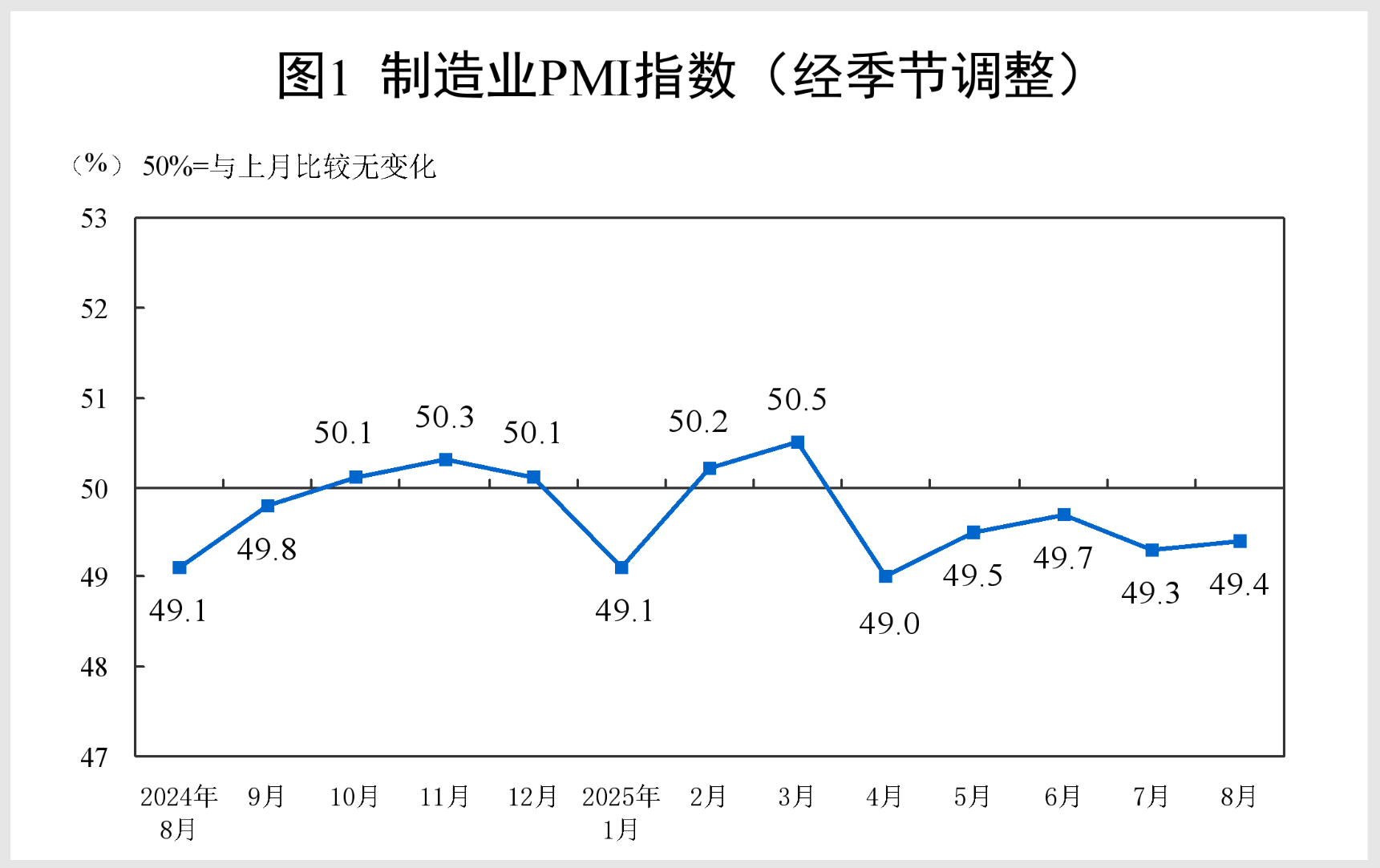
8月份我国制造业PMI为49.4%
Xin Hua She· 2025-08-31 03:57
Group 1 - The manufacturing Purchasing Managers' Index (PMI) for August is 49.4%, showing a slight increase of 0.1 percentage points from the previous month, indicating an improvement in manufacturing sentiment [1][2] - The production index stands at 50.8%, up 0.3 percentage points, marking the fourth consecutive month above the critical point, suggesting accelerated manufacturing production [1] - The new orders index is at 49.5%, reflecting a 0.1 percentage point increase, with significant performance in sectors like pharmaceuticals and computer communication electronics, while textiles and furniture industries remain below the critical point [1] Group 2 - The price index has been rising, with the main raw material purchase price index at 53.3% and the factory price index at 49.1%, both showing increases of 1.8 and 0.8 percentage points respectively, indicating an overall improvement in manufacturing market prices [1] - High-tech manufacturing PMI is at 51.9% and equipment manufacturing PMI is at 50.5%, both showing increases, which indicates sustained support and leading roles in the manufacturing sector [2] - The production and business activity expectation index is at 53.7%, up 1.1 percentage points, suggesting increased confidence among manufacturing enterprises regarding future market conditions [2]
7月份我国制造业PMI49.3%
Shen Zhen Shang Bao· 2025-07-31 19:05
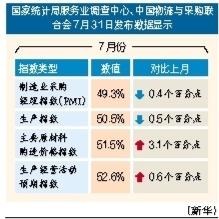
Group 1 - The Purchasing Managers' Index (PMI) for the manufacturing sector in July is reported at 49.3%, a decrease of 0.4 percentage points from the previous month [1] - The production index stands at 50.5%, indicating a slight increase of 0.5 percentage points [1] - The main raw materials purchasing price index is at 51.5%, which reflects an increase of 3.1 percentage points [1] - The production and business activity expectation index is recorded at 52.6%, showing an increase of 0.6 percentage points [1]
连续两个月回升!这一指数释放哪些信号?
Jing Ji Wang· 2025-06-30 09:13
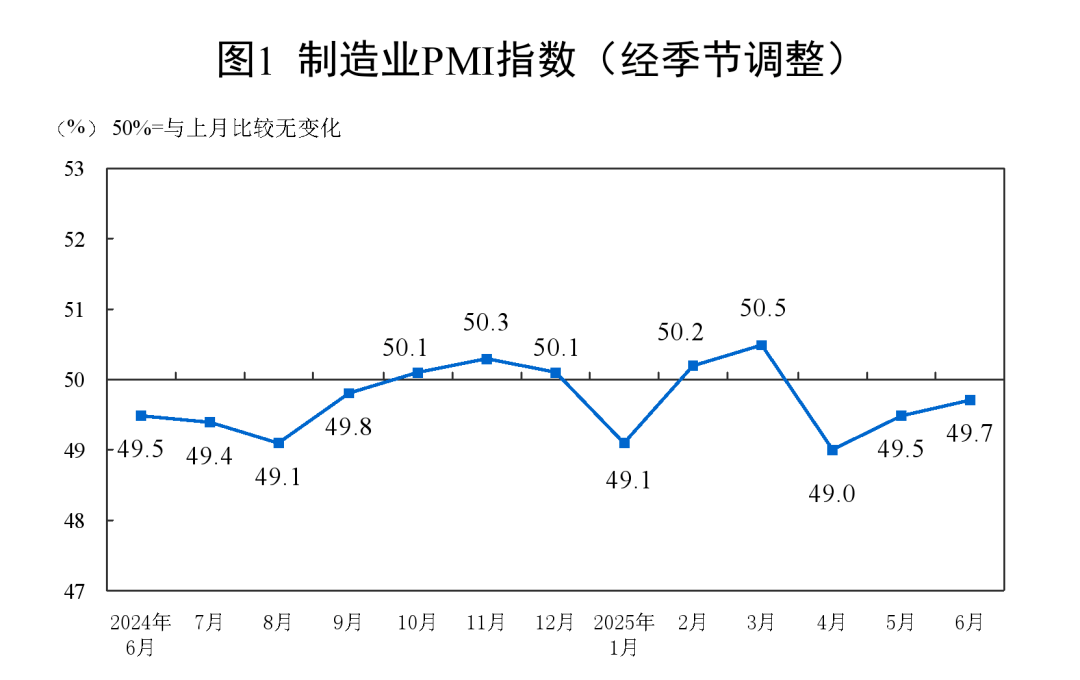
Group 1 - Manufacturing PMI has risen for two consecutive months, indicating a continued recovery in China's macro economy [5] - In June, the manufacturing PMI increased to 49.7%, with 11 out of 21 surveyed industries in the expansion zone, reflecting an improvement in manufacturing sentiment [6] - The new orders index returned to the expansion zone at 50.2%, indicating a recovery in market demand [6] Group 2 - The price index ended a three-month decline, with the main raw material purchase price index at 48.4% and the factory price index at 46.2%, both showing improvement [7] - Large enterprises' PMI rose to 51.2%, significantly supporting the overall manufacturing sector, while small enterprises' PMI fell to 47.3% [7] - The manufacturing sector is expected to maintain steady growth in the second half of the year, driven by policy support and stable market demand [7] Group 3 - The non-manufacturing business activity index was at 50.5%, indicating continued expansion in the service sector [10] - The service sector's business activity index was 50.1%, showing stability, while the business activity expectation index was at 56.0%, reflecting optimism for future growth [10] - The construction business activity index rose to 52.8%, with civil engineering construction remaining robust [11] Group 4 - Infrastructure projects are progressing rapidly, supported by special bonds for land acquisition and government investment funds [11] - The expansion of special bond allocations is expected to stimulate more infrastructure demand, contributing to stable economic growth [11]