生产指数

Search documents
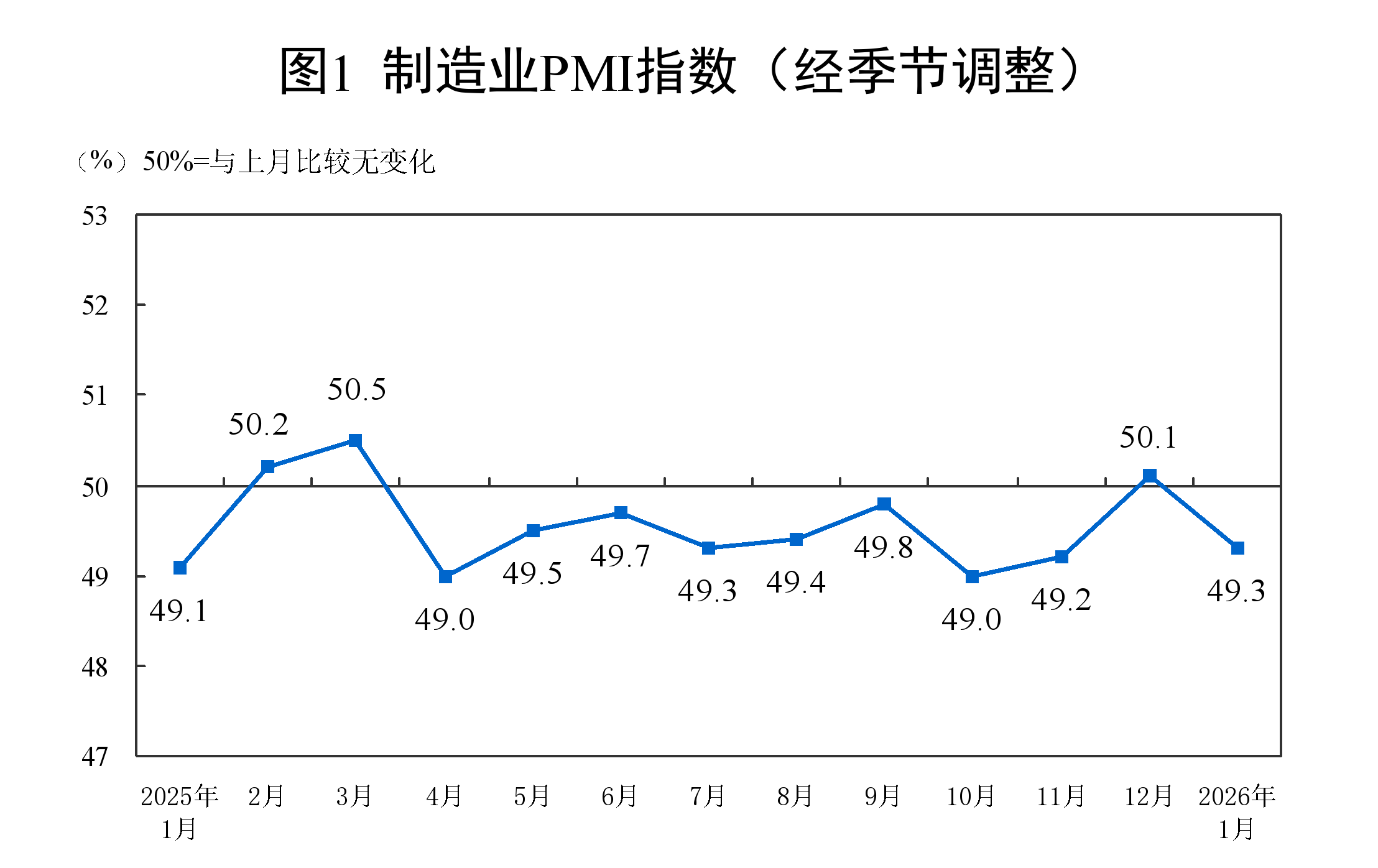
1月份制造业PMI为49.3%
Ren Min Ri Bao Hai Wai Ban· 2026-02-02 01:48
Group 1 - The manufacturing Purchasing Managers' Index (PMI) for January is 49.3%, a decrease of 0.8 percentage points from the previous month, indicating a decline in manufacturing activity due to seasonal factors and insufficient market demand [2] - The production index stands at 50.6%, indicating continued expansion in manufacturing production, while the new orders index is at 49.2%, reflecting a drop in market demand [2] - Certain industries such as agricultural processing and aerospace have production and new orders indices above 56.0%, indicating strong demand, while sectors like petroleum and automotive show indices below the critical point, suggesting a slowdown in market demand [2] Group 2 - The main raw materials purchasing price index and the factory price index are at 56.1% and 50.6%, respectively, both showing increases from the previous month, with the factory price index rising above the critical point for the first time in nearly 20 months [3] - Large enterprises maintain a PMI of 50.3%, indicating continued expansion, while medium and small enterprises show PMIs of 48.7% and 47.4%, reflecting a decline in their economic performance [3] - High-tech manufacturing leads with a PMI of 52.0%, remaining above 52.0% for two consecutive months, while consumer goods and high-energy industries show lower PMIs of 48.3% and 47.9%, indicating a decrease in their economic conditions [3] Group 3 - The production and business activity expectation index is at 52.6%, indicating optimism among enterprises, particularly in agricultural processing and food industries, which have indices above 56.0% [4] - The non-manufacturing business activity index for January is 49.4%, a decrease of 0.8 percentage points from the previous month, indicating a decline in overall non-manufacturing activity [4] - The service industry business activity index is at 49.5%, down 0.2 percentage points, with sectors like financial services showing high activity indices above 65.0%, while the real estate sector drops below 40.0%, indicating weak performance [4]

1月制造业PMI49.3%,制造业市场价格总体改善
2 1 Shi Ji Jing Ji Bao Dao· 2026-02-01 02:29
Core Viewpoint - The manufacturing Purchasing Managers' Index (PMI) in China for January is reported at 49.3%, indicating a decline of 0.8 percentage points from the previous month, reflecting a downturn in manufacturing activity [1][5][8]. Manufacturing PMI Analysis - The decline in manufacturing PMI is attributed to seasonal factors as some industries enter a traditional off-peak period, coupled with insufficient market demand [1][8]. - The production index stands at 50.6%, indicating continued expansion in manufacturing production, while the new orders index is at 49.2%, showing a decrease in market demand [6][8]. - High-tech manufacturing PMI remains strong at 52.0%, indicating sustained positive development in related industries [1][8]. Price Index Improvement - The overall price level in the manufacturing sector has improved, with the main raw materials purchasing price index at 56.1% and the factory price index at 50.6%, both showing increases from the previous month [2][14]. - The factory price index has risen above the critical point for the first time in nearly 20 months, suggesting a general improvement in manufacturing market prices [2][14]. Employment and Inventory Trends - The employment index is reported at 48.1%, indicating a slight decline in hiring conditions within the manufacturing sector [12]. - The raw materials inventory index is at 47.4%, reflecting a continued decrease in major raw material stocks, while finished goods inventory has increased, suggesting accelerated production activities ahead of the Spring Festival [13][12]. Future Expectations - The production and business activity expectation index is at 52.6%, remaining above the critical point, although it marks the lowest level since the second half of 2025 [15]. - There is a noted concern regarding the decline in new export orders, which fell to 47.8%, indicating a contraction in external demand and potential challenges for future manufacturing activity [7][15].
1月份我国制造业生产保持扩张
Xin Lang Cai Jing· 2026-01-31 20:32
Group 1 - The manufacturing Purchasing Managers' Index (PMI) for January is reported at 49.3%, indicating a slight contraction in the manufacturing sector [1] - The non-manufacturing business activity index stands at 49.4%, while the comprehensive PMI output index is at 49.8%, suggesting overall economic activity is below the expansion threshold [1] - The production index is at 50.6%, indicating that manufacturing production is still expanding [1] Group 2 - The price indices for major raw materials and factory output have risen, with the purchasing price index at 56.1% and the factory price index at 50.6%, marking a significant increase from the previous month [1] - The factory price index has risen above the critical point for the first time in nearly 20 months, indicating an overall improvement in market prices within the manufacturing sector [1] - High-tech manufacturing continues to lead with a PMI of 52.0%, remaining above 52.0% for two consecutive months, reflecting a positive development trend in related industries [2] Group 3 - Large enterprises maintain a PMI of 50.3%, indicating continued expansion, while small and medium-sized enterprises show a decline in their PMIs to 48.7% and 47.4%, respectively [2] - The production and business activity expectation index is at 52.6%, indicating optimistic expectations among enterprises [2] - Industries such as agricultural product processing and food and beverage sectors have maintained high expectation indices above 56.0%, reflecting strong confidence in recent industry developments [2]
2025年12月制造业采购经理指数升至扩张区间
Ren Min Ri Bao· 2026-01-02 22:09
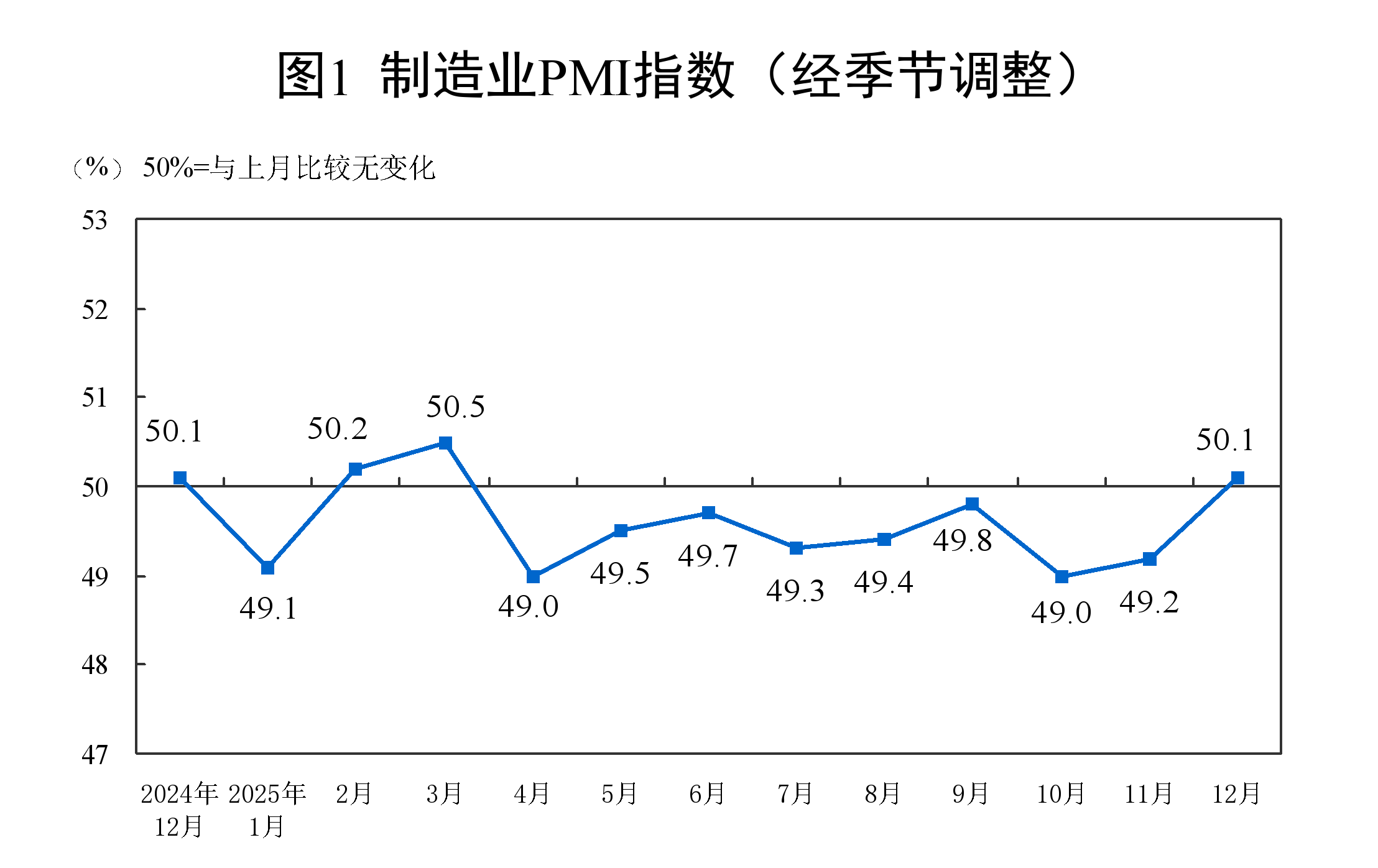
Group 1 - The manufacturing Purchasing Managers' Index (PMI) for December 2025 is reported at 50.1%, an increase of 0.9 percentage points from the previous month, marking a return to the expansion zone after eight consecutive months below 50% [1] - The production and business activity expectation index for December is at 55.5%, up 2.4 percentage points, the highest since April 2024 [1] - The new orders index for December is at 50.8%, rising 1.6 percentage points, indicating a return to the expansion zone after five months below 50% [1] Group 2 - The new export orders index for December is at 49%, an increase of 1.4 percentage points, indicating stable development in manufacturing exports [1] - The production index for December is at 51.7%, up 1.7 percentage points, showing significant growth in manufacturing activity [1] - The high-tech manufacturing PMI is reported at 52.5%, an increase of 2.4 percentage points, indicating a notable acceleration in expansion [1] Group 3 - The consumer goods industry PMI is at 50.4%, up 1 percentage point, with the production index exceeding 52% and the new orders index exceeding 51%, reflecting good expansion in the consumer goods manufacturing market [1] - The non-manufacturing business activity index for December is at 50.2%, an increase of 0.7 percentage points from the previous month [2] - The composite PMI output index for December is at 50.7%, up 1 percentage point from the previous month [2]
关键指标现积极信号!50.1%重返扩张区,12月PMI暖了
2 1 Shi Ji Jing Ji Bao Dao· 2025-12-31 06:56
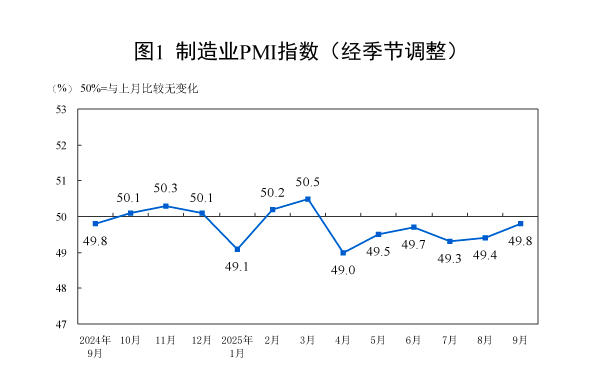
Core Viewpoint - The manufacturing Purchasing Managers' Index (PMI) in China rose to 50.1% in December 2025, marking the first expansion since April 2025, indicating a recovery in both production and demand [1][5]. Group 1: Manufacturing PMI Overview - The manufacturing PMI increased by 0.9 percentage points from the previous month, reaching the expansion zone [5]. - The production index and new orders index were reported at 51.7% and 50.8%, respectively, both showing significant month-on-month increases [6][7]. - In 2025, the monthly manufacturing PMI figures were 49.1%, 50.2%, 50.5%, 49%, 49.5%, 49.7%, 49.3%, 49.4%, 49.8%, 49.0%, 49.2%, and 50.1% [5]. Group 2: Sector Performance - Among the 21 surveyed industries, 16 showed an increase in PMI compared to the previous month, indicating improved business conditions [2][8]. - High-tech manufacturing, equipment manufacturing, and consumer goods sectors reported PMIs of 52.5%, 50.4%, and 50.4%, respectively, all above the expansion threshold [2][8]. - The new export orders index rose to 49.0%, up 1.4 percentage points, although it remains below the expansion threshold [7][9]. Group 3: Economic Indicators - The production activity expectation index reached 55.5%, indicating increased confidence among manufacturing enterprises regarding market development [10]. - The supplier delivery time index was reported at 50.2%, suggesting that the delivery times for raw materials are improving [9]. - The inventory indices for finished products and raw materials showed signs of recovery, with finished product inventory rising to 48.2% and raw materials inventory at 47.8% [9].
制造业景气水平改善 新出口订单指数升幅明显
Zheng Quan Shi Bao· 2025-11-30 18:17
Core Insights - The manufacturing Purchasing Managers' Index (PMI) for November increased to 49.2%, reflecting a slight improvement in economic conditions compared to the previous month [1] - The new export orders index rose significantly by 1.7 percentage points, indicating a positive shift in the external trade environment, particularly benefiting small enterprises [1][2] - Most of the 13 sub-indices for manufacturing showed an upward trend, with production, new orders, and purchasing volume indices all improving [1][2] Manufacturing PMI Details - The manufacturing PMI for November stands at 49.2%, up by 0.2 percentage points from the previous month, indicating a recovery in manufacturing activity [1] - The new orders index increased by 0.4 percentage points to 49.2%, while the production index returned to the neutral level of 50% after a brief contraction [2] - The equipment manufacturing, high-tech manufacturing, and consumer goods manufacturing sectors all maintained production indices in the expansion zone [2] Price Trends - The purchasing price index for manufacturing rose to 53.6%, up by 1.1 percentage points, indicating a general increase in raw material prices across major manufacturing sectors [2] - The decline in finished product prices has slowed, influenced by rising raw material costs and stable market demand [2] Future Outlook - Analysts suggest that the manufacturing market demand may continue to stabilize and recover in December, driven by year-end activities, policy implementation, and expected demand increases from the upcoming "15th Five-Year Plan" [2] - Despite the improvements, the manufacturing PMI remains at historically low levels, indicating a growing necessity for macroeconomic policy support [3]
10月份制造业采购经理指数有所回落 非制造业商务活动指数略有回升
Guo Jia Tong Ji Ju· 2025-10-31 02:32
Group 1: Manufacturing PMI Insights - In October, the manufacturing PMI decreased to 49.0%, down 0.8 percentage points from the previous month, indicating a slowdown in production activities [1][2] - Both production index and new orders index fell to 49.7% and 48.8%, respectively, reflecting a decline in manufacturing production and market demand [2] - Large enterprises maintained a PMI above the critical point, with indices at 50.9% for production and 50.1% for new orders, indicating sustained demand in this segment [2][3] Group 2: Non-Manufacturing PMI Insights - The non-manufacturing business activity index rose to 50.1%, up 0.1 percentage points from the previous month, indicating a slight expansion in the sector [4] - The service industry business activity index increased to 50.2%, with significant growth in sectors closely related to consumer travel, such as rail and air transport, which saw indices above 60.0% [4] - The construction industry business activity index slightly decreased to 49.1%, but the business activity expectation index improved to 56.0%, suggesting a positive outlook for future market conditions [4] Group 3: Composite PMI Insights - The composite PMI output index stood at 50.0%, indicating overall stability in production and business activities across sectors [5] - The manufacturing production index and non-manufacturing business activity index were recorded at 49.7% and 50.1%, respectively, contributing to the composite index's position at the critical point [5]
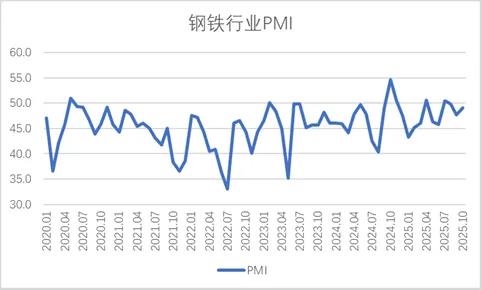
2025年10月钢铁PMI显示:钢铁行业有所恢复 供需两端回稳运行
Xin Hua Cai Jing· 2025-10-31 02:26
Core Viewpoint - The steel industry is showing signs of recovery in October 2025, with the PMI rising to 49.2%, ending a two-month decline, although challenges such as high raw material prices and inventory pressures remain [1][2]. Demand Recovery - October saw a recovery in steel demand due to the resumption of outdoor construction post-holidays and a lack of adverse weather in northern regions, but the real estate sector remains in deep adjustment, limiting overall market demand [2][3]. - The new orders index increased to 47.6%, up 2.4 percentage points, indicating some improvement in demand, but still within a contraction zone [3]. - Export orders showed significant improvement, with the new export orders index rising to 54.3%, the highest in nearly 20 months, driven by price differentials and overseas demand [3]. Production Trends - Steel production stabilized in October, with the production index rising to 49.8%, up 4.1 percentage points, indicating a recovery in production activities [5]. - Despite improvements in both supply and demand, the recovery in demand is weaker than the increase in supply, leading to continued inventory pressures for steel mills [5]. Raw Material Prices - Raw material prices remain high, with the purchasing price index exceeding 70%, indicating increased cost pressures for steel manufacturers [8]. - Prices for different raw materials are showing divergence, with iron ore prices stabilizing, scrap steel prices declining, and coke prices rising due to supply constraints [8]. Price and Profitability - Steel prices have shown a downward trend, with the Shanghai rebar price index dropping from 3176 CNY/ton to 3122 CNY/ton during October, leading to further compression of profit margins for steel mills [11]. - The overall cost pressure on steel manufacturers has increased compared to September, despite some recovery in demand [11]. Future Outlook - In November, steel demand is expected to show a "first rise then fall" trend, supported by construction activities and export resilience, but constrained by ongoing weakness in the real estate sector and seasonal factors [12]. - Steel production is anticipated to contract due to environmental restrictions in northern regions and a shift from peak to off-peak demand [15].
国家统计局发布9月重要数据
21世纪经济报道· 2025-09-30 10:13
Core Viewpoint - The manufacturing Purchasing Managers' Index (PMI) in September rose to 49.8%, indicating a continued improvement in the manufacturing sector's economic conditions [1][4]. Group 1: Manufacturing PMI Overview - The manufacturing PMI increased by 0.4 percentage points from the previous month, reflecting a recovery in manufacturing activity [1][4]. - The production index reached 51.9%, up 1.1 percentage points, marking a six-month high, while the new orders index rose to 49.7%, indicating a slight improvement in market demand [1][5]. Group 2: Sector Performance - Key sectors such as equipment manufacturing, high-tech manufacturing, and consumer goods showed strong expansion, with PMIs of 51.9%, 51.6%, and 50.6% respectively, all above the manufacturing average [6]. - The consumer goods sector has returned above the threshold line, achieving its highest level this year [2][6]. Group 3: Employment and Inventory Trends - The employment index improved to 48.5%, indicating a better employment situation in manufacturing, while the raw materials inventory index rose to 48.5%, suggesting a slowdown in inventory reduction [4][7]. - The production expectations index increased by 0.4 percentage points to 54.1%, showing a positive outlook among manufacturers for upcoming market conditions [7]. Group 4: Price Dynamics - The purchasing price index for raw materials was at 53.2%, indicating a slight decrease but still in the expansion zone, while the factory price index fell to 48.2%, suggesting a contraction in output prices [6]. - The gap between raw material purchasing prices and factory prices widened to 5.0 percentage points, indicating a shrinking profit margin for manufacturers [6].
制造业PMI连续两月回升 下阶段走势如何
Di Yi Cai Jing· 2025-09-30 02:57
Core Insights - The manufacturing PMI in China rose to 49.8% in September, indicating a slight recovery but still below the expansion threshold [1] - The non-manufacturing business activity index decreased to 50.0%, reflecting a slight slowdown in non-manufacturing activities [1] Manufacturing Sector - The manufacturing production index increased to 51.9%, marking a continuous expansion for five months [4] - The purchasing volume index rose to 51.6%, indicating improved procurement activities [4] - New orders index reached 49.7%, showing a stabilization in market demand [4] - The export new orders index improved to 47.8%, suggesting a narrowing decline in export demand [4] - The manufacturing purchase price index was 53.2%, while the factory price index fell to 48.2%, indicating mixed price trends across sectors [5] Non-Manufacturing Sector - The non-manufacturing business activity index remained stable at 50.0%, with the construction index at 49.3% and the services index at 50.1% [8] - The business activity expectation index for non-manufacturing remained above 55%, indicating stable optimism among enterprises [8] - The postal industry showed significant growth, with indices above 60%, reflecting active online shopping [8][9] Future Outlook - The manufacturing sector is expected to see continued growth in Q4, driven by macro policies and seasonal demand [5] - Non-manufacturing activities are anticipated to stabilize and recover, supported by year-end effects and holiday demand [10]