产业规范发展

Search documents
卢旺达颁布新规,要求非工业区工厂10年内迁入指定园区
Shang Wu Bu Wang Zhan· 2026-02-27 08:17
Core Insights - The Rwandan Minister of Trade, Prudence Sebahizi, issued a directive on February 13, 2026, mandating factories in non-designated industrial zones to relocate to government-approved industrial areas within ten years to standardize industrial development and enhance environmental protection [1] Group 1: Regulatory Changes - The new regulation aligns with the "2024-2034 National Industrial Policy" and applies to both light and heavy industries, excluding slaughterhouses, repair shops, and warehouses [1] - Rwanda currently has 2 economic zones and 8 industrial parks, with only over 320 factories operating, while there are more than 1,300 industrial enterprises, predominantly small and medium-sized enterprises, many of which are located in non-industrial planning areas [1] Group 2: Industrial Location Requirements - Heavy industries are restricted to the Bugesera Economic Zone and the Musanze and Muhanga industrial parks, while the Kigali Economic Zone's third and fourth phases are off-limits [1] - Light industries can establish operations in multiple parks and designated light industrial zones, while cottage industries are allocated specific commercial areas, with Nyagatare and Nyabihu parks designated for agricultural product processing [1] Group 3: Approval and Monitoring - All factory operators must obtain approval from the industrial regulatory authority, and those wishing to set up in special economic zones must also apply to the authorized operator, submitting a formal application letter, a copy of the business registration certificate, a detailed business plan, a factory layout, and an environmental and social impact assessment report [2] - The government will establish a monitoring system to regularly check compliance with industrial layout regulations and sustainable operations, imposing sanctions such as suspension or closure on non-compliant enterprises; if a business permanently ceases operations, the owner must notify the regulatory authority in writing [2]
创新治理方式 守护“舌尖上的安全”
Xin Lang Cai Jing· 2026-01-18 21:31
Core Viewpoint - Food safety is a fundamental aspect of public welfare and a crucial foundation for high-quality economic and social development in China. Recent governance efforts have made significant progress in enhancing food safety regulations and practices across the entire supply chain [1][2]. Group 1: Regulatory Framework and Innovations - The implementation of the "Opinions on Further Strengthening Food Safety Full-Chain Supervision" has effectively addressed regulatory barriers across production, storage, transportation, and sales [1]. - The introduction of the food safety law amendment includes regulations on the transportation of bulk liquid foods and the registration management of infant formula liquid milk [1]. - The promotion of "Internet + Bright Kitchen Bright Stove" and the integration of market supervision big data into a multi-dimensional analysis system have shifted regulatory approaches from reactive to proactive [1]. Group 2: Challenges in Food Safety Governance - New challenges in food safety governance arise from the rapid development of online food delivery and live-streaming sales, which outpace regulatory updates [2]. - There is a gap between consumer demand for information on emerging food products and the willingness of companies to disclose such information [2]. - Continuous innovation in governance methods is required to address these challenges and deepen food safety governance [2]. Group 3: Source Control and Industry Responsibility - Strengthening source control is essential for food safety, emphasizing the importance of strict regulations on agricultural inputs and food processing standards [2]. - Companies are encouraged to prioritize food safety over short-term profits and invest in technological innovations for sustainable food production [2]. Group 4: Smart Regulatory Models - The transition to digital and intelligent regulatory models is crucial for enhancing food safety governance efficiency [3]. - Utilizing big data, artificial intelligence, and the Internet of Things can create a smart regulatory system that enables early detection and response to risks [3]. - The establishment of a national data hub for market regulation plays a vital role in integrating data resources for effective risk management [3]. Group 5: Social Co-Governance and Public Participation - Public participation and social supervision are critical for effective food safety governance, with an increasing consumer focus on food safety [4]. - There is a need for improved scientific literacy among consumers regarding food safety issues, which can be addressed through innovative educational initiatives [4]. - Creating a collaborative governance atmosphere involving self-regulation by enterprises, government oversight, and public engagement is essential for food safety [4]. Group 6: Industry Development and Standards - Promoting the standardized development of the food industry is a long-term strategy for achieving food safety and industry advancement [5]. - The establishment of standards for special dietary foods and new food materials is necessary to guide compliant innovation and fill existing gaps [5]. - Companies should implement comprehensive quality safety management and traceability systems to enhance food safety from the ground up [5].
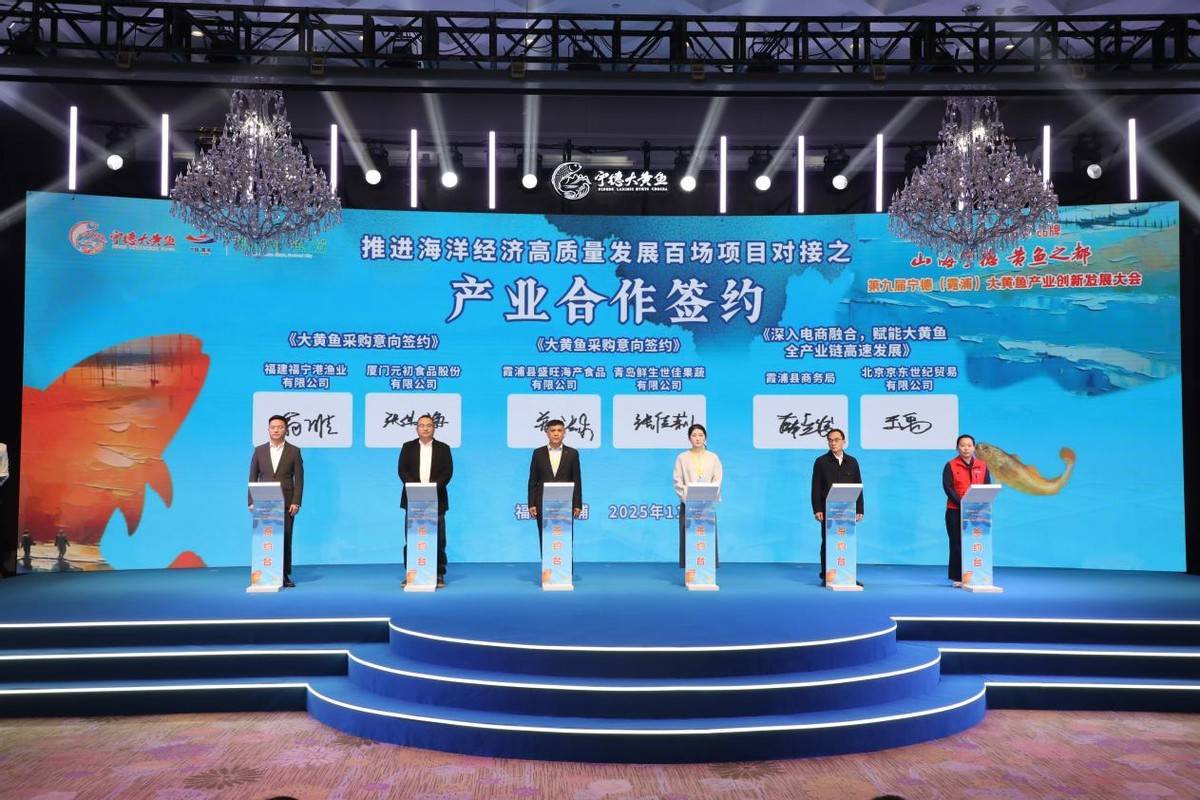
从宁德游向全国:一条大黄鱼的京东供应链跃升之路
Sou Hu Cai Jing· 2025-12-02 06:41
Core Viewpoint - The ninth Ningde (Xiapu) Large Yellow Croaker Industry Innovation Development Conference highlighted the strategic partnership between JD Fresh and the Xiapu County Commerce Bureau to promote the high-quality development of the entire large yellow croaker industry chain [1][3]. Industry Overview - Ningde, known as the "Capital of Large Yellow Croaker" in China, produces 80% of the country's large yellow croaker, with a projected output of 214,900 tons in 2024 and a total industry value exceeding 20 billion yuan [4]. - The large yellow croaker is a unique marine fish in China, highly regarded for its taste and nutritional value, often referred to as the "national fish" [3][4]. Company Strategy - JD Fresh leverages its super supply chain capabilities and a "source direct delivery + direct procurement" model to ensure that freshly caught large yellow croakers are processed within six hours and delivered quickly to consumers [3][6]. - The company has established a comprehensive quality assurance system covering all aspects of production, circulation, and sales, including strict pre-sale, in-sale, and post-sale quality control standards [6][8]. Product Innovation - JD Fresh has introduced a "three removals" process (scales, gills, and internal organs) to simplify cooking for consumers, along with a traceable QR code system for transparency from breeding to processing [8]. - The company offers competitive pricing by eliminating middlemen and utilizing direct sourcing, ensuring consumers receive high-quality products at lower prices [8]. Collaborative Efforts - JD Fresh is collaborating with leading brands in the large yellow croaker sector to establish a source direct delivery certification base, enhancing brand promotion and sales for Ningde large yellow croaker [9][11]. - The partnership aims to provide stable, high-quality supply and competitive pricing, thereby increasing JD's competitiveness in the large yellow croaker category [11][13]. Consumer Trends - There is a growing consumer demand for high-quality protein, leading to the introduction of premium products such as boneless yellow croaker fillets and various processed forms to cater to diverse consumer preferences [13].