
人力资源服务业与制造业融合发展

Search documents
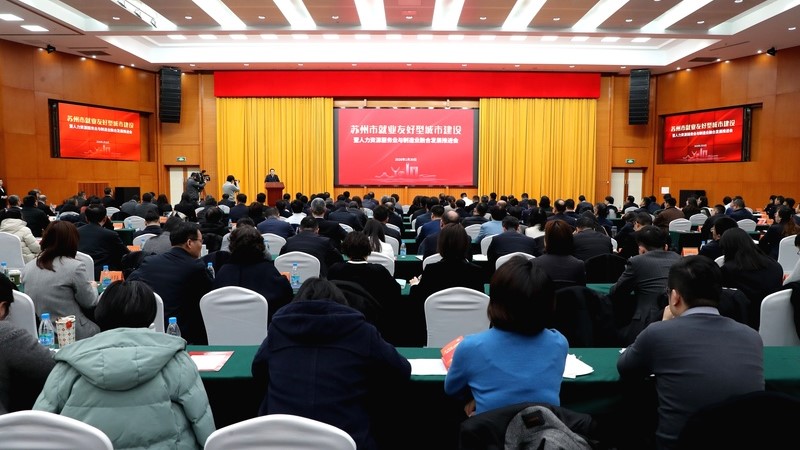
苏州市就业友好型城市建设暨人力资源服务业与制造业融合发展推进会举行 吴庆文讲话
Su Zhou Ri Bao· 2026-01-31 00:26
Group 1 - The core message emphasizes the importance of promoting high-quality and sufficient employment in Suzhou, aiming to make the city a prime destination for talent and urban development [1][2] - In the previous year, Suzhou added 415,200 urban jobs and 315,000 new talents with higher education, supported by a network of 2,202 grassroots public employment service points and 2,112 human resource service agencies [2] - The city has been recognized as one of the "Best Employment Promotion Cities" in the country for six consecutive years, highlighting its commitment to employment-friendly development [2] Group 2 - The city government plans to implement a three-year action plan (2026-2028) to accelerate the construction of an employment-friendly city and has launched ten major projects to integrate human resources services with the manufacturing industry [3] - Measures will be taken to stabilize enterprise operations, ensure workforce security, and combat issues like wage arrears and false recruitment, especially during the critical period around the Spring Festival [3]

我省唐山保定两市入选
Xin Lang Cai Jing· 2025-12-22 23:27
Group 1 - The core viewpoint of the article highlights the integration of human resources services with the manufacturing industry in Hebei Province, with Tangshan and Baoding selected as pilot cities for this initiative [1][2] - The Ministry of Human Resources and Social Security has designated 39 cities, including Beijing and Tianjin, as pilot cities for the integration of human resources services and manufacturing [1] - The manufacturing sector is emphasized as a foundation for national strength, with a focus on accelerating the development of a strong manufacturing country as essential for high-quality growth [1] Group 2 - The 2025 talent demand directory for the manufacturing sector in Hebei is the first of its kind, reflecting the needs of over 3,206 manufacturing companies and covering more than 30,000 job positions across key industries such as advanced steel, green chemicals, high-end equipment, and new materials [2] - The 2025 talent demand directory for private enterprises in Hebei aims to guide talent flow towards private companies and improve the efficiency of human resource utilization, collecting over 300,000 recruitment information entries from 3,286 representative private enterprises [2] - A cooperation agreement has been signed among the human resources departments of Beijing, Tianjin, and Hebei to jointly build human resources service industrial parks, enhancing collaboration in talent services and promoting the integration of human resources services with manufacturing [2][3] Group 3 - The establishment of the regional human resources service industrial park in Langfang has led to significant outcomes, including hosting over 260 recruitment and competition events, serving 3,657 enterprises, generating cumulative revenue of 3.762 billion, and delivering over 50,000 talents to the region [3]
济南市市中区人社局:以政企对接为抓手,共促人力资源服务业发展
Qi Lu Wan Bao· 2025-12-11 11:01
Core Viewpoint - The Jinan Municipal Human Resources and Social Security Bureau is actively optimizing the business environment and providing precise services to the development of human resources enterprises in the region through dialogue and collaboration with local companies [1][3]. Group 1: Policy and Support - The Human Resources Bureau introduced the latest policies aimed at stabilizing employment, benefiting enterprises, and nurturing talent, while addressing the actual issues and development demands faced by businesses [3]. - A service manual was created based on human resources policies to ensure that all applicable subsidy policies are fully utilized by enterprises, with over 30 human resources companies surveyed this year to establish tailored service records [5]. Group 2: Industry Development and Collaboration - Jinan has been designated as one of the first pilot cities for the integration of human resources services and manufacturing, focusing on key areas such as intelligent manufacturing and digital economy [7]. - The first supply-demand matching event for the human resources service industry and the real economy was held, promoting deep integration between human resources services and manufacturing [7]. Group 3: Market Optimization and Quality Improvement - The implementation of projects aimed at elevating the quality and quantity of human resources services is underway, with efforts to nurture and strengthen enterprises, including the application for various honors for three companies [9]. - A credit evaluation system has been established to regulate market order, and over 80 labor disputes have been resolved in collaboration with judicial and labor union departments to ensure healthy industry development [9].
人力资源服务业与制造业试点“跨界融合” 北京、天津、唐山等39个城市承担试点任务
Ren Min Ri Bao· 2025-12-06 05:50
Core Insights - The Ministry of Human Resources and Social Security has initiated a pilot program to integrate human resource services with the manufacturing industry, designating 39 pilot cities including Beijing, Tianjin, and Tangshan [1][2] - The integration aims to enhance the development and utilization of human resources in manufacturing, addressing labor supply shortages and improving employment opportunities [1][3] Group 1: Pilot Program Overview - The pilot program includes 39 cities across various regions: 15 in the eastern region, 9 in the central region, 12 in the western region, and 3 in the northeastern region, covering major economic and manufacturing hubs [2] - These cities have significant manufacturing output, strong employment absorption capacity, and a well-developed human resource service industry [2] Group 2: Focus Areas and Implementation - The pilot cities will focus on key manufacturing sectors, selecting 1 to 3 sub-industries for targeted exploration of innovative paths for industrial upgrading and employment promotion [2] - The program emphasizes collaboration among leading manufacturing enterprises, specialized small and medium-sized enterprises, and key human resource service companies to create joint recruitment and training initiatives [2] Group 3: Technological Integration and Future Steps - The initiative will leverage emerging technologies such as artificial intelligence and big data to enhance the efficiency of human resource supply and demand matching in the manufacturing sector [3] - The Ministry will guide local departments to refine pilot work plans, document progress, and develop replicable successful experiences while ensuring regulatory compliance to protect workers' rights [3]
人力资源服务业与制造业试点“跨界融合”(政策速递)
Ren Min Ri Bao· 2025-12-06 00:04
Core Viewpoint - The Ministry of Human Resources and Social Security has initiated a pilot program for the integration of human resources services and manufacturing industries in 39 cities, aiming to enhance the development of human resources in the manufacturing sector and improve employment services [1][2]. Group 1: Pilot Program Overview - The pilot program includes cities such as Beijing, Tianjin, and Tangshan, covering major economic and manufacturing areas in China, with a focus on advanced manufacturing clusters and robust human resources service foundations [2]. - The program aims to explore innovative mechanisms, policies, platforms, and models for the integration of human resources services with manufacturing, thereby enhancing the utilization of human resources in the manufacturing sector [1][3]. Group 2: Focus Areas and Implementation - Pilot cities will identify 1 to 3 specific sub-industries based on local industrial foundations and advantages, aiming to create innovative paths for industrial upgrading and employment promotion [2]. - The program emphasizes the role of leading manufacturing enterprises and specialized small and medium-sized enterprises in the pilot initiatives, fostering collaborative recruitment and training efforts [2]. Group 3: Technological Empowerment and Future Steps - The initiative will leverage emerging technologies such as artificial intelligence and big data to improve the efficiency of matching supply and demand in the manufacturing labor market [3]. - The Ministry will guide local departments to refine pilot work plans and document progress, challenges, and successful cases to create replicable experiences and projects [3].
人力资源服务业与制造业试点“跨界融合” 北京、天津、唐山等39个城市承担试点任务(政策速递)
Ren Min Ri Bao· 2025-12-05 21:57
Core Viewpoint - The Ministry of Human Resources and Social Security has initiated a pilot program to integrate human resource services with the manufacturing industry, selecting 39 cities including Beijing, Tianjin, and Tangshan for this initiative [1][2]. Group 1: Industry Overview - The human resource service industry is a crucial part of modern productive services, contributing positively to high-quality employment, human resource development, and the construction of a modern industrial system [1]. - By the end of 2024, there will be approximately 74,000 human resource service institutions in China, employing around 1.09 million people [1]. - During the 14th Five-Year Plan period, the industry is expected to provide employment and job-seeking services to 300 million laborers annually and professional support to over 50 million employers [1]. Group 2: Pilot Cities and Focus Areas - The 39 pilot cities are distributed across different regions: 15 in the eastern region, 9 in the central region, 12 in the western region, and 3 in the northeastern region, covering major economic cities and key manufacturing areas [2]. - These cities have significant manufacturing output, strong employment absorption capacity, and are involved in key sectors such as intelligent manufacturing, electronic information, new materials, new energy, and biotechnology [2]. - The pilot cities will focus on 1 to 3 specific sub-industries based on local industrial foundations and advantages, aiming to explore innovative paths for industrial upgrading and employment promotion [2]. Group 3: Technological Empowerment and Future Steps - There will be an emphasis on enhancing the efficiency of human resource supply and demand matching in the manufacturing sector through the application of emerging technologies like artificial intelligence and big data [3]. - The Ministry will guide provincial human resources departments and pilot cities to refine their work plans, track progress, and develop replicable and scalable effective experiences and projects [3]. - A regulatory framework will be established to oversee new business models and protect the rights of workers and employers, addressing issues such as false recruitment and employment discrimination [3].
年均服务3亿人次!人力资源服务业稳住就业“基本盘”
Xin Hua She· 2025-11-30 05:45
Core Insights - The human resources service industry in China has experienced significant growth in recent years, providing employment and job-seeking services to an average of 300 million workers annually since the start of the 14th Five-Year Plan [1] - By the end of 2024, there will be 74,000 human resources service agencies in the country, employing 1.093 million people [1] - The manufacturing sector accounts for nearly 40% of the total service volume in the human resources industry, indicating an increasing level of integration between human resources services and manufacturing [1] Industry Developments - The Ministry of Human Resources and Social Security has issued a notice designating 39 pilot cities, including Beijing, Tianjin, and Tangshan, to promote the integration of human resources services with the manufacturing sector [1] - These pilot cities will focus on key manufacturing areas such as intelligent manufacturing, electronic information, new materials, new energy, and biotechnology [1] - The initiative aims to explore innovative paths for industrial upgrading and employment promotion, addressing the human resource supply constraints that hinder manufacturing development [1]
年均服务3亿人次,我国人力资源服务业加力促就业
Xin Hua She· 2025-11-29 21:32
Core Insights - The human resources service industry in China is focusing on enhancing employment by providing comprehensive services to both job seekers and employers, with an average of 300 million people served annually [1][2] Group 1: Industry Development - The industry has established mechanisms to match human resource supply and demand, particularly in high-end manufacturing, digital economy, and modern services, addressing labor shortages in these sectors [1] - The industry has provided professional support to over 50 million employers, offering a full range of human resource services from recruitment to training and assessment [1] Group 2: Technological Integration - The application of digital technologies, such as AI and big data, is transforming human resource services, enhancing recruitment efficiency by enabling precise candidate matching [2] - New business models and products are emerging in the human resources sector due to the widespread adoption of digitalization [2] Group 3: Internationalization - Many human resource service companies are actively expanding into international markets, providing comprehensive services for companies going abroad, including personnel management and training [3] - The manufacturing sector accounts for nearly 40% of the total service volume in the human resources industry, indicating a strong integration between these two sectors [3] Group 4: Pilot Cities and Local Initiatives - Certain cities, including Wuhan, are designated as pilot areas for integrating human resources services with key industries, aiming to enhance innovation and employment through collaborative development [4] - Wuhan plans to organize over 5,000 recruitment events annually to strengthen supply-demand matching and boost employment [4]
民生直通车 | 年均服务3亿人次,我国人力资源服务业加力促就业
Xin Hua She· 2025-11-29 11:33
Core Insights - The human resources service industry in China is focusing on enhancing employment opportunities, with an average of 300 million people served annually, and over 50 million employers supported since the 14th Five-Year Plan began [1][2] Group 1: Industry Development - The industry is establishing mechanisms to match human resource supply and demand, particularly in high-end manufacturing, digital economy, and modern services [1][2] - Various regions are exploring ways to expand the human resources service industry, promoting high-quality employment through initiatives like skill training and subsidies [2][3] Group 2: Technological Integration - The application of digital technologies, such as AI and big data, is significantly enhancing recruitment efficiency by allowing companies to accurately identify suitable candidates from large talent pools [2][3] - New business models and products in human resources services are emerging due to the widespread adoption of digitalization [2] Group 3: Internationalization - Many human resources service companies are actively expanding into international markets, providing comprehensive services for overseas enterprises, including personnel management and training [3] - The manufacturing sector accounts for nearly 40% of the total service volume in the human resources industry, indicating a strong integration between these sectors [3] Group 4: Local Initiatives - Wuhan, as a pilot city, aims to enhance collaboration between human resources services and key industries such as automotive manufacturing and health, organizing over 5,000 recruitment events annually to strengthen supply-demand matching [4]
民生直通车丨年均服务3亿人次,我国人力资源服务业加力促就业
Xin Hua Wang· 2025-11-29 10:50
Core Insights - The human resources service industry in China is focusing on enhancing employment by providing comprehensive services to both job seekers and employers, with an average of 300 million people served annually since the start of the 14th Five-Year Plan [1][2] Group 1: Industry Development - The industry has established a mechanism to match human resource supply and demand, particularly in high-end manufacturing, digital economy, and modern services [1] - Over 50 million employers have received professional support from the human resources service industry [1] - Various local initiatives are being implemented to strengthen the human resources service sector, including skill training and subsidies [2] Group 2: Technological Integration - The application of AI and digital technologies is transforming human resources services, enhancing recruitment efficiency through big data and intelligent matching technologies [2] - New business models and products are emerging in the human resources service sector due to the widespread adoption of digital technologies [2] Group 3: Internationalization - Many human resources service companies are actively expanding into international markets, providing comprehensive services for overseas enterprises [3] - The manufacturing sector accounts for nearly 40% of the total service volume in the human resources service industry, indicating a strong integration between these sectors [3] Group 4: Pilot Cities and Local Initiatives - Wuhan is one of the pilot cities focusing on the integration of human resources services with key industries such as automotive manufacturing and life sciences [4] - The city plans to organize over 5,000 recruitment events annually to strengthen supply-demand matching and enhance employment opportunities [4]