
代言人营销

Search documents
2026年3大营销洞察:当品牌离开舞台中央
3 6 Ke· 2026-01-07 02:55
Core Insights - In 2025, brand marketing is experiencing a significant transformation, characterized by diverse expressions and increased engagement, largely driven by the widespread adoption of AI technology in marketing strategies [1][2] - The rise of nostalgia-driven campaigns is notable, with brands like McDonald's and Gap successfully launching retro-themed marketing initiatives that resonate well on social media [1] - Brands are shifting towards decentralized narratives, as seen in Nike's "So Win" series, which emphasizes individual athlete stories rather than a singular competitive focus [1] Group 1: AI in Brand Marketing - AI has become a default element in brand marketing strategies, enhancing efficiency in content creation, user insights, and ad optimization [2][3] - However, this reliance on AI has sparked a trust crisis among consumers, who are increasingly questioning the authenticity of brand messages and whether they are generated by real individuals [3][5] - The shift towards AI-generated content has led to a perception that brands are merely content publishers rather than authoritative voices [5][6] Group 2: Emotional Marketing - The proliferation of AI in content production has transformed emotional marketing, making it easier for brands to generate content but also diluting the authenticity of emotional expressions [7][10] - Brands are now faced with the challenge of maintaining genuine emotional connections with consumers in an environment where emotional expressions can quickly become superficial [10][11] - Successful emotional marketing hinges on the authenticity of the emotions conveyed and their relevance to the consumer's real-life experiences [11] Group 3: Endorsement Marketing - The role of celebrity endorsements is evolving, with brands increasingly distancing themselves from traditional celebrity-driven narratives [12][13] - Celebrities are now positioned more as facilitators of brand expression rather than central figures, allowing brands to maintain a clearer identity [13][15] - This shift reflects a broader trend of brands recalibrating their authority and narrative control in response to the unpredictable nature of public figures [16][17] Conclusion - In a landscape where expression is abundant, the focus for brands is shifting towards exercising judgment and restraint rather than merely amplifying their voices [17][18] - The challenge lies in ensuring that brands remain relevant and credible, even as the dynamics of communication and consumer engagement evolve [18]


QuestMobile 2025年营销热点事件盘点:“情绪”成为核心生产力,IP营销频出爆点,AI营销革命大幕拉开
3 6 Ke· 2026-01-06 05:13
Group 1 - The core theme of 2025 marketing is the integration of "emotion" as a driving force, influencing various industries and product trends, creating a closed-loop system that combines brand mental occupation, frequent marketing highlights, and blockbuster product sales [1] - The year 2025 is characterized by three major marketing peaks: popular IP marketing from New Year's to Spring Festival, new product marketing from Labor Day to 618, and diversified marketing from Mid-Autumn Festival and National Day to Double 11 [1][2] - Emotional marketing is driving traditional industries like food service and apparel, with co-branding marketing accounting for 18.5% and 12.1% respectively in these sectors [2] Group 2 - AI marketing is becoming a core topic in 2025, with advancements in AI technology enabling brands to capture user emotions more effectively and optimize marketing strategies [2][33] - The rise of virtual idols and AI-driven user operations is changing marketing paradigms, moving from traditional user segmentation to generative user management systems [2][38] - Content platforms are crucial for brand communication, triggering chain reactions that enhance brand visibility and engagement [9][2] Group 3 - Brands are increasingly focusing on emotional connections with users, utilizing co-branding strategies that resonate with consumer psychology and social emotions [18][20] - The marketing landscape is shifting towards a more diversified approach, with brands reducing conventional holiday marketing in favor of emotional and AI-driven strategies [13][3] - The importance of key marketing nodes, such as new product launches and public sentiment management, is emphasized as critical for brand success [7][2] Group 4 - The marketing rhythm aligns with holiday events, allowing brands to leverage these moments to convey their values effectively [11][3] - The focus on user-centric marketing is evident, with brands engaging in deeper interactions with segmented audiences to enhance marketing effectiveness [41][4] - The pet-related market is expanding, reflecting the growing diversity in consumer needs and the emotional connections brands are fostering with pet owners [43][4] Group 5 - Online channels are experiencing steady growth, with brands concentrating their marketing resources in these areas [50][5] - The beauty industry is shifting its marketing focus from flagship stores to experiential concepts like "scene laboratories" and "art experience pods" in high-tier cities [58][5] - E-commerce platforms are enhancing their offline retail strategies to optimize efficiency and expand data entry points [56][5]
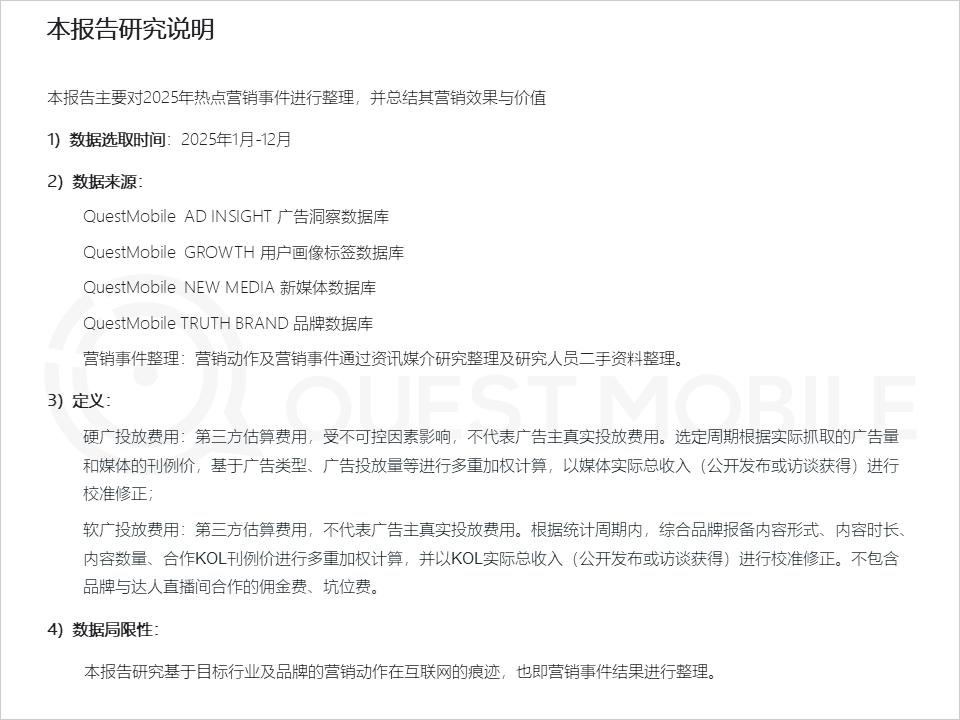
QuestMobile 2025年营销热点事件盘点:“情绪”成为核心生产力,IP营销频出爆点,AI营销革命大幕拉开……
QuestMobile· 2026-01-06 02:05
Core Insights - The article emphasizes the significant changes expected in the AI industry by 2026, driven by increased capital investment, systematic competition among models, and intensified competition in foundational applications [3] Group 1: Marketing Trends in 2025 - 2025 is projected to be a "harvest year" for marketing, with "emotion" becoming a core productivity driver influencing various industries and products [4] - The marketing landscape will see three major peaks: popular IP marketing from New Year's to Spring Festival, new product marketing from Labor Day to 618, and diverse marketing from Mid-Autumn Festival and National Day to Double 11 [4] - Emotional marketing will enhance brand connections by deeply exploring consumer emotional tags, leading to innovative collaborations like "Luckin Coffee X Line Dog" and "Morning Glory Stationery X 'Wang Wang Mountain Little Monster'" [4] Group 2: Industry Opportunities - Traditional industries such as food services and apparel will benefit from emotional marketing, with their respective co-branding marketing shares at 18.5% and 12.1% in 2025 [5] - AI marketing will gain momentum as AI technology matures, supported by government policies like the AI labeling system, making it a "new prominent field" [5] - Virtual idols will dominate content interaction, while intelligent marketing will evolve from single-point to cross-platform strategies, enhancing user engagement [5] Group 3: Brand Marketing Strategies - Brands will focus on diverse marketing strategies in 2025, balancing traditional methods with deeper AI marketing applications [9] - Key marketing nodes will include new product launches and public sentiment management, with content platforms playing a crucial role in brand communication [12][14] - Brands will increasingly align marketing efforts with holiday events, using emotional and AI marketing to convey brand values [19] Group 4: Co-branding and Emotional Marketing - Co-branding will thrive under the consumer logic of "buying for emotions," with brands leveraging deep understanding of consumer psychology and social emotions [24][26] - Brands will focus on aligning IP cultural cores with their value genes, creating fresh experiences that resonate with both IP and brand characteristics [28] - The overlap between mainstream IP users and core brand users will be emphasized to strengthen emotional connections [30] Group 5: AI Marketing Evolution - AI marketing will become a central topic in 2025, driving continuous optimization of marketing models [39] - The rise of AI virtual digital humans will shift from traditional models to AI-native entities, expanding their application across industries [43] - User operations will transition from segmented approaches to generative user management, enhancing marketing content across various scenarios [45] Group 6: Channel Marketing Dynamics - Online channels will see steady growth in traffic, with brands concentrating marketing resources on these channels [58] - Hard advertising will focus on e-commerce and live-streaming channels to shorten conversion paths [60] - The beauty industry will expand its offline channels, shifting marketing highlights from "flagship stores" to diverse concepts like "experience labs" [66]

2025品牌代言:顶流不再是“最优选”?
3 6 Ke· 2025-12-25 10:29
Core Insights - The article discusses the evolving landscape of celebrity endorsement marketing, highlighting a shift from traditional top-tier celebrities to a more diverse range of endorsers, including lesser-known figures and even non-human entities [2][18][24]. Group 1: Trends in Celebrity Endorsement - The number of official endorsements has increased by 22.61% in the first three quarters of this year, indicating a growing reliance on this marketing strategy [3]. - Brands are increasingly opting for unconventional combinations and cross-industry collaborations, such as luxury brands partnering with comedians or sports stars [4][7]. - The trend of using "cold" or "unusual" endorsers is on the rise, with brands selecting individuals who resonate with their image rather than just relying on mainstream celebrities [18][20]. Group 2: Market Dynamics - The competitive market landscape and fragmented media consumption have led to a demand for more authentic and diverse emotional connections from consumers [2][24]. - Brands are adapting to the changing social media landscape, where the production of topics has shifted from brands to ordinary users, allowing for greater interaction and engagement [15][16]. - The rise of digital influencers and virtual entities as brand ambassadors reflects a shift towards lower-cost and lower-risk marketing strategies [21][23]. Group 3: Challenges in Endorsement Marketing - Despite the diversification of endorsers, the most effective sales drivers remain a select group of top-tier celebrities, indicating a challenge in balancing short-term sales with long-term brand building [25][27]. - The increasing number of endorsements can lead to a "sea of people" effect, where the uniqueness of each endorsement diminishes, making it harder for brands to achieve deep resonance with consumers [29][30]. - Brands are exploring a hybrid approach, combining short-term endorsements with long-term partnerships to maintain both freshness and depth in their marketing strategies [29][30].




从于适到李现,全球旅游局为啥集体 “迷上” 明星代言人?
Jing Ji Guan Cha Bao· 2025-10-21 09:20
Core Insights - The focus of destination marketing has shifted from natural resources and hotel quality to leveraging social media influence and celebrity endorsements to attract tourists [1][4][7] Group 1: Celebrity Endorsements - New Zealand Tourism Board appointed actor Li Xian as its tourism ambassador to attract Chinese tourists by showcasing authentic experiences [1][2] - Australia Tourism Board invited actor and singer Yu Shi to participate in content creation, emphasizing the importance of real experiences over traditional advertising [3][4] - The trend of using celebrities as storytellers rather than mere advertisers reflects a deeper understanding of consumer engagement in the tourism sector [4][7] Group 2: Marketing Strategies - The shift from simple advertising to co-creation of content with celebrities aims to resonate with younger audiences who prefer authentic narratives [3][4] - Data-driven approaches are increasingly being adopted by tourism boards to select celebrities whose audience aligns with their target demographics, enhancing the effectiveness of marketing campaigns [6][7] - The competition among tourism destinations is now about who can create compelling stories that connect emotionally with potential travelers [7] Group 3: Challenges and Considerations - The reliance on celebrity endorsements carries risks, as public perception can change rapidly, impacting the effectiveness of marketing efforts [5] - There is a need for a balance between the idealized experiences presented by celebrities and the actual tourist experiences to avoid backlash [5][6] - The integration of data analysis, social media engagement, and visitor experience is crucial for successful destination marketing in the current landscape [5][6]