
渠道营销

Search documents
QuestMobile 2025年营销热点事件盘点:“情绪”成为核心生产力,IP营销频出爆点,AI营销革命大幕拉开
3 6 Ke· 2026-01-06 05:13
Group 1 - The core theme of 2025 marketing is the integration of "emotion" as a driving force, influencing various industries and product trends, creating a closed-loop system that combines brand mental occupation, frequent marketing highlights, and blockbuster product sales [1] - The year 2025 is characterized by three major marketing peaks: popular IP marketing from New Year's to Spring Festival, new product marketing from Labor Day to 618, and diversified marketing from Mid-Autumn Festival and National Day to Double 11 [1][2] - Emotional marketing is driving traditional industries like food service and apparel, with co-branding marketing accounting for 18.5% and 12.1% respectively in these sectors [2] Group 2 - AI marketing is becoming a core topic in 2025, with advancements in AI technology enabling brands to capture user emotions more effectively and optimize marketing strategies [2][33] - The rise of virtual idols and AI-driven user operations is changing marketing paradigms, moving from traditional user segmentation to generative user management systems [2][38] - Content platforms are crucial for brand communication, triggering chain reactions that enhance brand visibility and engagement [9][2] Group 3 - Brands are increasingly focusing on emotional connections with users, utilizing co-branding strategies that resonate with consumer psychology and social emotions [18][20] - The marketing landscape is shifting towards a more diversified approach, with brands reducing conventional holiday marketing in favor of emotional and AI-driven strategies [13][3] - The importance of key marketing nodes, such as new product launches and public sentiment management, is emphasized as critical for brand success [7][2] Group 4 - The marketing rhythm aligns with holiday events, allowing brands to leverage these moments to convey their values effectively [11][3] - The focus on user-centric marketing is evident, with brands engaging in deeper interactions with segmented audiences to enhance marketing effectiveness [41][4] - The pet-related market is expanding, reflecting the growing diversity in consumer needs and the emotional connections brands are fostering with pet owners [43][4] Group 5 - Online channels are experiencing steady growth, with brands concentrating their marketing resources in these areas [50][5] - The beauty industry is shifting its marketing focus from flagship stores to experiential concepts like "scene laboratories" and "art experience pods" in high-tier cities [58][5] - E-commerce platforms are enhancing their offline retail strategies to optimize efficiency and expand data entry points [56][5]

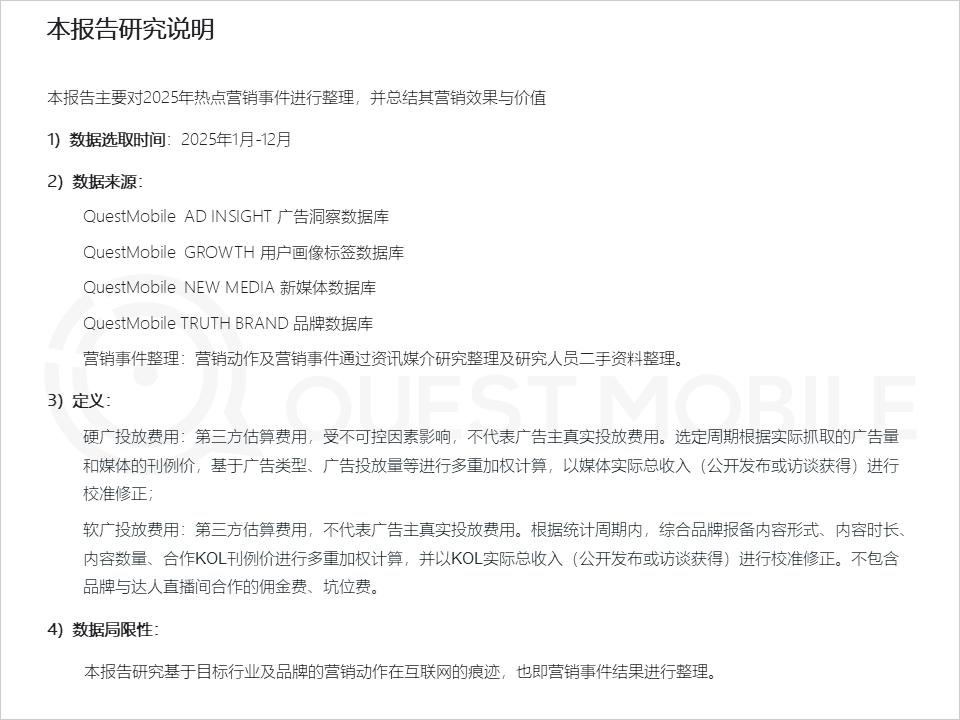
QuestMobile 2025年营销热点事件盘点:“情绪”成为核心生产力,IP营销频出爆点,AI营销革命大幕拉开……
QuestMobile· 2026-01-06 02:05
Core Insights - The article emphasizes the significant changes expected in the AI industry by 2026, driven by increased capital investment, systematic competition among models, and intensified competition in foundational applications [3] Group 1: Marketing Trends in 2025 - 2025 is projected to be a "harvest year" for marketing, with "emotion" becoming a core productivity driver influencing various industries and products [4] - The marketing landscape will see three major peaks: popular IP marketing from New Year's to Spring Festival, new product marketing from Labor Day to 618, and diverse marketing from Mid-Autumn Festival and National Day to Double 11 [4] - Emotional marketing will enhance brand connections by deeply exploring consumer emotional tags, leading to innovative collaborations like "Luckin Coffee X Line Dog" and "Morning Glory Stationery X 'Wang Wang Mountain Little Monster'" [4] Group 2: Industry Opportunities - Traditional industries such as food services and apparel will benefit from emotional marketing, with their respective co-branding marketing shares at 18.5% and 12.1% in 2025 [5] - AI marketing will gain momentum as AI technology matures, supported by government policies like the AI labeling system, making it a "new prominent field" [5] - Virtual idols will dominate content interaction, while intelligent marketing will evolve from single-point to cross-platform strategies, enhancing user engagement [5] Group 3: Brand Marketing Strategies - Brands will focus on diverse marketing strategies in 2025, balancing traditional methods with deeper AI marketing applications [9] - Key marketing nodes will include new product launches and public sentiment management, with content platforms playing a crucial role in brand communication [12][14] - Brands will increasingly align marketing efforts with holiday events, using emotional and AI marketing to convey brand values [19] Group 4: Co-branding and Emotional Marketing - Co-branding will thrive under the consumer logic of "buying for emotions," with brands leveraging deep understanding of consumer psychology and social emotions [24][26] - Brands will focus on aligning IP cultural cores with their value genes, creating fresh experiences that resonate with both IP and brand characteristics [28] - The overlap between mainstream IP users and core brand users will be emphasized to strengthen emotional connections [30] Group 5: AI Marketing Evolution - AI marketing will become a central topic in 2025, driving continuous optimization of marketing models [39] - The rise of AI virtual digital humans will shift from traditional models to AI-native entities, expanding their application across industries [43] - User operations will transition from segmented approaches to generative user management, enhancing marketing content across various scenarios [45] Group 6: Channel Marketing Dynamics - Online channels will see steady growth in traffic, with brands concentrating marketing resources on these channels [58] - Hard advertising will focus on e-commerce and live-streaming channels to shorten conversion paths [60] - The beauty industry will expand its offline channels, shifting marketing highlights from "flagship stores" to diverse concepts like "experience labs" [66]

下一个十年,国际学校别再只玩流量!“渠道为王”才是破局关键
Sou Hu Cai Jing· 2025-10-17 08:10
Core Insights - The main focus of international schools is shifting from middle-class families to asset families, who have more stable economic foundations and clearer demands [1] - As the target audience changes, the promotional strategies must also adapt to effectively engage asset families [1] Group 1: Current Promotional Strategies - Current promotional methods primarily rely on social media platforms and online advertising, collectively referred to as "traffic play," which increases visibility among parents [1][2] - These strategies are essential for new schools to establish a presence and attract initial interest from families [2][4] - However, for asset families, mere exposure through traffic play is insufficient; deeper trust-building channels are necessary [5] Group 2: Limitations of Current Strategies - Traffic content often lacks specificity and may not reach the intended asset families, resulting in ineffective engagement [6] - The content's credibility is questionable, as parents find it difficult to ascertain the authenticity of the school's portrayal online [6][8] Group 3: Effective Channels for Asset Families - Asset families prefer recommendations from familiar sources and community connections, making targeted channels crucial for outreach [9] - High-end communities serve as precise pools for asset families, where schools can engage through local events and activities [9][10] - Collaborations with banks and financial institutions can provide trust through association, enhancing the school's credibility [11][13] - Participation in exclusive clubs and associations allows schools to integrate into the asset families' social circles, fostering organic recommendations [14][15] Group 4: Building Trust and Community - Schools should leverage existing parents as advocates, creating opportunities for them to share positive experiences with potential new families [15] - Establishing a reputation within the asset families' circles is vital, as they value peer recommendations highly [15][16] - Ultimately, schools must focus on being seen as trustworthy choices within the asset families' networks to capture new opportunities [16]

大行评级|美银:上调统一目标价至10.6港元 重申“买入”评级
Ge Long Hui· 2025-08-07 02:25
Core Viewpoint - Bank of America Securities reports that Uni-President Enterprises' revenue and net profit after tax for the first half of the year increased by 10.6% and 33.2% year-on-year, respectively, indicating a strong performance that exceeded expectations [1] Financial Performance - Revenue growth for the second quarter reached high single digits, while net profit growth was 35% [1] - Core business remains solid, with food and beverage sales increasing by 8.8% and 7.6% year-on-year, respectively [1] - Other business segments saw a significant increase of 91.6%, with 73% of this growth attributed to customer OEM (Original Equipment Manufacturer) partnerships, such as with brands like Pinduoduo and Sam's Club [1] Management Guidance - Management maintains a cautious full-year sales growth guidance of 6% to 8%, citing competitive challenges from delivery platform subsidies affecting the growth of sugar-free tea and milk tea products in the second half of the year [1] - Despite these challenges, the firm believes that the target can be easily achieved, as Uni-President has not followed competitors in raising prices, leading to a continuous increase in market share [1] Strategic Initiatives - The company is actively launching upgraded beverage products and plans to increase channel marketing investments in the second half of the year [1] Earnings Forecast and Target Price - Based on revised growth expectations, the firm has raised its earnings per share estimates for Uni-President for 2025 and 2026 by 7% and 4%, respectively [1] - The target price has been adjusted from HKD 9.3 to HKD 10.6, supported by the company's solid growth outlook and a dividend yield of over 6% [1] - The firm reaffirms a "Buy" rating for the stock [1]