
供应商多元化

Search documents
美国被爆警告叙利亚别用中国电信技术,叙通信部回应
Huan Qiu Shi Bao· 2026-02-27 22:45
Core Viewpoint - The United States has warned Syria against relying on Chinese technology in the telecommunications sector, claiming it contradicts U.S. interests and poses a threat to national security [1][2] Group 1: U.S. Warnings and Diplomatic Engagement - The warning was issued during a private meeting between a U.S. State Department delegation and Syrian Communications Minister Abdul Salam Haykal in San Francisco [1] - The U.S. has urged Syria to use American or allied technologies in telecommunications [2] - The U.S. has expressed concerns regarding Chinese intelligence and security practices, alleging that they could compel Chinese citizens and companies to provide sensitive data [2] Group 2: Syria's Response and Infrastructure Development - The Syrian Communications Ministry stated that decisions regarding equipment and infrastructure will be made based on national technical and security standards [2] - Syria is actively pursuing telecommunications infrastructure development and is exploring the procurement of Chinese technology for building telecom base stations and local internet service provider infrastructure [1] - Syrian officials indicated a need for supplier diversification due to the urgency of infrastructure projects [1]

2025年美国制造业全景调研报告
Sou Hu Cai Jing· 2025-12-19 17:34
Group 1 - The core viewpoint of the article indicates that the U.S. manufacturing industry remains optimistic for 2025, despite facing challenges such as tariffs, supply chain issues, and workforce and technology transitions [1][3] - 79% of manufacturing decision-makers rate current business conditions as good or excellent, and 80% have a positive outlook for the next 12 months [1][26] - Financial concerns are significant, with 67% of companies worried about inflation, 64% about tariffs, and 63% about high interest rates [1][24] Group 2 - Tariffs and supply chain disruptions are major pain points, with 68% of manufacturers concerned about rising raw material costs and 63% about price pressures and profit margins [1][55] - To address tariff policies, 49% of companies are increasing inventory, 41% are investing in domestic manufacturing, and 40% are diversifying suppliers [1][45] - 61% of manufacturers view current supply chain disruptions as a serious challenge, with 66% concerned about future risks [1][55] Group 3 - Workforce challenges are prominent, with 37% of companies prioritizing attracting and retaining qualified employees, and 64% considering workforce recruitment and retention a long-term issue [2][16] - 49% of manufacturers see technology investment (AI, automation, robotics) as a significant business opportunity, with AI being a primary focus [2][32] - 91% of manufacturers have partially or fully adopted inventory management systems, and 83% are using IoT devices [2][17] Group 4 - Regulatory compliance pressures are increasing, with 87% of companies concerned about supply chain delays due to trade policy changes and 85% worried about cost increases from regulatory adjustments [2][19] - 89% of manufacturers report being significantly affected by recent regulatory changes, with compliance costs and new technology investment being major impacts [2][19] Group 5 - Overall, the U.S. manufacturing industry is optimistic for 2025, focusing on supply chain localization, supplier diversification, technology upgrades, and workforce strategy optimization to navigate multiple pressures [3]


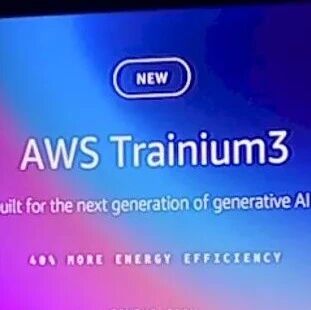
GPU的新对手来了!亚马逊官宣Trainium3:相比GPU,成本降低超50%
美股IPO· 2025-12-03 04:40
Core Viewpoint - The introduction of AWS's Trainium3 chip marks a significant advancement in AI video processing, offering performance improvements and cost reductions, but NVIDIA's market dominance remains largely unchallenged in the short term [4][11]. Group 1: Trainium3 Chip Launch - AWS officially launched the third generation of its custom AI chip, Trainium3, which claims to deliver four times the performance of its predecessor and reduce AI model training and operational costs by up to 50% compared to equivalent GPU systems [4][11]. - Trainium3 has already been adopted by several clients, including Anthropic and Decart, indicating its growing market penetration [5][8]. Group 2: Competitive Landscape - Despite the emergence of custom chips like Trainium3, NVIDIA's market position is expected to remain strong in the near term, as many of AWS's large clients are also NVIDIA customers [11][13]. - The trend of AI companies seeking supplier diversification is becoming more pronounced, with reports of Meta Platforms negotiating with Google for TPU chips and OpenAI collaborating with AMD and Broadcom [4][11]. Group 3: Performance Breakthroughs - Decart, an AI video startup, reported that Trainium3 enabled a fourfold increase in video generation frame rates compared to other chips, showcasing its technical advantages [5][9]. - The company experienced a breakthrough after extensive testing, allowing for the successful operation of a larger and more intelligent model without crashing [10]. Group 4: Market Dynamics - The market is shifting from a single supplier dominance to a more diversified competitive landscape, although this does not imply a complete replacement of NVIDIA's technology [13]. - NVIDIA's response to the competitive pressures includes emphasizing its superior performance and versatility compared to custom chips produced by Google and AWS [12][13].

GPU的新对手来了!亚马逊官宣Trainium3:相比GPU,成本降低超50%
Hua Er Jie Jian Wen· 2025-12-03 01:04
Core Insights - Amazon Web Services (AWS) has launched its third-generation custom AI chip, Trainium3, targeting the GPU market dominated by Nvidia [1][2] - The new chip boasts a fourfold performance increase over its predecessor and can reduce AI model training and operational costs by up to 50% compared to equivalent GPU systems [2][3] - AWS's strategy focuses on cost-effectiveness rather than directly replacing Nvidia, indicating a shift towards a more diversified supplier landscape in the AI sector [3][6] Group 1: Product Launch and Performance - AWS's Trainium3 chip is designed to enhance performance and reduce costs for AI applications, with significant improvements noted by clients like Decart [2][4] - Decart reported that Trainium3 enabled a video generation frame rate four times higher than other chips, showcasing its potential for real-time rendering applications [4][5] Group 2: Market Dynamics - Despite the introduction of custom chips like Trainium3, Nvidia's market position remains strong, with many AWS clients also purchasing Nvidia products [6][7] - The trend of AI companies seeking supplier diversification is primarily aimed at risk mitigation and cost optimization rather than a complete shift away from Nvidia's technology [7]
