信息披露质量

Search documents
分红方案“每10股”错写为“每股”,交通银行公告现“乌龙”紧急更正并致歉;去年因违反账户管理规定等收千万级大罚单
新浪财经· 2026-03-31 12:16
Core Viewpoint - The article discusses the correction announcement made by Bank of Communications regarding its previously disclosed dividend distribution plan for the year 2025, highlighting a significant error in the announcement that misrepresented the dividend per share [2][4]. Group 1: Dividend Distribution Correction - Bank of Communications corrected its earlier announcement stating that the cash dividend for 2025 was mistakenly reported as 3.247 yuan per share instead of 3.247 yuan for every 10 shares [4]. - The corrected dividend distribution plan indicates that the bank will distribute a cash dividend of 1.684 yuan (including tax) for every 10 shares, totaling 14.88 billion yuan, leading to an overall cash dividend of 28.692 billion yuan for the year 2025 [5]. - The cash dividend payout ratio is reported to be 32.3%, which represents the total cash dividends distributed as a percentage of the net profit attributable to the ordinary shareholders of the parent company [5]. Group 2: Financial Performance - As of the end of 2025, Bank of Communications reported total assets of 15.5 trillion yuan, reflecting a year-on-year growth of 4.35% [7]. - The bank achieved an operating income of 265.1 billion yuan and a net profit of 95.6 billion yuan for the year, marking year-on-year increases of 2.02% and 3.12% respectively [7]. Group 3: Regulatory Penalties - The People's Bank of China issued an administrative penalty against Bank of Communications, which included a warning and a fine totaling approximately 67.83 million yuan due to 11 types of violations, including issues related to account management and customer identification [8][10]. - The violations were identified during a comprehensive law enforcement inspection conducted from November 2022 to April 2023, and the bank has acknowledged the issues and completed corrective actions [11].


证监会通报2025年首发企业现场检查情况 “一查就撤”等市场乱象得到根本扭转 将进一步科学统筹现场检查覆盖面与有效性
Zhong Guo Zheng Quan Bao· 2026-02-07 02:18
Group 1 - The core viewpoint of the news is that the China Securities Regulatory Commission (CSRC) has improved the quality of new enterprise applications for public offerings through enhanced on-site inspections and a clearer understanding of market expectations [1][2] - In 2025, the CSRC completed inspections of 16 randomly selected companies and 4 problem-oriented companies, involving 8 from the main board, 9 from the Sci-Tech Innovation Board, and 3 from the Growth Enterprise Market [1] - The inspections have led to a significant improvement in the quality of applications, with no withdrawals among the 16 randomly selected companies, and 7 of them have passed the listing committee review [2] Group 2 - The CSRC has implemented a regularized approach to on-site inspections, focusing on the quality of information disclosure by issuers, with a 20% random sampling of new applications [2][3] - Among the inspected companies, 2 were found to have serious violations of information disclosure laws, leading to investigations and potential severe penalties for both issuers and intermediaries [3] - 6 companies had deficiencies in information disclosure quality, with 2 receiving formal criticism and 4 being warned, while 12 companies had minor compliance issues that did not affect the review process [3]
证监会:不断提高拟上市企业申报质量
Zheng Quan Ri Bao· 2026-02-06 16:12
Core Insights - The China Securities Regulatory Commission (CSRC) reported on-site inspection results for IPO applicants in 2025, indicating a focus on enhancing the quality of applications and protecting investor rights [1][2] Group 1: Inspection Overview - In 2025, the CSRC completed inspections of 16 randomly selected and 4 problem-oriented companies, including 8 from the main board, 9 from the Sci-Tech Innovation Board, and 3 from the Growth Enterprise Market [1] - All 16 randomly selected companies did not withdraw their IPO applications, with 7 companies passing the exchange's listing committee review [1][2] Group 2: Regulatory Focus - The CSRC emphasized risk prevention and strict regulation, aiming for high-quality development while maintaining a balance between investor protection and system inclusiveness [1] - Regular inspections will be conducted for IPO applicants, with a 20% random selection of new applications to verify submission quality [2] Group 3: Issues Identified - Among the inspected companies, 2 were suspected of major violations related to information disclosure, including inflating revenue through fictitious business activities [3] - 6 companies exhibited deficiencies in information disclosure quality, leading to varying levels of regulatory responses, including public criticism and warnings [3] - 12 companies had normative flaws in information disclosure, which did not affect the review process, prompting the CSRC to urge rectification without imposing regulatory measures [3]
证监会通报!事关IPO企业现场检查
Zhong Guo Zheng Quan Bao· 2026-02-06 14:22
Group 1 - The China Securities Regulatory Commission (CSRC) conducted inspections on 20 companies in 2025, including 16 randomly selected and 4 problem-oriented checks, involving 8 companies from the main board, 9 from the Sci-Tech Innovation Board, and 3 from the Growth Enterprise Market [1][2] - By the end of 2025, none of the 16 randomly selected companies withdrew their listing applications, with 7 companies having passed the exchange's listing committee review, indicating improved application quality [2][3] - The CSRC aims to enhance the effectiveness of inspections by focusing on risk management, emphasizing key areas, and categorizing responses to improve the quality of applications from companies seeking to go public [1][2] Group 2 - Two companies were found to be suspected of major violations in information disclosure, including inflating revenue through fictitious business activities, with significant amounts involved [3] - Six companies exhibited deficiencies in information disclosure quality, leading to criticisms for two companies and warnings for four, while appropriate measures were taken against intermediary institutions based on their performance [3] - Twelve companies had normative flaws in information disclosure, which did not affect the review process, prompting the CSRC to urge rectification without imposing regulatory measures [3]
证监会通报2025年首发企业现场检查情况,“一查就撤”等市场乱象得到根本扭转!
梧桐树下V· 2026-02-06 12:57
Core Viewpoint - The China Securities Regulatory Commission (CSRC) has enhanced the quality of IPO applications through regular inspections, resulting in improved disclosure standards and a reduction in market irregularities [1][5]. Group 1: Overall Inspection Situation - The CSRC conducted inspections on 20 IPO applicants, including 16 randomly selected and 4 targeted for issues, with a focus on verifying the quality of applications [5]. - By the end of 2025, none of the 16 randomly selected companies withdrew their IPO applications, and 7 of them passed the exchange's listing committee review [5][6]. - The inspections have clarified market expectations and significantly reduced irregularities such as "withdrawal upon inspection" [5][6]. Group 2: Issues Found and Handling - Two companies were found to have committed serious violations of information disclosure, including inflating revenue through fictitious business activities, leading to strict accountability measures [6]. - Six companies exhibited quality defects in their disclosures, such as improper accounting practices and omissions in related party disclosures, resulting in warnings and criticisms from the regulatory body [6]. - Twelve companies had normative flaws in their disclosures that did not affect the review process, prompting the CSRC to require rectifications without imposing regulatory actions [6]. Group 3: Future Actions - The CSRC plans to further enhance the effectiveness and coverage of inspections, focusing on risk management and categorizing issues to improve the quality of IPO applications and protect investor rights [7].
恒道科技海量微型客户核查似流于形式或信披失真,百余函证异常或暴露天健所审计漏洞
Xin Lang Cai Jing· 2026-01-22 15:39
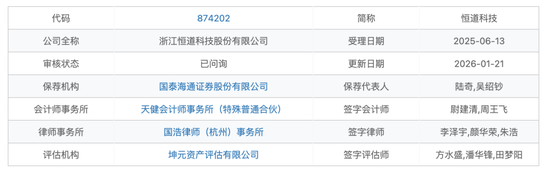
Core Viewpoint - The article discusses the shift in securities regulatory requirements from "formal compliance" to "substantive authenticity" in the context of the registration system reform, questioning whether Zhejiang Hengdao Technology Co., Ltd. has alleviated concerns regarding the authenticity of its revenue in its second-round inquiry response [1][14]. Group 1: Company Overview - Zhejiang Hengdao Technology Co., Ltd. is under review by the Beijing Stock Exchange, with its application accepted on June 13, 2025, and the latest update on January 21, 2026 [2][14]. - The company is sponsored by Guotai Junan Securities Co., Ltd., with representatives Lu Qi and Wu Shaochao, and audited by Tianjian Certified Public Accountants, with signatory accountants Wei Jianqing and Zhou Wangfei [2][14]. Group 2: Audit and Verification Concerns - There are concerns regarding the effectiveness of audit measures for a significant portion of small and micro clients, with 87% of these clients potentially lacking adequate verification [2][14]. - The on-site visit coverage for clients with transactions below 500,000 yuan has been low, with only 21.08% of small clients visited in 2024, indicating over 500 clients have not been verified by intermediaries [5][6][18]. - The audit process has been criticized for its low external confirmation rates, with only 17.62% of small clients receiving confirmation letters in 2024, raising questions about compliance with auditing standards [21][23]. Group 3: Risk of Revenue Inflation - A significant portion of Hengdao Technology's revenue (20%-30%) comes from high-risk clients, defined as those with registered capital below 500,000 yuan or newly established during the reporting period, which raises concerns about potential revenue inflation through shell companies [22][23]. - The identification of 136 clients with discrepancies in confirmation addresses or contacts signals a high level of fraud risk, suggesting that confirmation letters may not have reached the intended recipients [10][25]. Group 4: Ineffective Verification Methods - The reliance on internal documents for verification, such as contracts and orders, without independent third-party evidence, is questioned, as it may lead to circular reasoning in audits [21][26]. - The audit team’s explanations for address discrepancies, such as group procurement or internal personnel handling, are deemed inadequate and raise further doubts about the integrity of the verification process [10][25].
立案调查未果,回购计划先行 清越科技释放何种信号?
Jing Ji Guan Cha Bao· 2025-12-06 13:11
Core Viewpoint - Suzhou Qingyue Optoelectronics Technology Co., Ltd. (Qingyue Technology) is under investigation by the China Securities Regulatory Commission (CSRC) for suspected false reporting of financial data, which could lead to significant legal consequences including potential delisting of its stock [1][2][3] Financial Performance - Qingyue Technology reported a net loss of approximately 70 million yuan in 2024, with a further loss of 43.35 million yuan in the first three quarters of 2025, including a single-quarter loss of 12.59 million yuan in Q3 [3][4] - Revenue for the third quarter of 2025 was 476 million yuan, reflecting a year-on-year decline of 13.64%, primarily due to reduced sales of electronic paper modules [3][4] Regulatory Issues - The CSRC's investigation was initiated following a notice received by Qingyue Technology on November 1, 2025, regarding suspected false financial reporting [2][3] - The company had previously received a warning from the Jiangsu Securities Regulatory Bureau in August 2025 for three violations, indicating systemic issues in internal controls and financial compliance [3][4] Stock Performance - The stock price of Qingyue Technology fell from 8.94 yuan on October 31 to 6.84 yuan on December 5, marking a decline of 23.5% [2][5] - Despite a proposed share buyback plan by the chairman on November 4, the stock continued to decline, indicating market skepticism regarding the company's future [5][6] Management Response - The chairman proposed a share buyback of 10 to 20 million yuan to stabilize market expectations, but as of December 5, no formal plan had been submitted for board approval [4][6] - The company’s total assets were reported at 1.829 billion yuan, with a net asset value of 980 million yuan, reflecting a 5.07% decrease from the previous year [4][6] Market Implications - The ongoing investigation and financial struggles of Qingyue Technology raise concerns about the overall quality of information disclosure among companies listed on the STAR Market, impacting investor confidence in "hard tech" firms [6][7] - The situation highlights the need for improved regulatory frameworks to ensure accurate and complete information for investors, particularly in the context of technology-driven enterprises [7]
上市公司要争当信披优等生
Jing Ji Ri Bao· 2025-12-01 22:23
Core Viewpoint - The evaluation results of information disclosure for listed companies in China for the years 2024 to 2025 show that 85.24% of the 5,366 participating companies achieved a good disclosure quality rating, indicating significant improvements in compliance and transparency in the capital market [1][2]. Group 1: Information Disclosure Quality - A total of 1,001 companies received an A rating (excellent), accounting for less than 20% of the total, highlighting that there is still room for improvement in disclosure quality among many listed companies [2]. - The overall good disclosure rate of 85.24% reflects the effectiveness of strict regulations aimed at enhancing the quality of information disclosure among listed companies [1][2]. - Approximately 2% of companies were rated D (unqualified), which, while a small percentage, represents significant concerns for thousands of investors due to issues like false records and misleading statements [2]. Group 2: Importance of Information Disclosure - Information disclosure serves as a crucial window for listed companies to showcase their value, providing essential insights into their operational strategies, business structures, financial conditions, and competitive landscapes [1]. - The current trend indicates that most listed companies are adhering to regulations and are increasingly willing to disclose their true operational status and significant events, thereby fostering a more reliable information environment for investors [1][2]. Group 3: Future Directions - The capital market in China is transitioning towards a phase of high-quality development, necessitating a higher caliber of listed companies and improved information disclosure practices [3]. - Companies are encouraged to view information disclosure not merely as a compliance requirement but as an opportunity to actively communicate and build trust with investors, aiming for higher standards beyond just passing the minimum requirements [3].
沪深两市9年信披评价:超九成A级公司每年分红
Mei Ri Jing Ji Xin Wen· 2025-12-01 14:53
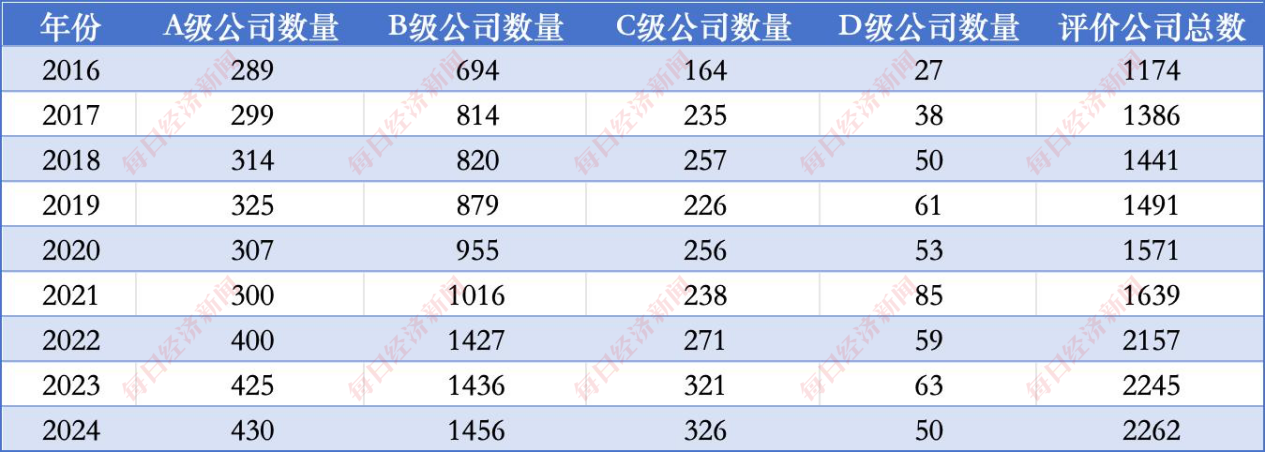
Core Viewpoint - Information disclosure is a core aspect of the registration system, with at least 60 A-share companies penalized for disclosure issues since 2025, highlighting the importance of transparency in corporate governance [1] Group 1: Information Disclosure Evaluation - The Shanghai and Shenzhen stock exchanges evaluate listed companies' information disclosure quality annually, categorizing them into four grades: A (excellent), B (good), C (qualified), and D (unqualified) [3] - Over the past nine years, the number of A-rated companies in the Shanghai market increased from 289 in 2016 to 430 in 2024, although the proportion of A-rated companies decreased from 24.6% to 19% due to the overall increase in evaluated companies [3] - In the Shenzhen market, A-rated companies grew from 375 in 2016 to 523 in 2024, with a similar decline in proportion from 20.2% to 18.4% [7] Group 2: Performance of A-rated Companies - A-rated companies in both markets consistently show strong performance, with over 90% of them paying annual dividends from 2016 to 2024, significantly higher than the overall market [5][9] - The average annual net profit growth rate for A-rated companies in the Shanghai market remained positive, with a peak growth of 60.5% in 2017 and a minimum of 12.78% in 2024 [4] - In the Shenzhen market, A-rated companies had an average net profit growth rate exceeding 30% in seven out of nine years, with the highest growth reaching 85.73% in 2017 [8] Group 3: Performance of D-rated Companies - D-rated companies exhibit poor performance, with an average market value ranging from 4.68 billion to 10.66 billion yuan, significantly lower than A-rated companies, which range from 68.51 billion to 105.38 billion yuan [6] - Over nine years, D-rated companies reported average net profits that were consistently negative, with the worst year showing a decline of -1155.83% in 2018 [6] - Only a small fraction of D-rated companies paid dividends, with less than 30% doing so in 2016 and as low as 1.1% in 2018 [9] Group 4: Implications for Investors - The quality of information disclosure serves as a critical reference for investors, with a clear correlation between disclosure quality and core operational data [10] - The disparity in performance between A-rated and D-rated companies underscores the importance of transparency and governance in attracting investment [10] - Recent evaluations revealed that six A-rated companies experienced a downgrade to C in 2024, indicating potential risks for investors [11]
沪深两市9年信披评价全景:九成A级公司保持每年分红,深市A级公司年度平均涨幅七次跑赢沪深300
Mei Ri Jing Ji Xin Wen· 2025-11-30 06:27
Core Viewpoint - Information disclosure is a core aspect of the registration system, with at least 60 A-share companies penalized for disclosure issues in 2023, including false statements and failure to disclose significant events in a timely manner [1][2] Group 1: Information Disclosure Evaluation - The Shanghai and Shenzhen stock exchanges evaluate listed companies' information disclosure quality annually, categorizing them into four grades: A (excellent), B (good), C (qualified), and D (unqualified) [3][5] - The number of A-rated companies in the Shanghai market increased from 289 in 2016 to 430 in 2024, although the proportion of A-rated companies decreased from 24.6% to 19% due to the total number of evaluated companies rising from 1,174 to 2,262 [4][9] - A-rated companies have shown a consistent trend of high dividend payouts, with over 90% of A-rated companies distributing dividends annually from 2016 to 2024, significantly higher than the overall market level [4][8] Group 2: Performance of A-rated Companies - A-rated companies in the Shanghai market have maintained a positive average net profit growth rate, with a peak growth of 60.5% in 2017 and a minimum of 12.78% in 2024 [5][6] - The average annual stock price performance of A-rated companies has outperformed the CSI 300 index in five out of the last nine years, with the highest average increase of 32.84% in 2019 [8][14] - A-rated companies have shown a strong correlation between high-quality information disclosure and core operational data, enhancing investor trust and attracting long-term capital [8][15] Group 3: Performance of D-rated Companies - D-rated companies have consistently underperformed, with an average market capitalization ranging from 4.68 billion to 10.66 billion yuan, compared to A-rated companies' range of 68.51 billion to 105.38 billion yuan [9][10] - The average net profit growth rate for D-rated companies has been negative for nine years, with the worst decline recorded at -1155.83% in 2018 [9][15] - D-rated companies have only a small percentage that distribute dividends, with less than 30% in 2016 and as low as 1.1% in 2018, indicating a significant loss of dividend capability [10][15] Group 4: Comparison Between A and D-rated Companies - The stark contrast in performance between A-rated and D-rated companies highlights the importance of information disclosure quality as a key reference for investors in assessing company value [15][17] - The analysis indicates that high-quality information disclosure leads to better governance and operational efficiency, allowing capital to flow towards well-managed companies [15][17]