
候鸟式养老

Search documents
“候鸟式”养老亟须“暖巢式”服务
Xin Lang Cai Jing· 2026-02-06 21:01
Core Viewpoint - The increasing trend of "migrant bird" living among the elderly in China reflects both a proactive choice for a better quality of life and the need for a comprehensive public service system to support this demographic's mobility [1][2]. Group 1: Current Situation and Challenges - The phenomenon of "migrant bird" living is characterized by elderly individuals relocating seasonally to seek favorable climates, highlighting the diverse development of elderly care services in China [1]. - Many elderly individuals face challenges such as difficulties in medical insurance settlement, access to chronic disease medications, low community integration, and a lack of cultural activities in their temporary locations [1][2]. - Existing elderly activity centers often restrict services to local residents, creating barriers for migrant elderly individuals and diminishing their overall happiness and increasing health risks [1]. Group 2: Proposed Solutions - To establish a "warm nest" public service system, it is essential to break down institutional barriers, including the promotion of nationwide direct medical insurance settlement and the inclusion of common chronic disease medications in reimbursement directories [2]. - The creation of a "national unified elderly service rights account" is suggested to allow for the portability of benefits such as elderly care subsidies and medical prioritization [2]. - Public service resources should be dynamically allocated based on seasonal changes in elderly populations, with an emphasis on community health stations, elderly universities, and cultural activity centers [2]. - Encouraging the involvement of professional social work organizations to provide psychological support and community engagement for migrant elderly individuals is recommended [2]. - Policies should balance "soft services" and "hard facilities," including the implementation of age-friendly modifications in transportation, public venues, and smart governance [2]. - Establishing a platform for information registration and service connection for "migrant bird" elderly individuals is crucial for achieving cross-regional data sharing and service coordination [2]. Group 3: Broader Implications - The concept of "migrant bird" living should not be viewed as a solitary migration but as a poetic dwelling for a happy old age, necessitating a robust service network and cultural sensitivity [3]. - Building a supportive environment for the elderly is essential for safeguarding individual dignity and fostering an age-friendly society, reflecting the civilization and governance quality of a region [3].
从“游客”到“家人” 银发族爱上候鸟式旅居
Yang Shi Xin Wen· 2026-02-02 02:39
Group 1 - The trend of elderly people traveling to warmer regions for winter living is increasing, with flight bookings to destinations like Hainan, Yunnan, and Guangxi showing a year-on-year growth of approximately 100% [3] - In Yunnan, the local government is promoting various cultural experiences to enhance the winter living experience for elderly travelers [3] - The number of elderly travelers in Yunnan is projected to reach 5.51 million by 2025, representing a year-on-year increase of 41.4%, with those aged 60 and above accounting for 17.74% of this demographic [7] Group 2 - The travel market is shifting from a sightseeing model to a lifestyle-oriented approach, with Yunnan focusing on building a comprehensive service system that includes health management, cultural entertainment, and social activities [7] - The implementation of the "Travel Elderly Care Service Standards" in Hainan aims to standardize elderly care services and enhance the travel experience for seniors [11] - Sanya has been rated as the top winter destination for elderly "snowbirds" according to a recent index evaluating 55 candidate cities [8]


险企养老版图加速“裂变”
Zheng Quan Ri Bao· 2025-12-25 23:28
Core Insights - The insurance industry is accelerating its investment in high-quality elderly care communities, responding to China's aging population and creating a network of services that cater to diverse needs [1][4][11] Group 1: Industry Trends - By the end of 2025, insurance companies are expected to launch over 10 elderly care community projects, with major players like China Life, Taikang Insurance, and China Pacific Insurance leading the way [2][3] - The insurance sector has transitioned from isolated projects to a nationwide network, enhancing the scale and reach of elderly care services [2][4] Group 2: Market Drivers - The demand for elderly care is driven by a rapidly aging population, with over 310 million people aged 60 and above in China, and the silver economy projected to reach 30 trillion yuan by 2035 [4][8] - Policy support from the government, including guidelines for the development of elderly financial services, is facilitating the growth of the insurance sector in this area [4][7] Group 3: Business Models - Insurance companies are adopting diverse operational models, including heavy asset, medium asset, and light asset strategies, to optimize their investments in elderly care [5][10] - The integration of insurance products with elderly care services is becoming a key strategy for enhancing sales and customer retention [9][10] Group 4: Challenges and Solutions - The industry faces challenges such as high operational costs and the need for a minimum occupancy rate of 60% to achieve cash flow sustainability [10] - To address these challenges, companies are exploring innovative service models and collaborating with government and industry associations for support [11]
银发旅客南下旅居升温!适老化改造助力“候鸟式养老”升级
Sou Hu Cai Jing· 2025-12-16 09:48
Core Viewpoint - The trend of "wintering" among the elderly is increasing, with various regions enhancing services to cater to the needs of the silver-haired population, transforming "bird-like retirement" from feasible to high-quality, thus injecting strong momentum into the silver economy [1]. Group 1: Travel Trends - Many elderly individuals are choosing to travel south for the winter, with the Z384 train from Changchun to Haikou becoming a popular option, where nearly half of the passengers are aged 60 and above [3]. - The Z384 train journey spans 11 provinces and cities, covering 22 stations, providing a scenic experience over nearly 48 hours [3]. Group 2: Comfort and Safety Enhancements - The train has undergone modifications to improve comfort and safety for elderly travelers, including equipping each carriage with a medical kit containing common medications and emergency supplies [5]. - The enhancements aim to ensure the health and well-being of senior passengers throughout their journey [5]. Group 3: Travel Experience - Elderly travelers not only enjoy the changing scenery but also come prepared with seasonal clothing and local specialties from their hometowns, referred to as "Northeast gift packages" [7].

城市24小时 | “煤炭产量第一省”,即将再度易主?
Mei Ri Jing Ji Xin Wen· 2025-12-01 15:19
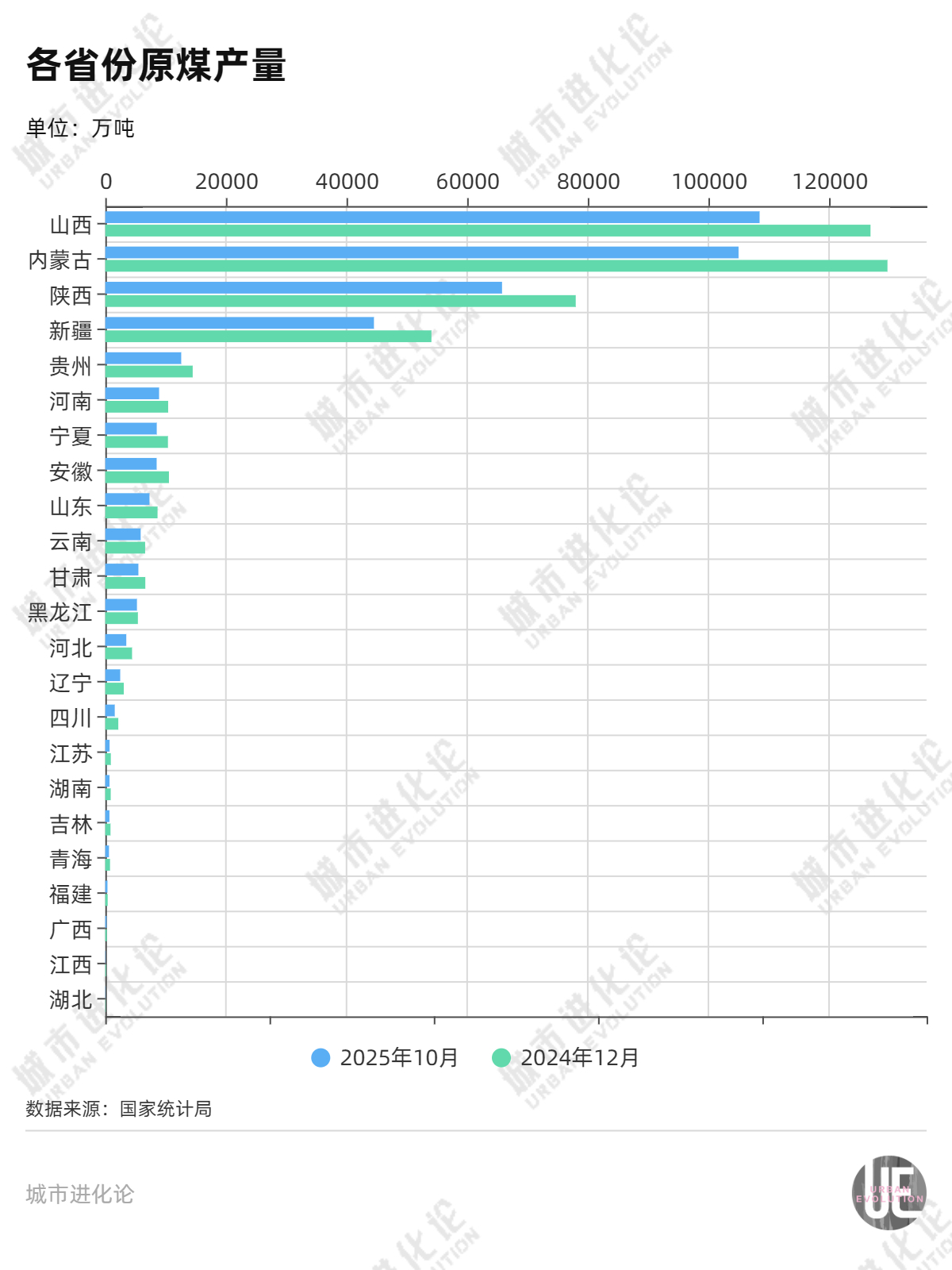
Coal Production Trends - In the first ten months of the year, Inner Mongolia's raw coal production reached 104,996.7 million tons, while Shanxi's production was 108,485.8 million tons, indicating that Shanxi is likely to reclaim its position as the top coal-producing province this year [1][3] - For 2024, projections show Inner Mongolia's coal production at 129,686.9 million tons, surpassing Shanxi's 126,873.8 million tons, marking a shift in leadership in coal production [3] Economic Impact of Coal Industry - Shanxi's GDP growth rate is projected to be only 2.3% in 2024, ranking it at the bottom among 31 provinces, largely due to increased safety regulations and declining coal prices [3][4] - In contrast, Shanxi's industrial output value increased by 4.6% from January to October, with the coal industry contributing significantly to this growth at 5.1%, accounting for 70% of the industrial growth [3] Transition and Diversification Efforts - Shanxi is under pressure to reduce its reliance on coal, with calls for a transition to a more diversified energy structure, as highlighted by the provincial government's recent initiatives [4] - Inner Mongolia is showing a more diversified industrial growth, with significant increases in emerging industries, such as equipment manufacturing (21.2% growth) and high-tech manufacturing (16.5% growth) [4]
康养名企山屿海涉非法吸储被立案,“候鸟旅居”变金融陷阱
Nan Fang Du Shi Bao· 2025-05-23 08:26
Core Viewpoint - The company "Shan Yu Hai," a well-known cultural tourism and health care enterprise, is facing severe operational issues due to allegations of illegal public deposit absorption, leading to criminal investigations and the detention of its executives [1][4][10]. Group 1: Company Operations and Financial Issues - Shan Yu Hai was reportedly operating normally until early April 2024, with ongoing strategic meetings and new project announcements [2]. - However, by early April, numerous investors began to voice concerns online about the company's inability to process withdrawals from its leasing platform, "Mai Zi," indicating a liquidity crisis [3][5]. - The company has diversified its operations beyond tourism and health care into sectors such as real estate, health management, and overseas mining, which may have contributed to its financial strain [11]. Group 2: Investment Model and Legal Concerns - The investment model of "Mai Zi" involved high promised returns of 9%-12% on rental income, which attracted many investors but lacked transparency regarding the actual rental assets [6][7]. - Legal experts have indicated that the company's practices may constitute illegal public deposit absorption due to their high returns, lack of real product flow, and public solicitation [6][7]. - The company has not published financial reports since 2019, raising concerns about its financial health and transparency [10]. Group 3: Investor Reactions and Consequences - Investors have expressed frustration over their inability to withdraw funds, with some reporting losses exceeding 1 million yuan [5][14]. - The company's physical locations have been reported as closed, and there is a significant presence of investors seeking recourse for their losses [13][14]. - The founder and chairman of Shan Yu Hai has become less visible, and the company's communication channels have ceased updates since early April [12][14].